The check fraud claim directory is the American Bankers Association's list of fraud contacts at U.S. banks and credit unions, built so one bank can find the right person at another to send a check warranty breach claim. It began as the ABA Check Fraud Claim Directory and is now the ABA Fraud Contact Directory, which also covers wire, ACH, RTP and FedNow fraud claims. Banks need it because a warranty claim on an altered or wrongly indorsed check is not routed through the payment system: the paying bank must deal with the depositary bank directly, and give it notice within 30 days of knowing of the breach and who the warrantor is. A claim sent to the wrong mailbox is a claim on a running clock. That makes the contact sheet the first input of any claims system, and the place a go-live plan should start. Botminds' Check Fraud Claims reads each depositary bank's claims contact from the fraud contact directory the bank keeps, sends approved claims to it, and records when each contact was last verified.
The go-live plan below is our suggestion, not a fixed schedule; the screens show the solution's sample data on fictional banks. Figures about the ABA directory are the ABA's own.
The directory in three numbers, and the clock it serves
2,443banks
actively use the ABA Fraud Contact Directory, by the ABA’s count in March 2026
1PDF
of claim documentation requirements each institution may upload with its contacts
30days
to give a warrantor notice of a breach after knowing of it and who the warrantor is (UCC 4-208(e))
What is the check fraud claim directory?
It is a contact list kept by the ABA in which each participating bank or credit union names the people who receive fraud claims, so other institutions can reach them. The ABA's own page describes the change of name and scope: "The ABA Check Fraud Claim Directory is now the ABA Fraud Contact Directory." It now helps institutions "resolve warranty breach claims for checks as well as claims for unauthorized and/or fraudulent transfers for wires, ACH, RTP, or FedNow", and it is searchable by institution name, city, state, FDIC number or NCUA charter number.
It works on reciprocity. Access is limited to institutions with an FDIC or NCUA charter number that provide fraud contacts, and "Institutions must submit their own fraud contacts in order to search the directory." Each institution may also upload one PDF of its documentation requirements for filing a claim. In March 2026 the ABA opened it to international banks and said it is available at no cost to all participating organizations. The ABA counts 2,443 banks using it, which it describes as more than half of all U.S. banks; that still leaves many institutions a claims team will need to reach another way.
Where do I send a check warranty claim?
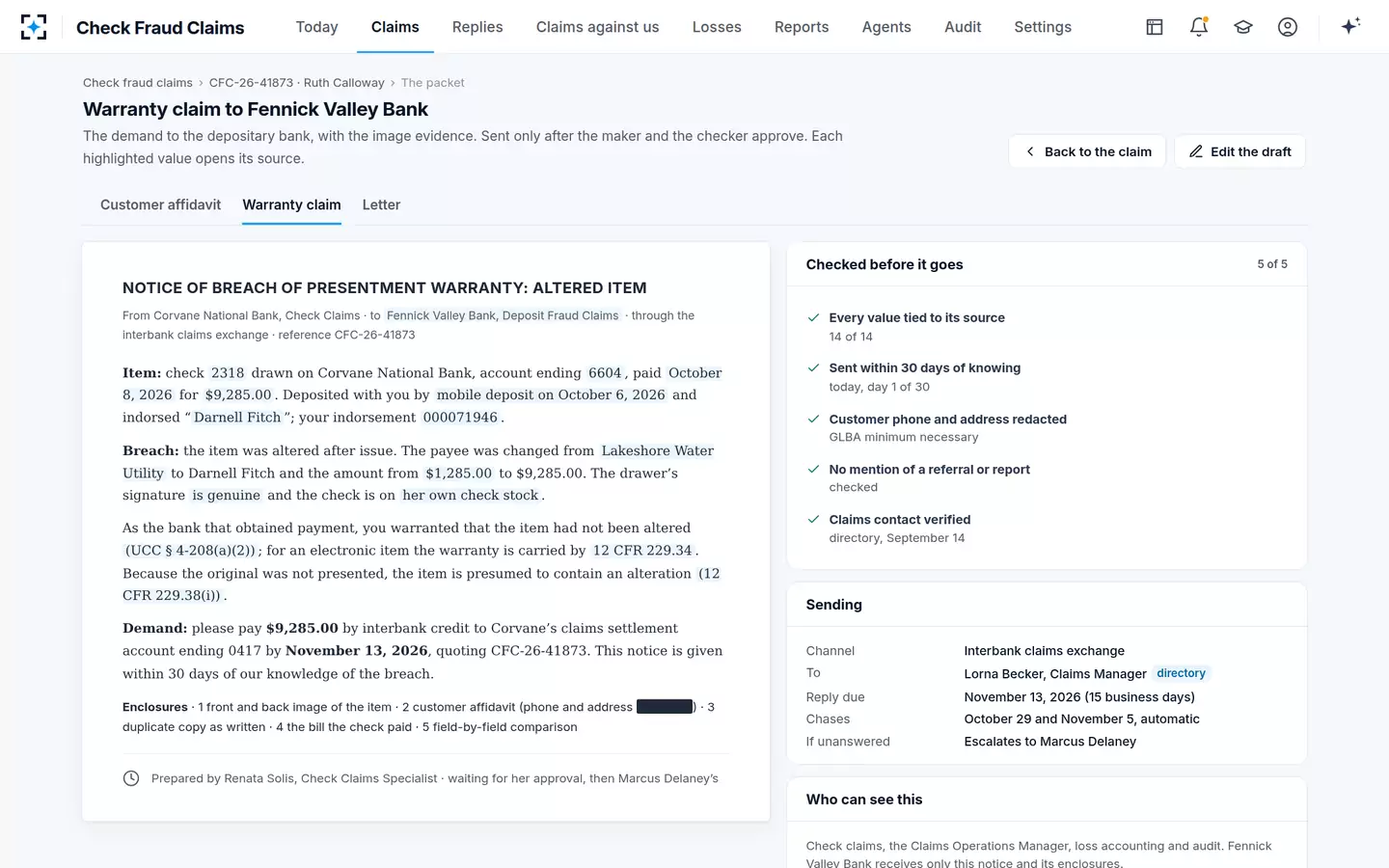
To the bank that presented the check for payment, almost always the depositary bank whose indorsement is on the back of the paid image, at the claims contact that bank has published. Not to the Federal Reserve: the Reserve Banks' Operating Circular 3, effective 5 January 2026, tells a bank with a claim based on an altered check or a forged, missing or unauthorized indorsement to deal with the other bank directly, and keeps its adjustment process for other kinds of claims. And not to a general customer service address, where a warranty claim can sit unread while the depositor empties the account.
The back of the image identifies the bank; the directory identifies the person. The depositary bank's indorsement carries its routing number and the date, which is also what starts the 30-day clock, because the clock runs from reason to know of the breach and the warrantor's identity. A claims team should record both dates on every claim: when it knew of the breach, and when it identified the bank. How the clock works and what a late notice costs is in the check fraud claim time limit.
The claim addressed to a verified contact, with the date it was checked
Why the claims contact is the first thing to load
Every other part of a claims system can be fixed after go-live; a claim sent nowhere cannot. The 30-day notice clock starts the day the bank has reason to know, whatever its software is doing, and a depositary bank that never received a claim has a simple answer when it finally does: the delay cost it the depositor's balance. A directory entry that sends the claim to a person who left last year has the same effect as no entry at all.
The contact sheet also shapes the rest of the build. A depositary bank that has uploaded documentation requirements expects its own enclosures; one that answers only through a specific channel decides how the chase works; a bank with no published contact needs a fallback, a phone call recorded on the claim and an escalation. Loading contacts first means the letter templates, the enclosure list and the chase rules are written for the banks the team actually claims against.
What do you need to start handling check claims?
Six connections and four kinds of document. The connections are to the systems a claims team already runs on; the documents are the bank's own rules, which the agents follow rather than replace.
What a bank brings to a Check Fraud Claims go-live
- Fraud contact directory
Each depositary bank’s claims contact, its channel, its documentation requirements and the date each was last verified.
- Check image archive
Front and back images of paid items and the customer’s earlier paid checks.
- Core banking system
Accounts, paid items, recredits, holds and check orders, including stock and serial ranges.
- Positive pay system
Business customers’ issue files, the strongest evidence of what was issued.
- Interbank claims exchange
The channel the bank uses to send warranty claims, chases and receive replies.
- General ledger
The claims suspense account, recovery matching and write-off entries.
- The bank’s own rules
Claims procedure, deposit agreement (with its reporting period), letter templates and approval limits.
- A sample of past claims
Closed altered and forged check claims with their outcomes, for the replay before go-live.
The Federal Reserve's check fraud toolkit adds a requirement many teams meet with spreadsheets: "Record and classify the fraud event and corresponding documentation in an internal tracking system." The go-live is the moment to stop doing that by hand. Each claim in the solution carries its type, its findings, its packet, its clocks, its replies and its accounting entries in one place, with every person and agent step on a read-only trail.
A go-live plan, week by week
A plan that starts with the contacts, proves itself on closed claims and runs beside the team before it runs alone can fit, in our estimate, into about six weeks for a single claims desk; a bank with clean contact data and a single image archive can move faster, and one with several cores and no issue files will take longer. The steps below say who does what at each stage.
Going live with Check Fraud Claims: contacts first, then rules, then a replay
A person decides
Week 1 · Claims operations: the contact sheetLoads every depositary bank claimed against in the last year into the fraud contact directory, with channel, documentation needs and a verification date; fills gaps from the ABA directory and phone calls.
Agent
Week 1 · Recovery agent: coverage checkReads last year’s claims and lists each depositary routing number with no verified contact, ranked by amount claimed.
Never: contacts another bank on its own
A person decides
Week 2 · Claims administrator: rules and templatesSets the clocks (affidavit, recredit, notice target, reply date, chases), the deposit agreement period and the letter templates; the head of claims approves each as a versioned setting.
A person decides
Week 3 · Manager and loss accounting: moneySets maker-checker roles, write-off limits, the suspense account and general ledger entries; tests that no one can approve their own work.
Agent
Weeks 4–5 · All agents: replay on closed claimsType, liability and packet for a year of closed claims, blind to the outcome; people read every disagreement that would have changed who paid.
Never: sees the closed claim’s outcome during the replay
A person decides
Week 6 · Specialists: parallel run, then liveWork new claims in the solution beside the old process, compare, and switch over when the team and the head of claims agree.
The replay in weeks four and five is the step most go-lives skip and should not. It is where a bank learns whether the solution types its own checks correctly, where the confidence floor should sit and which closed claims were written off too early. How to run a replay on closed claims covers what to pull and how to read the result.
Who approves a recredit on a check fraud claim?
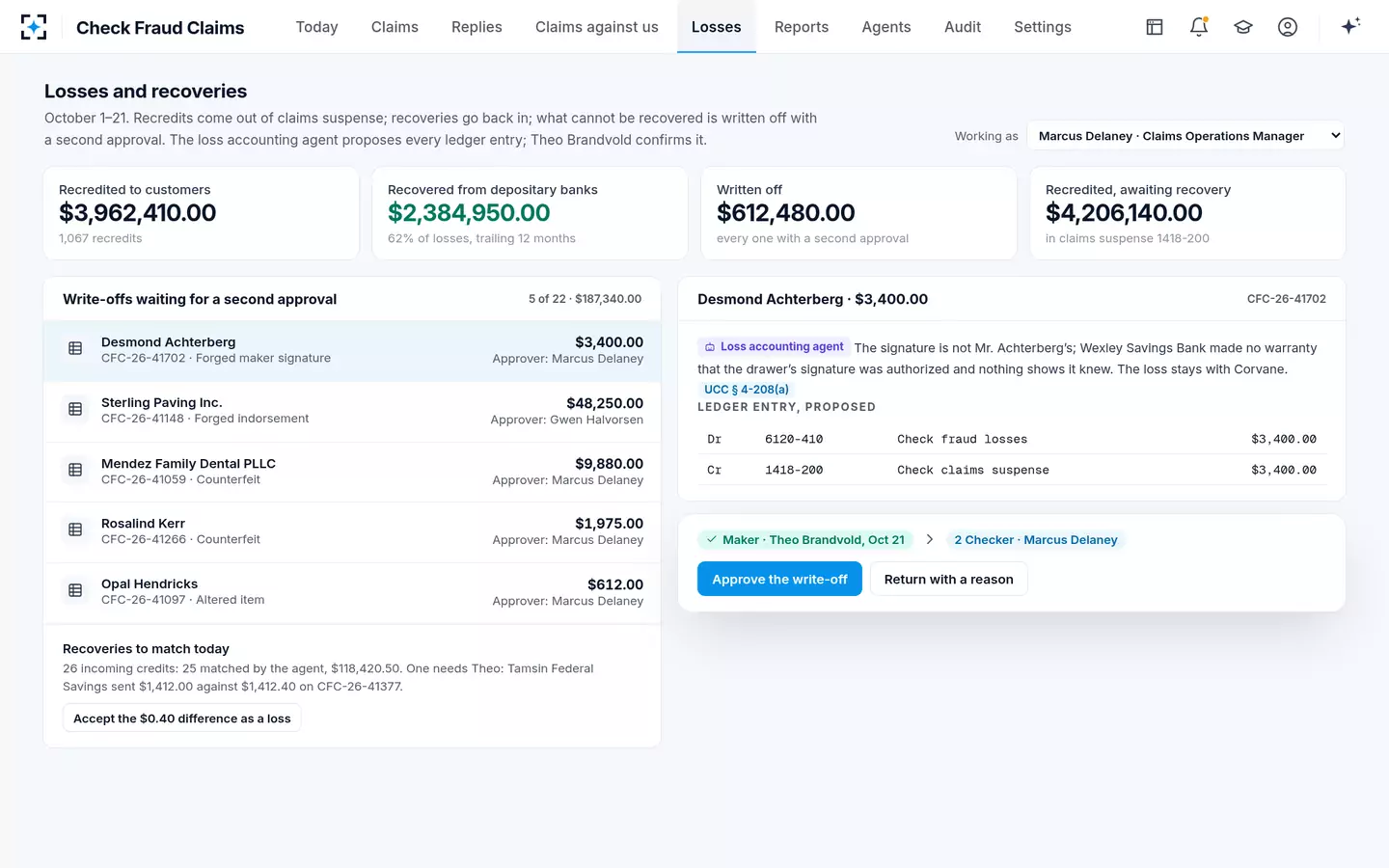
Two people, and never the one who prepared it. In the solution a check claims specialist approves each packet as the maker, the recredit, the warranty claim and the customer letter together, and a different person, the claims operations manager, gives the second approval. Write-offs above $25,000 need the head of fraud and claims operations. "No one approves their own work" is locked on, and a bulk approval is still recorded claim by claim.
The settings a go-live decides, with the sample bank’s values
| Setting | Sample value | Range in the solution |
|---|---|---|
| Affidavit due | 10 days | 1 to 30 business days after the customer reports |
| Recredit after a signed affidavit | 1 business day | 1 to 5 business days; altered items and forged indorsements up to $25,000 |
| Send the warranty notice by | 25 days | Up to 30; the target keeps a margin inside UCC 4-208(e) |
| Reply expected | 15 business days | 1 to 30 business days after sending, before escalation |
| First chase | Day 5 | Day 1 to 10; the second chase follows five business days later |
| Write-off that needs the head of claims | Over $25,000 | In steps of $5,000; below it, the claims operations manager approves |
| Comparison agent confidence floor | 0.85 | 0.60 to 0.99; the liability, recovery and pattern agents set the same way |
The recredit policy is the bank's choice, not a regulation's. Regulation E's investigation deadlines exclude transfers originated by check, so the speed of a check fraud recredit is set by the deposit agreement and the bank's procedure. The sample bank recredits the business day after the affidavit is signed, from a claims suspense account, and carries the amount there until the depositary bank pays or the loss is written off.
Recredits out of suspense, recoveries back in, write-offs with their entries
How do you track warranty claims against your bank?
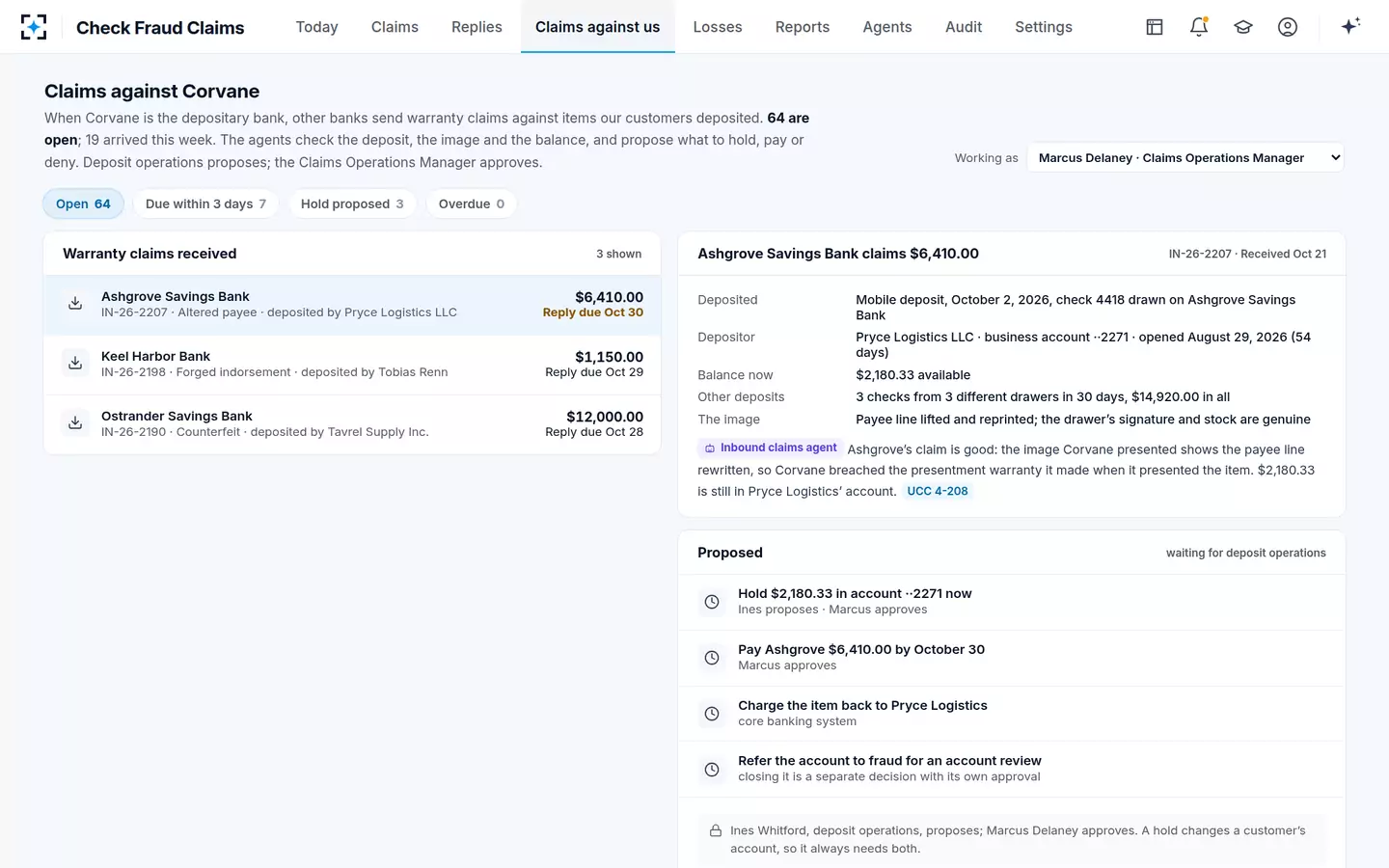
On the same system as your own claims, with the same clocks reversed. Joining a fraud contact directory publishes your own inbound address, and other banks will use it. Each claim that arrives is a question about a deposit your bank accepted: is the claim good on the image, who is the depositor, and what is left in the account to hold? A team that answers late is not saving money; it is letting the depositor's balance, its only cheap recovery, leave.
Claims other banks send against yours, with the clock and a proposed hold
How fast can check claims software go live?
As fast as the contact sheet, the rules and the replay allow, which in our estimate is weeks rather than months for a single claims desk, and the replay should not be cut to save time. The connections are reads from systems the bank already runs; the work is in the bank's own data: contacts that are current, check orders the agents can read, issue files for business customers and a year of closed claims with their outcomes.
One external change makes the bank-to-bank channel more important, not less. In December 2025 the Federal Reserve asked for comment on the future of the Reserve Banks' check services, and among the strategies it described for a simplified service was "eliminating check adjustment services"; comments closed on 9 March 2026. Altered-check warranty claims already go bank to bank under Operating Circular 3, and any narrowing of the Reserve Banks' role would put more of the interbank dispute work on the banks' own contacts and channels. To see the directory, the packet and the clocks on one claim, start from Check Fraud Claims.
Questions people ask
Is the ABA check fraud claim directory free?
Yes, according to the ABA, which says the directory is available at no cost to participating organizations and open to members and non-members. The condition is reciprocity: an institution must submit its own fraud contacts before it can search the directory.
Can credit unions use the check fraud claim directory?
Yes. The ABA invites credit unions to participate and makes the directory searchable by NCUA charter number as well as FDIC number. Access requires an FDIC or NCUA charter number and the institution's own fraud contacts.
What if the depositary bank is not in any directory?
Find the claims area by phone, record who you reached and when, and send the claim in writing to the address they give, keeping proof of delivery. The 30-day clock does not pause while you look, so the search belongs on the claim's record, which is the evidence if the depositary bank later argues the notice was late.
Should the bank publish its own claims contact?
Yes, if it wants to be reached in time. Every bank is a depositary bank for other banks' claims, and a claim that reaches the right person early is the one where a hold on the depositor's account can still recover the money. A role mailbox rather than a person's name survives staff changes, which is what the ABA asks for.
Does the directory send claims for us?
No. It is a contact list, not a claims channel: it tells a bank whom to contact and what documentation that bank asks for. Sending, chasing and recording the reply stay with each bank's own process, which is the work a claims system takes on.