A breach of warranty claim, in banking, is the paying bank's written demand that the bank which presented the check, almost always the depositary bank where the thief deposited it, repay the amount because the check was altered or carried an unauthorized indorsement. Every bank that presents a check makes promises under UCC 4-208 (3-417 in Article 3): that it was entitled to collect it, that it has not been altered and that it knows of no forged drawer's signature. When the promise fails, the paying bank, which has already put its own customer back in funds, claims the money from the depositary bank. The work is hard because it is split across two institutions that do not share a system: the evidence sits at the paying bank, the depositor and the balance sit at the depositary bank, and each side spends most of the claim waiting for the other. Botminds' Check Fraud Claims runs the paying bank's side with agents that decide the type from the paid image, draft the claim and chase it, and it answers the claims other banks send in.
The worked examples come from the solution's sample data on fictional banks and people: Corvane National Bank as the paying bank, Fennick Valley Bank as the depositary bank, and their customers. The rules are quoted from the Uniform Commercial Code, Regulation CC and the Federal Reserve Banks' operating circulars, linked where they appear.
Three numbers that set the pace of every warranty claim
30days
to give the warrantor notice after the claimant has reason to know of the breach and who the warrantor is (UCC 4-208(e))
3years
to sue on an Article 4 obligation after the cause of action accrues (UCC 4-111)
680,000+
check fraud suspicious activity reports filed in 2022, nearly double 2021
What is a breach of warranty claim on a check?
It is a claim by the bank that paid a check against a bank that presented it, for breaking one of the warranties the law attaches to presentment. The person obtaining payment, and every earlier transferor, makes those promises and makes them to one party only: they "warrant to the drawee that pays or accepts the draft in good faith". For a check, the drawee is the paying bank. The customer who wrote the check is not on the list, which is why the claim is bank to bank.
Two warranties carry most check claims. The first is that the check has not been altered, so a washed payee line or a raised amount breaks it. The second is that the warrantor was entitled to enforce the check, which a forged payee indorsement breaks, because a thief who forges the payee's name never becomes a person entitled to collect. The third presentment warranty is weaker: the warrantor promises only that it has no knowledge that the drawer's signature is unauthorized. That difference is why who is liable for altered checks turns on typing the check first: an altered item can usually be recovered, a check with a forged drawer's signature usually cannot.
The measure of the claim is set by the same section: the amount the paying bank paid, less what it received or is entitled to receive from its own customer, plus expenses and lost interest. The claim exists because the paying bank had to make its customer whole first. Under UCC 4-401 a bank may charge its customer only for an item that is properly payable, and an altered or wrongly indorsed check is not, so the customer's recredit and the bank's warranty claim are two halves of one loss.
Who files a check warranty claim, and against whom?
The paying bank files it, against the bank that presented the check, which in a mail-theft case is the depositary bank that accepted the deposit from the thief or a money mule. The Federal Reserve Banks, which collect and return checks for many banks, say so plainly in their operating circular. A bank with a warranty claim based on an altered check or a forged, missing or unauthorized indorsement "should deal directly with that other bank" (Operating Circular 3, effective 5 January 2026, section 21.11(b)). The Reserve Bank's adjustment process does not carry these claims for the banks; the paying bank has to find the right person at the other bank and send the claim itself.
The depositary bank then has a claim of its own, one step further back. Its customer, the depositor, made transfer warranties to it when the check went in for deposit, including that the item had not been altered (UCC 4-207(a)). If the depositor's account still holds money, the depositary bank can charge it back. If the money has gone, the depositary bank holds a claim against a person who often cannot pay. That is where the loss on an altered check tends to come to rest, and it explains the tone of many replies.
One altered check, four parties, three claims
A person decides
Customer (drawer)Reports the check, signs an affidavit that the payee or amount is not what she wrote, and is recredited because the item was not properly payable.
Agent
Paying bank: intake, comparison and drafting agentsFind the paid item, decide the type from the image, draft the affidavit, the recredit and the warranty claim for two people to approve.
Never: sends a claim or posts a recredit without a maker and a checker
A person decides
Paying bank: specialist and managerApprove the packet as maker and checker; the claim goes to the depositary bank within 30 days of knowing of the breach.
A person decides
Depositary bank: deposit operationsChecks the deposit, the image, the depositor and the balance; holds or charges back what is left, then pays, pays in part or denies.
Two banks, one check: the seats on each side
A warranty claim has more seats than most teams draw on their process maps, because half of them sit at the other bank. On the paying side, a claims specialist decides the type and writes the claim, a manager approves money and letters, and an accountant carries the recredit in suspense until the recovery arrives. On the depositary side, a deposit operations specialist reads the claim, looks at the deposit and the depositor, and decides whether there is anything left to hold. Each seat waits on a document that the other bank holds.
The seats in a check warranty claim, before and after Check Fraud Claims
Today
Pulls each image, compares it by eye with what the customer says they wrote, writes the letter and keeps the chase in a spreadsheet.
With agents
Opens a claim with the type decided and each finding pinned to the image, and approves the packet as the maker or changes the type with a reason code.
Still theirs: the type, and every packet as maker
Today
Signs recredits and claim letters from case notes, without the image or the rule in front of him.
With agents
Sees the evidence and exactly what his approval will post and send, and approves or returns it with a reason.
Still theirs: the second approval, write-offs up to his limit
Today
Learns of a claim against a depositor after the balance has left the account.
With agents
Sees the deposit, the account’s age and balance and a proposed hold before the money walks; proposes, and the manager approves.
Still theirs: holds, payments and denials on incoming claims
Today
Reconciles suspense, recoveries and write-offs by hand at month end.
With agents
Starts from recoveries matched to their claims and write-offs drafted with their entries.
Still theirs: every entry, confirmed
The fourth row is the one a paying bank can forget it also occupies. Every bank is a depositary bank for someone else's claims. At the sample bank, 64 claims from other banks were open in the week shown, 19 of them new; a team that answers them slowly is the slow counterparty another bank complains about.
Who waits on whom: the hand-offs that set the calendar
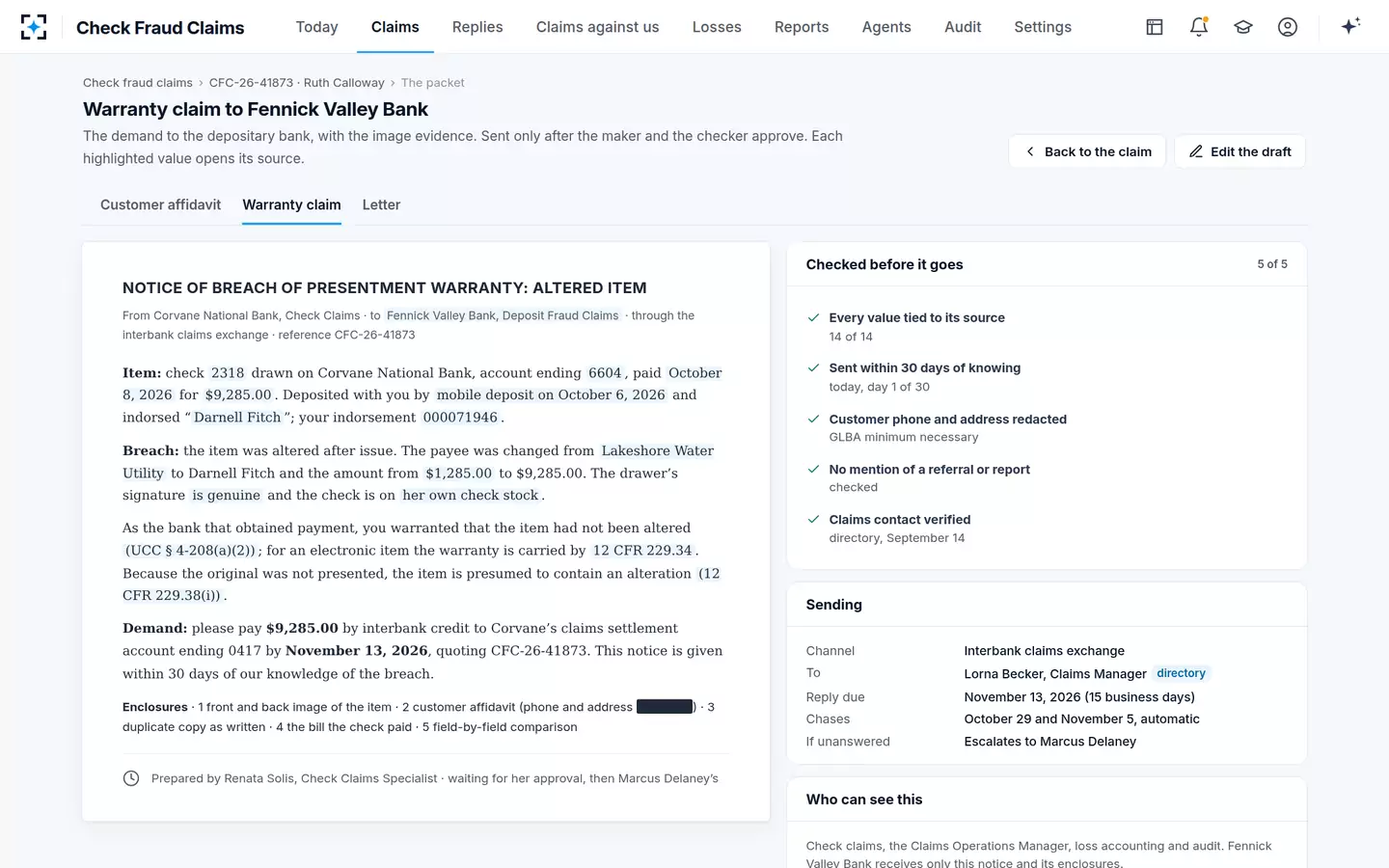
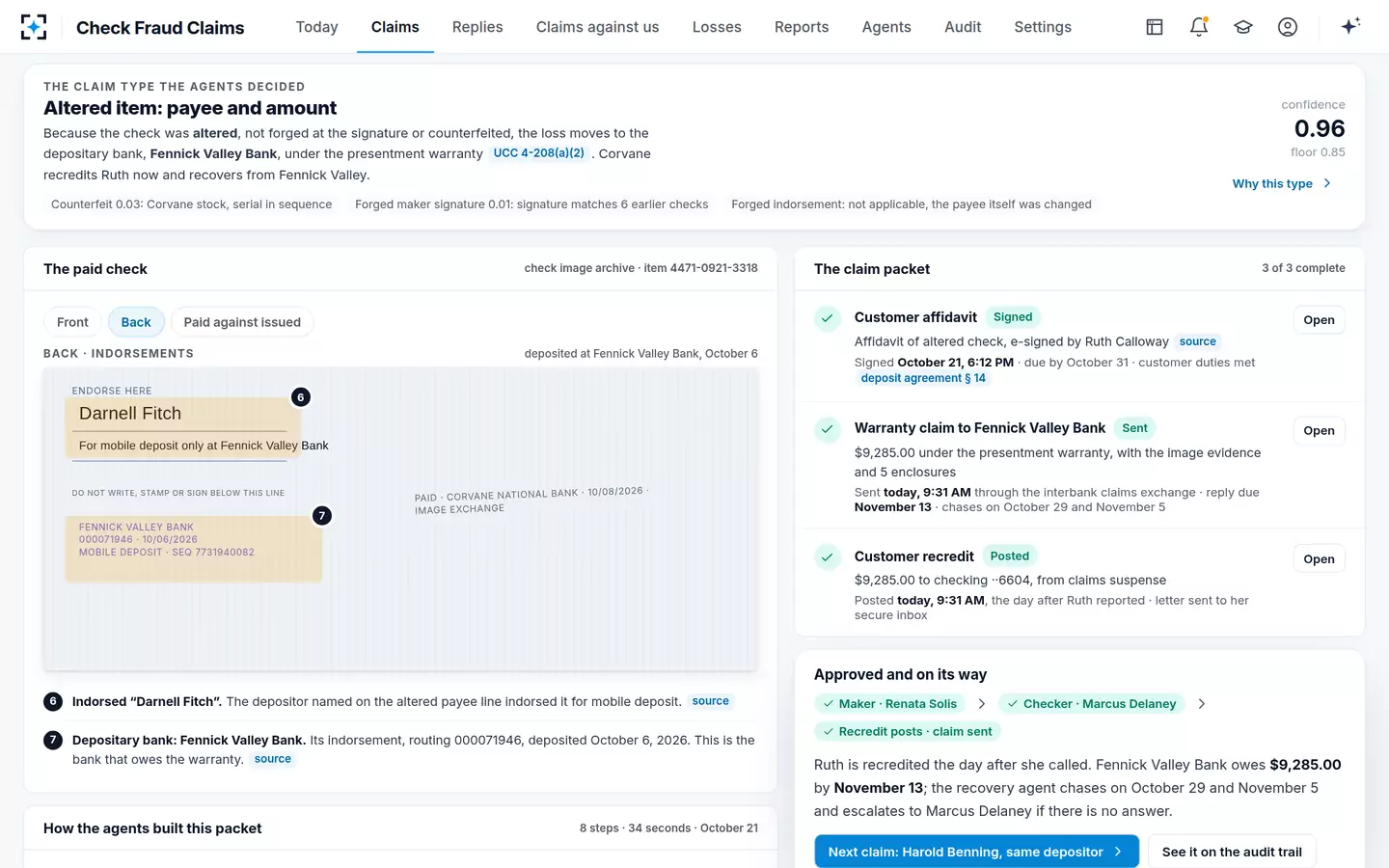
Most of a warranty claim's elapsed time is waiting, and very little of it is the paying bank's own work. The customer waits to notice; the paying bank waits for the affidavit; the depositary bank waits on its depositor; and the paying bank waits again for the reply. Take a sample customer, Ruth Calloway, whose check 2318 for $1,285.00 to her water utility was washed and paid on October 8 for $9,285.00 to a stranger, deposited by mobile phone at Fennick Valley Bank.
One altered check claim: 13 days to notice, one day to act, three weeks to wait
The middle bar is the only one the paying bank controls, and it is where manual claims lose the most. A specialist who pulls the image, compares it by eye, looks up the other bank's contact and writes a letter from a template turns one day into a week or more. The 30-day notice period in UCC 4-208(e) starts when the bank has reason to know of the breach and the warrantor's identity, so the week spent drafting is a week of the depositor's balance draining at the other bank. The economics of those days, and the four separate clocks that run on a claim, are set out in the check fraud claim time limit.
The warranty claim, drafted with its rules and enclosures, before two people approve it
What each bank holds that the other needs
The waiting has a structural cause: the facts that decide a check claim are split between the two banks, and neither can finish its half without the other's. The paying bank can prove what the customer wrote; only the depositary bank can see who deposited the item, through which channel, into an account opened when, with what left in it.
The evidence in a check warranty claim, and which bank holds it
| Question | Held by the paying bank | Held by the depositary bank |
|---|---|---|
| Was the check changed after it was written? | The paid image, the customer’s duplicate copy or register, the bill it paid, positive pay issue data for business customers | Its image of the deposited item; the original paper only if it was deposited at a branch and kept |
| Is it the customer’s own check? | The check stock order and serial range, earlier paid checks for signature comparison | Nothing |
| Who received the money? | The indorsement and the depositary bank’s stamp on the back of the image | The depositor, the account’s age, the deposit channel, other recent deposits |
| Can any of it still be recovered? | Nothing | The balance today, whether a hold is still possible, the depositor’s other accounts |
| Did the customer meet her duties? | The statement date, the report date, the affidavit | Nothing, unless it argues the customer was careless |
The last column explains why speed at the paying bank turns into money. The depositary bank's only cheap recovery is the depositor's balance, and in a mail-theft case that balance is often withdrawn as fast as the deposits become available. The difference between a counterfeit and an altered check on the image is a detection question for the depositary bank before it releases the funds; once the money has gone, it becomes the paying bank's argument for who owes it.
How long does a depositary bank have to respond to a warranty claim?
No fixed period. The warranty sections of UCC Article 4 and the warranty rules for electronic checks in Regulation CC, 12 CFR 229.34, set a notice rule for the claimant and a measure of damages, but no deadline for the warrantor's answer. What bounds the depositary bank is the paying bank's right to sue: three years under UCC 4-111 for a UCC claim, and one year from the violation for a claim under Regulation CC's own subpart, which is why a long silence should end in a demand letter rather than a fourth chase.
The absence of a deadline is the industry's complaint, and the regulators have recorded it. In their June 2025 request for information on payments fraud, the Federal Reserve Board, the FDIC and the OCC wrote that they "have received complaints from supervised institutions regarding challenges in resolving disputes about liability for allegedly fraudulent checks", and asked whether amendments to Regulation CC could help. The request proposed no rule. Until one exists, the reply date is a setting each paying bank chooses and enforces with its own chases: in the sample bank, 15 business days, a first chase on day 5 and an escalation to the manager when the date passes.
What does the depositary bank check before it pays?
A depositary bank that receives a claim checks four things: whether the item really came through it, whether the image supports the claim, who its depositor is, and what is left in the account. The first two decide whether it owes the money; the last two decide whether it can get any of it back. The answer it sends, pay, pay in part, deny or ask for more, follows from those four in roughly that order.
A claim from another bank: the deposit, the depositor and the balance, with a hold proposed
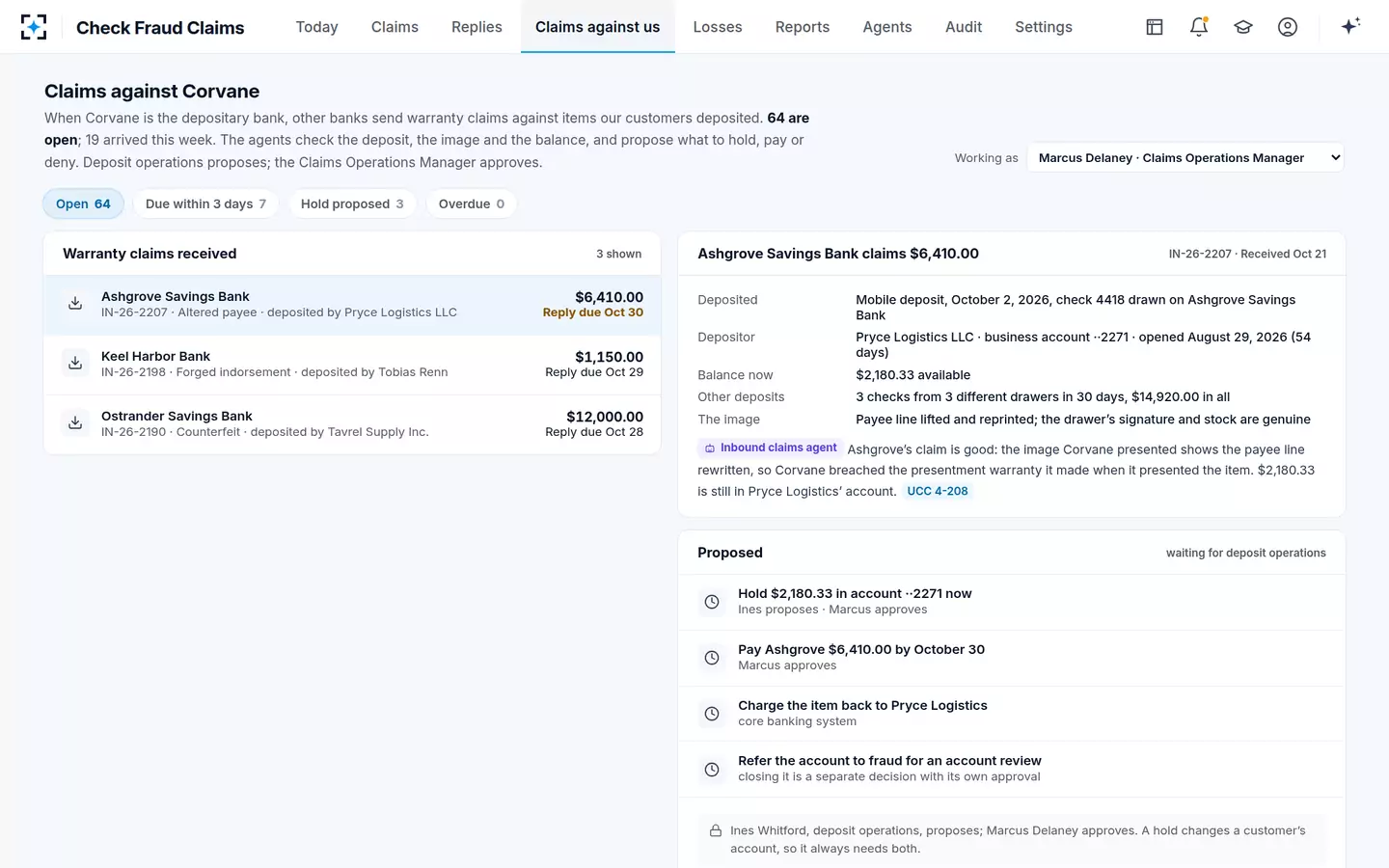
The sample claim shows the order that protects the depositary bank. The image supports the claim, so the bank will owe $6,410.00 whatever it does next; the only open question is how much of it the bank absorbs. Holding the remaining $2,180.33 today, before the claim is paid, is worth more than any argument about the claim. A depositary bank that answers its incoming claims weeks late is not saving the money; it is letting its own recovery walk out of the account.
The depositary bank also has defenses, and a good one changes the answer. It can show that an indorsement was effective because the drawer issued the check to an impostor or a fictitious payee, or that an employee entrusted with the checks forged it, or that the drawer's own carelessness or late review of statements precludes the claim. Each defense, and how to answer the replies that use them, is worked through in the altered check claim denied.
Who pays when an altered check is cashed?
When the claim works as designed, the depositary bank pays, and it recovers what it can from its depositor. The customer who wrote the check is recredited by her own bank because the item was not properly payable, the paying bank recovers from the depositary bank under the presentment warranty, and the depositary bank looks to the person who deposited the item. When that person has emptied the account, the loss stops at the depositary bank, the bank that chose to take the deposit and the one the Federal Reserve Board has described as better placed than the paying bank to inspect a check when it comes in.
Three things move the loss elsewhere. If the check turns out to have a forged drawer's signature or to be a counterfeit, the presentment warranty is not broken and the paying bank keeps the loss. If the customer's own care contributed, or she reported too late, part or all of it moves back to her, and with it the paying bank's warranty claim. And if the paying bank's notice is late, the depositary bank is discharged to the extent the delay caused it loss. The first is a question of evidence, the second of the customer's clock, and the third is the only one entirely in the paying bank's hands.
Recredited the day after she called, and the claim on its way
Can the customer file the warranty claim herself?
No. The presentment warranties run to the paying bank, so the customer's claim is against her own bank, which may not charge her for an item that was not properly payable. A customer who files against the depositary bank directly has no warranty to sue on. If her check was paid on a forged indorsement, the UCC's conversion remedy is not hers either: "An action for conversion of an instrument may not be brought by (i) the issuer or acceptor of the instrument or (ii) a payee or indorsee who did not receive delivery of the instrument".
So the customer's route is narrow and the bank's is wide. She reports, signs the affidavit and is recredited; the bank carries the dispute with the other bank. That is also why the affidavit matters: it is the paying bank's evidence of what the check said when it was written, and it travels with the claim as an enclosure. What a customer can expect from her bank, and how fast, is set out for the customer in my check was stolen and cashed.
Running both sides of the claim in Check Fraud Claims
The solution does the paying bank's waiting work for it and leaves the decisions with people. The intake agent opens the claim and its clocks the moment the customer calls; the comparison agent decides the type from the image with each finding pinned; the liability agent works out who bears the loss and by when; the drafting agent writes the affidavit, the claim and the customer letter; and the recovery agent finds the depositary bank's claims contact, sends the approved claim, chases it and reads the reply. Nothing posts and nothing goes to another bank until a specialist approves as the maker and a different person gives the second approval.
The same agents work the other direction. When another bank's claim arrives, the inbound claims agent reads the deposit, the image, the depositor and the balance and proposes a hold, a payment or a denial; deposit operations proposes and the manager approves. Running both sides on one system means a bank answers others the way it wants to be answered. To see a claim from the customer's call to the reply, start from Check Fraud Claims.
Questions people ask
What is a presentment warranty?
It is a promise the law attaches to presenting a check for payment: the presenter and every earlier transferor warrant to the paying bank that they were entitled to enforce the check, that it has not been altered, and that they know of no forged drawer's signature (UCC 4-208(a) and 3-417(a)). The warranties cannot be disclaimed for checks, so they hold whatever the deposit agreement says.
Is a breach of warranty claim the same as returning the check?
No. A return sends the unpaid check back before the paying bank's midnight deadline, usually the next banking day; a warranty claim is made after the check has been paid and the return window has closed. The Federal Reserve Banks' operating circular forbids slipping a warranty claim into a return letter after the deadline, so a late discovery always becomes a claim.
Does the warranty claim cover a forged indorsement?
Yes. A thief who forges the payee's indorsement is not a person entitled to enforce the check, so the presenting bank breaks the first presentment warranty and the paying bank can recover. The depositary bank may defend by showing the indorsement was effective, for example because the drawer was deceived by an impostor posing as the payee (UCC 3-404).
How much can the paying bank claim?
The amount it paid, less what it received or is entitled to receive from its own customer, plus expenses and lost interest caused by the breach (UCC 4-208(b)). For an electronic check, Regulation CC caps damages for its own warranties at the consideration the warranting bank received, plus interest and expenses (12 CFR 229.34(h)).
What happens to the recredit if the claim fails?
Nothing changes for the customer: she was recredited because the item was not properly payable from her account, and that is between her and her bank. A failed warranty claim leaves the loss with the paying bank, which carries the recredit in suspense until it either recovers or writes the amount off with a second approval.