A breach of warranty claim form for a check is the written notice a paying bank sends to the bank that presented a fraudulent check, usually the depositary bank, demanding repayment under the presentment warranties of UCC 4-208. No regulator prescribes a form, so each bank writes its own, and some depositary banks publish the documents they expect. A complete claim names the item and the depositary bank's indorsement, the warranty breached, what was changed, the amount claimed and how it was worked out, the date the paying bank knew of the breach, the enclosures, the demand date and where to pay. Each of those fields comes from a specific record, and each one decides an argument later: a missing "date known" loses the 30-day notice point, a wrong amount invites a part payment, an enclosure that names a fraud referral breaks a confidentiality rule. Botminds' Check Fraud Claims drafts the claim with every field tied to the record it came from, and a maker and a checker approve it before it goes.
The example claim on this page is from the solution's sample data on fictional banks: Corvane National Bank claims $9,285.00 from Fennick Valley Bank on its customer Ruth Calloway's altered check 2318.
The fields of a check warranty claim, the record each comes from, and the argument it wins
| Field | What it says | Source record | Why it matters later |
|---|---|---|---|
| Item | Check number, account ending, paying bank, amount paid, date paid | Core banking system; paid item record | The depositary bank must find the deposit; a wrong number or date costs a round of “please clarify” |
| Presenter | Depositary bank, its indorsement and routing number, deposit date and channel | The back of the paid image | Names the warrantor, which starts the 30-day clock |
| Breach | What changed: payee from X to Y, amount from $A to $B; signature and stock genuine | Comparison of the paid image with the customer’s copy, bill and earlier checks | States the type; a vague “fraudulent item” invites “counterfeit, not altered” |
| Warranty and rules | UCC 4-208(a)(2) for alteration, (a)(1) for a forged indorsement; 12 CFR 229.38(i) for an image item | The liability reasoning on the claim | Tells the other bank which defense it would need |
| Amount | Amount claimed and how it was reached | Paid amount, what the customer may still be charged, interest and expenses | A correct figure leaves no room for a part payment of “the balance remaining” |
| Date known | When the bank had reason to know of the breach and identified the warrantor | Report timestamp, affidavit date, the date the depositary bank was identified | The evidence if the other bank argues notice came late |
| Demand | Pay by a date, by interbank credit to a named account, quoting the reference | The bank’s reply-date setting and settlement instructions | Sets the date the chase and escalation run from |
| Enclosures | Images, affidavit, customer’s copy, bill, field comparison | Claim file, with personal data redacted | The evidence the other bank has to rebut |
What goes on a breach of warranty claim form?
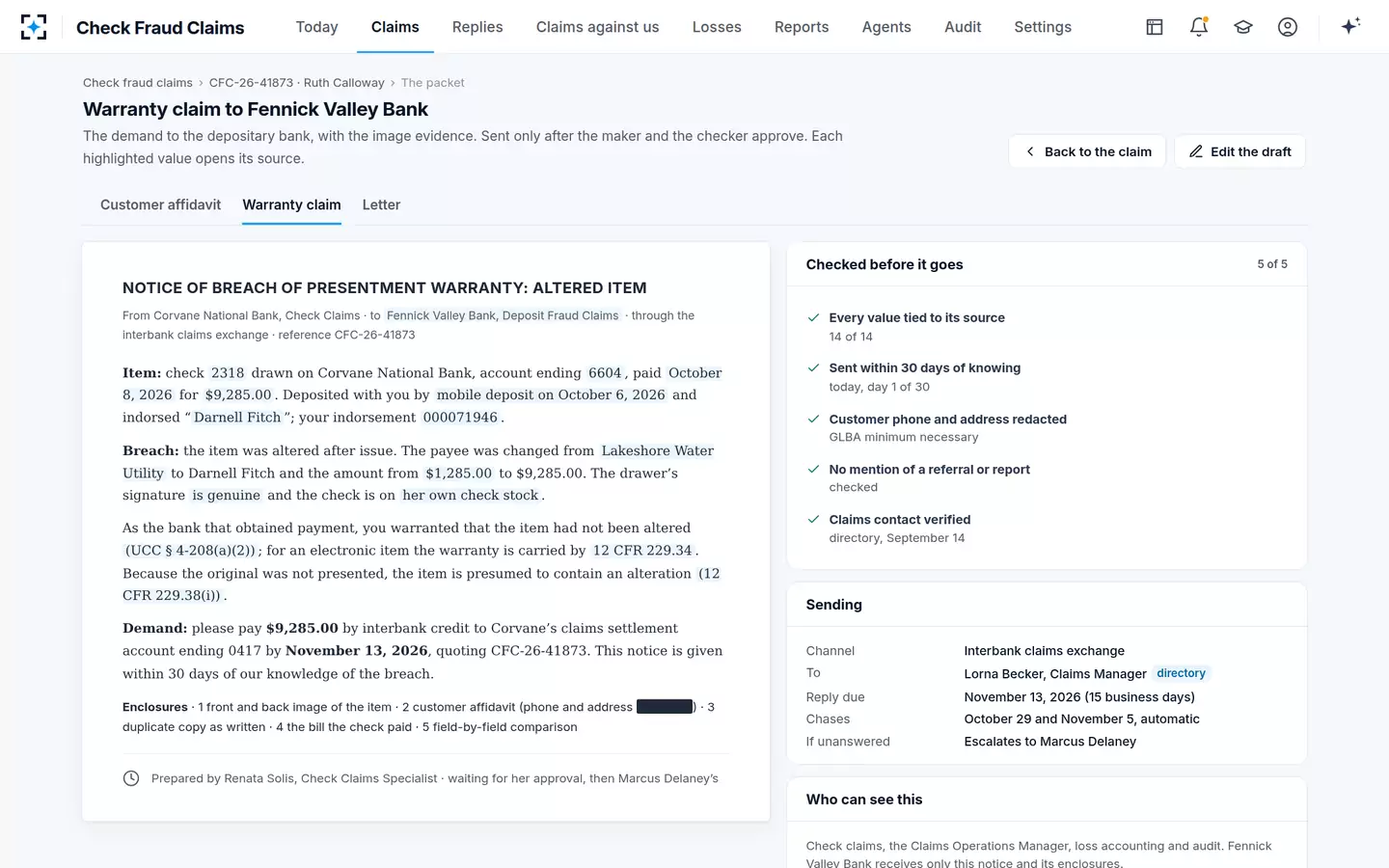
The facts that let the other bank find the deposit, the legal basis for the claim, the evidence, and a demand with a date. In the sample claim, the first line identifies the item: check 2318 drawn on Corvane National Bank, account ending 6604, paid on October 8, 2026 for $9,285.00, deposited with Fennick Valley Bank by mobile deposit on October 6 and indorsed "Darnell Fitch", with the depositary bank's own indorsement and routing number. The second states the breach: the payee was changed from the water utility to Darnell Fitch and the amount from $1,285.00 to $9,285.00, while the drawer's signature is genuine and the check is on her own stock.
Then come the rules, the demand and the enclosures. The sample claim tells Fennick Valley Bank that, as the bank that obtained payment, it warranted the item had not been altered under UCC 4-208(a)(2), and that because the original was not presented the item is presumed altered under Regulation CC. It asks for $9,285.00 by interbank credit by November 13, 2026, quoting the claim reference, and says the notice is given within 30 days of the bank's knowledge of the breach. Five enclosures follow.
The notice of breach of presentment warranty as Check Fraud Claims drafts it, every value tied to its source
Is there a standard check warranty claim form?
No regulator publishes one. The UCC says what the warranties are and when notice must be given, Regulation CC adds warranties and a notice rule for electronic checks, and neither prescribes a document. Each bank writes its own letter, so what a depositary bank receives varies from one claimant to the next.
The receiving bank's requirements are the closest thing to a standard. The ABA Fraud Contact Directory lets each participating institution "upload documentation requirements for filing a claim", one PDF per institution, next to its contacts. A claim that meets those requirements avoids the first reply many claims receive, a request for more information. Loading those requirements with the contacts is part of starting a claims go-live with the contact sheet.
Which warranty was breached?
Name the specific one, because each has a different defense. UCC 4-208(a) lists three warranties that matter for most checks; the presenter and every earlier transferor warrant to the paying bank that:
An altered payee or amount is a breach of (2). A forged payee indorsement is a breach of (1), because the thief never became a person entitled to enforce the check. A forged drawer's signature or a counterfeit breaks (3) only if the presenting bank knew, which a claim can rarely show, so those items are usually booked as losses rather than claimed. A claim that cites (2) for an alteration tells the depositary bank that its answer must be "not altered", the argument the Regulation CC presumption makes hardest on an image item.
What is the claim amount on an altered check?
The amount the paying bank paid, less what it can still charge its own customer, plus expenses and lost interest. The UCC sets the measure as damages equal to the amount paid less what the paying bank received or is entitled to receive from the drawer, and adds that "the drawee is entitled to compensation for expenses and loss of interest resulting from the breach." For an electronic check, Regulation CC caps damages under its own warranties at the "consideration received by the bank that presents or transfers a check", plus interest compensation and expenses.
The deduction matters most on a raised amount. Under UCC 4-401(d)(1), a bank that pays an altered item in good faith to a holder may charge its customer according to "the original terms of the altered item". If only the amount was raised and the payee is the one the customer chose, the customer owes what she wrote and the claim is the difference. Where the payee was changed too, as in the sample claim, the customer's intended payee was never paid, and the sample bank claims the full amount; how far 4-401(d) reaches on a changed payee is a question for the bank's counsel, and the claim should say how its figure was reached.
Two illustrative altered checks: what the paying bank claims, and what it may still charge the customer
Amount raised from $1,285 to $9,285; payee unchanged
- May charge the customer the original $1,285 · 14%
- Claim from the depositary bank: $8,000 plus interest and expenses · 86%
Payee and amount both changed (the sample claim)
- Claimed in full: $9,285 plus any interest and expenses · 100%
How do you prove the date you knew of the breach?
With records made at the time, not a sentence written afterwards. The 30-day notice period runs from when the bank had reason to know of the breach and the warrantor's identity, so the claim file needs both moments: the timestamp of the customer's report and the date the depositary bank was identified, usually the same day because its indorsement is on the back of the image. The affidavit's signing time, the call note and the claim's opening entry all corroborate it.
A claim that states the date helps twice. It puts the notice point on the record before the other bank raises it, and it makes a late-notice reply easy to answer: if notice went on day one, there is no delay to cause a loss. In the sample claim the notice says it is given within 30 days of the bank's knowledge, the solution shows it as day 1 of 30, and the audit trail records the report at 4:40 PM on October 21 and the claim sent at 9:31 AM on October 22. Why the date matters in money is worked through in the check fraud claim time limit.
What documents go with a warranty claim?
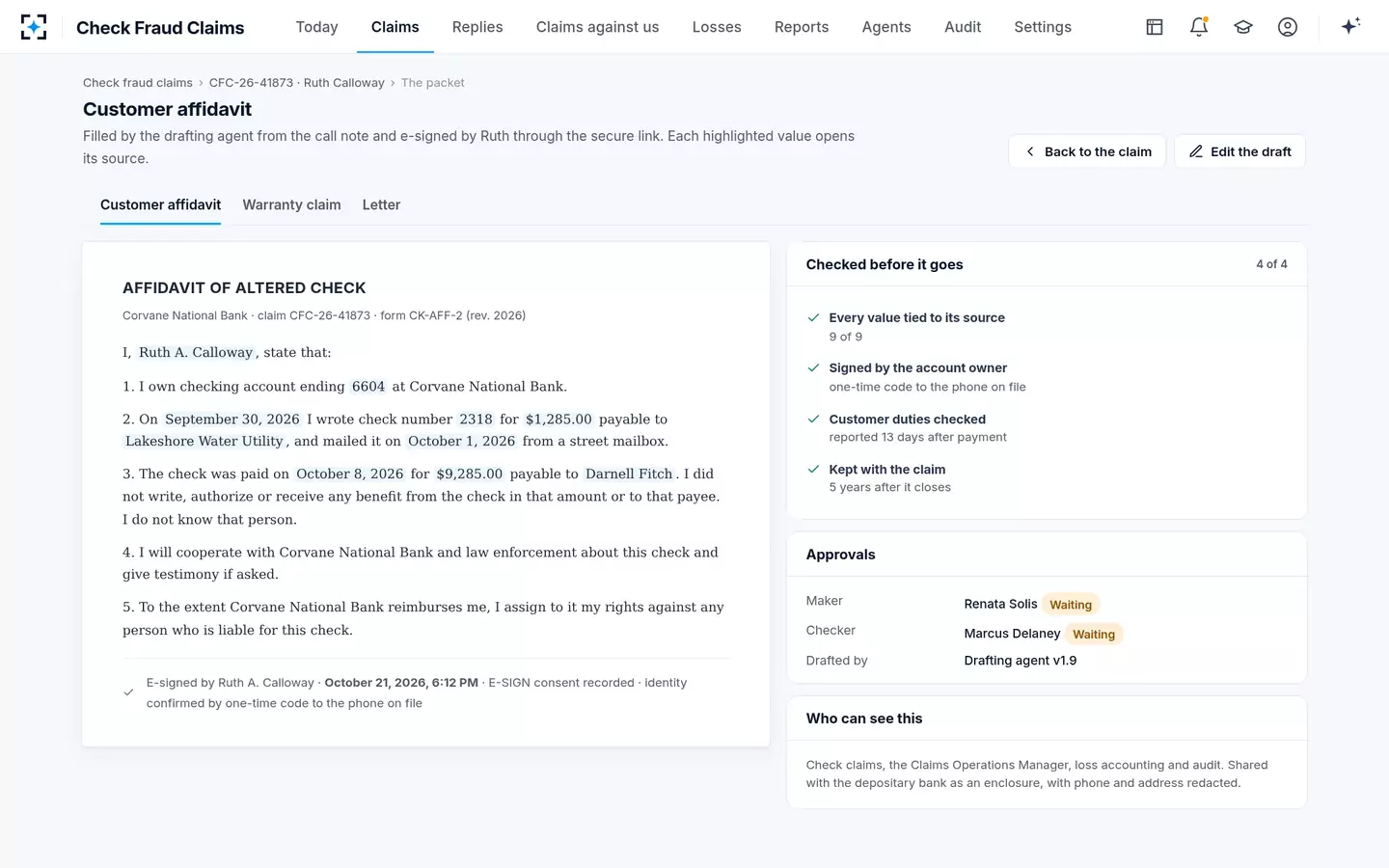
The evidence of what the customer issued and of what was paid, and the customer's sworn account. The Federal Reserve's check fraud toolkit tells banks to "Obtain an affidavit from the customer detailing the fraudulent check(s) and type of check fraud that occurred." The affidavit is usually the first enclosure, because it is the only document in the file in which the drawer herself states what she wrote and that she did not authorize what was paid.
The enclosures that make a check warranty claim hard to deny
- Front and back images of the paid item
As received through the image exchange, showing the altered fields and the depositary bank’s indorsement.
- The customer’s affidavit, signed
What she wrote, to whom, for how much, when and how she sent it; that she did not authorize or benefit from the item as paid.
- Her duplicate copy, register entry or issue file
The record of the original payee and amount, made before the fraud.
- The bill or invoice the check was meant to pay
Independent proof of the intended payee and amount.
- A field-by-field comparison
What changed and what did not, including signature and stock, so the type is shown, not asserted.
- For a forged indorsement: the payee’s statement
That the named payee never received or indorsed the check.
The affidavit of altered check in Check Fraud Claims, filled from the call and e-signed the same evening
Who signs a warranty claim?
Someone the paying bank has authorized to demand money from another bank, under its claims procedure. The UCC does not say who; the bank's own controls do. Because a claim commits the bank to a position another bank may contest for months, the sound practice is the one used for money: one person prepares and approves it, and a different person gives the second approval.
In the solution the drafting agent writes the claim but never sends anything. The check claims specialist approves the packet as the maker, the claims operations manager gives the second approval, and only then does the recovery agent send it through the interbank claims exchange to the verified contact. A specialist cannot be her own checker, and every approval, with its time and the version of each agent involved, sits on the claim's read-only trail.
What should a warranty claim letter leave out?
Anything the other bank does not need, and anything the law forbids sharing. The customer's phone number, address and date of birth add nothing to a claim about a check and travel to another institution; the sample bank redacts them from every enclosure. Speculation about the depositor, who is the other bank's customer, invites a dispute the claim does not need.
The firmest line is suspicious activity reporting. A claims team that has referred a mail-theft ring to its BSA officer must keep that referral off every outgoing document, because FinCEN's rule for banks keeps a suspicious activity report, and anything that would show one exists, confidential except where the rule allows; what that means when a subpoena arrives is worked through in a grand jury subpoena for bank records. The sample bank's drafting agent never mentions a referral or report on any letter, and a separate check confirms it before a claim can be approved.
A weak claim and a strong one, field by field
Weak: invites a denial: “The item was fraudulent.”
Strong: leaves little to deny: “The payee was changed from X to Y and the amount from $A to $B; the signature and stock are the drawer’s.”
Weak: invites a denial: “Breach of warranty.”
Strong: leaves little to deny: “UCC 4-208(a)(2): the item has not been altered; for this image item, 12 CFR 229.38(i).”
Weak: invites a denial: The paid amount, with no basis.
Strong: leaves little to deny: The amount and how it was reached, with interest and expenses if claimed.
Weak: invites a denial: Not stated.
Strong: leaves little to deny: “This notice is given within 30 days of our knowledge of the breach”, backed by the file.
Weak: invites a denial: The front image only.
Strong: leaves little to deny: Both sides, the affidavit, the customer’s copy, the bill and the comparison.
Weak: invites a denial: The full affidavit, phone, address and all.
Strong: leaves little to deny: Redacted to what the other bank needs; no mention of any referral.
What to look for in software that drafts warranty claims
A template that fills itself is the least of it. What a claims team needs is a draft whose every value can be traced, a type decided before the letter is written, checks that stop a bad claim before it goes, and approvals that cannot be skipped. Ask any vendor to open a drafted claim and click on the amount, the date known and the depositary bank's routing number: each should open the record it came from.
Check Fraud Claims fits where a bank sends enough warranty claims that drafting, enclosures and chasing take a specialist's week, and where it has an image archive and a core it can read. It does not replace the bank's counsel on a disputed amount or on whether 4-401(d) applies, it does not send anything a maker and a checker have not approved, and it is only as current as the bank's contact list. When the reply comes back as a denial, the answers to each kind of denial pick up where the claim leaves off. To see a claim drafted from a real-looking file, start from Check Fraud Claims.
Questions people ask
Is a breach of warranty claim the same as an affidavit of forgery?
No. The affidavit is the customer's sworn statement to her own bank that she did not authorize the check as paid; the warranty claim is the paying bank's demand to the depositary bank. The affidavit is usually enclosed with the claim as evidence, with the customer's personal details redacted.
Can a warranty claim be sent by email?
The UCC asks for notice, not a particular channel, so the bank's procedure and the receiving bank's published requirements decide. Whatever the channel, keep proof of when it was sent and to whom, because that proof answers a late-notice defense.
Should a warranty claim cite Regulation CC as well as the UCC?
For an item collected as an image, yes: the UCC warranty states the breach, and 12 CFR 229.38(i) presumes the item altered if the depositary bank argues forgery. Regulation CC's own warranty for electronic checks, in 12 CFR 229.34, is narrower, a promise that the image accurately represents the original check.
What reference should the claim carry?
The paying bank's claim number, the check number and the depositary bank's own item or deposit reference if known. The sample claim asks the other bank to quote the paying bank's reference with its payment, which is what lets an incoming credit be matched to its claim automatically.
Does the customer sign the warranty claim?
No. The warranty runs to the paying bank, so the bank makes the claim. The customer signs the affidavit, which in the sample bank's form also assigns to the bank her rights against anyone liable, to the extent the bank reimburses her.