If your check was stolen and cashed, call your bank today. A bank may charge your account only for a check that is "properly payable", meaning one you authorized, so a check that was washed and rewritten to a new payee, raised to a higher amount, signed by someone else or cashed by someone who forged the payee's name generally has to be credited back to you. Your part is to report it promptly, sign an affidavit saying you did not authorize the check as it was paid, and give the bank what you have: your copy or register, the bill it was meant to pay. Report within days, not months: the OCC says customers generally have up to 30 days from the statement date, and after one year you lose the claim against your bank altogether. Behind the scenes, your bank then claims the money from the bank that accepted the stolen check, under rules between banks that customers seldom see. Botminds' Check Fraud Claims is software that bank claims teams use for that work, from your call to the money coming back.
This guide is general information drawn from federal regulators' consumer pages and the Uniform Commercial Code, not legal advice; your deposit agreement and your state's law decide the details. The bank screens shown are sample data on fictional people.
My check was stolen and cashed: what to do, in this order
- Call your bank now, and say the check was stolen
Ask which of your checks have cleared, and whether any others from the same book are outstanding. Note the date, time and who you spoke to.
- Stop payment on checks that have not cleared
If a whole batch of mail was taken, others may still be on their way to a thief.
- Ask about closing or changing the account
The OCC suggests considering it when an account has multiple forgeries, for example from stolen checks.
- Sign the affidavit the bank sends
It states what you wrote, to whom, and that you did not authorize the check as paid. Return it quickly.
- Send your evidence
Your carbon copy or register entry, the bill or invoice the check was paying, and when and where you mailed it.
- Report the theft
To your local police; to the U.S. Postal Inspection Service if it was taken from the mail; and to the FTC at ReportFraud.ftc.gov.
- Tell the person you were paying
They were not paid. Ask how they want to be paid now, and avoid mailing a replacement check from the same mailbox.
- Read your next statements line by line
A second altered check by the same thief that you do not report in time can become your loss.
Will my bank refund a stolen check?
Usually, yes. The rule that protects you is in the Uniform Commercial Code, which every state has adopted in some form: a bank may charge your account for a check that is properly payable, and "An item is properly payable if it is authorized by the customer and is in accordance with any agreement between the customer and bank." A check you wrote to your water company for $1,285 that was paid to a stranger for $9,285 is not the check you authorized.
The federal bank regulator for national banks puts it the same way in its consumer answers. The OCC's HelpWithMyBank says "Banks are generally required to reimburse customers for forged checks. However, based on individual circumstances, a bank can investigate to determine if the customer is entitled to a reimbursement." The investigation is about you, not the thief: whether you reported in time, and whether your own carelessness made the fraud possible.
When can a bank refuse?
In three situations, and the bank has to show the first two. If your failure to take ordinary care contributed to the forgery, for example by leaving a signed check with the payee blank, you may be partly or wholly liable; the OCC adds that "even if you were negligent, the bank may still be required to reimburse you if you can show that the bank failed to exercise ordinary care in handling the check." If you did not review your statements and report in time, you may lose the claim, as the next section explains.
The third is a blank check. The CFPB warns that the usual protections "generally do not apply if you signed a blank check": if someone fills in their own name and cashes it, you usually cannot get the money back. A signed blank check that goes missing should be stopped at once.
Stolen and cashed: who usually bears the loss, case by case
| What happened | Usually recredited to you? | Who ends up with the loss | What your bank needs from you |
|---|---|---|---|
| You wrote it; it was washed and rewritten to a new payee or amount | Yes, if reported in time | The bank that accepted the deposit, through your bank’s warranty claim | Affidavit, your copy or register, the bill |
| You wrote it; the payee’s signature on the back was forged | Yes, if reported in time | Usually the bank that accepted the deposit | Affidavit; the payee’s confirmation it was never received |
| Someone signed your name on one of your stolen blank checks | Yes, unless your care contributed | Usually your own bank | Affidavit of forgery; how the checks were lost |
| You signed a check and left the payee or amount blank | Usually not | Usually you | Report it; stop payment on any others |
| A check written to you was stolen before you got it | Not your account | Between the writer, the writer’s bank and the bank that took the deposit | Tell the writer, who asks their bank and reissues |
How long do I have to report a stolen check?
Report it as soon as you see it, and check your statements every month. The OCC's answer is short: "You generally have up to 30 days from the statement date to notify the bank of an error, including an unauthorized signature or an unauthorized alteration on a check." It adds that the periods may vary by bank and state, and points customers to their deposit account agreement, which often sets its own period.
The 30 days matters most when the same thief strikes twice. Under the UCC, once you have had a reasonable time, at most 30 days, to review a statement, later checks forged or altered by the same wrongdoer and paid before you report can become your loss. And there is a hard outer limit: if you do not report an altered check or a forged signature within one year of the statement, you cannot make the claim against your bank at all, whatever either side's care (UCC 4-406(f)). The full rule, and why a late report also ends your bank's own claim, is in UCC 4-406, explained.
Do I need a police report?
Your bank may ask for one, and it is worth filing anyway. The OCC says that generally "the bank will require you to complete an affidavit stating that you did not authorize the check. It may also request that you file a police report." The Federal Reserve's guidance for individuals lists the reports to make: your local police, the U.S. Postal Inspection Service if the check was stolen from the mail, the FTC, and the FBI's Internet Crime Complaint Center for crimes that started online.
The police report can help more than your claim. In a 2024 analysis FinCEN found that in about six months financial institutions had filed more than 15,000 reports on check fraud linked to mail theft, and its 2023 alert asked them to flag such cases so investigators can connect them. Your report can be the one that ties a mailbox to a ring.
Mail theft and check fraud, in FinCEN’s count
15,417
reports on mail theft-related check fraud filed with FinCEN between 27 February and 31 August 2023
$688M+
in transactions those reports covered, which may include both actual and attempted fraud
What is an affidavit of forgery?
It is a signed statement, sometimes notarized and increasingly e-signed, in which you swear that a check paid from your account was not the check you authorized. Banks use different names for the variants: an affidavit of forgery when your signature was faked, an affidavit of altered check when the payee or amount was changed, and an affidavit of forged indorsement when the payee's signature on the back was faked. Each states your account, the check number, what you wrote and to whom, what was paid and to whom, and that you did not authorize it or benefit from it.
The affidavit is also your bank's evidence. When your bank claims the money from the bank that accepted the deposit, your affidavit usually goes with the claim, with your phone number and address removed, because it is the only document in which the account holder herself says what the check said when she wrote it. A form may also assign to your bank your rights against whoever is liable, to the extent the bank reimburses you, so the bank, not you, pursues the other bank; the sample bank's affidavit does. The fields the bank's own claim carries are in the breach of warranty claim form.
Who is responsible for a washed check?
Toward you, your own bank; in the end, usually the bank that took the deposit. A washed check is an altered check: a thief dissolved the ink on the payee and amount and wrote new ones, and the check is still your genuine check with your signature. Your bank pays it, recredits you because it was not properly payable, and then recovers from the bank that presented it, which promised the check had not been altered. How thieves wash checks, and what still shows on the image, is covered in how checks are washed.
That is why your bank will ask detailed questions about the check: what you wrote, whether you have a copy, where you mailed it. The answers decide whether your check is treated as altered, which the other bank pays for, or as a forgery or counterfeit, which your bank usually absorbs. Either way the refund to you does not depend on which bank finally pays.
Does Regulation E cover stolen checks?
No. Regulation E, the federal rule behind the 10-business-day investigation deadline for debit card and electronic transfer errors, excludes "Any transfer of funds originated by check, draft, or similar paper instrument". A stolen and cashed check is governed by state law under the UCC and by your deposit agreement, which is why there is no federal deadline for a check recredit.
Two exceptions are worth knowing. If your check was converted into an electronic payment, the CFPB notes you "have additional protections under federal law". And if your bank gave you a substitute check, the paper copy made from an image, Regulation CC gives consumers an expedited recredit right: the claim must reach the bank by the end of the 40th calendar day after the statement or the substitute check was provided, and a bank that has not decided a complete claim by the 10th business day must recredit up to $2,500 then, and the rest by the 45th calendar day (12 CFR 229.54).
What if a check written to me was stolen and cashed?
Then it is not your account that was charged, and the person who wrote the check is the one to act. Tell them it never arrived. Their bank paid a check on a forged indorsement, which is not properly payable from their account, so they can report it to their bank and ask for a recredit, and then pay you again. The UCC does not let a payee who never received the check sue for its conversion, so your route is to be paid by the writer, not to pursue the banks.
If the check was from a government agency, the agency's own process applies: federal checks, for example, have rules of their own set by the Treasury, outside the bank-to-bank claim described here.
What your bank does next, behind the scenes
It works your claim on two fronts at once. Toward you, it decides the claim and recredits your account, under its deposit agreement and its own procedure. Toward the bank that accepted the stolen check, it decides what kind of fraud it was, and if the check was altered or the indorsement forged, it sends that bank a breach of warranty claim within 30 days of learning of the fraud. Your recredit does not wait for the other bank to pay.
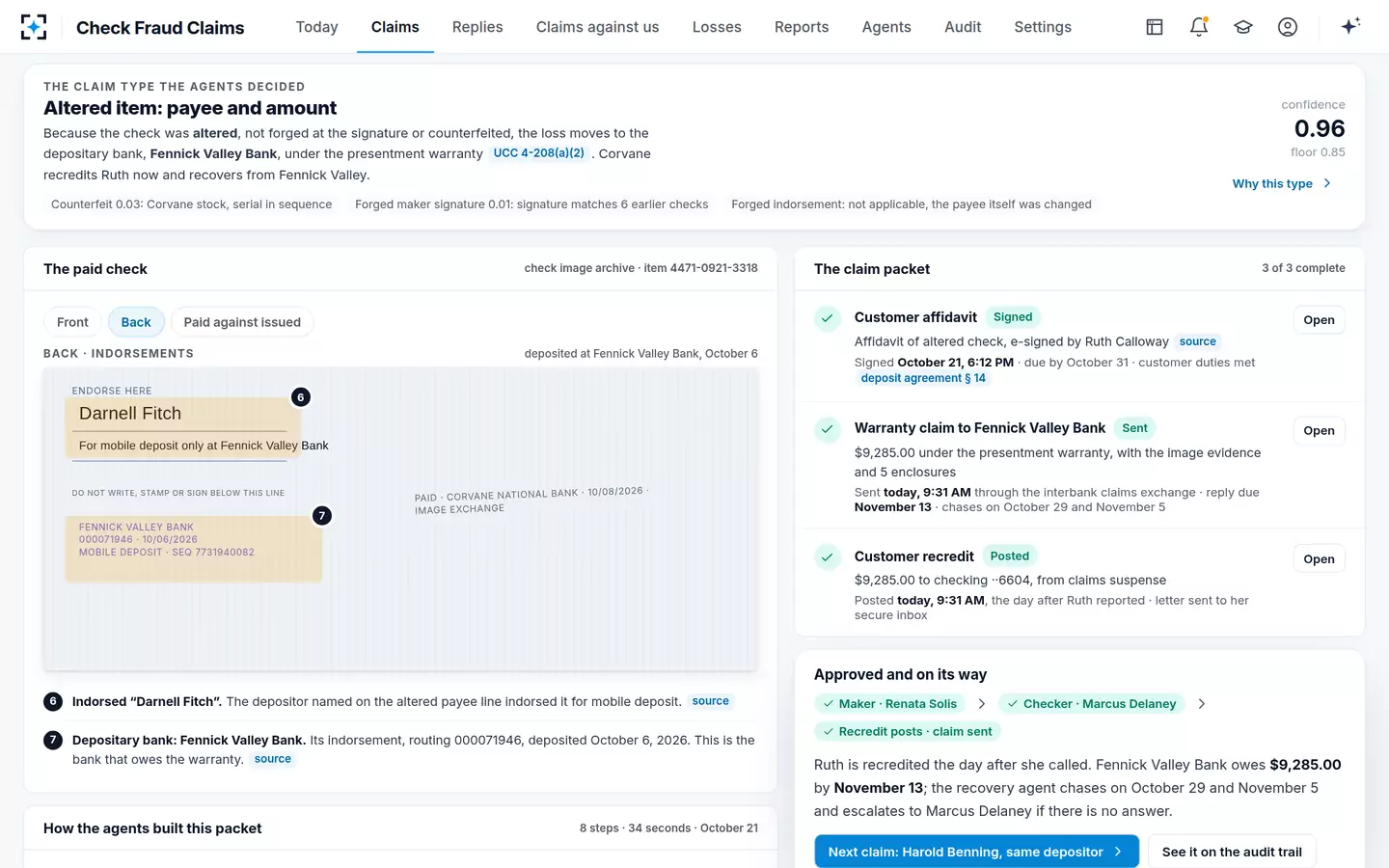
Take a sample customer as she runs through Check Fraud Claims at a fictional bank. Ruth Calloway mailed check 2318 for $1,285.00 to her water utility on October 1; it was washed and paid on October 8 for $9,285.00. She called on October 21 at 4:40 PM, e-signed her affidavit at 6:12 PM and uploaded her copy and the bill, and was recredited the next morning, after a specialist and a manager both approved. The same morning the bank's claim went to the bank where the thief had deposited the check by phone.
Check Fraud Claims: recredited the day after she called, with the claim on its way to the other bank
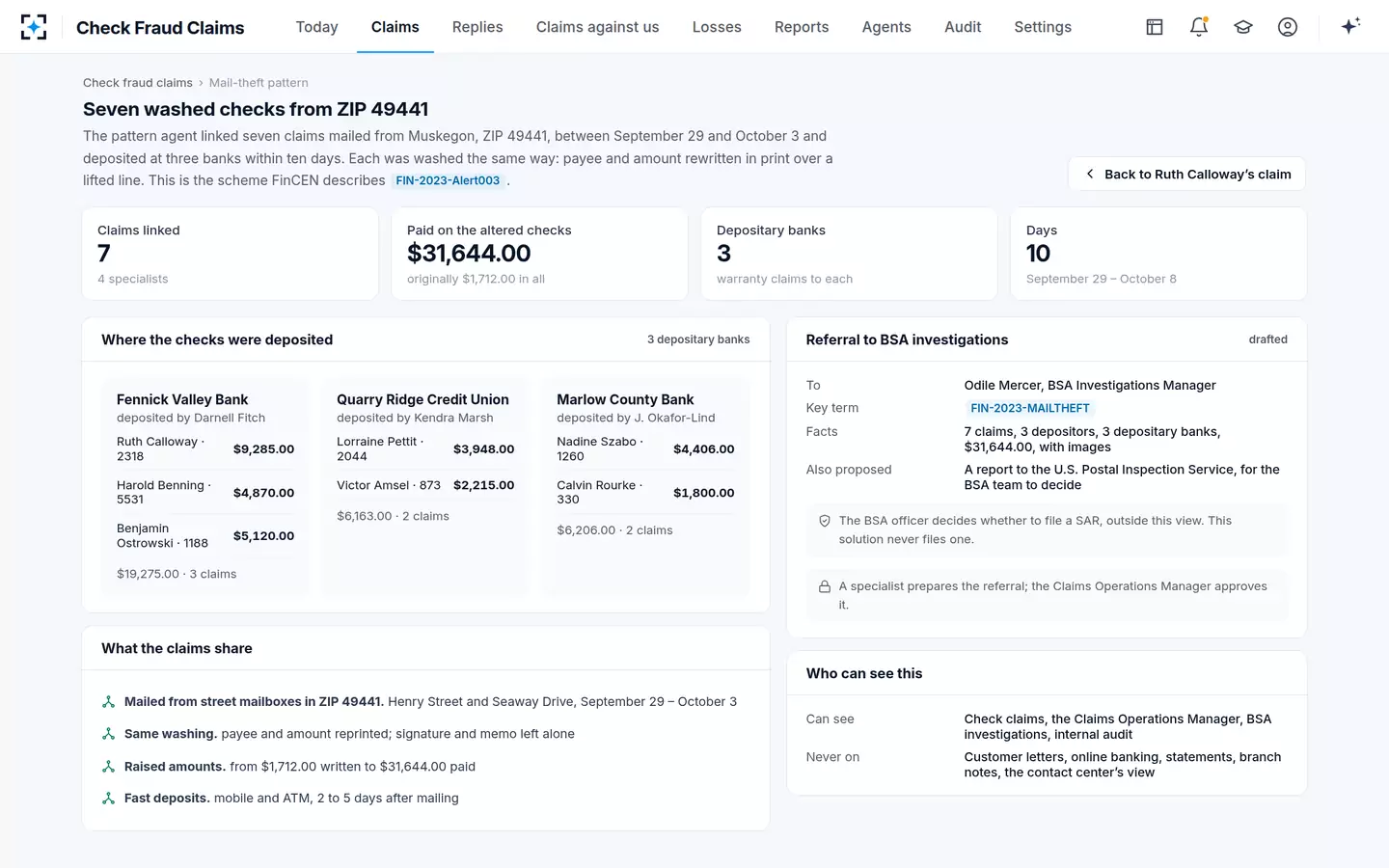
Your check may also be one of many. The sample bank's pattern agent linked Ruth's claim to six others mailed from the same ZIP code within five days and washed the same way, and drafted a referral to the bank's financial crimes team. Banks keep that work confidential by law, so you will not be told about it, and a well-run bank keeps it off every letter you receive.
Seven washed checks from one ZIP code, linked in Check Fraud Claims for the bank’s investigators
If your bank says no
Ask for the reason in writing, and for the documents it relied on. If the reason is that you reported late or were careless, compare it with your deposit agreement and the dates on your statements. If you cannot resolve it with a national bank or federal savings association, the OCC says to "file a written complaint with the Office of the Comptroller of the Currency's (OCC) Customer Assistance Group"; for other banks, file with their regulator, and you can also file with the CFPB.
For bank staff taking the call, the steps above are the script: what to ask, what to send, what the customer can expect and when. A customer who hears on the first call that her refund does not depend on the other bank, and that she will be told the outcome in writing, is far less likely to call back three times. Banks that run their claims in Check Fraud Claims give that first call a claim number, the clocks and an affidavit in the customer's inbox before she hangs up.
Questions people ask
Doesn't FDIC insurance cover a stolen check?
No. FDIC deposit insurance protects deposits if a bank fails; it does not pay for fraud. The OCC's answer is direct: deposit insurance "does not cover losses due to theft or fraud." Your protection against a stolen check is the bank's duty to charge you only for checks you authorized.
How long does my bank take to refund a stolen check?
There is no federal deadline for an ordinary check, because Regulation E's investigation clock does not apply to checks. Banks set their own timing in the deposit agreement and procedure, so ask when you report; the sample bank in this guide recredits one business day after the signed affidavit, as its own policy.
Can my bank make me pay because I mailed the check?
A bank that wants to hold you responsible must show your lack of ordinary care contributed to the fraud. Mailing a bill payment is an everyday use of a check; a signed check with the payee or amount left blank is the conduct the CFPB warns about. If the bank says mailing was careless, ask it to put the reason in writing.
Should I close my account after a check is stolen?
Consider it if more than one check is involved, or if the thief has your account number and signature on several checks. The OCC suggests closing the account when there are multiple forgeries, for example from stolen checks. Ask your bank to move automatic payments and deposits to the new account.
What if the stolen check was cashed at a check-cashing store?
The rules are the same: your bank paid a check that was not properly payable and generally recredits you. The check-cashing business presented the check through its own bank, which made the same warranties as any depositary bank, so your bank's claim runs against that bank.