Checks are washed in four steps: a criminal steals a signed check, usually from the mail; dissolves the ink of the payee and the amount with a common solvent, leaving the drawer's genuine signature; writes in a new payee and, usually, a larger amount; and deposits it where no bank employee looks at the paper, by mobile or at an ATM. FinCEN defines it simply: "Check washing involves the use of chemicals to remove the original ink on a check to replace the payee and often the dollar amount." Washing is one route to the most common kind of check fraud in FinCEN's data, the altered check, and the Federal Reserve's 2025 survey found 83% of institutions had experienced it. It is detectable, because every step leaves something behind: faded writing under darker writing, damaged paper, a rewritten line whose ink sits differently from the rest. Botminds' Check Fraud Detection reads for those traces on the deposited image, compares the check with the payor's earlier checks, and puts what it finds in front of a deposit fraud analyst before the funds are released.
Where this page uses examples from the solution, they come from a fictional sample, Norrell Federal Credit Union, in October. The descriptions of how washing works come from FinCEN, the U.S. Postal Inspection Service and the New York Department of State, linked where they appear.
How checks are washed: four steps, and what each leaves behind
- 1
Steal a signed check
From a blue collection box, a home mailbox or a cluster box unit; business checks are worth more to a thief.
Leaves behindA check that never arrives; the payee complains, the drawer may not know for weeks.
- 2
Wash the ink
A household solvent lifts the payee and amount; the drawer's signature is kept.
Leaves behindFaded traces of the old writing under the new; a drawer who may not know for weeks.
- 3
Rewrite payee and amount
A new name, often an account the criminal controls, and usually a larger amount.
Leaves behindNew ink over old: darker strokes, different density, a box amount the written line may not match.
- 4
Deposit without a person
By mobile deposit or ATM, often into a new account or a recruited mule's account; funds out fast.
Leaves behindAn image instead of paper; a new or quiet account; a withdrawal soon after the deposit.
How does check washing work?
It works because the hardest part of a check to fake, the drawer's signature, is left untouched. FinCEN's February 2023 alert, written with the Postal Inspection Service, describes the trade in full: "Check washing involves the use of chemicals to remove the original ink on a check to replace the payee and often the dollar amount. Fraudsters may also copy and print multiple washed checks for future use or to sell to third-party criminals" (FinCEN FIN-2023-Alert003).
The New York Department of State's consumer alert adds the detail that matters to a bank: thieves "use common chemicals like nail polish remover to erase (or 'wash') the payee and dollar amount while preserving the check's original signature" (New York Department of State, January 23, 2024). The result is a genuine check, on genuine stock, signed by the real account holder, payable to someone else for more money.
FinCEN's 2024 analysis of mail-theft filings places washing in the middle of the range of sophistication. It counts as "moderately sophisticated", above crossing out a payee or using correction fluid and below new accounts opened online with stolen or synthetic identities. "Effective alterations and counterfeit checks require some knowledge of the technology and chemicals used to wash checks," it notes (FinCEN Financial Trend Analysis, 2024).
What chemicals are used in check washing?
Government sources name only ordinary household solvents, and that is deliberate on their part and on ours. New York's alert gives nail polish remover as the example; FinCEN's analysis speaks of "chemicals or compounds that remove the ink from a check". Nothing in the public guidance gives a recipe, and nothing a bank needs to detect washing depends on one.
What matters to a bank is the result, not the recipe. The solvent clears the fields the criminal wants to change and leaves the drawer's signature in place, so the check keeps the one feature that is hardest to forge. New York's advice on pens, below, rests on the same point: some inks are harder to erase than others. Everything a bank can test for, the faded old writing, the rewritten line, the disagreement between fields, follows from that partial erasure.
Can a washed check be detected?
Often, yes: on paper by a trained eye, and on a good image by comparison. FinCEN's red flag describes the commonest trace: "Examination of suspect checks reveals faded handwriting underneath darker handwriting, giving the appearance that the original handwriting has been overwritten" (FIN-2023-Alert003). A rewritten amount may also leave the figures and the written line out of step, and a cleaned field may sit at a different ink density from the date and signature beside it.
Imaging cuts both ways. The FFIEC warned in 2009 that "Certain check security features may be lost or the physical alteration of a deposited check – such as by 'washing' or other alteration techniques – may be obscured in imaging or electronic conversion processes" (FFIEC, Risk Management of Remote Deposit Capture). A phone photo can lose features a teller would catch on the paper; it keeps layout, ink density and the relationship between fields, which software can measure.
Where the traces of washing show: at the counter, on the image, against the archive
| Trace | At the counter, on paper | On a deposited image | Against the payor's earlier checks |
|---|---|---|---|
| Old writing under new | Often visible, especially under angled light | Sometimes: faint strokes under darker ones | Not needed |
| Ink density of payee and amount | Hard to judge by eye | Measurable against the other lines | Comparable with the drawer's usual ink |
| A payee who says the check never arrived | Often heard first at a branch | Not visible | The paid item can be pulled and compared |
| Written amount vs figures | Readable | Readable | Not needed |
| Payee unusual for the drawer | Not knowable | Not knowable | Visible if the drawer's checks have passed through before |
| Copies of one washed check | Not knowable | Not knowable | A serial already paid, or the same layout with another payee |
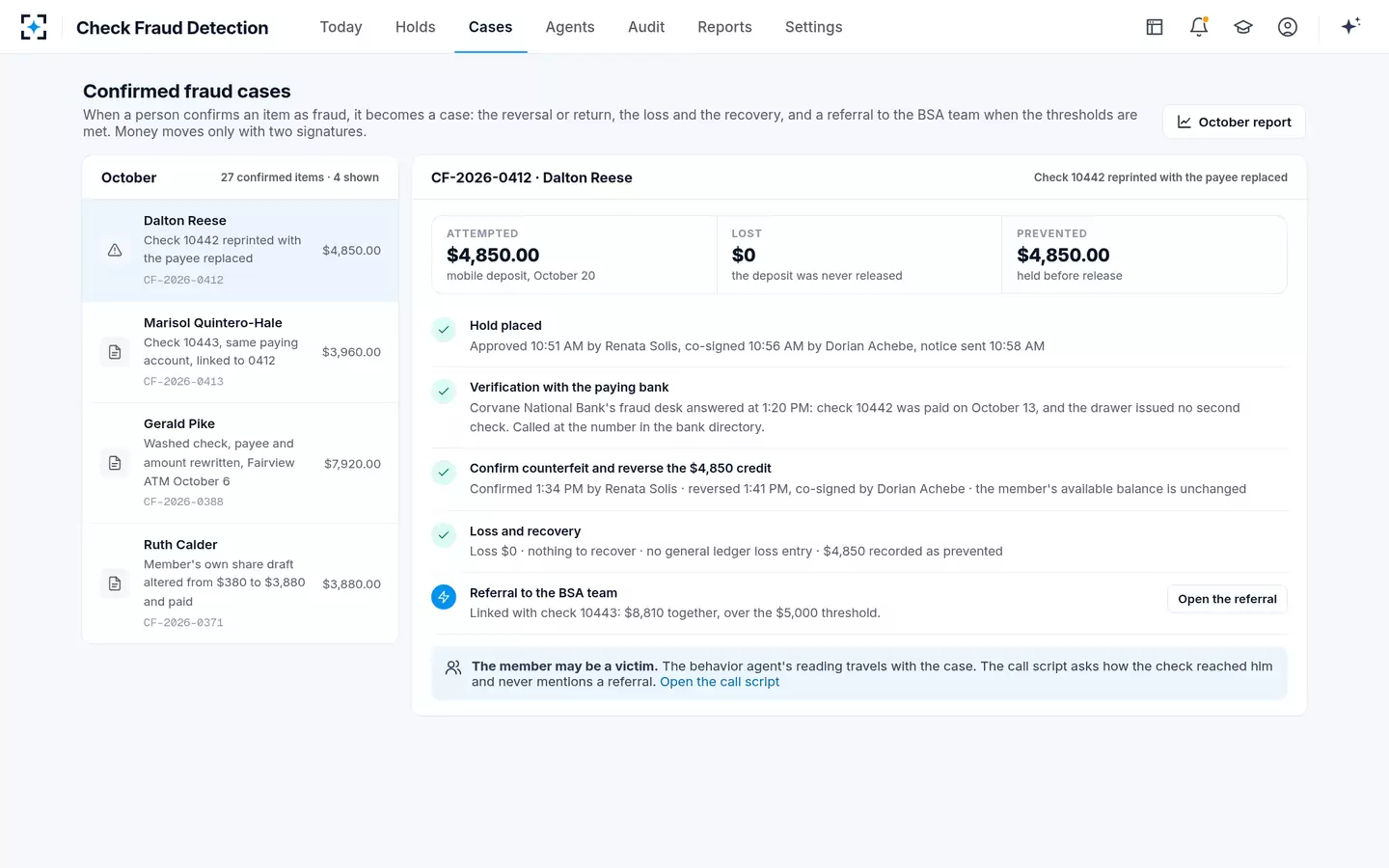
The sample credit union's October cases include a washed check that the image caught: a $7,920 item deposited at a Fairview ATM on October 6, its payee and amount rewritten, later confirmed as fraud. The same month's list shows the image agent's limit too: an ATM deposit that arrived front only was held for the image and not judged. The agent never judges an item without both sides, and below its confidence floor a finding is shown to the analyst as a question rather than marked on the check.
How common is check washing?
Very: it is one of the three most widely experienced kinds of check fraud. In the Federal Reserve Financial Services risk officer survey fielded in late 2025, "89% of respondents reported that they experienced payee forgery, 84% disclosed endorsement forgery and 83% reported check washing", and 21% reported washing increasing (FRFS Risk Officer Survey, 2026). The survey describes itself as "not independent academic research", with a margin of error of plus or minus 6%.
Check washing in the public numbers
83%
of institutions reported experiencing check washing
21%
reported check washing increasing
44%
of FinCEN's mail-theft check fraud reports involved altered checks, washing among the methods
$1 billion+
in counterfeit checks and money orders Postal Inspectors recover each year
FinCEN does not count washing separately in its mail-theft figures; it found altered checks in about 44% of reports, with the payee line the field most often altered and the amount next, and noted that forging signatures and altering issuer information "often requires washing the checks first". The Postal Inspection Service frames the scale from the other side: "Postal Inspectors recover more than $1 billion in counterfeit checks and money orders every year" (USPIS, Check Washing).
Is check washing still a thing, and why is it increasing?
It is, because its supply chain still works. Mail theft provides the checks: FinCEN's alert describes thieves working blue collection boxes, residential mailboxes and cluster box units with fishing devices and stolen or counterfeit master keys, and the Postal Inspection Service recorded a 161% rise in mail theft complaints between March 2020 and February 2021. A washed check is also a product: the alert says they "may also be copied, printed, and sold to third-party fraudsters on the dark web and encrypted social media platforms in exchange for convertible virtual currency".
The deposit side makes it safer than it used to be. FinCEN found perpetrators favour remote deposit and ATMs, where no one at the bank handles the paper. The full set of reasons, with the numbers, is in why check fraud is on the rise while checks disappear.
What pens prevent check washing?
Gel pens help, according to the one government source we found that addresses pens, and no pen is a guarantee. New York's Department of State advises: "Use black gel pens: Gel pens may have ink that thieves have greater difficulty erasing compared to standard ballpoint pens" (NY Department of State, 2024). That is one state's consumer advice, carefully worded ("may"); we found no federal agency that tests pens or endorses a brand.
The federal advice concentrates on the mail, where the theft happens. The Postal Inspection Service tells people to deposit outgoing mail "in blue collection boxes before the last pickup or at your local Post Office", to collect mail promptly, and to hold mail when away (USPIS; USPIS mail theft tips). A credit union that passes on that advice, and the reporting route below, does more for its members than a pen recommendation.
What to tell members and business customers about check washing
- Mail checks inside the Post Office, or before the last pickup
The Postal Inspection Service and New York both put this first.
- Do not leave mail in the box overnight
Collect it promptly; use a hold when away.
- Write checks in black gel ink
New York's advice: gel ink may be harder to erase than ballpoint ink. Helpful, not a guarantee.
- Watch for checks that clear to someone else
Review the account and the check images regularly, and ask payees to confirm receipt.
- If a check was washed, call the bank at once
Then file a police report and report it to the Postal Inspection Service at 1-877-876-2455 or uspis.gov/report.
- Businesses: ask about positive pay with payee checking
Where the bank offers it, a check whose payee does not match the business's issue file can be stopped before it is paid.
What happens if you deposit a washed check?
For the depositor, the check is returned as altered, the credit is reversed, and if the money has been spent the account goes negative; a depositor who knew it was washed has also taken part in a fraud. For the banks, the law sends the loss back towards the bank where it was deposited. The paying bank can charge its own customer only according to the check's original terms (UCC 4-401(d)), and every bank that presented the check warranted that it had not been altered (UCC 4-208(a)(2)). The bank of first deposit usually ends up with the claim against its depositor, and the loss if the depositor cannot pay.
That allocation is why washing matters most to the bank that takes the deposit, and why the screening has to happen there, before availability. The full comparison with counterfeits, where the loss usually stays with the paying bank instead, is in counterfeit check vs altered check. The depositor may also be a victim: FinCEN's analysis describes stolen checks run through romance and employment scams, where the person depositing believes the check is theirs. The solution's depositor behavior agent says so when the facts fit, and the case carries a call script that never mentions a referral.
What the image can still show
The image still shows the relationships that washing disturbs: one line inked differently from its neighbours, figures that disagree with words, a payee the drawer has never paid, a layout that matches a check already paid. Check Fraud Detection's image forensics agent reads front and back for ink and toner density, washing, the amount fields, stock and microprint, the MICR line and the endorsement, and pins each finding on the region where it was found, with a confidence and the item it compared against.
A finding pinned on the payee line, where washing and reprinting both show
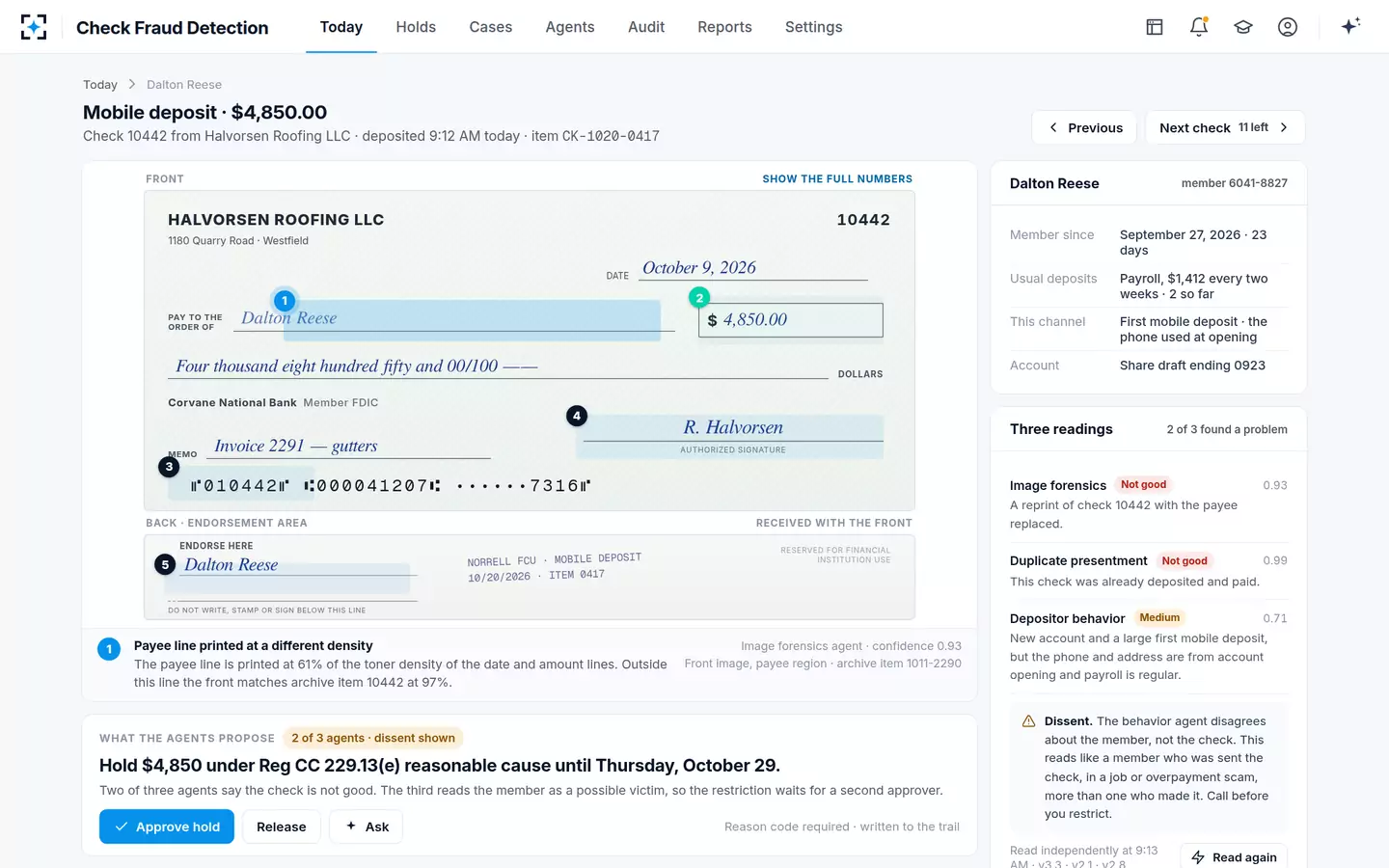
The density finding is also where the sample shows the cost of over-reading. In September, a payee-density finding on its own led to 212 holds on checks later paid in full, the largest single cause of good-item holds; the tuning agent proposed showing that finding as a question when it stands alone, which a backtest on the same month suggested would avoid 118 such holds without missing any of the 61 confirmed frauds. Washing traces are real, but a faint line is not proof. What a teller can add at the counter is set out in check fraud training for tellers; to see a washed check from deposit to confirmed case, start from Check Fraud Detection.
A washed check confirmed, beside a counterfeit and an altered share draft
Questions people ask
How do criminals get checks to wash?
Mostly from the mail. FinCEN describes thefts from blue collection boxes, unsecured home mailboxes and apartment cluster box units, using fishing devices or stolen or counterfeit Postal Service master keys, and its 2024 analysis adds newly ordered blank checks stolen in transit. Insiders at banks or the Postal Service appear in the most organised cases.
Does mobile deposit make washed checks harder to catch?
Yes, in part. The FFIEC noted that washing "may be obscured in imaging or electronic conversion processes", and FinCEN found that criminals prefer remote deposit because no one at the bank handles the check. An image still shows density, layout and field consistency, which is what software comparison uses.
Who is liable for a washed check?
Usually the bank where it was first deposited, not the person who wrote it. The paying bank may charge the writer's account only according to the check's original terms, and recovers from the presenting banks, which warrant the check was not altered. The writer can lose that protection by reporting late, after one year at the latest, or through negligence that contributed.
What should I do if my check was washed?
Contact your bank immediately, file a police report, and report it to the U.S. Postal Inspection Service at 1-877-876-2455 or uspis.gov/report. That is New York's advice, and FinCEN asks banks to refer mail-theft victims to the Postal Inspection Service.
Can a washed check be copied and used again?
Yes. FinCEN warns that fraudsters "may also copy and print multiple washed checks for future use or to sell to third-party criminals". Each copy is a counterfeit made from an altered original, and a duplicate search that compares serials and images across deposits is how the second and third copies are caught.