Duplicate presentment is the same check presented for payment more than once: the image deposited by phone and then the paper original deposited at a branch, an ATM or another bank, or the same image sent to two banks, or a reprint of a check that has already been paid. Remote deposit made it common, because the depositor keeps the paper after the image is accepted. The paying bank pays the first presentment and returns the second as already paid, but the return can arrive after the second bank has made the funds available, and by then the money may be gone. Federal rules decide who carries that loss, often the bank that took the image, but the cheaper answer is to catch the second presentment before the funds are released. Botminds' Check Fraud Detection does that with a duplicate presentment agent that searches the institution's whole item archive, across teller, ATM, mobile and business remote deposit, by serial, routing number, account, amount and image fingerprint, and never closes a duplicate on the serial alone.
The worked examples use two kinds of illustration: the Federal Reserve Board's own "Bank A, Bank B" examples from the Reg CC commentary, and a fictional sample, Norrell Federal Credit Union, as it runs through the solution in October.
What does duplicate presentment mean?
It means a paying bank is asked to pay a check it has already paid. Regulation CC builds a promise against it into every electronic check. Each bank that transfers or presents one warrants that "No person will receive a transfer, presentment, or return of, or otherwise be charged for an electronic check or electronic returned check, the original check, a substitute check, or a paper or electronic representation of a substitute check such that the person will be asked to make payment based on a check it has already paid" (12 CFR 229.34(a)(1)(ii)).
Supervisors have treated it as a known risk of remote deposit since remote deposit began. The FFIEC's 2009 guidance says: "Duplicate presentment of checks and images at the institution or another depository institution represents both a business process and a fraud risk" (FFIEC, Risk Management of Remote Deposit Capture, January 2009). Business process, because an honest customer can deposit twice by mistake; fraud risk, because a dishonest one can do it on purpose, at several banks, in a few hours.
How does duplicate presentment happen with mobile deposit?
Mobile deposit separates the image from the paper. The Board's commentary sets out the mechanism: "Because the depositary bank's customer retains the original check, that customer might, intentionally or mistakenly, deposit the original check in another depositary bank. The depositary bank that accepts the original check, in turn, may make funds available to the customer before it learns that the check is being returned unpaid and, in some cases, may be unable to recover the funds from its customer" (Reg CC commentary, 229.34(f)).
Four patterns cover most cases. The image goes to one bank by mobile and the paper to another at a branch or ATM. The image goes to two banks by two mobile apps. The image goes to the same bank twice, by accident or by testing: on the sample credit union's Tuesday a $2,300 check was deposited twice by mobile, four minutes apart, and the agents proposed returning the second. Or the paid check becomes the template for a reprint with a new payee, which is both a duplicate and a counterfeit; that was the sample's $4,850 case, set out in counterfeit check vs altered check.
The return comes back after the money is gone
The timing is the whole problem. Reg CC requires a paying bank that decides not to pay a check to return it "in an expeditious manner such that the check would normally be received by the depositary bank not later than 2 p.m. (local time of the depositary bank) on the second business day following the banking day on which the check was presented to the paying bank" (12 CFR 229.31(b)). Meanwhile, a local check deposited at the second bank must normally be available on the second business day after deposit.
One check, two banks: the second bank's funds are due before the duplicate return arrives
- DepositMon
- PaidTue
- DepositTue–Wed
- Funds dueThu
- ReturnFri
- MatchTue
- Reasonable-cause hold, 5 business daysto next Thu
A reasonable-cause hold closes the gap only if someone sees the duplicate at deposit. A paid check already in the institution's own archive is the clearest fact the rule could ask for, and the sample's notice stated it in one sentence the member could check: the same number, account and amount had already been deposited and paid. The hold, its date and its records are covered in what a reasonable cause exception hold needs.
Who is liable for a duplicate presented check?
When the duplicate is the paper original of a check first deposited as an image, Reg CC usually puts the loss on the bank that took the image. Under the remote deposit capture indemnity, a depositary bank that accepted an image, never received the original, was paid, and did not get the check back unpaid "shall indemnify ... a depositary bank that accepts the original check for deposit for losses incurred by that depositary bank if the loss is due to the check having already been paid" (12 CFR 229.34(f)(2)). The Board's three examples show where the indemnity reaches and where it stops.
Who carries a duplicate-presentment loss: the Board's examples and two more
| What happened | Who loses first | Is there a claim? |
|---|---|---|
| Image to Bank A by mobile; paper original to Bank B, no restrictive endorsement | Bank B, if it released the funds | Yes: Bank B against Bank A under the remote deposit capture indemnity |
| Same, but the original reads "for mobile deposit at Depositary Bank A only" | Bank B | No: Bank B accepted a check with a restrictive endorsement inconsistent with the deposit |
| Image to Bank A and to Bank B by mobile; paper original to Bank C | Banks B and C | Bank C against Bank A; Bank B has none, because it never took the original |
| The same image deposited twice at one institution | That institution | Against its own depositor, by charge-back or agreement |
| A reprint of a paid check with a new payee | The bank that took the reprint | A counterfeit: the warranty and forgery rules apply, not the indemnity |
The restrictive endorsement row is the one depositors should hear about. The commentary's example b turns on an original that "bears a restrictive indorsement 'for mobile deposit at Depositary Bank A only' and the customer's account number at Depositary Bank A". The bank that took that original "may not make an indemnity claim against Depositary Bank A because Depositary Bank B accepted the original check bearing a restrictive indorsement inconsistent with the means of deposit." A teller who reads the back of a check is protecting the bank's claim, not only spotting fraud.
The mobile-to-mobile row is the least comfortable. In the commentary's example c, the second bank to receive an image "does not have an indemnity claim against Depositary Bank A because Depositary Bank B did not receive the original check for deposit". A credit union whose mobile deposit takes the second copy of an image has no indemnity claim under Reg CC; it has its depositor, and whatever its account agreement says.
How long does a duplicate presentment return take?
The paying bank must return it so it would normally arrive by 2 p.m. on the second business day after presentment, and the return must say why. The commentary to Reg CC's return rules is explicit that the reason "must be clearly indicated", and that a vague one will not do: "a reason such as 'Refer to Maker' would be inappropriate in cases where a check is being returned due to the paying bank having already paid the item, where a check has been altered, or where a check is unauthorized" (Reg CC commentary, 229.31). The Board settled the point in its 2017 amendments, noting that commenters "agreed with the proposal that 'refer to maker' should not be used in situations involving duplicate presentment" (82 FR 27552, June 15, 2017).
Claims have a clock too. A bank claiming under a Reg CC warranty or indemnity must notify the bank that gave it within 30 days of having reason to know both of the breach, or of the facts behind the indemnity, and of which bank is responsible; late notice discharges the other bank to the extent of the loss the delay caused (229.34(k)). A file that holds the presentment dates, the archive item and the images makes the 30 days enough.
Can banks see a check deposited at another bank?
Not directly, and not in real time. A bank's own archive holds what its own channels received; a deposit at another bank appears only when it comes back as a return, or through a shared service. The Reserve Banks run one: their Duplicate Check Notification, expanded from Treasury checks to commercial checks in November 2024, provides "Reports ... for both commercial and Treasury checks deposited by your institution or another BOFD on the current day or within a specific date range", by encrypted email, to "supplement your own research" (Federal Reserve Financial Services).
Its reach is the Reserve Banks' own volume. The Board's December 2025 request for information says the Reserve Banks "currently process nearly half of the nation's check volume overall" (FR Doc. 2025-22272), so a duplicate that clears entirely through private channels will not appear. An institution's own cross-channel search and the Fed's notification are complements: the first catches the same check coming through your own doors, the second some of the copies going through other banks' doors.
Check Fraud Detection is plain about which one it is. Its duplicate presentment agent searches the institution's own item archive, every channel, and links sibling items from the same paying account; it does not see deposits at other banks. A bank that wants both pairs the agent with the Fed's notification and with its returns.
How the duplicate search works on one sample check
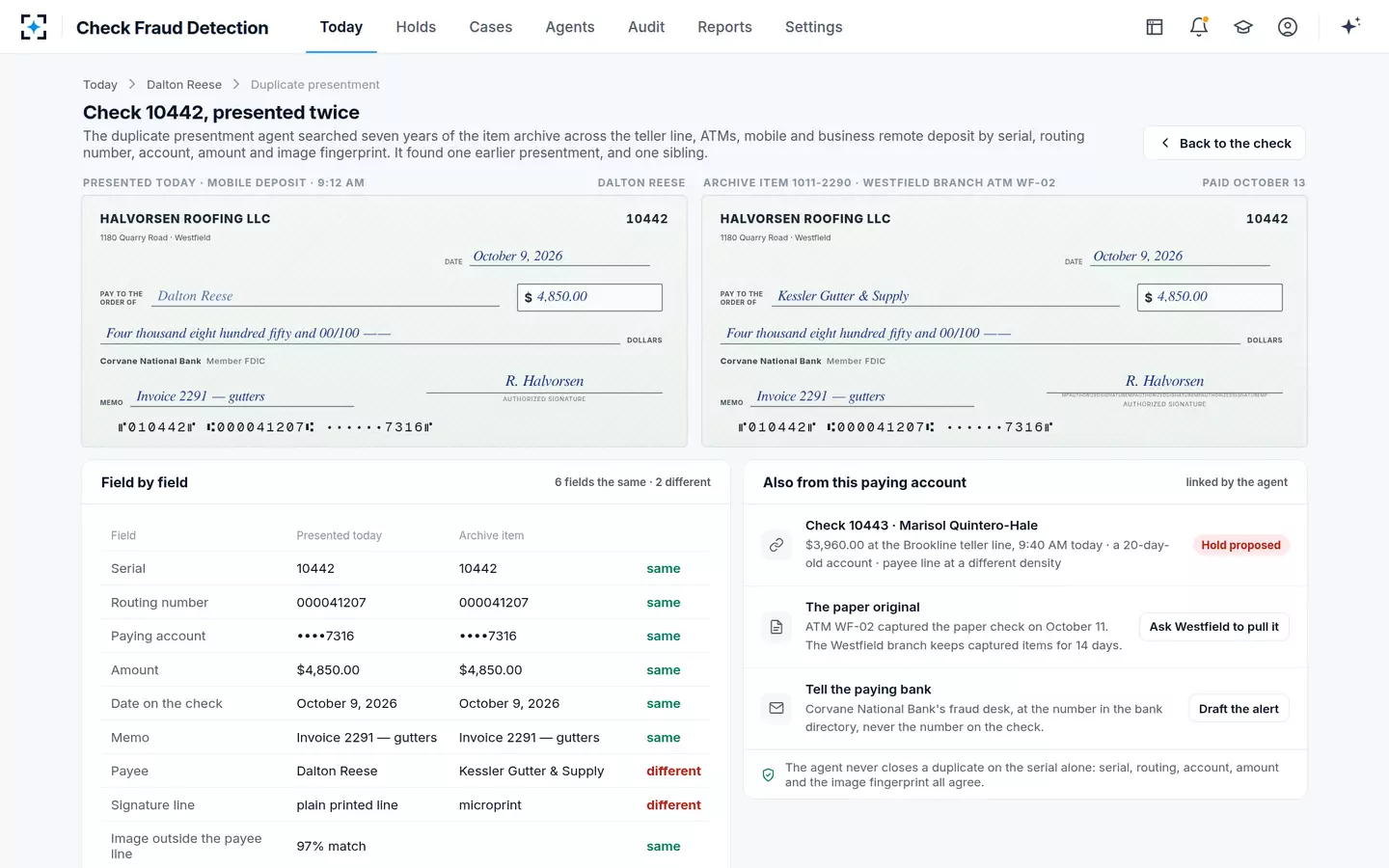
The sample shows the search on a hard case: a reprint with a new payee, so the serial and amount matched but the payee did not. At 9:12 AM a member of 23 days deposited check 10442 from Halvorsen Roofing LLC for $4,850 by mobile. The duplicate presentment agent searched seven years of the credit union's archive across all four channels and found the same check deposited at a Westfield branch ATM on Sunday, October 11 at 4:51 PM by a different payee and paid on October 13, at a confidence of 0.99.
How Check Fraud Detection's duplicate presentment agent searches, and where people take over
Agent
Match on more than the serialSearches every channel by serial, routing number, account, amount and an image fingerprint; on the sample, six fields agreed; the payee and the signature line did not.
Never: closes a duplicate on the serial alone.
Agent
Mark what it could not searchWhen the archive answered slowly from 7:40 to 8:05 AM, six searches that covered only the remote deposit index were marked partial and run again at 8:06.
Never: reports a partial search as clean.
Agent
Link the siblingsFound check 10443 from the same paying account, $3,960, presented at another branch's teller line 28 minutes later.
Agent
Propose the hold and the reasonProposed a reasonable-cause hold to Thursday, October 29, with the reason "already presented and paid".
Never: places the hold.
A person decides
Deposit fraud analystApproved the hold at 10:51 AM with reason code HR-01; later confirmed the counterfeit after calling the paying bank at a number from the bank directory.
A person decides
Fraud operations supervisorCo-signed the hold, the mobile deposit pause and the reversal; loss $0.
Callout 3: this check was already deposited and paid
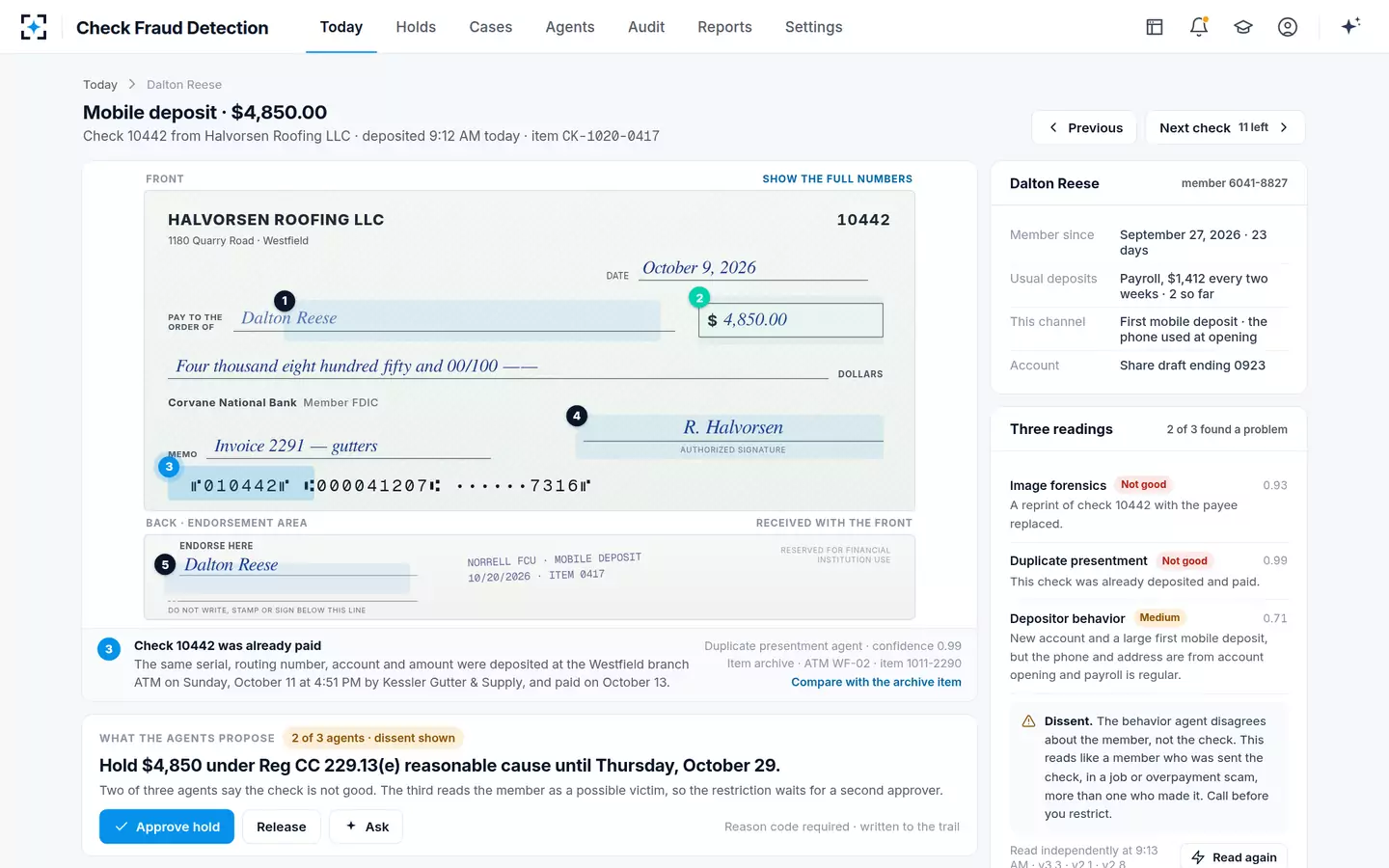
The paper matters as well as the image. The Westfield ATM had captured the paper original on October 11, and the branch keeps captured items for 14 days, so the solution offered to ask the branch to pull it for examination. In a dispute with another bank, the original can settle what the images cannot.
The presented check beside the archive original, field by field
How do you stop double deposits?
Stop them at the edges and at the middle: at the depositor, with endorsements and training; at deposit, with a search across every channel; and after deposit, with holds that outlast the return. The FFIEC's guidance asks for the depositor part explicitly: "Sound training should include documentation that addresses routine operations and procedures, including those related to the risk of duplicate presentment and problem resolution", and for the monitoring part, reports on duplicate entries and deposit thresholds (FFIEC, 2009).
Seven controls against duplicate presentment
- Require a restrictive endorsement on mobile deposits
Words such as "for mobile deposit at [bank] only" protect the depositor and limit a later bank's claim against yours.
- Read the back of every paper check at the counter
A mobile-deposit endorsement from another bank on a paper original is a duplicate in progress.
- Search every channel, not just the one the item came through
Teller, ATM, mobile and business remote deposit share one archive; the search should too.
- Match on more than the serial
Serial, routing, account, amount and the image together; a serial alone produces false matches and misses reprints.
- Treat a partial search as unfinished
If the archive is slow, mark it and run it again before the availability run.
- Enrol in the Fed's duplicate notification
It reaches checks other banks deposit through the Reserve Banks.
- Teach remote deposit customers what to do with the paper
Keep it secure for the agreed period, then destroy it; the FFIEC names duplicate presentment as a training topic.
Every control on that list has a cost in friction, and the search is the one depositors never feel. In the solution the search runs on every deposited check, not only on flagged ones, so a duplicate does not depend on a score to be found. How the search sits beside the archive and core a deposit team already runs is in check fraud detection software that works beside your image archive; to follow the sample case from the first image, start from Check Fraud Detection.
Questions people ask
Can you deposit the same cheque twice by accident?
Yes, and it happens: a mobile deposit that seems to fail, then succeeds, or a paper check deposited after its image. The paying bank pays once and returns the second as already paid, and the bank of deposit reverses the second credit. The FFIEC treats duplicate presentment as a business process risk as well as a fraud risk for this reason.
What does "duplicate presentment" mean on a returned check?
It means the paying bank refused the item because it had already paid that check. Reg CC's commentary requires the return reason to be clearly indicated and rules out "Refer to Maker" for an item returned because it was already paid. The bank that receives the return then reverses the deposit or, if the funds are gone, looks to its depositor or to any claim it has against another bank.
How long should a business keep a check after mobile deposit?
As long as its bank's remote deposit agreement says, and securely. The FFIEC's guidance asks institutions to require customers to have document procedures covering deposited items from receipt until destruction, and the Board's commentary lets a bank allocate duplicate losses to its remote deposit customer by agreement.
Is duplicate presentment fraud or an error?
Either. The FFIEC calls it "both a business process and a fraud risk". What distinguishes them is the pattern: a single repeat by a long-standing customer is usually an error, while the same check at several banks within hours, or a reprint with a different payee, is fraud.
Does a reasonable-cause hold apply to a duplicate check?
Yes, when the bank has facts showing the check was already paid; Reg CC's model notice even lists "Other" reasons, and an earlier paid presentment in the bank's own archive is a specific fact about the item. A local check can then be held up to five business days beyond its normal date, which usually outlasts the paying bank's return.