A reasonable cause to doubt collectibility exception hold lets a bank or credit union delay a deposited check beyond Regulation CC's normal schedule when it has facts that would make a reasonable person believe the check will not be paid. The test is evidential, not statistical: the belief may not rest on the kind of check or the kind of depositor, the reason must appear in the notice the depositor receives, and the bank must keep a brief statement of the facts behind it. In return, the hold may extend availability by up to one business day for a check drawn on the same bank, five for a local check and six for a deposit at a nonproprietary ATM, and longer only if the bank can show why. Botminds' Check Fraud Detection treats each of those requirements as part of the hold itself: the agents pin the facts on the check image, the hold and notice agent drafts the reason and counts the date, and a named analyst decides whether the facts are enough.
The worked examples come from a fictional sample, Norrell Federal Credit Union, on Tuesday, October 20, as it runs through the solution. The rule text is quoted from the current Code of Federal Regulations and the Federal Reserve Board's official commentary.
What is reasonable cause to doubt collectibility?
It is one of six exceptions in 12 CFR 229.13 that suspend Reg CC's availability schedule, and the only one that turns on the bank's judgment about a particular check. The rule reads: "Reasonable cause to believe a check is uncollectible requires the existence of facts that would cause a well-grounded belief in the mind of a reasonable person. Such belief shall not be based on the fact that the check is of a particular class or is deposited by a particular class of persons. The reason for the bank's belief that the check is uncollectible shall be included in the notice required under paragraph (g) of this section" (12 CFR 229.13(e)(1)).
Three requirements sit in those three sentences. There must be facts, not a feeling or a score. The facts must be about this check, not about a category it belongs to. And the facts must be stated, to the depositor, in the notice. A fourth sits further down the section: the bank must keep each notice "together with a brief statement of the facts giving rise to the bank's reason to doubt the collectibility of the check" (229.13(g)(5)).
What counts as reasonable cause? The commentary's examples
The Board's official commentary gives four kinds of example, and each is about information specific to the item. A notice from the paying bank that the check "was not paid and is being returned" is enough, even if the notice is incomplete. Information from the paying bank before presentment, such as a stop payment or insufficient funds in the drawer's account, can be enough. A stale check, deposited more than six months after its date, or a postdated one, is "a reasonable indication that the check may be uncollectible". And confidential information can be enough: the commentary's example is "its reasonable belief that the depositor is engaging in kiting activity", or the insolvency of the drawer or the drawee bank (Reg CC commentary, 229.13(e)).
The commentary is equally specific about what does not count. A depositary bank "cannot invoke this exception simply because the check is drawn on a paying bank in a rural area and the depositary bank knows it will not have the opportunity to learn of nonpayment of that check before funds must be made available under the availability schedules. Similarly, a depositary bank cannot invoke the reasonable cause exception based on the race or national origin of the depositor."
The Board's model notice, C-13, lists the reasons it expects most often, and says the list is not exhaustive: a reason not on it may be used "if the reason satisfies the conditions for invoking this exception", and a combination of factors may support a hold, in which case the bank should disclose "the primary reasons". The fraud-related reasons on the model map directly onto what an image and an archive can show.
The model notice's reasons, and the facts a file should hold for each
| Reason on Reg CC model notice C-13 | The brief statement of facts to keep | Sample reason code |
|---|---|---|
| We received notice that the check is being returned unpaid | The paying bank's notice; a copy of the hold notice can suffice | — |
| We have confidential information that indicates that the check may not be paid | A fuller description of the facts, such as kiting or the drawer's insolvency | — |
| Some information on the check is not consistent with other information on the check | Which fields disagree, e.g. a written amount the box figure does not match | HR-02 alteration found |
| There are erasures or other apparent alterations on the check | The region, the finding and what it was compared with | HR-02 alteration found |
| The routing number of the paying bank is not a current routing number | The routing number and the lookup | HR-03 counterfeit stock or issuer mismatch |
| Information from the paying bank indicates that the check may not be paid | Who at the paying bank said what, when, reached at a number from a directory | HR-04 paying account closed |
| The check is postdated or has a stale date | The date on the check and the deposit date | — |
| Other (the reason must be given) | For example: the same serial, account and amount already presented and paid, with the archive item | HR-01 already presented and paid |
Can a bank hold a check because the depositor is new?
Not under the reasonable-cause exception: being new is a class of depositor, which the rule excludes. Reg CC handles new accounts with a separate exception. An account counts as new for its first 30 calendar days, and during that period the ordinary schedule for local checks does not apply at all, while certain next-day items such as Treasury and cashier's checks get next-day treatment only for the first $6,725 a day, the rest by the ninth business day (229.13(a)).
The two exceptions are often confused because they meet on the same deposit. The sample's $4,850 mobile deposit came from a member of 23 days, so the new-account exception was available; the credit union held under reasonable cause instead, because it had a specific fact to state: the same check had already been deposited and paid. A hold built on a fact survives the account turning 31 days old and reads better to the member. A hold built on newness alone is lawful in the first 30 days but explains nothing.
The sample's own numbers show the cost of leaning on newness. In September, 188 of the 674 holds that landed on good checks had "new account" as their only reason. That is a policy choice, not a legal error, and it is exactly the kind of choice a monthly review should put in front of the Fraud Manager.
How long can a bank hold a check for suspected fraud?
Under the reasonable-cause exception, Reg CC treats as reasonable an extension of "up to one business day for checks described in § 229.10(c)(1)(vi), five business days for checks described in § 229.12(b) (1) through (4), and six business days for checks described in § 229.12(c) (1) and (2) or § 229.12(f)" (229.13(h)(4)). Translated into check types, that is one day for a check drawn on the same bank and deposited at its branch, five for a local check, and six for a nonlocal check or a deposit at an ATM the bank does not own.
How long a reasonable-cause hold can run, by kind of check deposit
| Kind of check deposit | Normal availability | Reasonable extension | Latest date without more proof | Evidence the hold needs |
|---|---|---|---|---|
| Drawn on the same bank, deposited at its branch (229.10(c)(1)(vi)) | Next business day | Up to 1 business day | 2nd business day | The facts about this item, stated in the notice |
| Local check: every check, since 2010 (229.12(b)) | 2nd business day | Up to 5 business days | 7th business day | The same |
| Treasury, cashier's, certified or government check otherwise due next day | Next business day | Added to the local schedule | 7th business day | The same |
| Deposited at a nonproprietary ATM (229.12(f)) | 5th business day | Up to 6 business days | 11th business day | The same |
| Any of the above, held longer | — | Longer than the table | As the bank can justify | Facts showing why a longer period is reasonable; the burden is the bank's |
One historical fact makes the table shorter in practice. The agencies' 2025 RFI explains that the Reserve Banks "reduced the number of their paper check-processing offices from 45 in 2003 to a single office in 2010. The consolidation resulted in all checks being considered 'local checks' under Regulation CC" (90 FR 26293, note 16). Reg CC's Appendix A now lists every routing symbol under one Federal Reserve office. The six-day nonlocal row survives in the rule's text, but for check deposits it applies in practice to nonproprietary ATMs.
For checks that would otherwise be available the next day, such as Treasury checks, cashier's checks and teller's checks, the commentary says the "additional hold is added to the local or nonlocal schedule that would apply based on the location of the paying bank", and that when a bank places a hold under this exception "it need not make the first $275 of a deposit available for withdrawal on the next business day" (Reg CC commentary).
Counting the date: two sample holds, one with a holiday
The date is counted in business days from the normal availability date, so a Federal Reserve holiday in the window moves it. The sample shows both cases. The $4,850 mobile deposit on Tuesday, October 20 would normally be available on Thursday, October 22, the second business day; five business days later is Thursday, October 29, with no holiday in between. A $2,180 check held for an alteration, deposited on Friday, October 9, crossed Columbus Day on Monday, October 12, and released on Wednesday, October 21.
Two reasonable-cause holds in calendar days: a weekend and a holiday add three
- Normalto Oct 22
- Extension, 5 business daysto Oct 29
- Normal, over a weekend and a holidayto Oct 14
- Extension, 5 business daysto Oct 21
Counting by hand is where good holds go wrong: a release date one day late is a hold beyond the schedule, and a date in the notice that does not match the date in the core is a complaint in waiting. The solution computes the date against the Federal Reserve holiday calendar and checks, before the notice is sent, that the date in the notice matches the hold posted to the core.
Is a longer exception hold ever allowed?
Yes, but the bank carries the burden. The rule says "A longer extension may be reasonable, but the bank has the burden of so establishing" (229.13(h)(4)). The commentary's example is concrete: a bank extends a local check by five business days, and on the day before the hold expires the paying bank says the check is being returned unpaid. The bank "may determine that a longer hold is warranted, if it decides not to charge back the customer's account based on the notification", but it "must send a second notice" with the new date.
The example sets the pattern for any extension: a new fact, a new notice, a new date. A longer hold placed because an analyst ran out of time is not in the commentary's contemplation, which is why the solution's settings let the Fraud Manager choose an extension of one to five business days.
What must a Reg CC exception hold notice say?
Five things: a number or code identifying the account, which need not exceed four digits; the date of the deposit; the amount being delayed; "The reason the exception was invoked"; and the time within which the funds will be available (229.13(g)(1)(i)). The commentary allows the actual availability date in place of a count of business days, which is kinder to the reader.
Timing depends on how the check came in. For a deposit made in person to an employee, the notice goes to the depositor at the time of deposit. Otherwise, or if the facts only come to light later, it must be mailed or delivered "as soon as practicable, but no later than the first business day following the day the facts become known to the depositary bank, or the deposit is made, whichever is later". Electronic delivery to a consumer requires consent under the federal E-SIGN Act, the commentary adds. In the sample, the notice for the Tuesday mobile deposit was due by Wednesday, October 21; it went to online banking and by mail at 10:58 AM on Tuesday.
The notice, and how its release date was set
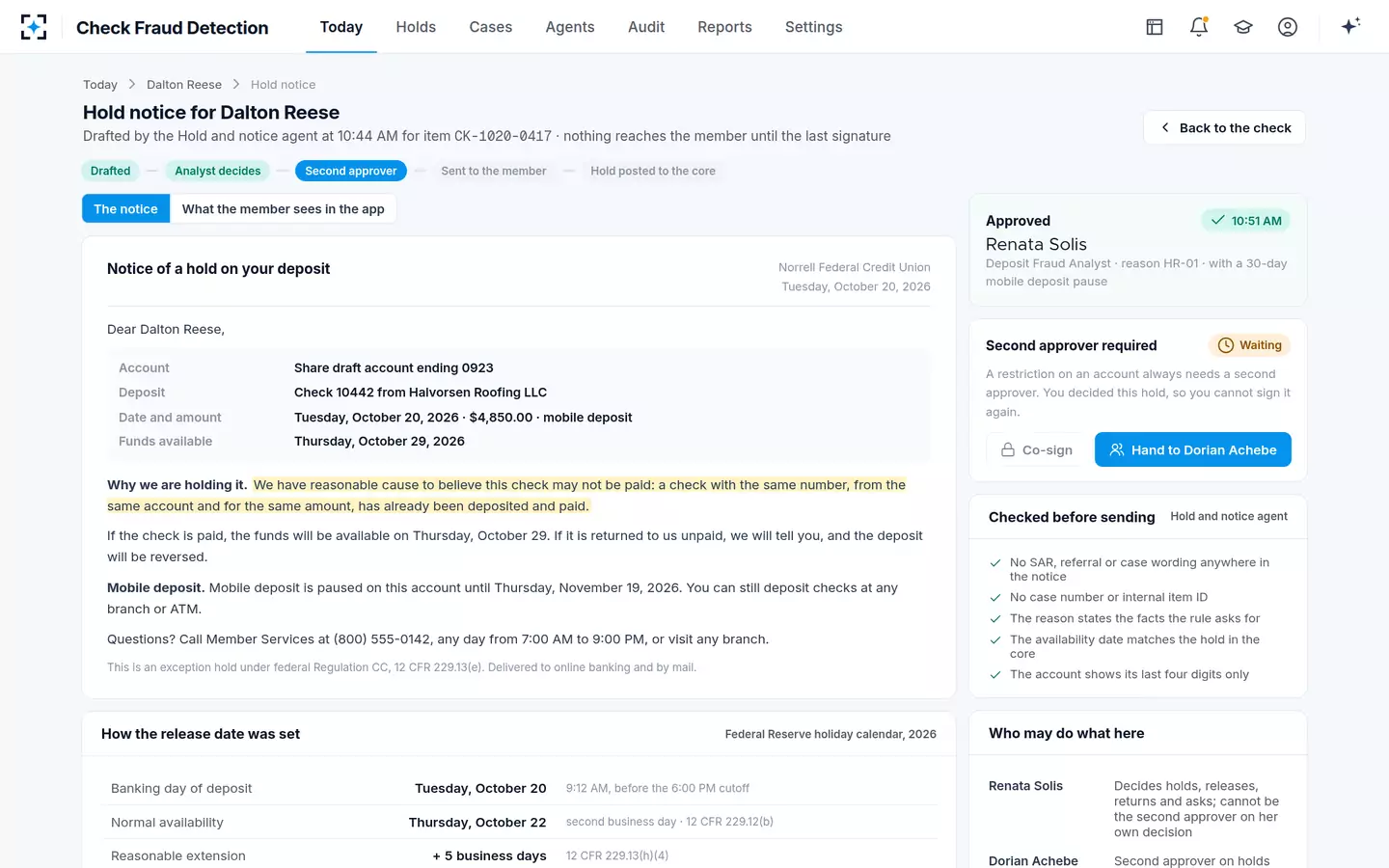
The notice can also cost fee income if it arrives late. If the bank does not give written notice at the time of deposit and the check is later paid, it may not charge overdraft or returned-check fees caused by the delay, unless the notice tells the depositor they may be entitled to a refund and how to get one, and the bank refunds on request (229.13(e)(2)). The model notice carries that paragraph in brackets for exactly this case.
Writing the reason: weak and strong sentences of facts
The reason is the hold's weakest point in most files, because it is written last, in a hurry, from a list. A strong reason names a fact about this check that the depositor can recognise and the bank can prove; a weak one names a category or a feeling.
The same hold, explained two ways
A reason that will not stand: "Suspicious item."
A reason built from facts: "A check with the same number, from the same account and for the same amount, has already been deposited and paid."
A reason that will not stand: "Check flagged by our fraud system."
A reason built from facts: "The amount in words does not match the amount in figures."
A reason that will not stand: "Unusual activity on your account."
A reason built from facts: "There are apparent alterations on the payee line."
A reason that will not stand: "Funds may be at risk."
A reason built from facts: "The paying bank told us on October 20 that the account the check is drawn on is closed."
A reason that will not stand: "New accounts are subject to holds."
A reason built from facts: Use the new-account exception and say so; reasonable cause needs a fact about the check.
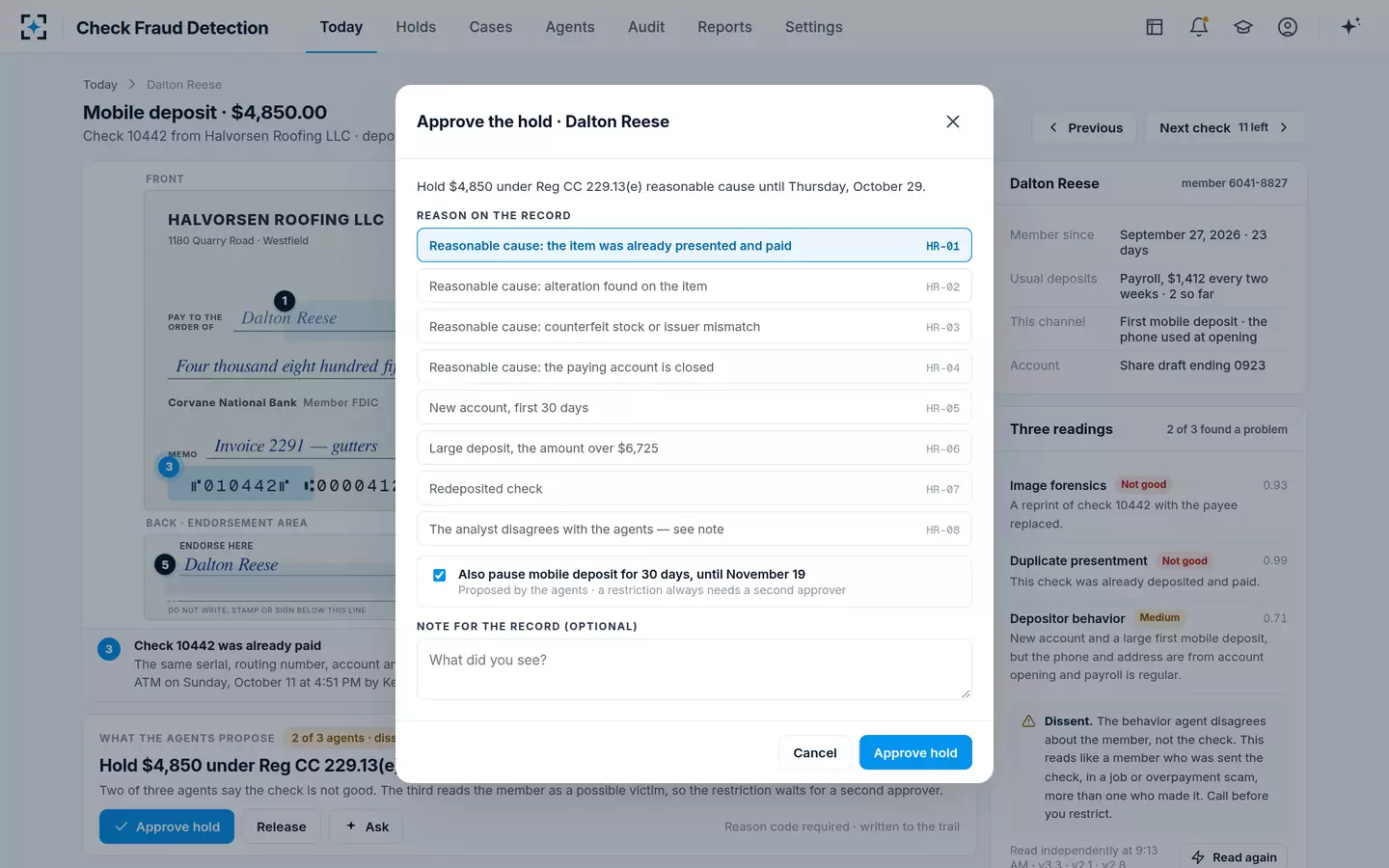
In the solution, the hold and notice agent drafts the reason from the agents' findings, and a pre-send check confirms four things before a person sends it: no SAR, referral or case wording; no case number or internal item ID; a reason that "states the facts the rule asks for"; and a date that matches the hold in the core. The analyst picks one of eight reason codes, including one for disagreeing with the agents, and the brief statement of facts is kept with the notice. Why a person, not the software, has to own that belief is set out in AI check fraud detection: inside the image forensics agent.
The analyst chooses the reason that will stay with the hold
What records must a bank keep for an exception hold?
A copy of every reasonable-cause notice, with a brief statement of the facts, for at least two years. The commentary explains how much is enough: "In many cases, such as where the exception was invoked on the basis of a notice of nonpayment received, the record requirement may be met by retaining a copy of the notice sent to the customer. In other cases, such as where the exception was invoked on the basis of confidential information, a further description to the facts, such as insolvency of drawer, should be included" (Reg CC commentary, 229.13(g)).
For image-based fraud findings the copy of the notice is rarely enough, because the notice deliberately says less than the file knows. The useful file holds the image regions, the archive items compared, the confidence of each finding, the reason code, both signatures and the notice as sent. The solution keeps decisions, images and notices for the institution's chosen period, seven years in the sample, never less than the five years Bank Secrecy Act records require. A file built that way also answers the duplicate case set out in what is duplicate presentment, where the other bank may ask for it.
Did the 2025 payments fraud RFI change Reg CC holds?
No. The June 2025 request for information from the OCC, the Federal Reserve and the FDIC said plainly that "the Board is not proposing any changes to Regulation CC at this time", and asked: "Is this exception effective in allowing depository institutions to mitigate check fraud while also allowing timely access to funds? Would depository institutions benefit from further clarification on when it may be appropriate to invoke this exception?" (90 FR 26293). Comments closed on September 18, 2025; in November 2025 the Federal Reserve said "The agencies are assessing comments" (FR Doc. 2025-19942). No rule or guidance had followed in the Federal Register by October 26, 2026.
Two other threads run alongside. The RFI notes that in October 2024 a petitioner asked the Board and the CFPB to shorten maximum hold times, and the Board treats it as a consideration in the RFI. And the dollar thresholds did change, on schedule: the new-account, large-deposit and repeated-overdraft amounts rose to $6,725 on July 1, 2025, with the next adjustment due on July 1, 2030 (12 CFR 229.11; final rule, May 2024). The reasonable-cause test itself has not moved. What the RFI's questions signal is that its use, and its effect on depositors, are being watched; the cost side of that is in check fraud losses in 2025, and the cost of a wrong hold. To see a reasonable-cause hold drafted, signed and sent on one sample deposit, start from Check Fraud Detection.
Questions people ask
What is the reasonable cause to doubt collectibility time frame?
Up to five business days beyond the normal schedule for a local check, which since 2010 means every check; one business day for a check drawn on the same bank and deposited at its branch; six for a deposit at a nonproprietary ATM. A local check normally available on the second business day can therefore be held to the seventh. Longer is possible only if the bank can show it is reasonable.
Is a reasonable cause hold the same as a large deposit hold?
No. The large-deposit exception covers the amount of a day's check deposits above $6,725, whatever the checks look like, and needs no suspicion. Reasonable cause needs facts about a particular check and can apply to the whole amount. Both fall under the same notice section and the same reasonable extension periods.
Can a bank place a reasonable cause hold after the funds were already available?
A hold can be placed or extended when the facts become known after the deposit, and the notice is then due by the first business day after the bank learns them. The commentary treats a bank as knowing the facts when they reach the people responsible for the decision, or would have with due diligence. Funds already withdrawn are a recovery question, not a hold.
Does a reasonable cause hold require a SAR?
No. The hold is a funds-availability decision under Reg CC; a SAR is a separate Bank Secrecy Act decision with its own thresholds and 30-day clock. The two must also stay apart in writing: the hold notice may never mention a SAR or anything that would reveal one.
Can the reason on the notice be "confidential information"?
Yes. The model notice includes "We have confidential information that indicates that the check may not be paid", and the commentary's examples include suspected kiting and a drawer's insolvency. The bank's own file must then describe the facts more fully than the notice does.