Check fraud losses in 2025 cannot be stated as one national number, because no government source publishes one. What the public data do say is sharp enough for a budget: in the Federal Reserve's risk officer survey fielded in late 2025, 63% of financial institutions reported check fraud attempts and 31% of those reported losses, and FinCEN's last detailed count found $688 million in actual and attempted mail theft-related check fraud in six months of 2023. The harder number is the one each institution has to build itself, because check fraud costs on two sides: the altered or counterfeit check that is paid and charged back to the bank of deposit, and the hold placed on a good check, which costs analyst time, a Reg CC notice, a branch conversation and sometimes a fee refund. Botminds' Check Fraud Detection is designed to count both, per check, from the moment an item is flagged to the moment its money moves.
Where this page uses the solution's figures, they are its sample data on a fictional credit union, Norrell Federal Credit Union, or the solution's own estimates, and are labelled as such.
How much do banks lose to check fraud in 2025?
Nobody outside each institution knows the total, and the agencies say so. Their 2025 request for information on payments fraud concedes that payments fraud data, from the value and volume of fraudulent payments to the industry's negative lists, is gathered piecemeal, without a common standard and with gaps (the new account fraud statistics guide quotes the passage; OCC, Federal Reserve and FDIC, 90 FR 26293, June 2025). A loss figure quoted for 2025 without a source is an estimate, usually a vendor's.
The best current read is the share of institutions affected. The Federal Reserve Financial Services Risk Officer Survey, fielded in the fourth quarter of 2025 with 403 responses, found check fraud "the second most-frequently reported type of fraud", behind debit cards.
Check fraud in the Federal Reserve's 2025 risk officer survey
63%
of institutions reported check fraud attempts
31%
of those reported losses from it
32%
reported counterfeit checks increasing
±6%
margin of error; the survey says it is not independent academic research
FinCEN's counts give the scale of what is reported. In the six months after its February 2023 alert, institutions filed 15,417 reports on mail theft-related check fraud "associated with more than $688 million in transactions, which may include both actual and attempted transactions" (FinCEN Financial Trend Analysis, 2024). FinCEN warns that the amounts may include duplicates, both sides of transfers, typos and attempts that never paid. Read it as reported exposure, not losses booked.
The typical report is not small. Across those filings the average activity amount was $44,774 and the median $14,215: a few very large items pull the average far above the middle, so a program sized on the average will misjudge most of its cases.
Is check fraud increasing in 2025?
Attempts are still rising at many institutions, while losses have levelled at some. The survey reports that check fraud "continued its multi-year resurgence, with significant reported increases in counterfeit checks, check washing, forgery and physical alteration", and that 32% of institutions saw counterfeiting increase, 21% check washing and 18% payee forgery. In the same survey, the share of payments fraud losses attributed to checks "decreased by 2% compared to the previous year" (FRFS, 2026).
The reported series all point the same way over a longer run. Check fraud SARs rose 23% from 2020 to 2021, to more than 350,000, and then nearly doubled in 2022 to more than 680,000 (FinCEN Alert FIN-2023-Alert003). FinCEN reports that check fraud accounted for about 30% of fraud-related SARs filed in 2023, and SARs on check, ACH and wire fraud together rose 489% between 2014 and 2024 (90 FR 26293).
Every public series on check fraud has climbed, most of all the reports
For 2024 the public picture is the same gap: counts and shares, no national loss total from a government source. Anyone who needs a 2025 loss number for a board should build it from the institution's own charge-offs, recoveries and holds, which is the subject of the rest of this page.
Who pays for check fraud losses?
The loss usually lands on whichever bank the rules say was best placed to stop the item, and for an altered check that is typically the bank of first deposit. The Federal Reserve Bank of Atlanta summarises the principle: if the crime goes unsolved, "the cost falls on the entity that was in the best position to halt the transaction, whether that entity was the customer, the bank on which the check was drawn, or the bank where the check was presented" (Federal Reserve Bank of Atlanta, July 2025). FinCEN's analysis adds that mail theft-related check fraud can "negatively impact financial institutions that typically cover check fraud losses".
Where a check fraud loss usually comes to rest, by type
| What happened to the check | Who usually carries the loss | Why, in one line |
|---|---|---|
| Altered: payee or amount changed on a genuine check | The bank of first deposit | Each bank that presents a check warrants to the paying bank that it has not been altered |
| Counterfeit or forged drawer signature | Often the paying bank | Presenting banks warrant only that they do not know the signature is unauthorized |
| The same check paid twice, one deposit by mobile | The bank that took the image, by indemnity | Reg CC gives the bank that took the paper original a claim against it |
| The drawer's own carelessness contributed | Shared with the drawer | Negligence that substantially contributes can shift part of the loss |
| The bank of deposit released the funds and cannot charge back | The bank of deposit | The money has left; its claim is against a customer who may have nothing |
The table is simplified on purpose; the detail, with the statutory text, is in counterfeit check vs altered check: two frauds, two kinds of evidence. Its practical message for a depositary institution is blunt: on the most common type, the altered check, the screening it does on its own deposits is the screening that protects its own money.
The rules do not end the argument. The agencies' 2025 RFI records that supervised institutions have complained to the agencies about how hard it is to settle disputes over who bears the loss on allegedly fraudulent checks, and asks whether Reg CC should change to help (90 FR 26293). A bank that has the image, the finding and the date of each step in one file is better placed in that dispute than one that rebuilds it from four systems.
How many check fraud SARs are filed?
More than 680,000 check fraud SARs were filed in 2022, the latest annual count in FinCEN's check fraud publications, and check fraud made up about 30% of fraud-related SARs in 2023. Those counts drive work as well as statistics: each SAR is a referral someone reviewed, a narrative someone wrote and supporting documentation someone kept for five years.
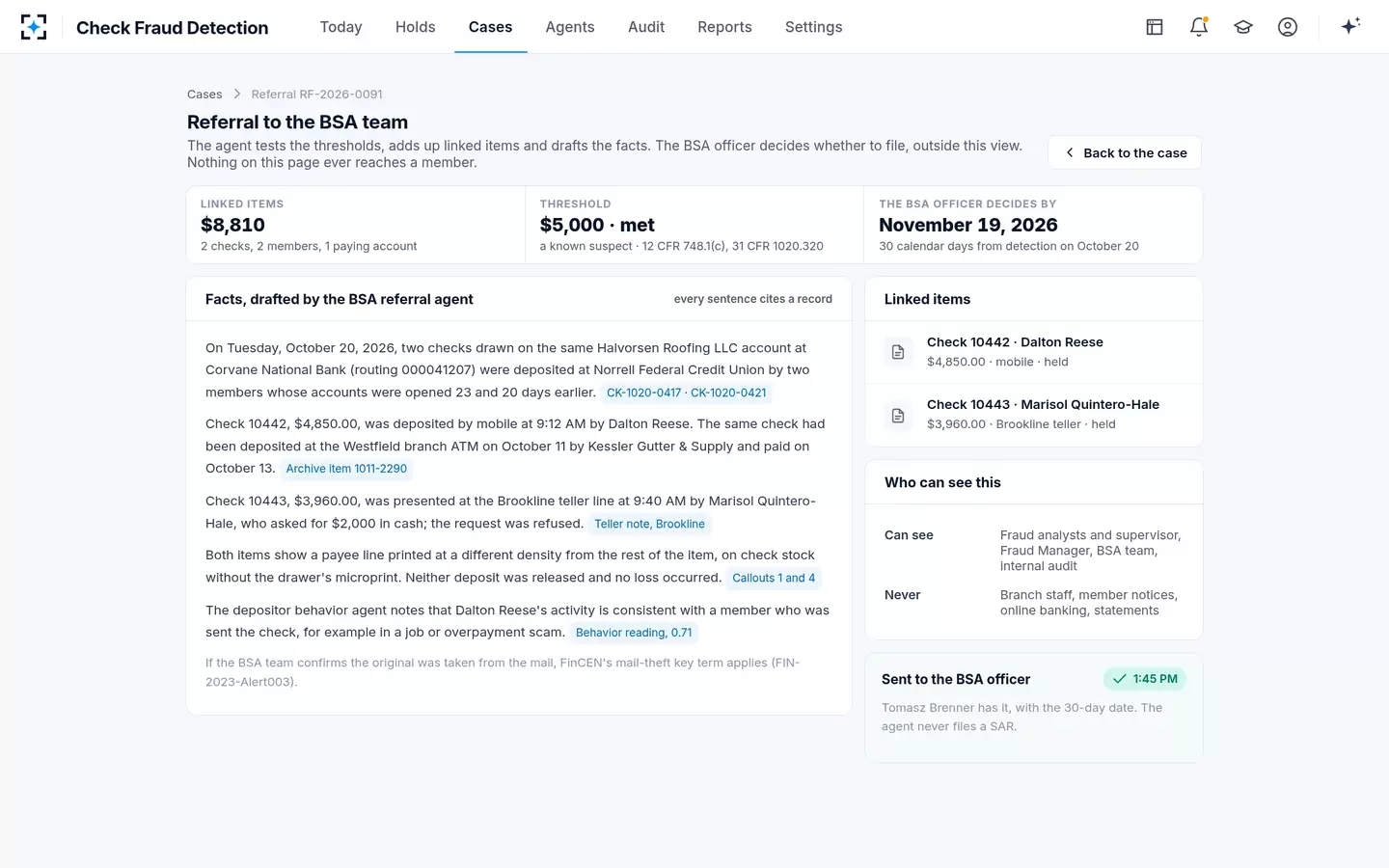
The thresholds that decide which check frauds become SARs are old and fixed. For banks the OCC's rule, with parallel rules at the other agencies, requires a report on insider abuse of any amount, on violations of $5,000 or more where a suspect can be identified, and on $25,000 or more regardless of a suspect (12 CFR 21.11(c)). In the sample, two linked checks totalling $8,810 crossed the $5,000 line with a known depositor, so the solution's referral agent drafted the facts for the BSA officer, who decides by November 19, 30 calendar days after detection; it never files.
A referral to the BSA team: thresholds, linked items and the clock
What does a check hold cost a bank?
A hold costs the minutes of the person who decided it, the notice Reg CC requires, the branch conversation that usually follows, and, on a good check, the goodwill of a member who did nothing wrong. Most of the cost is people's time, and most of that time is spent before the decision, gathering what the decision needs.
Where a flagged check's working minutes go, by hand and with Check Fraud Detection's agents reading
By hand · about 31 minutes
- Reading the image · 19%
- Searching each channel · 26%
- Member history · 13%
- Deciding · 10%
- Notice and date · 19%
- Second signature · 13%
With the agents · about 7.5 minutes
- Reading findings · 13%
- Search · 7%
- History · 13%
- Deciding · 33%
- Notice · 13%
- Signature · 20%
Put a price on those minutes with public wage data and the order of magnitude is clear. O*NET shows a median of $38.99 an hour for the occupational group that includes fraud examiners and analysts; BLS does not publish fraud analysts separately, so the figure is for the broader "Financial Specialists, All Other" group (O*NET 13-2099.04). At that rate, 31 minutes is about $20 of wages for one flagged check and 7.5 minutes about $5, before benefits and overhead; that is our arithmetic, not a measured cost.
The notice carries its own exposure. If a reasonable-cause hold is placed without written notice at the time of deposit and the check is then paid, Reg CC bars overdraft and returned-check fees caused by the delay, unless the notice told the depositor they "may be entitled to a refund" and the bank refunds on request (12 CFR 229.13(e)(2)). On a good check, that is revenue the hold gives back.
Counting both sides: a missed check and a wrong hold
A check program's economics are two-sided, and both sides have to be counted per check, not per alert. An alert cleared before the availability run costs minutes; a hold on a good check costs minutes, a notice and a member; a missed fraud costs the face amount, less whatever can be recovered.
The cost of a check fraud program, per flagged check, as a sum
Fraud that gets through
fraud items × average amount × share released before a decision − recoveries
The sample month: 61 confirmed frauds, $176,400 attempted, about $2,890 each.
Fraud Manager and finance
Holds on good checks
good items held × (review + notice + branch time + fee refunds)
The sample month: 674 holds on checks later paid in full, 92% of all holds.
Deposit operations
Review time on every flag
flagged items × minutes each × loaded cost per minute
Our estimate: about 31 minutes by hand, 7.5 with agents reading and drafting.
Fraud operations
Fraud stopped before release
fraud items held × amount
In the sample case, $4,850 held, confirmed counterfeit, loss $0.
Measured per case
The sample month shows why both sides matter. Holding 674 good checks to stop 61 frauds is about eleven wrong holds per catch. The solution's tuning agent found that 212 of those good-item holds rested on a single image finding, and proposed a change that, backtested on the same month, would have avoided 118 of them without releasing any of the 61 frauds. A backtest on the month it was designed from flatters the change, as the planted-check test explains, but it shows where the money in a program sits: in the holds that did not need to happen.
What the regulators are asking about wrongful holds
The agencies are asking the depositor's question as well as the bank's. Their 2025 RFI asks whether the reasonable-cause exception works, and then: "What are the experiences of businesses and consumers when depository institutions invoke this exception in order to delay the availability of depositors' funds?" (90 FR 26293). The Federal Reserve said in November 2025 that the agencies were assessing the comments; no rule had followed in the Federal Register by October 26, 2026.
That question is why a hold's reason is part of its cost. A hold whose notice states a fact the member can understand, and which the institution can show it believed, is defensible in a complaint and in an exam. A hold whose reason is "suspicious item" is a cost that may have to be justified twice. What the reason has to contain is set out in what a reasonable cause exception hold needs.
Counting per check, from flag to money
The useful unit for check fraud economics is the check, followed from flag to the moment its money moves. In the solution every confirmed fraud becomes a case that records three amounts: attempted, lost and prevented, with the reversal or warranty claim and the general ledger entry the loss and recovery agent drafts, all posted only with two signatures.
A confirmed counterfeit, counted as attempted, lost and prevented
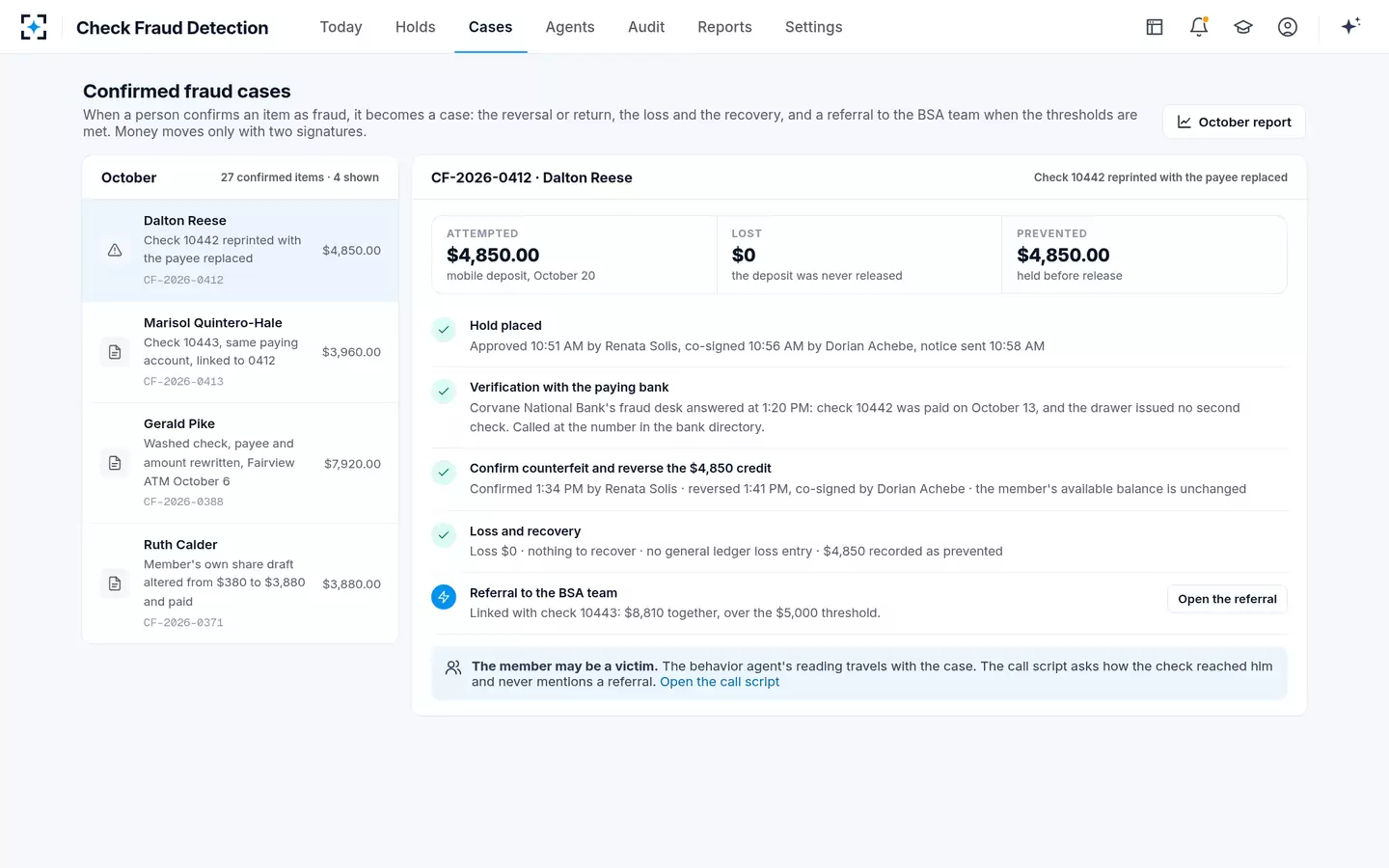
Counted this way, a month answers the board's questions directly: how many dollars were attempted, how many were stopped before release, how many left and were recovered, and how many good checks were held to get there. The October sample shows 27 confirmed items, one of them a member's own share draft altered from $380 to $3,880 and paid, the kind of loss that comes back through a warranty claim. To follow one deposit from flag to case, start from Check Fraud Detection.
Questions people ask
What were check fraud losses in 2024?
No government agency publishes a national 2024 total for check fraud losses. The agencies themselves describe payments fraud data as incomplete and fragmented. What is published are counts, such as SAR filings, and survey shares, such as the 31% of attacked institutions reporting losses in the survey fielded at the end of 2025.
Does the bank or the customer pay when a check is altered?
When a genuine check is altered, the paying bank may charge its customer only according to the check's original terms under UCC 4-401(d), so the customer is generally not liable for the alteration; the paying bank then claims against the bank that presented it, which warranted the check was not altered. The customer can lose that protection by failing to review statements promptly or by negligence that contributed to the alteration.
How much check fraud is linked to mail theft?
FinCEN does not publish a share, but its mail-theft key term drew 15,417 reports and more than $688 million in actual and attempted transactions in six months of 2023, from 841 institutions. Banks filed 88% of those reports; FinCEN found that altered checks were the most common outcome of a stolen check.
Do check holds reduce fraud losses?
A hold reduces losses only when it lasts until the institution learns the item is bad. Reg CC lets a reasonable-cause hold extend availability by up to five business days on a local check, and the paying bank must return an unpaid check so it would normally arrive by 2 p.m. on the second business day after presentment. A hold on a good check reduces nothing and costs time.
What share of institutions report check fraud losses?
In the Federal Reserve Financial Services survey fielded in late 2025, 63% of institutions reported check fraud attempts and 31% of those reported losses, which is about one in five of all respondents. The survey has a margin of error of plus or minus 6% and describes itself as not independent academic research.