AI check fraud detection reads the image of a deposited check and compares it with what that check should look like: its own fields against each other, the payor's earlier checks and stock in the institution's archive, and every other time the same item has been presented. Done well, it reports each anomaly as a finding pinned to the region where it was found, with a confidence and the source it compared against, and it leaves the hold to a person. That is how the image forensics agent in Botminds' Check Fraud Detection works. It reads ink and toner density, washing, the amount fields, stock and microprint, the MICR line and the endorsement; below its confidence floor it shows a finding as a question rather than a callout; and it never places a hold, because a Reg CC exception hold needs a reason a person can stand behind in the notice.
The worked example is a fictional sample: one $4,850 mobile deposit at Norrell Federal Credit Union on Tuesday, October 20, as it runs through the solution.
How does AI detect check fraud?
AI detects check fraud by comparison, not by recognising "fraud" in the abstract. Three comparisons do most of the work. The first is the item against itself: does the written amount agree with the figure in the box, is one line printed or inked differently from the others. The second is the item against the payor: does it match the stock, layout, signature line and MICR encoding of that account's earlier checks. The third is the item against every other presentment: has this serial, routing number, account and amount already been deposited somewhere in the institution.
Remote deposit is why the comparison has to be done by software at all. The FFIEC warned as early as 2009 that "Check alteration, including making unwarranted changes to the Magnetic Ink Character Recognition (MICR) line on the image of scanned items, may be more difficult to detect when deposited items are received through RDC and are not inspected by a qualified person" (FFIEC, Risk Management of Remote Deposit Capture, 2009). Most deposits now arrive exactly that way.
Institutions have drawn the same conclusion. In the Federal Reserve Financial Services Risk Officer Survey fielded in late 2025, respondents put AI analysis of check images, looking for alterations and anomalies, first among their own solutions for check fraud losses (FRFS Risk Officer Survey, 2026); the guide to replaying check image analysis on closed claims gives the full list. The survey calls itself "not independent academic research", with a margin of error of plus or minus 6%; it records what peers are doing, not whether it works.
One check, five findings: what the image forensics agent pins
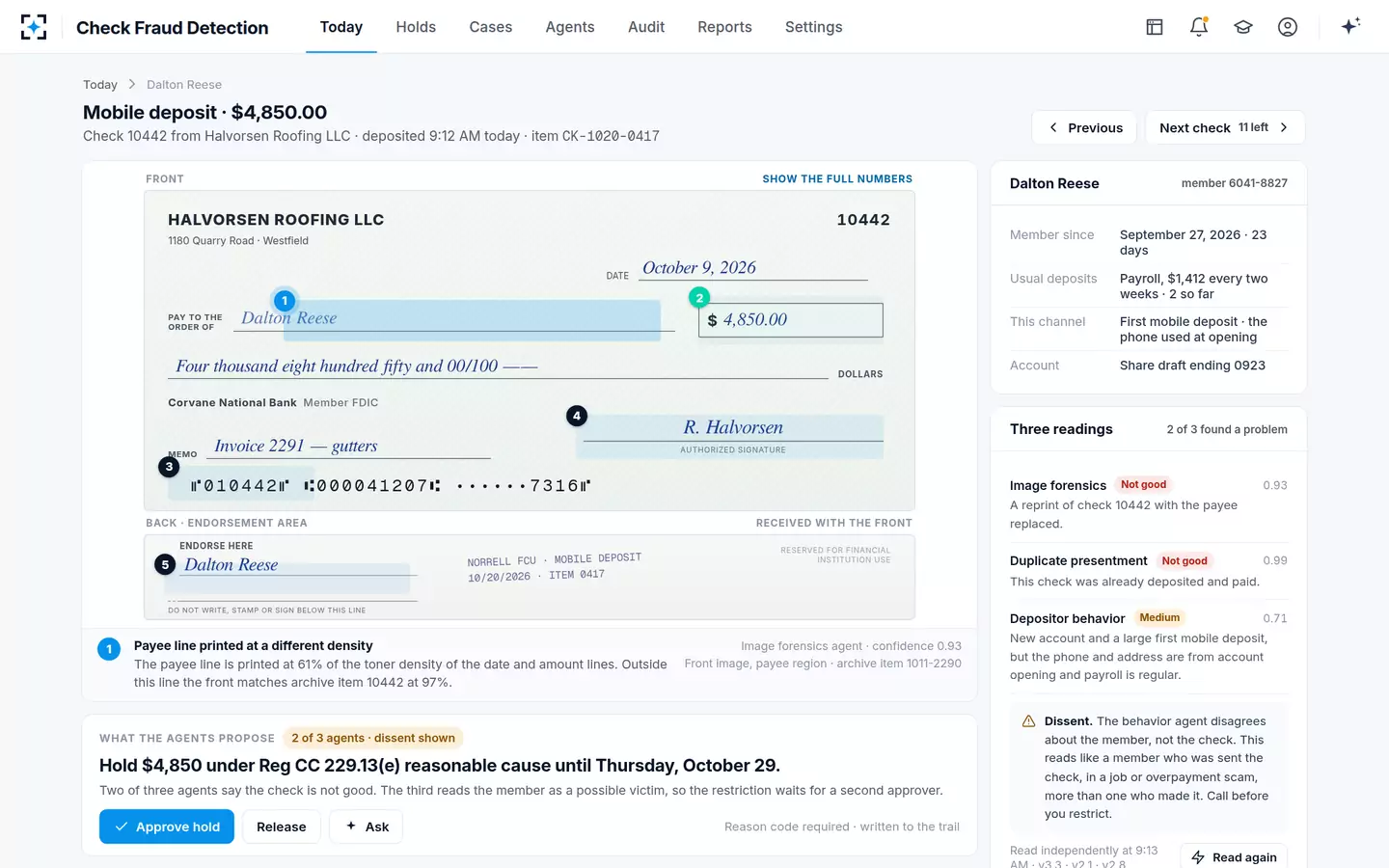
The agent's output is not a score; it is a set of findings, each pinned to a region of the image. On the sample $4,850 check, five regions carry a callout: the payee line, the amount field, the MICR serial, the signature line and the endorsement. Three of them disagree with the archive; two read clean, and saying so is part of the evidence.
One sample check, five pinned findings: where each was found, how sure, and against what
- 10.93
Payee line Image forensics
Printed at 61% of the toner density of the date and amount lines, while the rest of the front matches the archive original at 97%.
Front image, payee region; archive item 1011-2290
- 2agrees
Amount field Image forensics
Courtesy box and written line agree at $4,850.00, and both match the archive original.
Front image; archive item 1011-2290
- 30.99
MICR serial Duplicate presentment
Serial, routing number, account and amount already deposited at a Westfield branch ATM on October 11 and paid on October 13.
Item archive, all four channels, seven years
- 4differs
Signature line Image forensics
A plain printed line where the archive original carries microprint.
Front image; archive item 1011-2290
- 5read
Endorsement Image forensics
Back received with the front; endorsed in the depositor's name with the credit union's mobile-deposit stamp.
Back image
Read together, the findings tell a story a score cannot. The payee line was reprinted at a different density on an otherwise faithful copy; the signature line lacks the microprint the genuine stock carries; and the same serial, account and amount were paid a week earlier to a different payee. That is a counterfeit made from a genuine check, not an altered one, and the classification matters for what happens next.
The screen puts the check itself at the centre, front above back, with the callouts on it and one proposed action underneath. Beside it sit three independent readings, including one that disagrees.
The check with every finding pinned where it was found
Can AI detect altered checks?
Yes, when the alteration leaves a trace the image keeps. Overwriting leaves density differences between a rewritten line and the untouched ones; FinCEN's own red flag is older, fainter writing showing beneath a darker rewrite on suspect checks (FIN-2023-Alert003). A raised amount often leaves the two amount fields disagreeing. A reprinted or counterfeit item often differs from the payor's stock in layout, microprint or MICR spacing. All three are measurable on a decent image.
The sample day had one of each kind on the list. A county refund deposited by mobile showed $1,275.40 in the box while the written line still read two hundred seventy-five and 40/100. A washed check with its payee and amount rewritten had come through a Fairview ATM on October 6. And the $4,850 item above showed a reprinted payee line on genuine-looking stock. The mechanics of the second kind are in how checks are washed, and what still shows on the image.
What AI cannot do is read what the image does not carry. Some security features do not survive a phone camera, and a check that arrives with one side missing cannot be judged at all. The agent's limit is written into its definition: it never judges an item without both sides of the image. On the sample day an ATM deposit of $612 arrived front only; the solution held it for the image and did not read it.
Below its confidence floor, the agent asks
Every finding carries a confidence, and below a floor the agent shows it as a question to the analyst rather than as a callout on the check. The floor is a policy setting owned by the Fraud Manager: 0.80 in the sample, adjustable from 0.60 to 0.95 in steps of 0.05, versioned and written to the audit trail. A finding at 0.74 is not hidden; it is presented as something to look at, not something the agents assert.
The floor is where accuracy and workload trade. In the sample's September review, 735 checks were held and 61 turned out to be fraud; the other 674 holds landed on good items. The tuning agent counted which single finding had led to each good-item hold, and one stood out.
Where a month of holds on good checks came from: one finding alone caused the most
The tuning agent's proposal followed from the bar: when payee density is the only finding on an item, raise its floor from 0.80 to 0.85 and show it as a question instead of a callout. Backtested on September, the change would have avoided 118 holds on good items and missed none of the 61 confirmed frauds, because every one of the nine frauds with a payee finding also had a second finding. The agent proposed it; only the Fraud Manager can sign it, as a new version, from November 1.
That backtest ran on the same month the change was designed from, so it flatters the change. It is the right first look and the wrong final proof; the stronger test is one built from planted alterations, set out in check fraud detection tools, tested with planted altered checks.
Can AI place a hold on a check?
It should not, and in Check Fraud Detection it cannot. The reasonable-cause exception in Regulation CC turns on facts that would persuade a reasonable person, and it requires the bank to state its reason in the notice it sends the depositor. A finding with a confidence is evidence for that reason; it is not the reason, and it is not a person's belief. The full test, and what the notice has to say, is in what a reasonable cause exception hold needs.
The enforcement history points the same way. In 2022 the CFPB found that Bank of America had acted unfairly when it turned down prepaid cardholders' error notices and froze their accounts on nothing more than the output of a fraud filter the Bureau called flawed, and ordered a $100 million penalty, beside a separate $125 million OCC fine (CFPB, Bank of America, N.A., 2022). The case was about card disputes, not checks, but the principle travels: an automated fraud signal that decides on its own becomes the institution's decision, with nobody who can explain it.
Who does what on one flagged check: the agents read and draft, people decide and sign
Agent
Image forensics agentReads front and back against the payor's archived checks and pins each finding with its confidence and source.
Never: judges an item without both sides, or shows a finding below its floor as a callout.
Agent
Duplicate presentment agentSearches the institution's own archive across teller, ATM, mobile and business remote deposit for the same item.
Never: closes a duplicate on the serial alone.
Agent
Depositor behavior agentReads account age, history, channel and device, and says when the member reads as a victim rather than a maker.
Never: calls a member a suspect on any screen a member can see.
Agent
Hold and notice agentProposes the Reg CC exception, counts the release date and drafts the notice with the stated reason.
Never: places a hold or sends a notice.
A person decides
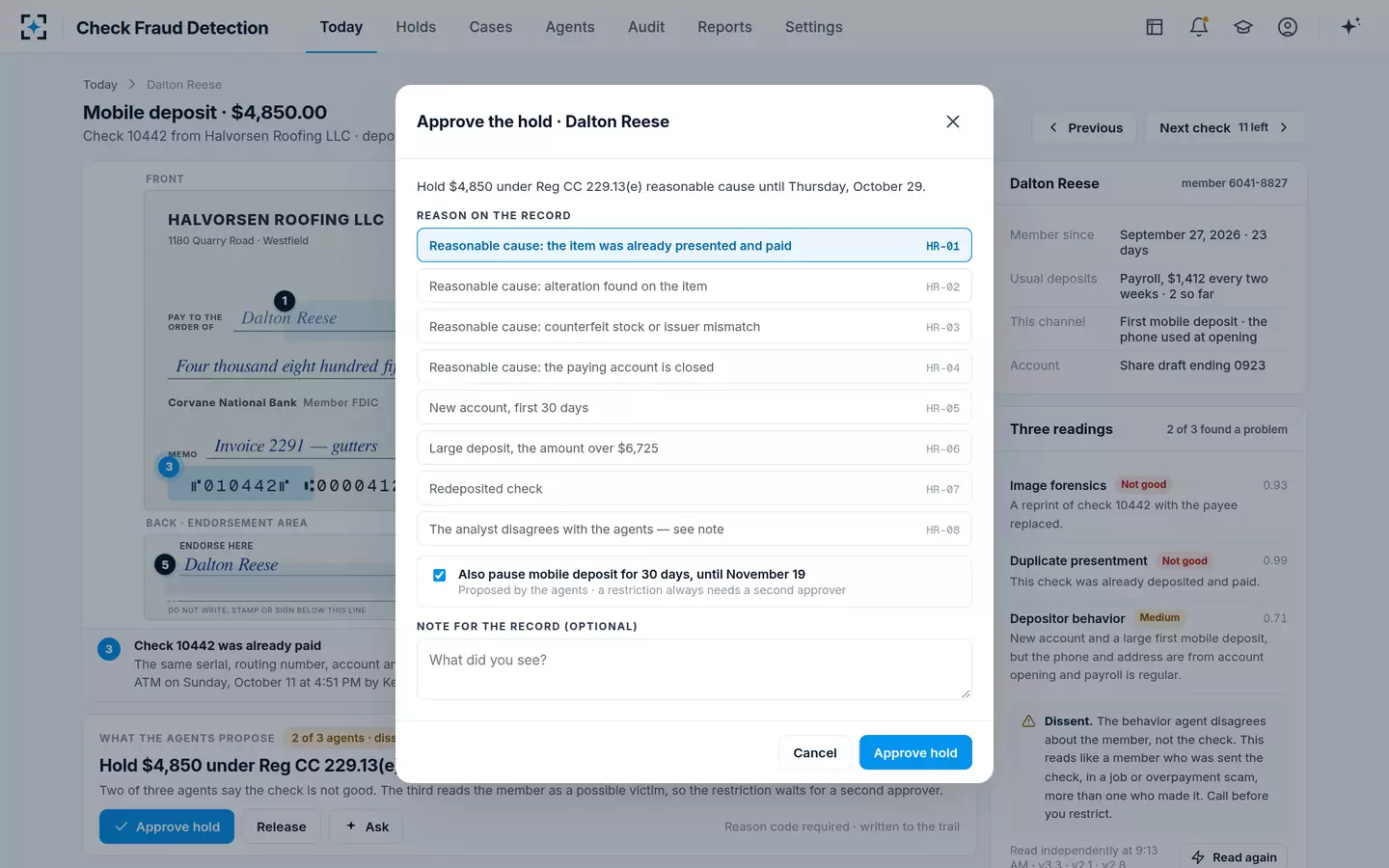
Deposit fraud analystApproves, releases with a reason, returns or asks; picks the reason code that stays with the hold.
A person decides
Fraud operations supervisorCo-signs holds over $5,000 and every restriction; cannot sign a decision of their own.
Is check fraud AI a model under model risk guidance?
A statistical image classifier fits the regulators' definition of a model; a generative or agentic AI system is, for now, outside the guidance altogether. The revised interagency guidance issued on April 17, 2026 defines a model as a quantitative method that turns input data into estimates by applying statistical, economic or financial theory, and leaves out fixed rule-based software with no such theory behind it (the behavioral biometrics guide quotes both definitions; OCC Bulletin 2026-13; the Federal Reserve's parallel letter is SR 26-2).
The same guidance then sets newer systems aside: because generative and agentic AI are new and changing fast, it places them outside its scope altogether. The agencies said they would issue a request for information on AI in model risk management; as of October 26, 2026 it had not appeared. The guidance also says it will be most relevant to organisations with more than $30 billion in assets, which leaves most community banks and credit unions reading it as good practice rather than an expectation.
Out of scope is not out of governance. A check tool that influences holds on members' money still needs what the guidance asks of any model: a documented purpose, testing before use, monitoring of outcomes and a named owner of every change. In the solution, each item keeps the agent versions it was read with, the Fraud Manager sets the floors and the eight hold codes, and a threshold moves only when the Fraud Manager signs a new version after the monthly review.
What a pinned finding gives the analyst that a score does not
A score says how worried to be; a pinned finding says what to look at, where, and why. The difference shows up in three places: the analyst's time, the notice the member receives, and the file an examiner reads.
A fraud score vs a pinned finding, on the same flagged check
A score on the item: One number on the engine's scale, for the whole item.
Findings pinned on the image: Payee line reprinted at 61% density; serial already paid on October 13; no microprint on the signature line.
A score on the item: Anywhere: the analyst opens the image and starts from the top.
Findings pinned on the image: At the numbered region, with the archive original one click away.
A score on the item: Rarely stated.
Findings pinned on the image: Named: archive item 1011-2290, the payor's stock, the four channels searched.
A score on the item: Averaged into the number.
Findings pinned on the image: Shown: two agents say not good, one says the member may be a victim.
A score on the item: Has to be written from scratch.
Findings pinned on the image: Drafted from the findings in words the member can read.
A score on the item: A score and a decision.
Findings pinned on the image: Each finding, its source, the agent version and both signatures.
The disagreement row is the one most tools hide. The sample's depositor behavior agent rated the member medium, not high, and wrote why: a 23-day member whose phone and address match account opening and whose payroll is regular, who "reads like a member who was sent the check, in a job or overpayment scam, more than one who made it." The coordinator never averages a dissent away, so the analyst calls before restricting the account.
How accurate is AI check fraud detection?
Nobody can answer that for your institution from published data. There is no independent public benchmark for check-image forensics, and peer-reviewed work on it is thin. Accuracy depends on your deposit mix, your image quality, how much of each payor's history sits in your archive, and where you set the floors, so it has to be measured on your own checks.
The clearest public result is the government's own. Treasury reported that in fiscal year 2024 "Expediting the identification of Treasury check fraud with machine learning AI" produced "$1 billion in recovery" (U.S. Treasury, October 17, 2024). That is Treasury screening checks it issued itself, with its own issue records to compare against, not a bank screening deposits drawn on thousands of payors; it shows the approach works at scale, not what any vendor's tool will do on a credit union's mobile deposits.
What a buyer can demand is the right measurement: catches and misses by fraud type, holds on good checks per confirmed fraud, and dollars stopped before release. The solution's design target is 90% of attempted check fraud dollars stopped before release; it is a target, to be measured in a live deployment, not a result.
Where AI check screening fits, and where it does not
AI check screening fits between the score and the decision: it turns a flagged item into evidence a person can act on before the availability run. It does not replace the institution's fraud scoring engine, which still decides which items are flagged; it does not replace item processing or the image archive, which it reads; and it does not replace the analyst, who decides.
Three limits deserve plain statement. The archive comparison is only as good as the archive: a payor whose checks have never passed through the institution can be compared with itself and with known stock, but not with its own history. The duplicate search covers the institution's own archive across its channels, not deposits at other banks; that gap, and the Federal Reserve service that partly fills it, are covered in the duplicate presentment guide. And an image is a copy: a feature that does not survive capture cannot be tested on it, which is why the sample credit union can ask a branch to pull a paper original that an ATM captured.
The analyst approves with a reason code the agents cannot choose
Where it does fit, the effect is on minutes and on the notice. The solution's own estimate, kept modest, is that a flagged check takes about 31 working minutes by hand across reading the image, searching channels, reading history, deciding, writing the notice and getting the second signature, and about 7.5 with the agents reading and drafting; the decision itself takes about as long either way. To see the whole flow on the sample deposit, start from Check Fraud Detection; for how it sits beside the systems a deposit team already runs, see check fraud detection software that works beside your image archive.
Questions people ask
Can an ATM detect a fake check?
An ATM captures images of the check; judging whether the item is genuine happens afterwards, in the depositary institution's own screening. That is one reason ATM deposits are popular with fraudsters: FinCEN found perpetrators of mail theft-related check fraud favour ATMs and remote deposit because they avoid bank staff. An ATM that captures the paper original does keep evidence a branch can later examine.
Does AI check fraud detection work on mobile deposits?
Yes, provided both sides of the check arrive as usable images. Mobile deposit is where it matters most: on the sample day 8,770 of 16,480 checks, 53%, came in by phone. Image quality is the constraint; a finding the agent cannot support with enough confidence is shown as a question, not asserted.
What is a confidence floor in check fraud screening?
It is the confidence below which a finding is shown to the analyst as a question rather than marked on the check as a callout. In the sample it is 0.80, set by the Fraud Manager between 0.60 and 0.95. Raising it reduces holds on good checks and risks missing fraud, which is why a change is backtested and signed as a new version.
Can AI read an altered MICR line?
It can compare the MICR line on the image with the encoding on the payor's earlier checks and with the amount and account fields, which is where an altered or reprinted MICR line can show. The FFIEC flagged MICR changes on scanned items as harder to detect without a qualified person's inspection, which is the gap image comparison is meant to close.
Does AI replace the deposit fraud analyst?
No. In the sample the agents flagged 138 of 16,480 checks; 92 cleared on a second look and 46 still needed a person before the 6:00 PM cutoff. The agents shorten each review by doing the reading, searching and drafting; the analyst still decides every flagged check, and a supervisor co-signs the larger holds.