Check fraud detection software for a bank or credit union has one job: get every flagged deposited check to a sound decision, with a reason, before the next availability run. It does not need to replace the systems that already hold the evidence. The check image archive keeps every item from every channel, the remote deposit platform keeps the mobile and business sessions, the core keeps the member and the hold, and positive pay already protects the institution's own business customers on the paying side. Botminds' Check Fraud Detection is built to sit beside all of them: its agents read from those systems, pin findings on the check image, draft the hold and the Reg CC notice, and write the result back only after a named analyst decides and, where policy says so, a second person signs. Go-live changes the analyst's screen and the minutes per check; it does not change item processing, the core's posting rules or the notice process the examiners already know.
The examples come from a fictional sample, Norrell Federal Credit Union, as it runs through the solution on Tuesday, October 20.
What does check fraud detection software do?
It turns a deposited check that something has flagged into a decision someone can defend: hold, release, return or ask, with the reason written down and the member's notice drafted. Most institutions already own the first half of that chain. A fraud scoring engine flags items; an image archive keeps them. What is usually missing is the work between the flag and the decision, and that is where analysts spend their day.
The problem is the number of places the evidence lives. A deposit fraud analyst typically opens a flagged item in the image archive, the core, the remote deposit platform and a case tool, looks for a counterfeit, an alteration, a washed payee or a duplicate across channels, then writes the hold notice and counts the release date around Federal Reserve holidays by hand. Software earns its place by doing that gathering, not by adding a fifth window to it.
The institutions in the Federal Reserve's 2026 risk officer survey describe their own toolkits the same way, as layers rather than one system: image analysis for alterations, positive pay, manual review backed by staff training, and closer monitoring of new accounts (FRFS Risk Officer Survey, 2026). The survey says of itself that it is "not independent academic research", with a margin of plus or minus 6%.
Replace the platform, or add agents beside it?
Add beside it, unless the platform itself is failing. Replacing the image archive or the item-processing chain to get better fraud review is the most expensive route to the smallest change, and it puts the availability run, the institution's most time-critical batch, at risk for a problem that lives upstream of it.
Two ways to get better check fraud review: replace the platform, or put agents beside it
Replace the deposit platform: Item processing, the archive and often the remote deposit front end.
Agents beside the systems you run: The analyst's screen: one item, findings pinned, a drafted decision.
Replace the deposit platform: Re-tested end to end; a cutover weekend.
Agents beside the systems you run: Untouched: holds post to the core as they do today, after signatures.
Replace the deposit platform: Migrated, with years of history to move.
Agents beside the systems you run: Read in place; the sample searched seven years across four channels.
Replace the deposit platform: Often bundled and re-implemented.
Agents beside the systems you run: Kept: it protects your issuing customers on the paying side.
Replace the deposit platform: New templates in a new system.
Agents beside the systems you run: Your templates and reason codes, drafted per item, sent by a person.
Replace the deposit platform: Depends on the vendor's workflow.
Agents beside the systems you run: A named analyst; a second signature over your threshold and on every restriction.
Replace the deposit platform: There is no previous system to return to.
Agents beside the systems you run: Analysts go back to the four windows they use today.
The last row is the one a risk committee should weigh. A tool that sits beside the core and the archive can be switched off without stranding a deposit, and it can be piloted on a slice of items while the old process carries the rest. A replacement cannot.
Does check fraud software replace positive pay?
No. Positive pay and deposit screening protect different money. Positive pay works on the paying side: a business customer tells its bank which checks it issued, and the bank stops presented items that do not match, which the survey's respondents describe as "Positive Pay to stop unauthorized checks from clearing" (FRFS, 2026). Deposit screening works on the receiving side: it reads checks drawn on thousands of other banks, whose issuers' lists the depositary institution never sees.
An institution needs both because the losses fall on both sides. When a genuine check is altered, the presenting bank warrants it was not altered, so the bank of first deposit usually carries the loss; when a counterfeit carries a forged drawer's signature, the paying bank often does. Positive pay helps with the second for the institution's own business customers; deposit screening helps with the first. The detail is in counterfeit check vs altered check.
How does check fraud software connect to the core?
It should read widely and write narrowly. Check Fraud Detection reads from six kinds of system a deposit fraud team already runs, and writes back only three things: a hold or release, a member notice, and, after confirmed fraud, the reversal and the general ledger entries for the loss. Each write waits for a person's decision, and the money-moving ones for two.
Six systems the agents read, and the three things written back after a person decides
| System | What the agents read | What is written back, and who signs |
|---|---|---|
| Core banking system | Member, account age, deposit history, existing holds | The hold or release, after the analyst; over $5,000 and on restrictions, after a second approver too |
| Item processing and check image archive | Every item, front and back, from every channel, and the payor's earlier checks | Nothing |
| Remote deposit capture platform | Mobile and business sessions, devices, the image as captured | Nothing; a deposit pause is posted through the core with two signatures |
| Fraud detection engine | The score on every deposited check, as one input | Nothing |
| Member notice service | Templates and delivery preferences | The Reg CC notice, sent by a person, never by an agent |
| General ledger | Loss and recovery accounts | Reversal, warranty claim and loss entries, posted only with two signatures |
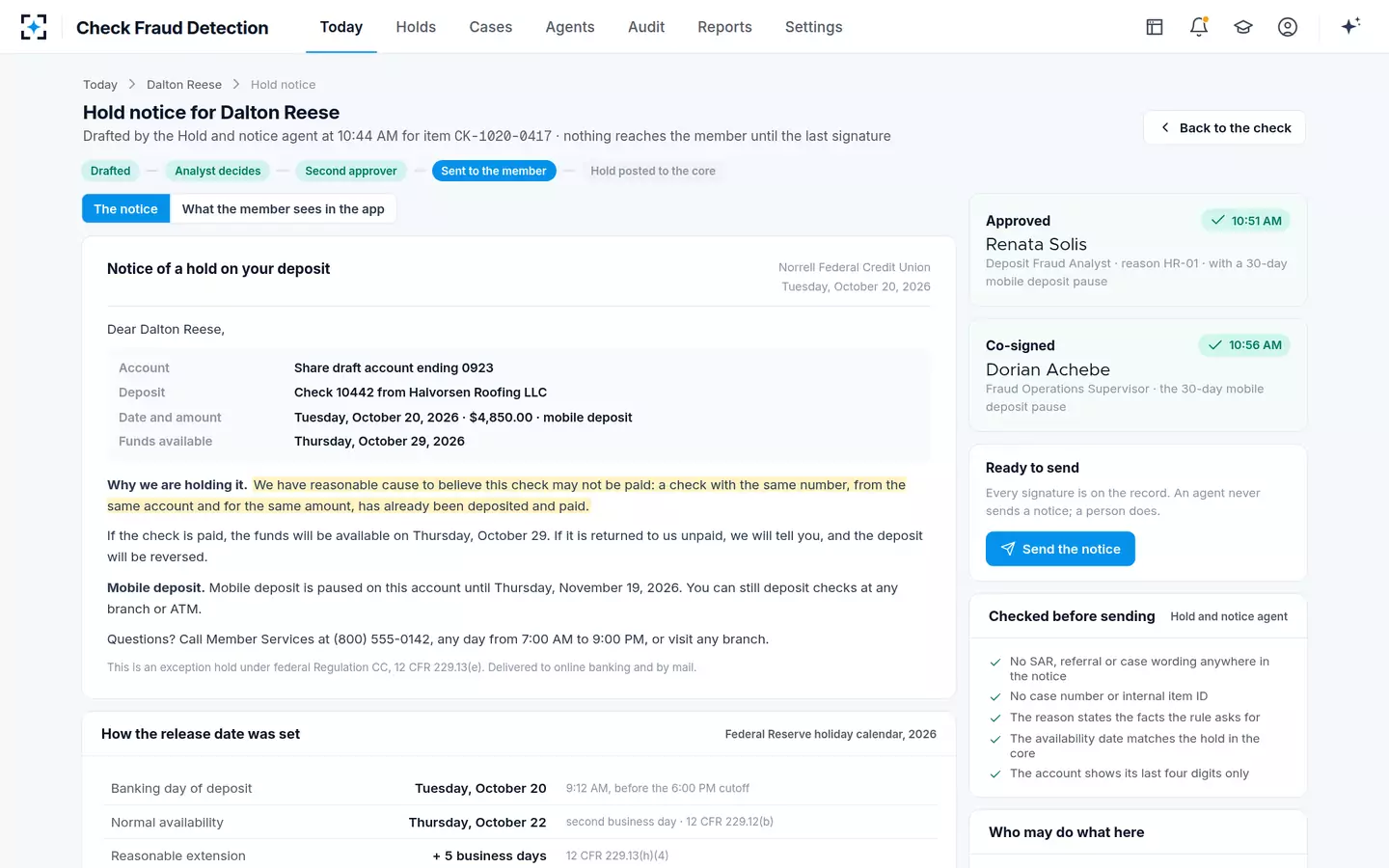
The narrow write path is also the compliance design. Reg CC's notice must state the reason for the exception (12 CFR 229.13(g)), and SAR rules forbid disclosing a report or anything that would reveal one (31 CFR 1020.320(e)). Because the notice is drafted from the findings and checked before anyone sends it, the solution confirms, item by item, that no SAR, referral or case wording and no internal item ID reaches a member.
The drafted notice waits for the last signature before it reaches the member
Can check fraud software read mobile deposits?
It has to, because that is where most checks now arrive. On the sample day, 8,770 of 16,480 checks came in by mobile and 1,560 by business remote deposit, together 63% of the total. FinCEN found that criminals working stolen mail prefer remote deposit and ATMs because no one at the bank handles the item, and Treasury's 2024 money laundering risk assessment names the spread of remote capture among the reasons check fraud has grown (Treasury, 2024 NMLRA).
Reading mobile deposits well means reading the session as well as the image: the device, whether it was used at account opening, the deposit's size against the member's history. The FFIEC's guidance on remote deposit capture already asks for that kind of monitoring: "Reports on duplicate entries (file and/or item recognition and interception) and violations of deposit thresholds may help monitor for unauthorized activities", with velocity metrics such as "transaction dollar value and volume" (FFIEC, Risk Management of Remote Deposit Capture, 2009). Software that reads the remote deposit platform turns those reports into evidence on the item.
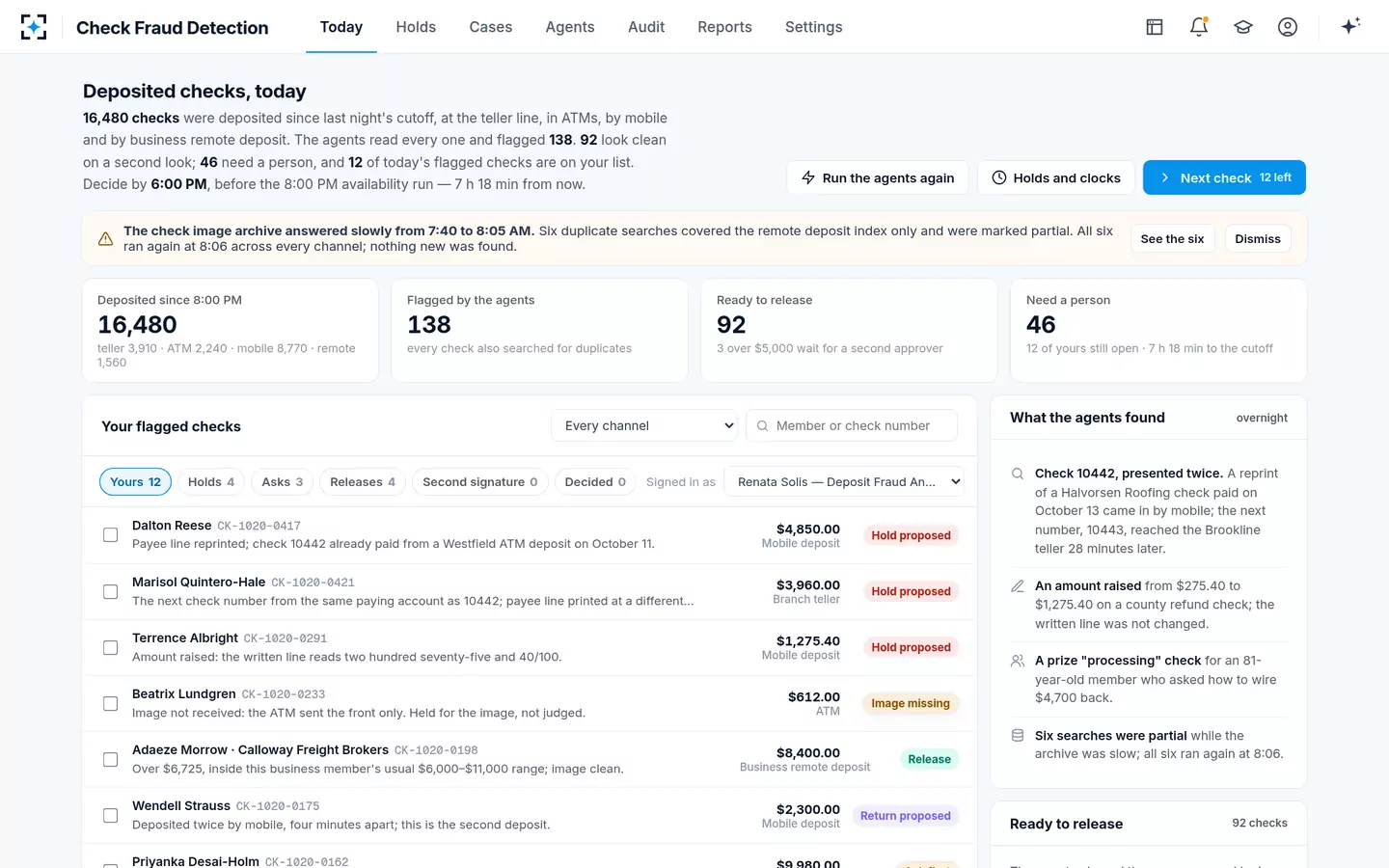
It also has to know when it cannot read. The solution's image agent never judges an item without both sides; on the sample day an ATM deposit arrived front only and was held for the image, not judged. When the archive answered slowly between 7:40 and 8:05 AM, six duplicate searches that covered only the remote deposit index were marked partial and run again at 8:06 across every channel.
What data does check fraud software need?
It needs the images, the archive, the member history, the remote deposit sessions and the score, plus the institution's own rules written down: reason codes, notice templates, thresholds and the holiday calendar. Those inputs come from systems the institution already runs; the rules come from its policy and procedures.
The archive's depth matters most. The duplicate search in the sample covered seven years of items across the teller line, ATMs, mobile and business remote deposit, by serial, routing number, account, amount and image fingerprint. The image comparison needs the payor's earlier checks, which exist in the archive only if they passed through the institution. Neither reaches deposits at other banks. For checks processed by the Reserve Banks, the Federal Reserve's Duplicate Check Notification service "offers banks of first deposit (BOFDs) early notice of potential duplicate checks processed by the Federal Reserve Banks" (Federal Reserve Financial Services); by the Federal Reserve Board's own count, the Reserve Banks handle close to half of all checks (Federal Reserve Board, December 2025). How the two searches fit together is in what is duplicate presentment.
The rules are the institution's settings, versioned and changed only by the Fraud Manager. In the sample: a second approver for holds over $5,000 and for every restriction, return, chargeback and change to a member's file; a 6:00 PM decision cutoff before the 8:00 PM availability run; escalation to the supervisor at 4:00 PM; a reasonable-cause extension of five business days; the 2026 Federal Reserve holiday calendar; an image confidence floor of 0.80; and seven years' retention.
How long does check fraud software take to implement?
The honest answer depends on one thing more than any other: how the agents reach the image archive and the core. Where the archive can be queried in place, the work is configuration of the institution's rules and testing on its own items; where images have to be exported, the export becomes the project. We do not quote a calendar on this page for that reason.
The order of work does not vary much. First, connect read access to the archive, the core, the remote deposit platform and the score. Second, write the institution's reason codes, notice templates, thresholds and holiday calendar into the settings. Third, run a planted-check test on the institution's own cleared items, as set out in check fraud detection tools, tested with planted altered checks. Fourth, run the agents beside the analysts for a period, with analysts deciding as they do today, and compare. Only then switch the analysts' screen.
What does check fraud software cost, and what does it save?
Price depends on volume, channels and connections, and a page cannot quote it honestly. What a buyer can estimate is the time the software gives back, using the institution's own flag counts. The solution's own estimate, kept modest, is about 31 working minutes per flagged check by hand and about 7.5 with agents reading and drafting, with the decision itself taking about as long either way.
One sample day's flagged checks, by hand and with Check Fraud Detection's agents reading
46
flagged checks still needing a person before the 6:00 PM cutoff
23.8 h
of analyst work at about 31 minutes each, by hand
5.8 h
at about 7.5 minutes each, with the agents reading and drafting
The bigger number is usually not time but holds. In the sample's September review, 674 of 735 holds landed on checks later paid in full, and the tuning agent traced 212 of them to a single image finding. Every hold avoided is a notice not sent, a branch call not taken and a member not kept waiting; the economics are set out in check fraud losses in 2025, and the cost of a wrong hold. The solution's design target is 90% of attempted check fraud dollars stopped before release, a target to measure in a live deployment, not a result.
The day in one sentence, then the checks that need a person
What to ask before you buy check fraud software
Ask what it reads, what it writes, who decides, and what you can prove afterwards. A demonstration on the vendor's data answers none of those for your institution.
Questions to put to any check fraud detection software
- Does it read our archive in place, or need our images copied?
The answer decides how long implementation takes and where member data lives.
- What does it write to the core, and after whose signature?
Holds, notices and general ledger entries should wait for a named person; money-moving ones for two.
- Does it read both sides of every image, and say when it cannot?
A missing back is a reason to wait, not a clean result.
- How does it search for duplicates, and across which channels?
Serial alone produces false matches; ask what else must agree.
- Can it draft a Reg CC notice in our wording, with a computed date?
The reason must be the institution's, in words the member can read.
- Will it run on our own planted checks before we sign?
Catches, misses and holds on good items, by fraud type.
- What do we keep if we switch it off?
The decisions, the images they rested on and both signatures, exportable for examiners.
- Where does it not fit?
A vendor who cannot name a limit has not looked at your operation.
Here are the solution's own limits, stated plainly. It does not replace the scoring engine that flags items, item processing, the image archive or positive pay. It does not see deposits at other banks. It does not place holds, send notices or file SARs: its agents read, cite and draft, and the deposit fraud analyst decides. To see it on one sample deposit, from the flag to the case, start from Check Fraud Detection.
Questions people ask
What is the best check fraud detection software?
The best one is whichever performs best on your own deposits: there is no independent public ranking. The agencies' 2025 request for information says products to detect altered or forged checks have varying effectiveness. Run each candidate on the same planted set of your cleared checks and compare catches, misses and holds on good items.
Is check fraud detection software only for large banks?
No. FinCEN found that small and medium-sized banks filed a majority of mail theft-related check fraud reports, and 165 credit unions filed in the first six months after its 2023 alert. The work per flagged check is the same at any size; a smaller team simply has fewer people to absorb it.
Does check fraud software decide which checks to hold?
It should not decide on its own. A reasonable-cause hold needs a reason the institution states in the depositor's notice, and enforcement against automated fraud decisions, such as the CFPB's 2022 action against Bank of America over a fraud filter, shows the risk. In Check Fraud Detection the agents propose and a named analyst decides.
Can check fraud software work with our existing fraud scoring engine?
Yes. In Check Fraud Detection the engine's score on every deposited check is one input; the agents then read each flagged item and pin what they find. The engine keeps deciding which items get a second look; the agents make that look faster and its result explainable.
What happens to holds the software proposes but nobody approves?
Nothing posts. In the sample, flagged checks still open at 4:00 PM escalate to the fraud operations supervisor, and the decision cutoff is 6:00 PM, two hours before the availability run. A proposal without a person's decision is not a hold.