Check fraud is on the rise while checks disappear because the four things a fraudster needs have all become easier to get. Stolen mail supplies genuine checks to alter or copy. Remote deposit and ATMs let a criminal deposit them without facing an employee. The checks still written are larger, so each theft is worth more. And a check carries the payor's name, account and routing number in plain sight with no built-in way to verify it. Treasury's 2024 National Money Laundering Risk Assessment put it in one sentence: check fraud "has boomed due to the limited capability of financial institutions to verify the legitimacy of checks in a timely manner, the lack of self-verification systems built into checks, the prevalence of remote capture technology, and the ability to directly access all funds within a specified account through a single check" (U.S. Treasury, 2024 NMLRA). Botminds' Check Fraud Detection exists for the work this leaves at banks and credit unions: reading every flagged check from every channel, against the institution's own archive, before the money is released.
Where the page uses the solution's examples, they come from a fictional sample, Norrell Federal Credit Union. Every other figure is from a government or Federal Reserve source, linked where it appears.
A quarter-century of fewer checks and more check fraud
- c. 2000
More than 40 billion checks a year
More than all ACH, credit, debit and prepaid card transactions combined.
- 2004
Check 21 takes effect
October 28: the image becomes a legal stand-in for the paper check, opening the way to remote deposit.
- 2003–2010
Fed check offices: 45 to one
All checks become local checks under Reg CC.
- 2015
People 65 and over pay 11% by check
The heaviest check users.
- 2018
10.2% of returned checks potentially fraudulent
Average check value $1,772 (late 2018).
- 2020–21
Mail theft complaints up 161%
299,020 to the Postal Inspection Service, March 2020 to February 2021.
- 2021
About 11 billion checks; 15% of returns potentially fraudulent
Check fraud SARs pass 350,000, up 23%.
- 2022
Check fraud SARs pass 680,000
Nearly double the year before.
- 2023
FinCEN mail-theft alert
Check fraud about 30% of fraud-related SARs filed that year.
- 2024
Reserve Banks process about 3.0 billion commercial checks
Down from 5.7 billion a decade earlier; people 65+ now pay 6% by check.
- 2025
Average check $2,830; agencies ask for comment
Payments fraud RFI in June; the Fed asks about the future of its check services in December.
Check useFraud and theftRules and responses
Why is check fraud increasing?
Because the supply of stolen checks went up, the risk of depositing them went down, and the reward per check went up, all at once. The supply came from the mail: FinCEN's 2023 alert, written with the Postal Inspection Service, says that "Despite the declining use of checks in the United States, criminals have been increasingly targeting the U.S. Mail since the COVID-19 pandemic to commit check fraud" (FinCEN FIN-2023-Alert003). The lower risk came from remote deposit and ATMs. The higher reward came from the checks themselves, which are fewer but larger.
The fraud numbers moved accordingly. The Federal Reserve Board reports that "from 2018 to 2021, the share of returned checks handled by the Reserve Banks that were potentially fraudulent increased from 10.2 percent to 15 percent" (Federal Reserve Board, December 2025). Over roughly the same years, the Federal Reserve Bank of Atlanta notes, "the number of real or attempted check fraud transactions grew nearly fourfold, even as the number of checks paid fell by more than 18 percent from 2018 to 2021" (Federal Reserve Bank of Atlanta, July 2025).
Fewer checks, each worth more, and more of them bad
10.2→15%
share of returned checks potentially fraudulent at the Reserve Banks, 2018 to 2021
$1,772→$2,830
average value per check processed by the Fed, late 2018 to early 2025
−18%
checks paid, 2018 to 2021, while fraud transactions grew nearly fourfold
Is check fraud still common?
Yes: it is the second most frequently reported type of payments fraud at financial institutions. In the Federal Reserve Financial Services risk officer survey fielded in late 2025, 63% of institutions reported check fraud attempts and 31% of those reported losses, behind only debit cards (FRFS Risk Officer Survey, 2026). The survey says of itself that it is "not independent academic research", with a margin of error of plus or minus 6%.
Suspicious activity reports say the same at larger scale. FinCEN received more than 680,000 check fraud SARs in 2022, nearly double 2021's 350,000, and FinCEN reports that check fraud made up about 30% of fraud-related SARs filed in 2023 (90 FR 26293, note 5). For a payment that makes up about one in twenty noncash payments, that is a remarkable share of the fraud.
How many checks are written each year?
About 11 billion in 2021, the latest full count the Federal Reserve cites, down from more than 40 billion at the turn of the century. "At the turn of the twenty-first century, more than 40 billion checks were written annually in the United States, greater than the total number of automated clearinghouse (ACH), credit card, debit card, and prepaid card transactions combined," the Board's December 2025 request for information says; by 2021 checks were "approximately 5 percent of overall noncash payments" (FR Doc. 2025-22272).
Checks have shrunk by nearly three-quarters, and the Reserve Banks' volume with them
The decline continues. The Federal Reserve's 2025 Payments Study, released in July 2026, reports that "check payments and ATM cash withdrawals continued to decline by both number and value" in 2024, while total noncash payments rose to 236.6 billion (Federal Reserve Board, July 1, 2026). Even the heaviest users are leaving: people aged 65 and older made about 6% of their payments by check in 2024, against 11% in 2015.
Yet value lags volume. In 2021 checks were about 5% of noncash payments by number but about 21% by value, $27.23 trillion. The checks that remain are disproportionately business and large-dollar payments, which is exactly what makes them worth stealing.
Checks in 2021: a sliver of payments by number, a fifth by value
Share of noncash payments by number
- Checks 5% · 5%
- All other noncash payments · 95%
Share of noncash payments by value
- Checks 21%, $27.23 trillion · 21%
- All other noncash payments · 79%
How does mail theft lead to check fraud?
Mail theft hands criminals genuine checks, with real signatures and real account numbers, which they then alter, copy or sign. FinCEN describes the supply chain: thieves target blue collection boxes, residential mailboxes and cluster box units, by forced entry, "makeshift fishing devices" and, increasingly, "authentic or counterfeit USPS master keys, known as Arrow Keys", including by robbing carriers for them. The Postal Inspection Service received 299,020 mail theft complaints between March 2020 and February 2021, an increase of 161% on the year before (FinCEN, 2023).
FinCEN's 2024 analysis adds the scale of the theft: the Postal Service reported 38,500 high-volume mail theft incidents from mail receptacles between October 2021 and October 2022, and 412 mail carriers robbed on duty in the same period (FinCEN Financial Trend Analysis, 2024). Once stolen, a check is altered, used as a template for counterfeits, fraudulently signed, or sold online. Business checks are preferred, the alert notes, "because business accounts are often well-funded and it may take longer for the victim to notice the fraud". The two main outcomes are compared in counterfeit check vs altered check, and the chemistry of alteration in how checks are washed.
Remote deposit took the teller out of the loop
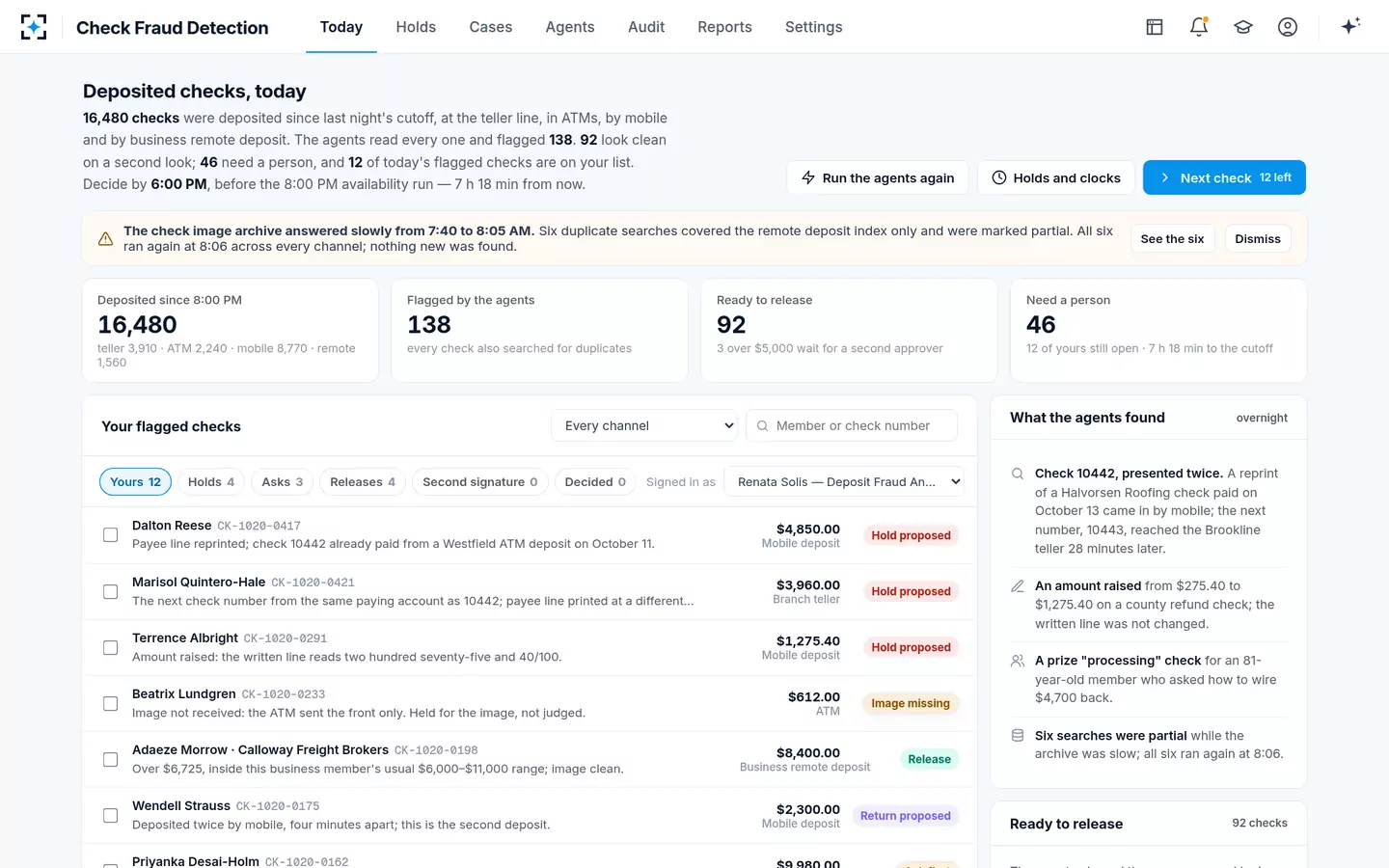
Remote deposit is the second engine of the rise, and it is a legal one. The Check 21 Act, which took effect on October 28, 2004, made an image of a check usable in place of the paper and "paved the way for the development of RDC", as the FDIC put it in 2009 (FDIC Supervisory Insights, Summer 2009). Two decades later, most deposits never cross a counter: on the sample credit union's Tuesday, 63% of 16,480 checks came by mobile or business remote deposit and another 14% through ATMs.
FinCEN found that criminals use exactly that. Deposits at ATMs or by remote deposit were the preferred method in the mail-theft reports, and "While both allow depositors to avoid bank personnel, RDC ensures that no one from the receiving bank physically handles the check" (FinCEN, 2024). The person who might have noticed the overwritten payee, the odd stock or the nervous presenter is no longer in the transaction; what the teller can still do is set out in check fraud training for tellers.
Most of a day's checks now arrive as images
The fewer the checks, the bigger each one
The average check is larger than it was, which raises the prize for each theft. The Atlanta Fed reports that "The average value per check rose by 60 percent in the past seven years, from $1,772 in late 2018 to $2,830 in early 2025, according to a report of checks processed by the Fed." FinCEN's alert had already noted that the Board's data show the dollar amount per commercial check increasing year by year.
Treasury's risk assessment names the other half of the attraction: a single check gives "the ability to directly access all funds within a specified account". A check, presented once, can reach whatever the account holds. And it carries the details for the next fraud. The agencies' 2025 RFI notes that checks contain "the payor's name, account number, routing number, address, and signature" that "can be used by criminals to conduct other forms of payments fraud" (90 FR 26293).
Is check fraud worse at small banks?
The reports do not show it concentrated at the largest banks. In FinCEN's six-month review of mail theft-related check fraud, banks filed 88% of the 15,417 reports; the largest banks by assets filed 44% of the bank filings, and "Small-to-medium size banks filed a majority of BSA reports". Credit unions filed 882 reports from 165 institutions (FinCEN, 2024).
Filing is not the same as being hit: a report shows what an institution noticed and reported, not every attempt it received. But the spread of filers says check fraud is everyone's problem, and a community bank has fewer people to absorb the review. The cost side is worked through in check fraud losses in 2025, and the cost of a wrong hold.
What did FinCEN find about check fraud?
FinCEN found a surge tied to the mail, dominated by altered checks and routed around bank staff. Its February 2023 alert set out red flags and a key term for SARs, "FIN-2023-MAILTHEFT". Its September 2024 analysis of the first six months of filings under that term counted 15,417 reports from 841 institutions, involving more than $688 million in actual and attempted transactions, and found altered checks in about 44% of reports, counterfeits in 26% and fraudulently signed checks in 20%. Activity was reported from every state, Washington, D.C., and Puerto Rico.
It also found that the schemes range from crude to organised: from crossed-out payees and correction fluid, through chemical washing and counterfeits printed from stolen checks, to new accounts opened online for the purpose, romance and employment scams that turn victims into depositors, and insiders at banks or the Postal Service.
What are banks and regulators doing about check fraud?
Regulators are asking questions; the Reserve Banks have added a duplicate service; banks are layering tools. In June 2025 the OCC, Federal Reserve and FDIC asked for comment on payments fraud, including whether Reg CC's reasonable-cause hold works; in November 2025 the Fed said the agencies were assessing comments, and no rule had followed by October 26, 2026. In December 2025 the Board asked for comment on the future of the Reserve Banks' check services, with options up to significant simplification, comments due March 9, 2026.
On the operating side, the Reserve Banks expanded their Duplicate Check Notification to commercial checks in November 2024, so banks of first deposit can see potential duplicates among the checks the Reserve Banks process (Federal Reserve Financial Services). Treasury, screening the checks it issues, credited machine learning with $1 billion recovered from Treasury check fraud in fiscal 2024 (U.S. Treasury, 2024). And institutions in the 2026 survey name their own mix: image analysis, positive pay, manual reviews and staff training, and monitoring of new accounts.
Five questions a board can ask about its own check fraud exposure
- What share of our check deposits arrive without an employee seeing them?
In the sample, over three-quarters. The answer sets where review has to happen.
- How far back, and across which channels, can we search for a duplicate?
Our own archive covers our deposits; other banks' deposits need the Fed's notification or the return.
- How many holds did we place last month, and how many were on good checks?
Every hold has an outcome; the ratio shows whether review is tuned.
- Who carries the loss on each type we see?
Altered checks usually land on the bank of first deposit; counterfeits often on the paying bank.
- Can we show an examiner why each hold was placed?
Reg CC requires the reason in the notice and a brief statement of facts kept for each reasonable-cause hold.
Check Fraud Detection's answer to the rise is narrow on purpose. Its agents read each flagged check from all four channels, search the institution's own archive for the same item, pin findings on the image, and draft the hold and its notice; a deposit fraud analyst decides and a supervisor co-signs. It does not stop mail theft or replace the Fed's services. It makes sure that when a stolen check arrives as an image at 9:12 AM, someone with the evidence decides on it before the evening availability run. To follow one such deposit, start from Check Fraud Detection.
Questions people ask
Is check fraud worse than it was before the pandemic?
By every public measure, yes. Mail theft complaints to the Postal Inspection Service rose 161% between March 2020 and February 2021, check fraud SARs nearly doubled in 2022 to more than 680,000, and the share of potentially fraudulent returned checks at the Reserve Banks rose from 10.2% in 2018 to 15% in 2021.
Why do criminals still steal checks when so few are written?
Because the checks still written are large and revealing. The average check processed by the Fed rose to $2,830 by early 2025, business checks draw on well-funded accounts, and every check shows the payor's account and routing numbers, which can be used to print counterfeits or commit other payments fraud.
Has the Federal Reserve said it will stop processing checks?
No. In December 2025 the Board asked for public comment on the future of the Reserve Banks' check services, describing options that include significant simplification of the services; comments were due by March 9, 2026. The request notes that the Reserve Banks process nearly half of the nation's check volume.
Does Treasury treat check fraud as a money laundering threat?
Treasury's 2024 National Money Laundering Risk Assessment gave check fraud a special focus section as one of the threats with increased risk in the review period. FinCEN's 2023 alert calls fraud, including check fraud, the largest source of illicit proceeds in the United States.
Will check fraud keep rising?
The forecast is not in any government source. What the data show is that the drivers persist: checks are still declining, remote deposit is the norm, and in the survey fielded at the end of 2025 more institutions reported counterfeiting and check washing increasing than declining.