Behavioral biometrics in banking means scoring how a person types, taps, swipes and moves a mouse during an online or mobile session, and comparing it with how the account's owner usually does, to flag a session that someone else may be driving. Banks use the scores mainly against account takeover, where the password is right but the person is not. For the second line, the hard part is that the score is a probabilistic model, often a vendor's, with error rates that vary by device and population and that are rarely tested on the bank's own confirmed takeovers. Botminds' Account Takeover Fraud Prevention treats any such score as one signal on the session, shown with its source next to the device, reset and contact-change evidence, so no hold rests on the score alone and a validator can test each decision.
Sample figures on this page come from a fictional bank, Corvane National Bank, as it runs through the solution. Research figures come from peer-reviewed or preprint studies and from regulators, linked where they appear.
What are behavioral biometrics in banking? The FFIEC's and NIST's definitions
Behavioral biometrics are measurements of how someone interacts with a device, used to judge whether the current user is the account's usual one. The FFIEC lists "Behavioral Biometrics Software" among the authentication solutions in its 2021 guidance, describing analysis that "can include data such as the customer's finger swipes, taps, keystrokes, and mouse usage" (FFIEC, Authentication and Access, 2021, Appendix).
NIST's 2025 digital identity guidelines put behavioral traits inside the definition of biometrics itself: "keystroke patterns, angle of holding a smart phone, screen pressure, typing speed, mouse movements, or gait" sit beside fingerprints and faces (NIST SP 800-63B-4). The same document places them a second time, under session monitoring, as one of the session characteristics a service may evaluate to "detect possible fraud during a session", listed as "Behavioral biometric characteristics (e.g., typing cadence)".
That double placement is the first thing a model risk reviewer should pin down. Used to authenticate, a behavioral score is making the access decision. Used to monitor a session already authenticated, it is one risk indicator among several. The second is far easier to defend, and it is how most takeover detection should use it.
Is behavioral biometrics a model? Under the 2026 guidance, yes
A behavioral biometric score is a model in the sense of the revised interagency guidance issued on April 17, 2026. The guidance defines a model as "a complex quantitative method, system, or approach that applies statistical, economic, or financial theories to process input data into quantitative estimates", and it excludes "deterministic rule-based processes and software where there are no statistical, economic, or financial theories underpinning their design" (OCC Bulletin 2026-13; Federal Reserve SR 26-2). A system that learns each customer's typing rhythm and outputs a probability that someone else is typing is squarely on the model side of that line.
Two scope notes matter. The agencies expect the guidance to matter most to banking organizations with more than $30 billion in total assets, though it may reach smaller banks with significant model exposure. And it replaces SR 11-7, the 2011 guidance most fraud model validations were written against, so validation documents that cite only the 2011 text are now citing a superseded letter.
The fraud rules around the score usually are not models. A rule that says "hold any transfer to a payee added in the last hour if the phone number also changed" is deterministic. It still needs testing and change control, but it sits outside the model definition, which is one reason a takeover program built from explainable steps carries a smaller validation load than one built on a single opaque score.
How accurate are behavioral biometrics? What the published benchmarks measured
Published studies report equal error rates in the low single digits under controlled conditions, which is accurate enough to be a useful signal and not accurate enough to decide alone. The equal error rate is the point where the share of genuine users wrongly flagged equals the share of impostors wrongly accepted; lower is better.
Equal error rates in four published behavioral biometric studies, lower is better
The authors' own conclusions are more useful than the numbers. Carnegie Mellon's benchmark noted that the European access-control standard asks for a false-alarm rate under 1% with a miss rate of no more than 0.001%, and that "no anomaly detector has achieved these error rates in repeated evaluation, and so keystroke dynamics could not be deployed as a sole access-control technology" (Killourhy and Maxion, 2009). The Touchalytics team wrote that its findings "disqualify this method as a standalone authentication mechanism for long-term authentication" (Frank et al., 2013). The 2024 challenge, with far more data, reached a 3.33% equal error rate on desktops, but at a 1% false-match rate it still failed 11.96% of genuine desktop users and 17.44% of mobile ones.
Put those rates against a bank's volume and the design follows. The sample bank had seen 1,384,220 digital logins by 2:32 PM on the day of its case. A signal that wrongly flags 3% of genuine sessions would flag about 41,500 of them by mid-afternoon (our arithmetic, for illustration). No fraud team can step up, let alone hold, that many customers. A behavioral flag earns its place when it coincides with other steps, a reset, a new device, a contact change, and is worthless as a trigger on its own.
Can behavioral biometrics be biased? What the research and NIST say
They can, and the evidence is not hypothetical. The 2024 keystroke challenge, run on data from over 185,000 people, reported that "the analyzed scores reflect the subjects' age and gender to various extents, not negligible in a few cases" (KVC-onGoing, 2024). How fast and how steadily someone types or swipes varies with age, motor conditions, the device and the language, so a model trained on one population can misfire on another.
NIST sets a demographic test for biometrics used in authentication: the system "SHALL operate with an FMR [false match rate] of one in 10000 or better for all demographic groups", with sex and skin tone named where they affect performance (NIST SP 800-63B-4). NIST writes for federal systems, not banks, and its threshold was set with faces and fingerprints in mind; but the principle travels: error rates should be reported by group, not just overall.
For a fraud team the consequence is concrete. If older customers are flagged more often, they are stepped up and held more often, and a hold that lands on the wrong group again and again becomes a fair-treatment question as well as a model one. The second line should ask to see false-flag and miss rates by age band and device type, measured on the bank's own sessions.
Why NIST will not let a behavioral score authenticate alone
NIST allows biometrics in authentication only as part of multi-factor authentication: "Biometrics SHALL only be used as part of multi-factor authentication with a physical authenticator (i.e., "something you have")." Its reasons apply with extra force to behavior. "The biometric FMR does not provide sufficient confidence in the subscriber's authentication by itself because it does not account for active impersonation attacks," and "Biometric comparison is probabilistic, whereas the other authentication factors are deterministic" (NIST SP 800-63B-4).
Session monitoring is a different use, and NIST permits it as "a risk reduction measure": when potential fraud is detected, a service should "reauthenticate, terminate the session, or notify appropriate support personnel". That list is a close match for what a takeover program does with a behavioral flag: step the customer up, end the session, or send it to an analyst. It is not a list that includes moving money or locking a customer out on the score alone.
Policymakers see the technique's promise too. Federal Reserve Governor Michael Barr said in April 2025 that bank identity verification "should evolve in kind to include AI-powered advances such as facial recognition, voice analysis, and behavioral biometrics to detect potential deepfakes" (Barr, April 17, 2025). Respondents to the Federal Reserve Financial Services 2026 risk officer survey listed "Real-time behavioral analytics to detect account takeover" among their fixes for ACH fraud (FRFS Risk Officer Survey, 2026; the survey says of itself that it is not independent academic research). Encouragement to use it is not encouragement to let it decide.
A score-only decision versus a decision on cited signals
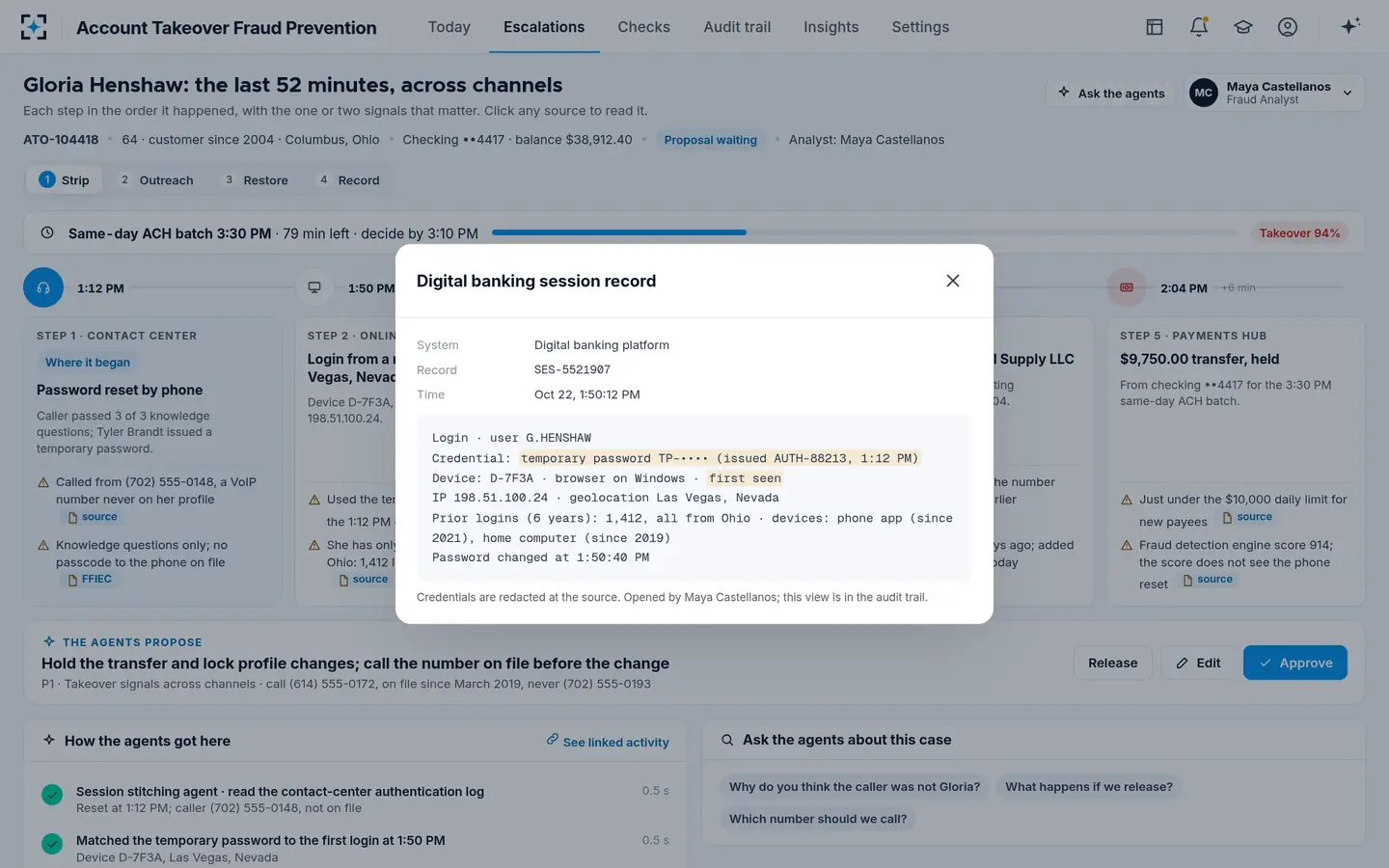
The difference shows in what a reviewer can test afterwards. When a hold rests on one number, the only questions are whether the number was right and whether the threshold was sensible. When it rests on named signals, each linked to its source, every one of them can be checked, and the behavioral score becomes one line that can be right or wrong without carrying the whole decision.
The same takeover alert, decided on a score and on cited signals in Account Takeover Fraud Prevention
Score-only decision: A behavioral or transaction score above a threshold
Cited-signal decision: Five dated steps: phone reset, first login from a new device using the reset's temporary password, mobile number change, new payee, transfer; confidence 94%
Score-only decision: A number and the top features
Cited-signal decision: Each step with one or two plain signals, each opening its source: the authentication log, the session, the change log, the payee
Score-only decision: Nothing: the score is above or below the line
Cited-signal decision: "Unclear" below 0.60, with a step-up proposed instead of a hold
Score-only decision: Often the system, with a person reviewing later
Cited-signal decision: The analyst approves, edits or releases; a supervisor checks releases, unlocks and restores
Score-only decision: Score distributions and threshold performance
Cited-signal decision: The score, plus whether each cited signal was true and whether the action fitted the band
Score-only decision: That the score was wrong
Cited-signal decision: Which signal was misread or which context was missing, by reason code
One signal opened at its source in Account Takeover Fraud Prevention, credentials redacted
What does model risk review for fraud models? The 2026 guidance, applied to takeover
Model risk review for a fraud model covers the same three things the 2026 guidance asks of any model: conceptual soundness, ongoing monitoring and outcomes analysis, with effective challenge from people independent of its developers. Outcomes analysis, in the guidance's terms, means setting what the model said against what actually happened, and judging it by what the model was built and used for (Revised Guidance on Model Risk Management, 2026; the new account replay guide works one through). For takeover, the real-world outcome is a confirmed takeover or a confirmed genuine session, and that label is the hardest part.
Questions for the second line, and where each comes from
| Question | Grounded in | What a good answer looks like |
|---|---|---|
| Is the score a model, and is it in the inventory? | 2026 guidance: model definition; model inventory | Yes, with its owner, use, limitations and version recorded |
| What are its error rates on our confirmed takeovers? | 2026 guidance: outcomes analysis | False-flag and miss rates on the bank's own labelled cases, not the vendor's benchmark |
| Do error rates differ by age, device or language? | NIST SP 800-63B-4; KVC-onGoing 2024 | Rates reported by group, with a plan where one group is flagged far more |
| What do we receive from the vendor? | 2026 guidance: vendor and other third-party products | Enough on design, development data and performance to validate; ongoing monitoring of outcomes |
| How do we know when it drifts? | Dal Pozzolo et al., 2018: concept drift | A monitoring plan with thresholds that trigger recalibration or redevelopment |
| Can it act alone? | NIST SP 800-63B-4; FFIEC layered security | No: it raises risk, and a person or a rule with other signals decides |
| Who can change thresholds? | 2026 guidance: governance | A named owner proposes, the second line approves, and every change is versioned |
The vendor row is where most behavioral programs are thinnest. The guidance recognises that "certain components may be proprietary" and that banks "may not receive from the vendor the underlying code, data, or methodology", and still treats "the validation of vendor products, either by internal or outside parties" as an important element. If the vendor cannot share its development data, the bank's own outcomes analysis has to carry more of the weight, which brings the validation back to labelled takeover cases.
Is agentic AI covered by model risk guidance? Not yet, and what to do meanwhile
No. The 2026 guidance leaves generative and agentic AI out of its scope altogether, on the ground that both are new and changing quickly. The agencies said they plan to issue a request for information on AI, including agentic AI; as of 26 October 2026 it had not appeared in the Federal Register.
Out of scope is not the same as ungoverned. A bank that puts agents into a fraud workflow still answers for safety and soundness and for consumer protection, and the sensible course is to govern the agents with the same disciplines: a named owner, versioned prompts and thresholds, change approval, testing on labelled cases and monitoring of outcomes. In Account Takeover Fraud Prevention, agent versions, prompts and thresholds are versioned and changed only with model risk approval, and every rule the strategy agent drafts goes to the strategy manager and then to model risk before it is used.
The design also limits what there is to govern. The agents in the solution stitch, date, explain and propose; they do not hold, release, call or restore. Their outputs are readable claims with sources, which a validator can sample like any other work product.
How do you validate a fraud model on takeover cases? Labels, latency and overrides
Validate on the bank's own confirmed takeovers and confirmed genuine sessions, accept that the labels arrive late, and use analysts' overrides as a second stream of evidence. The academic literature names the timing problem precisely. Fraud detection faces "concept drift (customers' habits evolve and fraudsters change their strategies over time), class imbalance (genuine transactions far outnumber frauds), and verification latency (only a small set of transactions are timely checked by investigators)" (Dal Pozzolo et al., IEEE TNNLS, 2018).
For takeover, latency cuts both ways. A takeover stopped in the hold window is confirmed within the hour by an outreach call; one that was missed may only be labelled weeks later, when the customer disputes a transfer. A validation sample drawn only from fast-confirmed cases will flatter the model. The fix is to include the slow labels: completed takeovers reported through disputes, and sessions released as genuine that later turned out not to be.
Overrides are the cheap, continuous check. In the sample bank's last week, analysts approved 739 of 840 agent proposals as written, edited 67 and overrode 34, coding each override: context the agents did not have (19), a signal misread (11) or a policy exception (4). A rising count of "signal misread" on one signal type is an early drift alarm that does not wait for labels.
Outcomes, entry points and overrides for the strategy and model risk teams
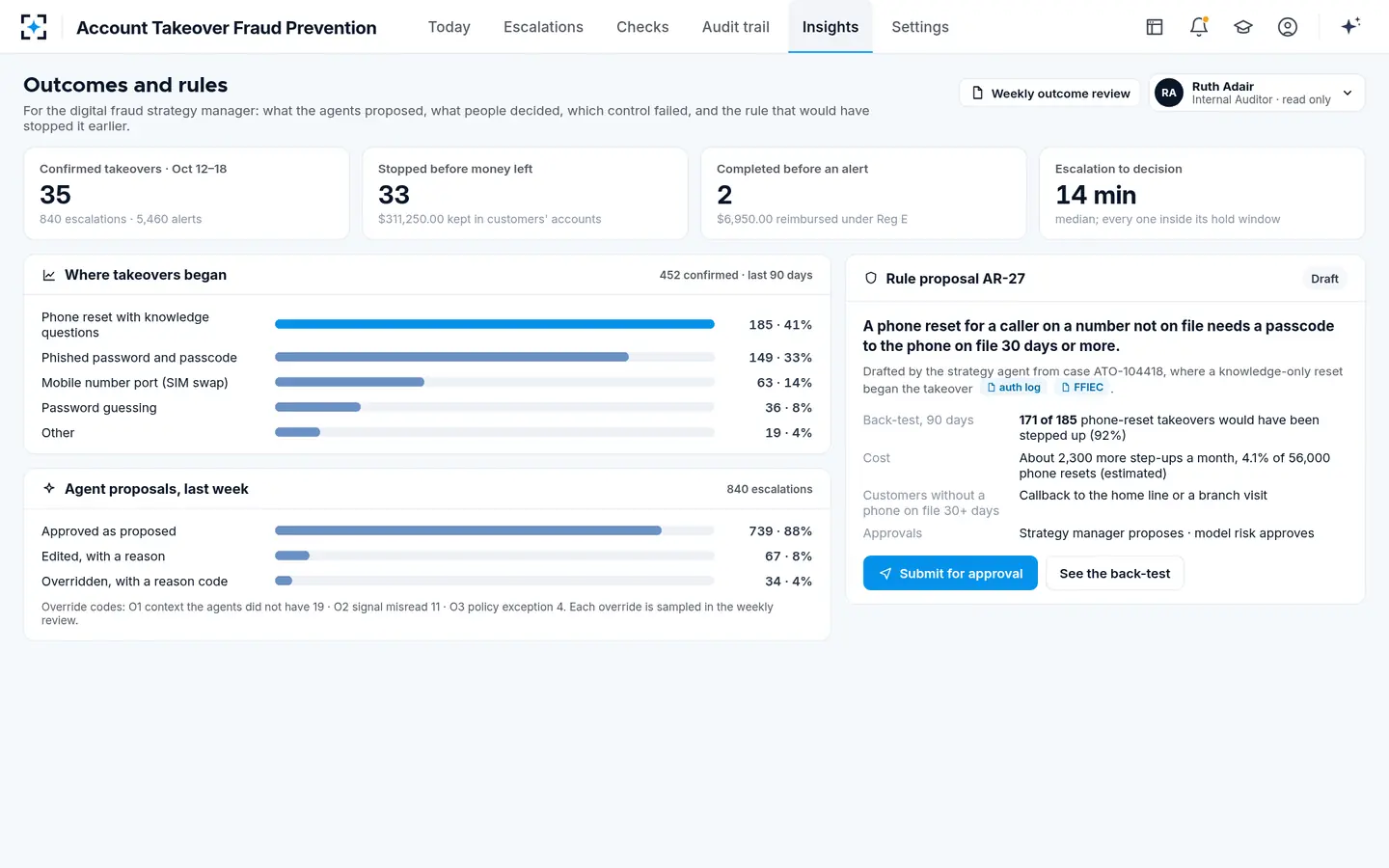
Back-testing belongs in the same loop. The strategy agent's draft rule for phone resets, a passcode to the phone on file 30 days or more when the caller's number is not on file, would have caught 171 of 185 phone-reset takeovers in the sample bank's 90 days, at an estimated 2,300 more step-ups a month. That is the shape of evidence a second line can challenge: a proposed change, its benefit on labelled history, and its cost to genuine customers, before approval.
Buying behavioral biometrics for takeover: what to require
If a bank is buying a behavioral biometric product, or a takeover system that includes one, the second line should set the conditions before the contract, not at the first validation. The list below turns the questions above into requirements.
Seven requirements for a behavioral biometric signal in a takeover program
- Error rates on your own sessions
A pilot that measures false flags and misses on the bank's confirmed takeovers and genuine sessions, not the vendor's test set.
- Rates by group
False-flag rates by age band, device type and, where relevant, language, with a remediation plan for any group far above the rest.
- A stated use
Session monitoring that raises risk, not authentication that grants or denies access on its own.
- A citable output
Each flag explained in terms an analyst can check, linked to the session it came from.
- Drift monitoring
Thresholds on flag volumes and override reasons that trigger review, with the vendor's model changes notified in advance.
- Privacy assessment
NIST notes most session characteristics "have privacy implications"; collection, storage and retention need a documented assessment.
- An exit
The program still works, with step-up and outreach, if the score is switched off.
Account Takeover Fraud Prevention does not supply a behavioral biometric engine; it reads the scores a bank already has, alongside the contact-center log, the digital session, the change log and the payments hub, and shows each as a cited signal. Where it fits in detection as a whole is set out in the guide to account takeover fraud detection, and how the FFIEC frames layered controls in the guide to the FFIEC authentication guidance. To see a score sit beside the evidence on your own cases, start from Account Takeover Fraud Prevention.
Questions people ask
What is an example of a behavioral biometric?
Typing rhythm is the classic example: the time between key presses and how long each key is held. Others include swipe speed and pressure on a touchscreen, the angle at which a phone is held and mouse movement. The FFIEC's 2021 guidance names swipes, taps, keystrokes and mouse use among the signals such software reads.
Can behavioral biometrics replace passwords?
Not on current evidence. Published benchmarks report equal error rates of roughly 3% to 10%, and their authors conclude the methods should not be a sole or standalone authentication mechanism. NIST's 2025 guidelines allow biometrics only as part of multi-factor authentication with a physical authenticator.
Does behavioral biometrics need customer consent?
That depends on the jurisdiction and the bank's notices, and some state biometric privacy laws are strict, so it is a question for counsel. NIST's guidelines say most session characteristics "have privacy implications" and require their collection and processing to be covered by a privacy risk assessment.
Is a fraud rule a model under the 2026 guidance?
A purely deterministic rule is not: the guidance leaves out fixed rules with no statistical, economic or financial theory behind them. A rule still needs testing and change control, and a threshold set on a model's output is part of that model's use.
How often should a fraud model be revalidated?
The 2026 guidance does not set a fixed cycle; it says the timing, nature and frequency of validation "vary based on model purpose, model methodology, frequency and scope of model changes, data limitations, and other practical constraints". For takeover models, frequent vendor updates and fast-changing attacks argue for continuous outcomes monitoring between full validations.