Account takeover prevention at a bank comes down to three capabilities: seeing a hijacked session across channels, deciding inside the window before the money settles, and reaching the real customer on a contact the criminal did not plant. Putting them live is mostly a data and governance project, not a modelling one: the contact-center log, the digital sessions, the profile changes and the payments hub have to be joined, the clocks and contact rules written down, and the whole thing tested on live sessions before it proposes a single hold. This page sets out a six-week plan for doing that with Botminds' Account Takeover Fraud Prevention, with the measure that has to pass before each next step. Six weeks is our planning assumption for a bank whose logs can be reached through existing feeds; it is not a promise, and the first two weeks are where it usually slips.
Sample figures on this page come from a fictional bank, Corvane National Bank, as it runs through the solution; targets are called targets and the time estimates are ours or the product's, as marked.
Six weeks from first feed to first proposed hold, with a measure that must pass at the end of each stage
- Weeks 1–2 · connect feeds, prove the joins on past cases
- Week 3 · clocks, contact rules, thresholds, checkers
- Weeks 4–5 · shadow on live sessions
- Week 6 · proposals live, every one checked
- The existing queue and screens; agents' output seen only in review sessions
- The strip and proposals
How long does account takeover prevention take to implement? Six weeks, if the logs can be reached
About six weeks for the core capability, on the condition that the systems a takeover runs through can be read: the contact center, digital banking, the core system's contact details and the payments hub. The work is not building a model from scratch. It is connecting feeds, proving that a phone reset can be matched to the login that used it, writing the bank's own clocks and contact rules, and watching the result on live sessions until the fraud team trusts it.
What stretches the timeline is almost always access, not analytics. A contact-center platform that cannot export which authentication was used on each call, a digital banking platform that keeps device identifiers for only a few days, or a core system that does not date contact-detail changes will each cost weeks. The first conversation with IT should be about those three points, before any contract is signed.
The plan also assumes the solution is built from the bank's own material: its authentication standard, its outreach scripts, its hold windows and a sample of past takeover cases. That last item is the one most teams underestimate. A quarter of confirmed takeovers and false alarms, with their outcomes, is what every later measure is tested against.
What data do you need for takeover detection? Five feeds and the join that matters
You need the logs of every system a takeover passes through, with timestamps and identifiers precise enough to join them: who authenticated how in the contact center, which device logged in from where, what changed on the profile and when, which payees were added, and which transfers are waiting in which window. The FFIEC's guidance describes the purpose plainly: transaction and audit logs "help reconstruct adverse events" (FFIEC 2021).
The feeds Account Takeover Fraud Prevention reads, and the field in each that makes the join work
- Contact-center telephony and authentication
Caller number, authentication method used (knowledge questions, passcode, callback), resets issued and the temporary credential's identifier, never its value.
- Digital banking sessions
Login time, device identifier and first-seen date, IP address and location, the credential used, and password or device changes within the session.
- Core banking contact details
Every phone number, email and address with the date it went on file and the date it changed, from the contact preferences store.
- Payments hub
Payees with creation time, held transfers, same-day ACH batches, wire cutoffs and person-to-person release times.
- Fraud detection engine
Transaction scores and holds, so the strip shows what the existing engine saw and what it did not.
- Case management and disputes
Past cases with outcomes for testing, and the hand-off route for transfers that have already left.
The join that matters most is between the contact center and digital banking. In the sample case the proof was that the temporary password issued on a 1:12 PM phone reset was the one used at a new device's first login at 1:50 PM. If the contact-center log records only "password reset" without the identifier of the credential issued, the join falls back to time and customer, which is weaker. Ask for the identifier in week one.
Weeks one and two: connect the logs and prove the joins on past cases
The first two weeks connect the feeds and replay a set of past confirmed takeovers through them. The measure to pass is simple and strict: for the replayed cases, how many come out as one strip with the steps in the right order and the entry point correctly marked? If the answer is below the level the bank sets, usually where an analyst would accept the strip without rebuilding it, the problem is a missing field or a lagging feed, and week three waits.
The solution marks a step "may be incomplete" when a feed lags rather than drawing a clean strip from partial data. Counting those marks in the replay is the cheapest early warning of a feed problem that would otherwise surface as a missed takeover in production.
How do you set hold windows? From the rails' clocks, backwards
Set hold windows by starting from the moment each payment rail makes money hard to recall, and working backwards to a decision time and an escalation time. Every window in the solution is a setting, proposed by the fraud systems administrator, approved by the strategy manager and kept on the audit trail. The sample bank's are typical in shape: same-day ACH batches at 11:00 AM and 3:30 PM, a wire cutoff at 3:00 PM, person-to-person payments held 45 minutes, and profile-only cases, with no money yet moving, decided within two hours.
The decision time sits ahead of the window. In the sample bank the agents ask for a decision 20 minutes before a window closes and escalate to the supervisor at 15, and a hold past its window needs the supervisor. Texas's bank supervisor puts the reason in one phrase in its account-takeover standards: a bank must be ready to respond "as quickly as possible (measured in minutes, not hours)" (Texas Department of Banking, Supervisory Memorandum 1029).
The clocks are moving. Today the Fedwire Funds Service opens at 9:00 p.m. ET the evening before and closes at 7:00 p.m. ET, five days a week, and the Federal Reserve has announced 22-hour, six-day operation in 2028–2029; in the comments it published, banks warned that fraud tends to rise at weekends and on holidays, when fewer people are watching (Federal Reserve, FR Doc. 2025-19942; the Fedwire cutoff guide sets out the schedule). Windows written as settings can follow the rail; windows hard-coded into a queue cannot.
Week three: contact rules, thresholds and who checks whom
Week three turns the bank's policy into settings, and the measure to pass is that every setting has an owner and an approver on file. Four groups of settings carry most of the risk.
The settings to write down in week three, with the sample bank's values
| Setting | Sample bank value | Why it matters |
|---|---|---|
| Confidence bands | Propose a hold at 0.80+; escalate at 0.60; step-up only 0.30–0.60; close below 0.30 with a reason, 2% sampled daily | Decides how often good customers are held and how often unclear sessions are asked instead |
| Trusted contact detail | On file 30 days or more before the first suspicious step | The rule that stops the bank calling the criminal's number |
| Outreach attempts | 2 attempts, 15 minutes apart; then the hold stays and the supervisor is told | An unreachable customer should not mean an automatic release |
| Who checks | Protective holds act at once, confirmed within 30 minutes; releases, unlocks, restores, payee blocks, letters and bulk protection wait for a second person | Nobody checks their own request |
| Contact-center step-up after a takeover | Passcode plus callback for 90 days | The victim's phone channel is the likeliest next target |
| Retention and redaction | Evidence 5 years; call audio 25 months; temporary passwords, passcodes, full account and card numbers always redacted | Examiners, auditors and disputes all draw on the same file |
What is shadow mode testing? Weeks four and five on live sessions
Shadow mode means the agents read every live takeover alert and write their strip and proposal, but nobody acts on them: analysts keep working from the existing queue, and the two are compared afterwards. It is the only test that uses today's attacks and today's data quality rather than last quarter's.
Two weeks is usually enough to see the shape. The measures to pass before week six are the ones a fraud head would ask about first: of the takeovers analysts confirmed during the shadow period, how many would the agents have proposed to hold, and how many inside the window; of the sessions the agents would have held, how many were genuine customers; and how often would an analyst have edited or overridden the proposal, and why. The bank sets the pass marks; the solution's target, to be measured in the live service, is 90% or more of confirmed takeover transfers held before they leave.
Shadow also tests the people side. Supervisors should practise the checks, contact-center fraud specialists should run outreach from the prepared contact list on real cases, and internal audit should pull a sample of shadow decisions and trace them to their sources. Anything that cannot be traced is a fault to fix before go-live, not after.
What should be live on day one of account takeover prevention?
On day one, the agents propose and people decide. Live from the first hour: the strip for every escalated alert, ordered by time left in its window; proposals inside the confidence bands; protective holds and profile locks that act when an analyst approves and are confirmed by a supervisor within 30 minutes; outreach prepared only to contacts on file before the first suspicious step; and every step on the audit trail.
Day one in Account Takeover Fraud Prevention: what needs the analyst, in hold-window order
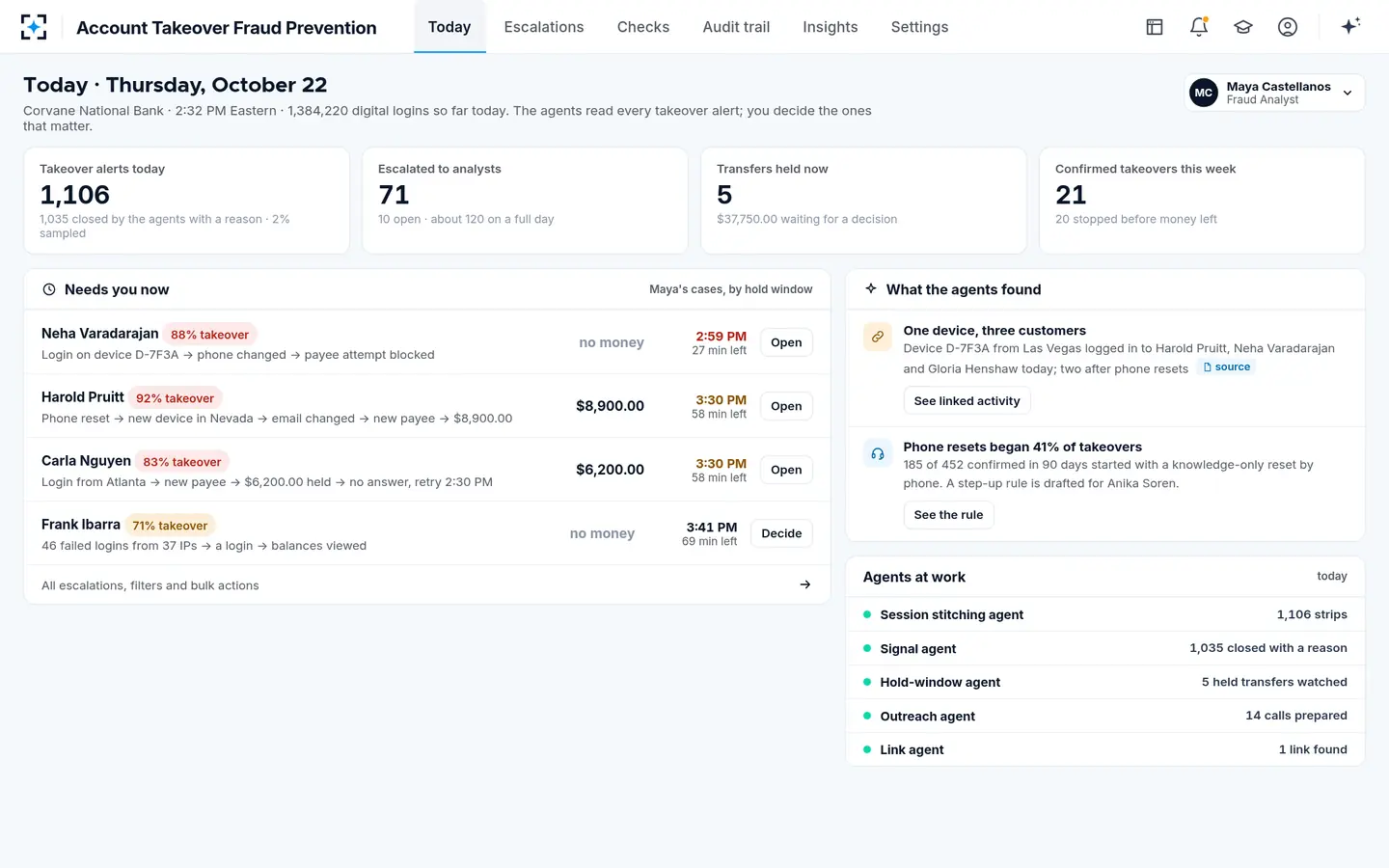
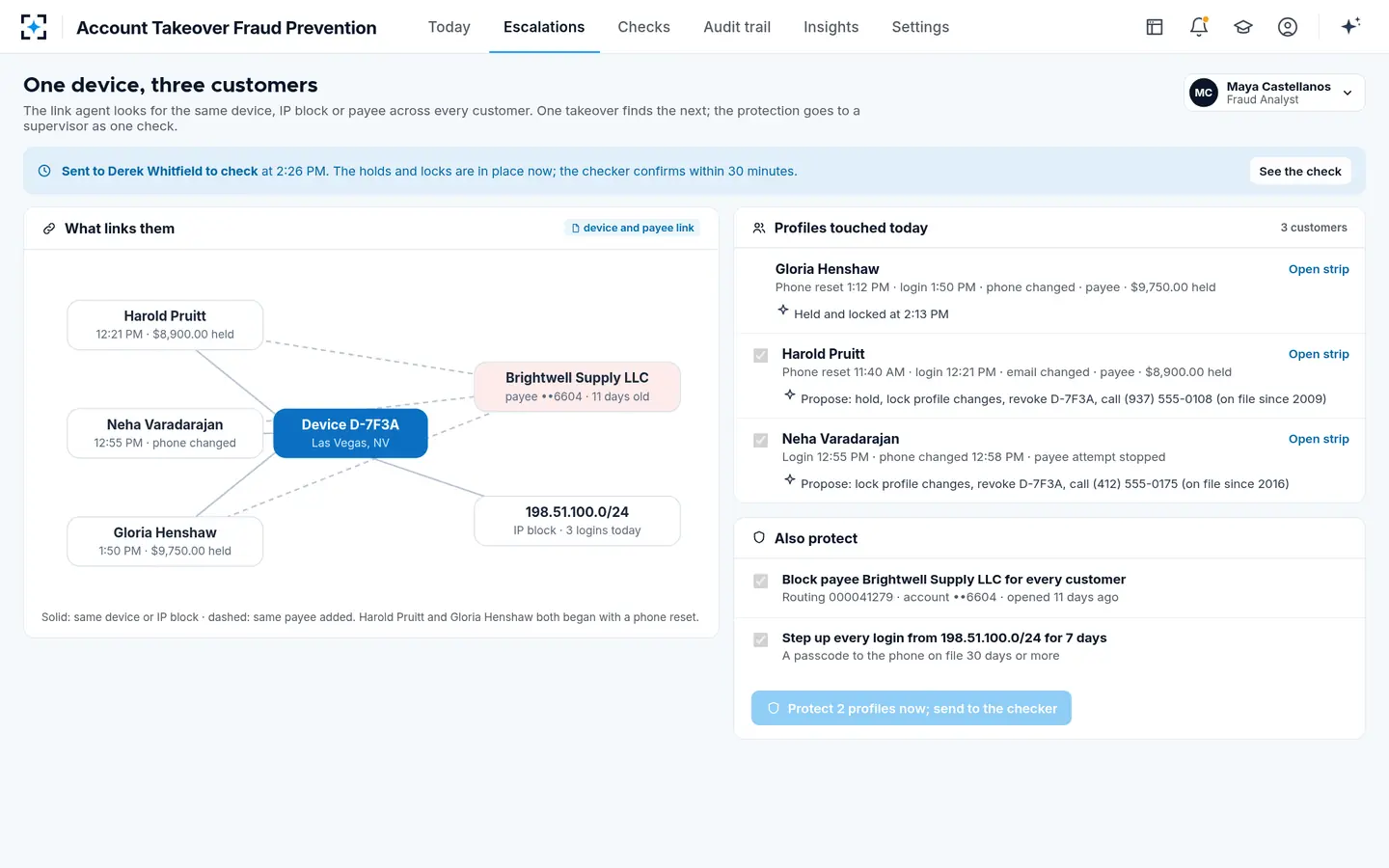
Linked protection is worth switching on early. When one device, IP block or payee shows up on several customers, the link agent proposes protection for all of them in one bundle, and a checker confirms it. In the sample case, the device that took over Gloria Henshaw's account had logged in to two other customers that day; one already had $8,900.00 held.
One takeover finds the next: the same device on three customers
What should wait: automatic closure below the lowest band until the supervisor's daily 2% sample has run for a few weeks, and any new rule from the strategy agent until it has been back-tested and approved by the strategy manager and model risk.
How do you measure takeover prevention? Six numbers, two of them targets
Measure takeover prevention by where the money ended, not by how many alerts were worked. Among the topics of its guidance the FFIEC lists "Periodically evaluating the effectiveness of user and customer authentication controls", and it points to a bank's own confirmed fraud cases as the evidence of which controls have stopped working (FFIEC 2021). Six numbers cover it.
The first two are the solution's design targets: 90% or more of confirmed takeover transfers held before they leave, and 100% of outreach calls made to contact details on file before the first suspicious step. The other four are the bank's to set: median time from escalation to decision, measured against the window (14 minutes in the sample bank's week, every case inside its window); the share of holds released as genuine after outreach; overrides by reason code; and where confirmed takeovers began, which tells the strategy team which control to fix first. In the sample bank's 90 days, 41% began with a phone reset on knowledge questions, the subject of the contact center fraud prevention guide.
Where an escalated takeover case's minutes go, by hand and with the solution (estimated)
By hand · about 105 minutes
- Pulling logs, sessions, changes, payees · 24%
- Where it began · 14%
- Finding a safe number · 10%
- Calling the customer · 14%
- Restore and second check · 19%
- Writing up · 19%
With the solution · about 26 minutes
- Reading the strip · 8%
- Where it began · 12%
- Safe number · 4%
- Calling the customer · 38%
- Restore and second check · 31%
- Writing up · 7%
The split makes one point about what changes. With the solution, the call to the customer and the second person's check become most of the work, as they should: those are the steps that need judgment, and the time saved goes to doing them inside the window.
What does account takeover prevention software cost? A frame for the business case
The honest answer is that cost depends on volume and integration, so the business case is better built as a frame the bank fills with its own numbers. The benefit side is unusually concrete for fraud software because, on consumer accounts, a completed takeover transfer is mostly the bank's loss, as the guide to Reg E and account takeover explains. Recovery after the fact is partial: the FBI's Recovery Asset Team froze 58% of the attempted thefts it worked in 2025 (FBI IC3, 2025 Annual Report).
The business case for account takeover prevention, term by term
Losses avoided
takeovers stopped × average transfer − customer share
From the shadow period: confirmed takeovers the agents would have held inside the window, valued at the transfer amount.
Fraud and finance
Analyst time returned
escalated cases × minutes saved per case
The product estimates about 79 minutes saved on an escalated case; test it in shadow.
Fraud operations
Claims avoided
disputes not opened × cost per Reg E claim
Every stopped transfer is a claim that never starts.
Disputes
Running cost
licence + integration + people who check
Including supervisors' checking time and the contact center's step-up volume.
Technology and fraud
One cost line belongs in every case and is often missing: friction on genuine customers. Step-ups and holds that land on real customers cost calls, complaints and abandoned payments. Risk officers feel the trade-off; one large credit union told the Federal Reserve's 2026 survey that "The more secure you make your systems, the more inconvenience it places on the account holders" (FRFS Risk Officer Survey, 2026; not independent academic research, by its own account). The shadow period is where that friction is counted before anyone commits to it.
Where the solution does not fit is worth saying in the same breath. If the bank cannot read its contact-center authentication log or date its contact details, the strip will be thinner and the outreach rules harder to enforce, and those gaps should be closed first. What to ask of any takeover system during selection is in the guide to account takeover fraud detection. To walk through the six weeks on your own past cases, start from Account Takeover Fraud Prevention.
Questions people ask
How do you prevent account takeover fraud at a bank?
Combine strong authentication on the steps criminals use, password resets, contact changes and new payees, with monitoring that joins those steps across channels and acts before the transfer settles. Then confirm with the customer through a contact detail that predates the activity. The FFIEC's 2021 guidance calls this layered security; the timing is what decides whether money is saved.
Can account takeover prevention run without changing core systems?
Yes, if the systems' logs can be read. Account Takeover Fraud Prevention reads the contact center, digital banking, core contact details, payments hub and fraud engine; it does not replace them. What it needs is fields such as the identifier of a temporary credential and the date each contact detail went on file.
How long should shadow testing last?
Long enough to see a representative mix of confirmed takeovers and false alarms, which for most banks means at least two weeks of live alerts. The measures to judge it by are takeovers that would have been held inside the window, genuine customers who would have been held, and how often analysts would have edited or overridden the proposals.
Who should own account takeover prevention?
Usually the digital fraud strategy manager owns the rules and thresholds, fraud operations owns the decisions and checks, and the contact center owns outreach and step-up. Model risk approves changes to agent prompts and thresholds. The plan works when each of those owners signs off the settings in week three.
What is a good takeover prevention rate?
There is no published industry benchmark from a government or academic source. The solution's design target is to hold 90% or more of confirmed takeover transfers before they leave; in the fictional sample bank's week, 33 of 35 confirmed takeovers were stopped. A bank should set its own target from its shadow period.