The Fedwire cutoff time for customer transfers is 6:45 p.m. Eastern time on each Fedwire business day; bank-to-bank transfers can be sent until the service closes at 7:00 p.m., and the business day opens at 9:00 p.m. the evening before. Those are the Federal Reserve's times. A bank's own cutoff for its clients is earlier, because held wires need time to be reviewed, called back and signed before the Fed's deadline. That gap is where wire fraud is caught or missed, and it is about to change shape: the Federal Reserve will extend Fedwire to Sundays and weekday holidays in 2028 or 2029. Botminds' Wire Fraud Prevention puts every held wire on a runway to the cutoff of the rail it must meet and escalates before time runs out, so review finishes before the deadline rather than being skipped by it.
Where the guide shows the solution, the data are a fictional sample bank's: Corvane National Bank, whose client cutoffs are 4:45 p.m. for CHIPS and 5:00 p.m. for Fedwire, on the afternoon of Thursday 22 October.
Fedwire's operating days today and under 22x6
Today: Monday to Friday, excluding Federal Reserve holidays
22x6, from 2028 or 2029: Sunday to Friday, including weekday holidays
Today: 22: from 9:00 p.m. ET the evening before to 7:00 p.m. ET
22x6, from 2028 or 2029: Unchanged: the same 22 hours on every operating day, Sundays and holidays included
Today: From Friday 7:00 p.m. to Sunday 9:00 p.m.
22x6, from 2028 or 2029: 26 hours, from Friday 7:00 p.m. to Saturday 9:00 p.m., when the Sunday day opens
Today: Business days only
22x6, from 2028 or 2029: Optional: banks may choose not to operate in the new hours
Today: —
22x6, from 2028 or 2029: Up to 22x7x365 possible, no sooner than two years after 22x6, after a new proposal
What is the Fedwire cutoff time?
Fedwire has several cutoffs, one for each kind of message, and the one that governs a client's wire is 6:45 p.m. Eastern. The Federal Reserve's published schedule sets 5:00 p.m. ET for tax payments and special-account messages, 6:45 p.m. ET for customer transfers and 7:00 p.m. ET for bank transfers and other messages, when the service closes. In Pacific time the customer-transfer cutoff is 3:45 p.m.
In ISO 20022 terms, which Fedwire has used since 14 July 2025, a customer transfer is a pacs.008 message and a bank transfer a pacs.009. A business paying a supplier, a law firm paying out a settlement and a title company sending sale proceeds all send pacs.008 messages, so 6:45 p.m. is the deadline for nearly every wire a business client sends. The Reserve Banks can extend a cutoff or the business day itself "to facilitate special market needs", but a wire room cannot plan on it.
The end of a Fedwire day, minute by minute, with one bank's client cutoffs
| Time (ET) | Fedwire (Federal Reserve) | Sample bank (set by the bank) |
|---|---|---|
| 4:45 p.m. | — | CHIPS client cutoff |
| 5:00 p.m. | Cutoff for tax payments and special-account messages | Fedwire client cutoff; held wires already accepted are still worked |
| 6:45 p.m. | Cutoff for customer transfers (pacs.008) | Last moment a reviewed client wire can go today |
| 7:00 p.m. | Cutoff for bank transfers (pacs.009) and other messages; the service closes | — |
| 8:35 p.m. | Non-value messages for the next day start processing | — |
| 9:00 p.m. | The next funds-transfer business day opens | Wires held over can be released, after review |
Your client cutoff is earlier, and fraud review lives in the gap
A bank's client cutoff is the time by which it accepts a client's wire for same-day sending, and it sits well before 6:45 p.m. for a reason. Every wire accepted near the deadline is a wire that cannot be held for long. If a held wire needs a callback and nobody answers, the bank either sends it unverified, holds it to the next business day, or asks a supervisor to decide, and only the last two are defensible when the wire turns out to be fraud.
The sample bank's afternoon shows the squeeze. At 4:22 p.m. it had 34 held wires open, with 23 minutes to its CHIPS client cutoff and 38 to its Fedwire one. Three CHIPS wires were still waiting: one for a client CEO's callback and two that the agents had found unchanged and that only needed a second name. The supervisor had been alerted at 4:15 p.m., 30 minutes before the CHIPS cutoff, as the bank's setting requires; the wire operations manager is alerted at 15 minutes.
Held wires grouped by the cutoff each must meet
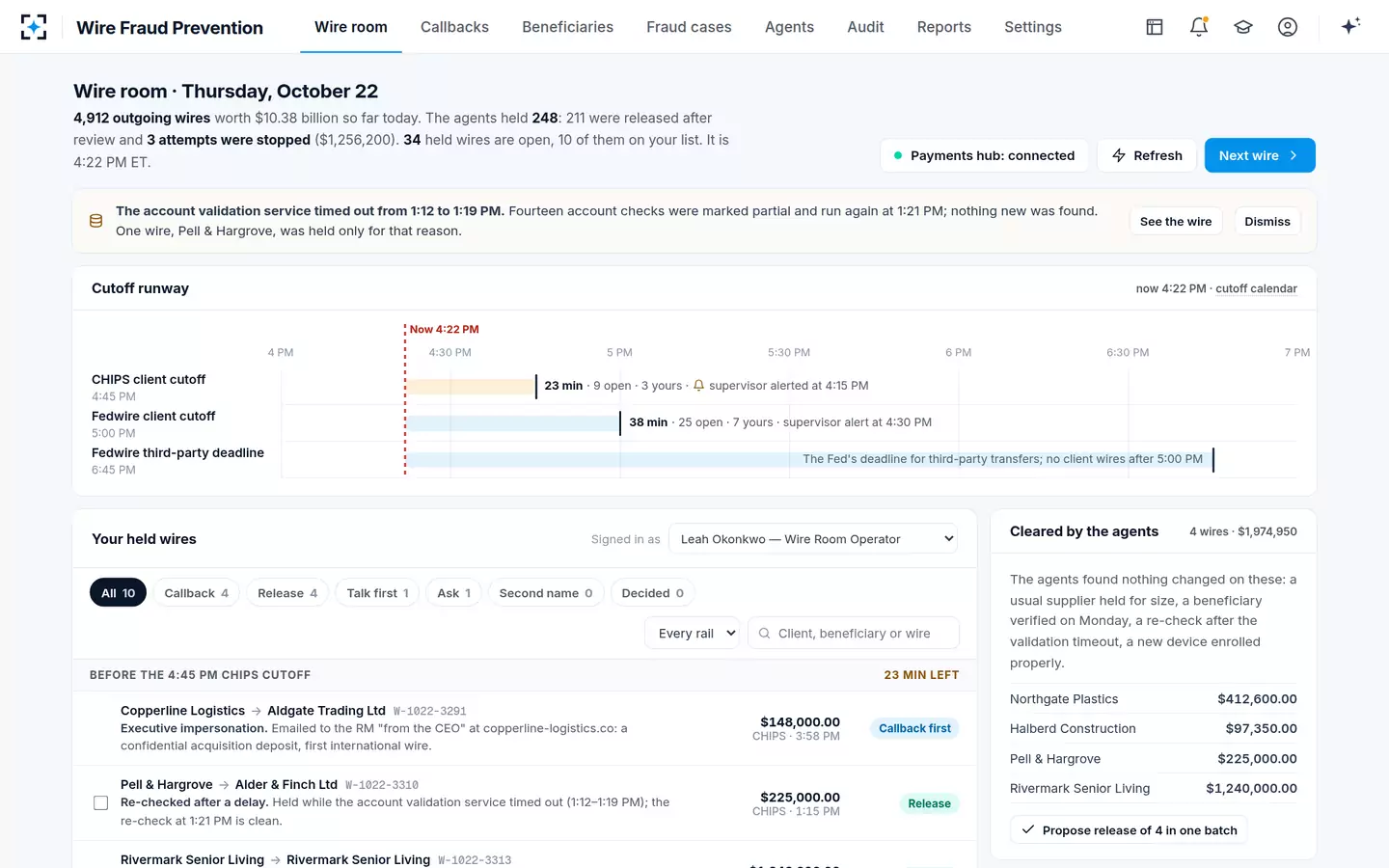
Most of the gap is spent on genuine wires. At the sample bank, 211 of 248 held wires had been released after review by 4:22 p.m., and 3 attempts had been stopped. A process that clears the genuine ones quickly is what leaves time for the few that need a long call.
Is Fedwire open on weekends?
Not yet. Fedwire treats all Saturdays, all Sundays and the Reserve Banks' holidays as non-business days, so a wire sent on a Saturday waits for Monday's business day, which opens at 9:00 p.m. on Sunday. Banks can queue messages for release when the service opens, but nothing settles on the weekend.
That will change for Sundays, not Saturdays. Under the Federal Reserve's 22x6 plan, the Sunday operating day will open at 9:00 p.m. on Saturday and close at 7:00 p.m. on Sunday, leaving a 26-hour pause from Friday evening to Saturday evening for maintenance and testing. Instant payments are already a different matter: the FedNow Service runs 24x7x365.
When will Fedwire expand its hours?
The Federal Reserve Board announced on 9 October 2025 that Fedwire and the National Settlement Service will add Sundays and weekday holidays, and said the Reserve Banks "will implement this expansion in several years, no earlier than 2028 to ensure operational and industry readiness". Its Federal Register notice of 17 November 2025 narrows that: the Board plans implementation "in 2028 or 2029", with the final date set by industry readiness and announced with advance notice.
"22x6" means 22 hours a day, six days a week: Sunday to Friday, with the same 9:00 p.m. to 7:00 p.m. day on Sundays and holidays as on weekdays. The Board considered 22 hours, seven days a week and every day of the year, and settled on six days for now; it said it stands ready to go to 22x7x365 "no sooner than two years after implementing 22x6 operations", and only after a new proposal and public comment.
The dates on a wire room's calendar
| When | What changes | Why it matters for fraud review |
|---|---|---|
| 14 July 2025 | Fedwire moved to the ISO 20022 message standard | Reviewers and tools read pacs.008 and pacs.009 fields instead of the old format |
| November 2027 | The Fedwire release that brings the hybrid postal address format, rescheduled from November 2026 | Address fields change again; tools that compare payee details must read both formats |
| 2028 or 2029 | Fedwire runs 22x6: Sundays and weekday holidays added | Held wires, callbacks and second names on days most wire rooms do not staff today |
| No sooner than two years after 22x6 | Possible move to 22x7x365, after a new proposal | Saturday operation, if it comes |
Will wire fraud increase with longer hours?
The Federal Reserve did not predict that it would, but it recorded the concern and agreed controls must keep up. Its November 2025 notice summarised what commenters said about fraud in its own section on fraud risk: that fraud already tends to run higher at weekends and on holidays, and that banks' controls would have to adapt, through automation or staffing, before the hours grow (Federal Reserve Board, 17 November 2025; the guide to wire recalls at major banks quotes the passage).
A sixth operating day is a sixth day of fraud. The controls have to be staffed, or automated, for the hours the rail is open, not the hours the office is.
The Board's reply was that "strong mechanisms are necessary to support the overall safety and efficiency of the nation's payment system", and it pointed to the request for information on payments fraud it had issued with the FDIC and the OCC in June 2025; the agencies said they were assessing the comments. Nothing in the notice promises a new fraud rule tied to 22x6.
The mechanism behind the worry is simple. Business email compromise and scams depend on the victim not checking, and on the bank not reaching anyone in time. A Sunday wire from a client whose finance team is off, to a supplier whose controller cannot be called until Monday, is a wire whose callback has nowhere to go. That is the commenters' point: the controls that catch these frauds depend on people being reachable.
Fedwire holiday hours, and the 9:00 p.m. start
Today Fedwire is closed on the Federal Reserve's holidays, listed on its holiday schedule and including days such as Thanksgiving and Christmas. The business day after a holiday still opens at 9:00 p.m. on the holiday itself: the schedule says the day begins at 9:00 p.m. ET on the preceding calendar day "including if that preceding calendar day is a holiday observed by the Federal Reserve Banks".
Under 22x6, weekday holidays become operating days with the normal hours, so a holiday Monday will have a Fedwire day that opens on Sunday evening. For a wire room, that means two things. A client who sends a wire on a holiday may expect it to settle that day, if the bank opts in. And the people who usually make callbacks and add second names may not be at work.
What runs through the 6:45 p.m. cutoff
217.3M
Fedwire funds transfers in 2025
$1.15Q
their total value, about $1,148 trillion
$5.28M
the average value of one transfer
869,187
transfers on an average business day
How do banks staff wire rooms after hours?
Most do not, today, beyond queuing messages, and the Federal Reserve heard that staffing is the biggest obstacle to longer hours. In its notice, "Staffing considerations represented the most common challenge noted by commenters", and small banks said they "often rely heavily on manual processes to support wholesale payment operations". Some commenters noted that banks already running weekend operations for instant payments could build on them.
Participation in the new hours will be optional, and a bank can decide not to send or receive Fedwire payments on Sundays and holidays. A bank that does take part needs three things in place before its first Sunday: rules that hold wires on the same basis as on weekdays, someone authorised to make callbacks and add second names, and a way to reach clients and payees when their own offices are closed. Holding a Sunday wire to Monday is a legitimate outcome; sending it unreviewed is not.
Agents change the arithmetic, though not the need for people. In this solution the agents gather a held wire's evidence at any hour, so a smaller weekend team spends its time on calls and decisions rather than on opening systems. By Botminds' estimate, a held wire that needs a callback takes about 65 minutes by hand and 15 with the evidence prepared. The decisions stay with named people, as the seats in the wire room explain.
Keeping held wires inside the cutoff with Wire Fraud Prevention
In the solution, cutoffs are settings, and so are the alerts. The sample bank's Fedwire client cutoff is 5:00 p.m., with options from 4:30 to 5:30 p.m.; the supervisor is alerted 30 minutes before a cutoff and the wire operations manager at 15. Every held wire is shown under the cutoff it must meet, wires the agents found unchanged are released in one batch with a second name, and a wire whose callback cannot be completed stays held, by a person's decision on the record. In the sample month, no held wire missed a cutoff.
When the 22x6 date is set, a Sunday is configured like any other day. What does not change is the rule that a held wire is released only after review: the callback to a number of known origin works the same on a Sunday as on a Tuesday, if someone is there to make it. If a wire has already gone and fraud is found, the return request and tracing belong to Wire Recall Management; on FedNow, a bank that receives a return request is expected to answer by midnight Eastern of the next standard business day. To see the runway itself, start from Wire Fraud Prevention.
Questions people ask
What is the Fedwire cutoff time today?
On a Fedwire business day, 6:45 p.m. Eastern for customer transfers and 7:00 p.m. Eastern for bank transfers and the close of the service. Tax payments and special-account messages cut off at 5:00 p.m. Your bank's cutoff for client wires will be earlier; check your funds transfer agreement.
What is the Fedwire cutoff time in Pacific time?
The customer-transfer cutoff is 3:45 p.m. Pacific (6:45 p.m. Eastern), and the service closes at 4:00 p.m. Pacific. A West Coast bank's own client cutoff usually falls well before that, since held wires need time for review.
What happens to a wire sent after the cutoff?
Article 4A lets a bank "fix a cut-off time or times" and treat an order that arrives after it as received at the opening of the next funds-transfer business day. So a client wire that misses the bank's cutoff normally goes on the next Fedwire business day, which opens at 9:00 p.m. Eastern the evening before, unless the client cancels it first.
Will CHIPS also run on Sundays?
The Federal Reserve's decision covers Fedwire and the National Settlement Service, not CHIPS, which is privately operated. The notice records that the private operator of large-value and instant payment services supported longer Fedwire hours; any change to CHIPS hours is for that operator to announce.
Do banks have to operate Fedwire on Sundays after 22x6?
No. The Board kept participation in the expanded hours optional, as it is for the overnight hours today. Small banks told the Board they may feel competitive pressure to join if large banks offer Sunday wires, but the Federal Reserve itself will not require it.