Banks verify wire transfers in three layers. The security procedure the client agreed to, such as a token, a password and dual approval in the treasury portal, proves that the payment order came through the client's own channel. A review of the order against the client's history, and a callback to a number the bank already holds, test whether the instruction behind it is genuine. Then a second person signs before the wire is released. Each layer belongs to a different seat in the wire room, and business email compromise lives in the gaps between them: the client's own staff create and approve a real order on the strength of a forged email, so the first layer passes and only the second can catch it. Botminds' Wire Fraud Prevention is a set of agents that put each held wire's evidence (what changed, where the new instruction came from, and a number of known origin to call) in front of the people who decide, before the Fedwire cutoff.
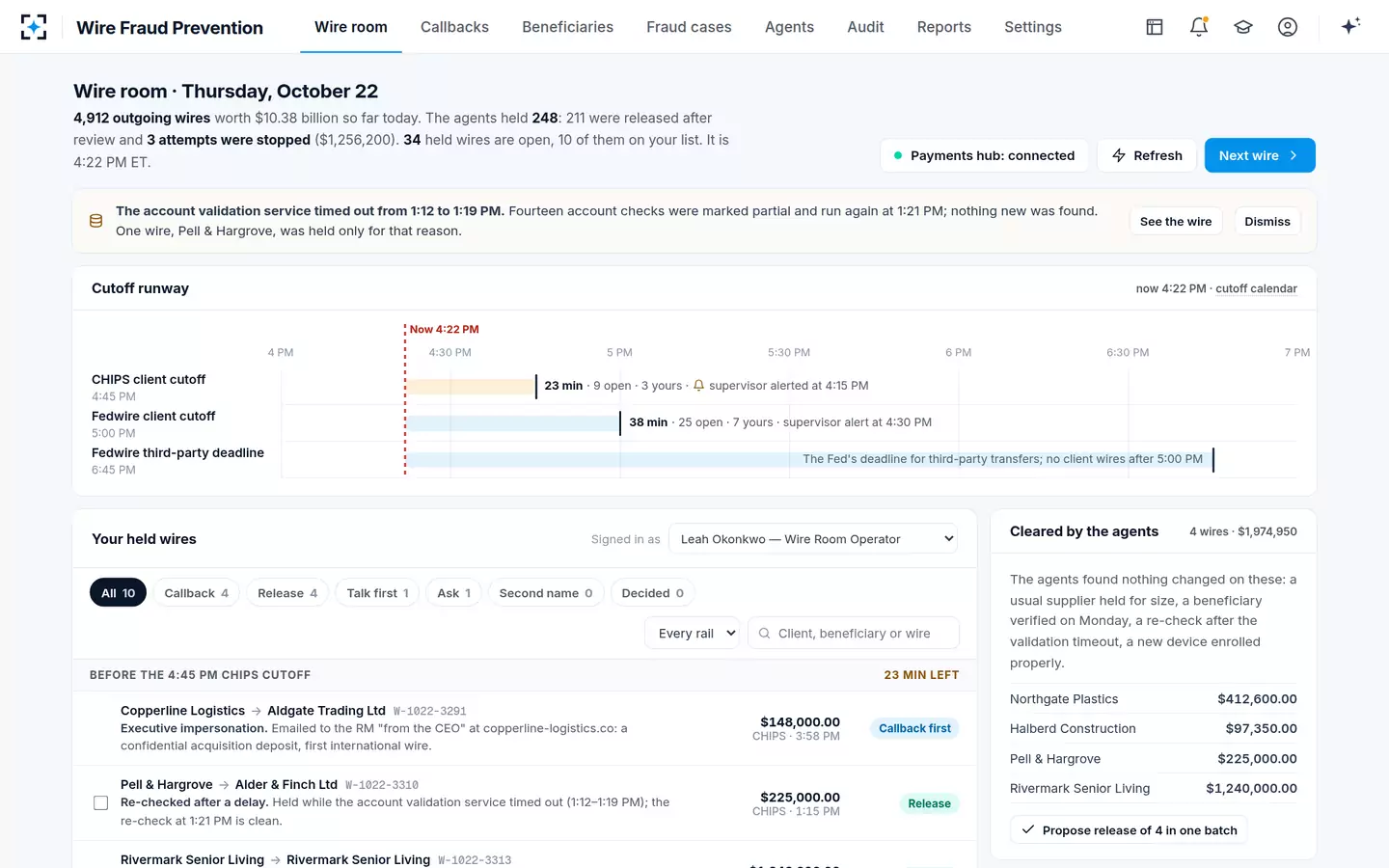
The examples come from a fictional sample bank as it runs through the solution: Corvane National Bank on the afternoon of Thursday 22 October, which by 4:22 p.m. had sent 4,912 outgoing wires worth $10.38 billion and held 248 of them for a closer look. The research figures come from regulators and are linked where they appear.
Five seats verify one wire, and each sees a different part of it
Today
Sees the payment order in the payments hub: amount, beneficiary, bank and the client's approvals. The email behind a new instruction and the client's past payments sit in other systems.
With agents
Opens one held wire with what changed against the client's history, the email behind the change already read, and a number of known origin ready to call.
Still theirs: the call, the judgement and the proposal to release or stop
Today
Often the operator. Picks a number to call, too often the one printed in the instruction, and types the answer into a free-text note.
With agents
Calls a number taken from the beneficiary template, the onboarding file or the signed agreement, with a script that never reads the new account out.
Still theirs: the conversation, and deciding whether the answer is convincing
Today
Adds the second name in the payments hub, often with only the maker's note to go on.
With agents
Signs against the callback result, the reason code and the evidence, and is never asked to check a decision of their own.
Still theirs: the second name on every release, stop and return
Today
Knows the client's vendors and habits, but is rarely in the wire room at 4:30 p.m. and hears about a stopped wire second-hand.
With agents
Approves a plain-words message to the client, drafted and checked for blame and confidential wording.
Still theirs: the relationship, and what the client is told
Today
Sees the pattern after the fact, when a recall or a client complaint arrives.
With agents
Gets a case with the evidence attached the moment an attempt is stopped, and a referral ready for the BSA team.
Still theirs: the investigation and the referral decision
What does it mean to verify a wire transfer?
Verifying a wire means answering three separate questions, and most failed controls answer only one. FinCEN's 2019 advisory on email compromise asks banks to look at how they "1) authenticate participants in communications, 2) authorize transactions, and 3) communicate information and changes about transactions". A token proves the first. An approval limit and a second signature cover the second. The third, a change of bank details carried by email, is where the money goes.
The order a wire room receives can be perfectly authentic and still wrong. In a vendor-impersonation scheme the client's accounts payable clerk enters the wire and the client's CFO approves it with a token, both in good faith. Every credential checks out, because the people using them are real. What is false is the account number they were given. The Federal Reserve Financial Services risk officer survey defines business email compromise on wires in exactly those terms: "The authorized credit transaction was misdirected to the criminal because the sender was deceived."
So "verify" has to mean more than "authenticate". A bank that checks only that the order came from the client has verified the sender. It has not verified the beneficiary, and in this kind of fraud the beneficiary is the only thing that changed.
Who approves a wire transfer at a bank?
At most banks a wire is approved twice inside the bank as well as by the client: a maker in the wire room releases or proposes, and a checker with a higher authority limit adds a second name. The client's own approvals in the portal come first and are a separate control. Where the bank's procedures require more, a held wire also needs a callback before either name goes on.
The approval chain should rise with the amount and with who is asking. After Heartland Tri-State Bank failed in 2023, the Federal Reserve's Inspector General recorded what one regulator told it: "A senior bank regulator noted that bank wire policies should establish a tiered system of approvals based on the title or duties of the requester and the dollar amount of the requested wire transfer." Heartland had no such tiered policy, and the report says that if it had, the board "may have had an opportunity to detect and potentially prevent" the wires that brought the bank down.
In the solution the tiers are settings. At the sample bank, a release, stop or return under $250,000 needs any second name; from $250,000 the second name must be a supervisor; and nobody can add a second name to a decision they made themselves. Other banks set the line at $100,000, $500,000 or $1 million. What matters is that the line is written down, versioned and enforced by the system rather than by memory.
What each seat verifies, and what it cannot see from its own screen
| Seat | What it verifies | What it cannot see on its own |
|---|---|---|
| Client portal (token, dual approval) | That the order came through credentials the client controls, approved by people the client authorised | Whether the bank details in the order belong to the vendor the client means to pay |
| Wire room operator | Format, limits, the template, and that the order matches what the hub expects | The email or document the new instruction came from, and the client's past payments to that payee |
| Callback caller | That a person at a known number confirms the details | Anything, if the number came from the instruction itself |
| Supervisor (second name) | That the maker's decision fits policy and authority limits | The evidence, unless it is put in front of them; otherwise the signature rests on a note |
| Relationship manager | Whether the payment fits what the client does and whom it pays | The held wire, unless someone calls them before the cutoff |
| Fraud analyst | Patterns across clients: one new bank appearing in two clients' wires on the same day | Today's held wires, until a case is opened |
The operator's seat: the payments hub shows the order, not the email
The operator verifies what arrives in the payments hub, and the hub holds the order, not its history. It shows the amount, the beneficiary, the routing and account numbers, the client's approvals and any rule that caused the hold. It does not show the email thread the client acted on, the PDF with the "new bank details", or the eleven earlier payments to the same supplier, all to a different bank.
That is why the work by hand takes so long. For one held wire that needs a callback, the operator opens the payments hub, the portal's audit log, the beneficiary templates and the core, each in its own window. In the sample bank's held wire, a $286,400.00 Fedwire from Brightwater Mechanical to its steel supplier Kessler Steel Supply, the useful facts were spread across four systems and one inbox: 11 earlier payments to Quillfield Bank, today's instruction to Harrowgate Savings Bank in Houston, and an emailed letter from a domain registered nine days earlier.
The agents' job at this seat is to gather, not to decide. The payment history agent sets the old details beside the new and marks what changed, 3 of 6 fields in that wire. The instruction origin agent reads the email and the attached document. The operator still judges what it means, and the line between what the agents prepare and what people decide is drawn so that no agent can release a wire.
The operator's afternoon: every held wire on a runway to its cutoff
The callback seat: the number decides the call
A callback verifies a wire only if the bank chose the number. Article 4A of the Uniform Commercial Code, which governs business wires, names callback procedures among the forms a security procedure can take; but a call to a number printed in a fraudster's letter reaches the fraudster, who will confirm everything. The phone number is the one part of the instruction the criminal is guaranteed to control.
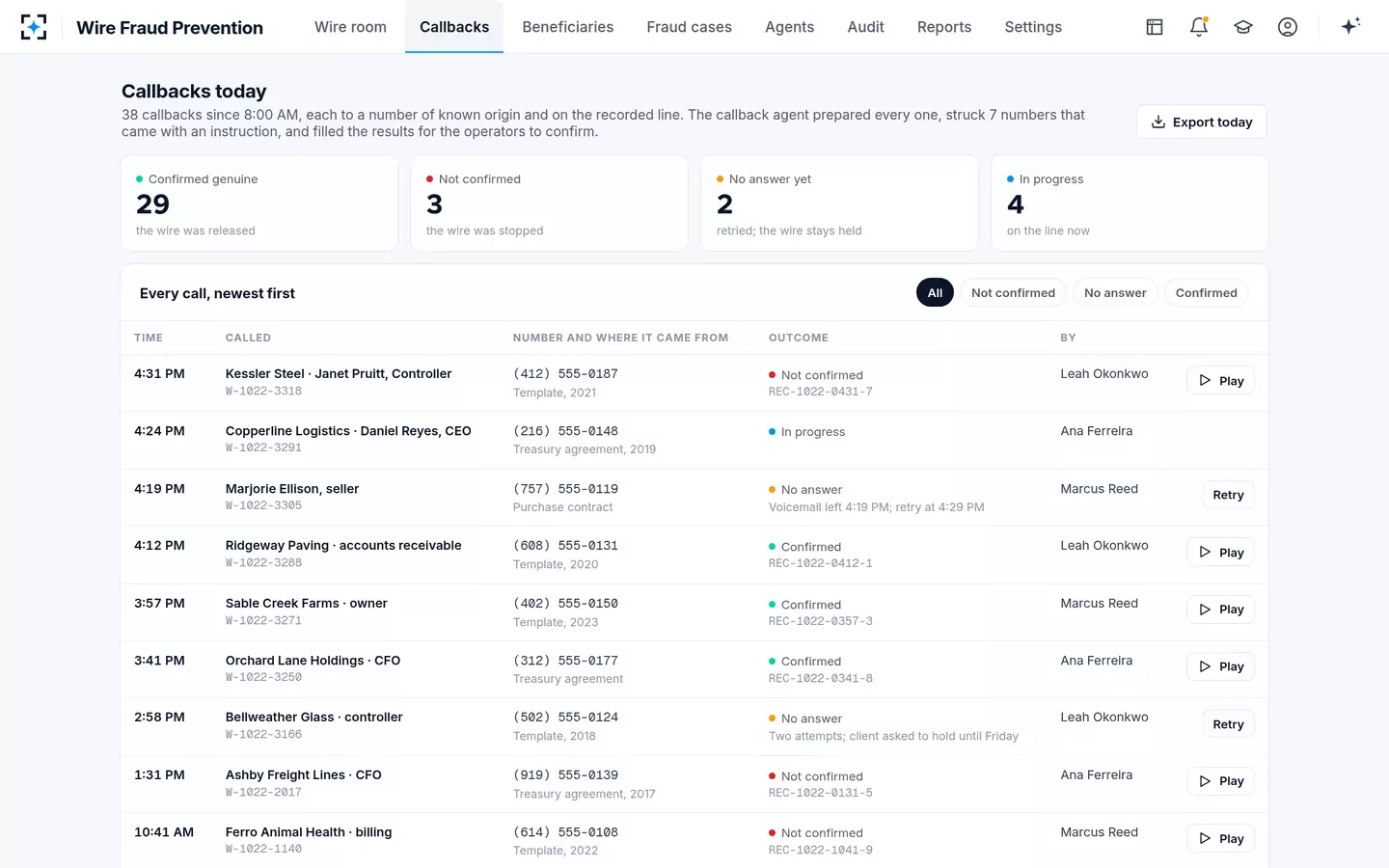
In the sample wire, the emailed letter carried a Houston number, (713) 555-0164. The callback agent struck it out and offered only Kessler's number from Brightwater's beneficiary template, on file since March 2021 and reconfirmed in April 2025. On that line Kessler's controller said Kessler still banked at Quillfield and had sent no change. The full path of that one account number, and the script used on the call, are the subject of their own guide.
The call stays with a person for a reason that has become sharper: a voice can now be imitated. What protects the bank is the origin of the number and the questions asked, not the sound of the voice that answers.
Every callback today, with where each number came from
What is dual control for wires, and why it failed at Heartland
Dual control means no single person can complete a wire: one prepares or proposes it and a second approves it. It is the oldest wire control there is, and it fails in a specific way, when the second person signs without evidence or cannot say no.
Heartland Tri-State Bank, a Kansas bank, is the plainest recent example. Between 30 May and 7 July 2023 its chief executive initiated ten outgoing wires, ranging from $1.4 million to $10.3 million and totalling about $47.1 million, to a cryptocurrency platform as part of what the Federal Reserve's Inspector General calls an apparent "pig butchering" scam. In April 2022 the bank had sent 16 outgoing wires, only one of them over $1 million. On 24 June 2023 its board adopted a wire policy that cut the daily limit to $3 million per sender, introduced dual control and required an officer to approve every wire. The three wires sent after that date each broke the new limit, by $300,000 to $5 million, and the CFO and other employees approved them anyway, according to the Inspector General's material loss review. The bank failed on 28 July 2023.
The lesson for a wire room is not that dual control is useless. It is that a second name is only as strong as what the second person sees and their freedom to refuse. A checker who signs against a maker's note is approving the note. A checker who signs against the payment history, the instruction's origin and the recorded call is approving the wire.
A second name is a control only when the second person can see the evidence and is free to say no. Without both, it is a signature on someone else's note.
The relationship manager and the fraud analyst: seats outside the room
Two people outside the wire room hold information the wire room needs: the relationship manager, who knows the client, and the fraud analyst, who sees across clients. In most banks they are reached by phone, if at all, while the cutoff approaches.
The relationship manager knows that a manufacturer has bought steel from the same supplier for five years and has never paid it by any other bank. That context turns "a new bank" from an anomaly into a red flag. The fraud analyst sees something no single wire shows. At the sample bank, the agents noticed that Harrowgate Savings Bank's routing number appeared in two held wires that afternoon: Brightwater's payment to "Kessler Steel" and $612,750 of seller proceeds from Fairhaven Title & Escrow for a house sale, also changed by email that morning. Neither client had ever paid that bank.
The solution brings both seats in at the moment they matter. The relationship manager approves the message to the client after a stop, in plain words and without blame, and the fraud analyst receives a case with the timeline and evidence attached, so the BSA team's referral starts from facts rather than from a phone call days later.
Why did my bank call me about a wire?
If a bank calls you about a wire, the wire has usually been held because something about it differs from your history: a first payment to a beneficiary, bank details that changed, or an amount far outside your usual range. The call is the bank verifying the instruction through a channel the instruction did not come from.
A properly run callback has three marks a client can recognise. The bank calls a number it already holds for you or for the payee, not one from the request. It asks you to state the details, such as the payee's bank and account, rather than reading them out for you to confirm. And it does not release the wire on "no answer". At the sample bank, a first wire to a new beneficiary over $10,000, or a payment more than three times the client's 12-month median to that payee, triggers a hold; banks set their own thresholds and write them into the funds transfer agreement.
A client who did not expect the call should still not trust it blindly. A caller claiming to be the bank can be a fraudster too. The safe answer is to hang up and call the bank back on the number from your agreement or the back of your card.
How long does wire verification take?
A wire that matches the client's history and the bank's rules is verified in seconds by the systems that screen it. A held wire that needs a callback takes as long as the evidence takes to gather and the call takes to make. By Botminds' estimate, that is about 65 minutes of work by hand, most of it spent opening systems and reading documents rather than on the phone.
Where one held wire's minutes go: with the evidence gathered, the call becomes most of the work
By hand · 65 minutes
- Opening four systems and comparing history · 22 min · 33.8%
- Reading the email · 15 min · 23.1%
- Finding a number and calling · 15 min · 23.1%
- Write-up and second name · 13 min · 20%
With the agents · 15 minutes
- Opening, history and email · 4 min · 26.7%
- The call · 8 min · 53.3%
- Write-up and second name · 3 min · 20%
The clock that matters is the cutoff. The Federal Reserve stops accepting customer transfers at 6:45 p.m. Eastern, and banks set their own client cutoffs earlier, 5:00 p.m. at the sample bank, to leave time for review. A held wire that needs an hour of work at 4:30 p.m. is a wire that either goes out unverified or misses the day. The Fedwire cutoff and the longer operating hours coming from 2028 change that arithmetic for every wire room.
Where Wire Fraud Prevention sits in the room
Wire Fraud Prevention does not add a seat; it changes what each seat sees. A coordinator agent holds wires that meet the bank's callback rules and keeps each rail's cutoff clock, alerting the supervisor 30 minutes before a cutoff and the wire operations manager at 15. The payment history agent builds the before-and-after, the instruction origin agent reads the email, and the callback agent prepares the number and the script.
People keep every decision that moves money. The operator calls and proposes release, stop or return with a reason code; the supervisor adds the second name; the relationship manager approves what the client is told; the fraud analyst owns the case. In the sample wire, the operator proposed a stop at 4:39 p.m. and the supervisor signed at 4:41 p.m., 19 minutes before the cutoff, and the $286,400.00 never left. If fraud is found only after a wire has gone, the work moves to recall and tracing, which Wire Recall Management and Wire Inquiry and Payment Tracking cover; to see the held-wire screens themselves, start from Wire Fraud Prevention.
Questions people ask
What is a wire room?
A wire room is the operations team that releases a bank's outgoing wires and works its incoming ones, usually inside payments operations. Its staff review held wires, make callbacks, repair messages and add second names before the Fedwire and CHIPS cutoffs. The sample bank's wire room, for instance, had released 211 held wires after review and stopped 3 attempts by mid-afternoon, so most of its work is clearing genuine wires quickly, not catching fraud.
Is a token approval enough to verify a wire?
A token proves the order came through the client's credentials; it does not prove the payee's bank details are right. In business email compromise the client's own staff approve the wire with real tokens after a forged email, so the token passes. Banks add a review of what changed and a callback to a number of known origin for exactly that case.
Does a bank check the beneficiary's name against the account number?
Not necessarily. Under UCC 4A-207, a beneficiary's bank that does not know the name and number refer to different people "may rely on the number" and need not check the name. That is why the sending side's verification of the account number matters more than the name on the order.
Can a bank verify a wire instruction by replying to the email?
No. If the email account is compromised or imitated, the reply goes to the fraudster. FinCEN's advisories point banks to a different means of communication, such as a call to a number on file or a check with others authorised on the account.
What happens if the bank cannot reach anyone before the cutoff?
The wire stays held. At the sample bank, two of 38 callbacks that day had no answer by mid-afternoon; both were retried while the wires waited. A held wire that misses the cutoff goes the next business day, which is a cost the client can be told about; a released wire that was fraudulent may not come back at all.