Wire fraud AI is most useful where a wire room is weakest: reading. In a business email compromise, the evidence that a wire is fraudulent sits in the client's own payment history, in the headers of the email that carried the "new bank details" and in the metadata of the attached letter, and an operator facing a 5:00 p.m. cutoff rarely has time to read all three. Agents can read them in seconds and set the result in front of a person. What wire fraud AI should not do is decide. In Botminds' Wire Fraud Prevention, agents compare, read and prepare a callback; a named operator makes the call and proposes release or stop; a different person adds the second name; and the record shows who did what and on which evidence. That split is not caution for its own sake. It is what the law of wire transfers rewards and what supervisors have penalised banks for ignoring.
The examples come from a fictional sample bank running the solution: Corvane National Bank on Thursday 22 October, holding a $286,400.00 Fedwire from a client, Brightwater Mechanical, to its steel supplier. The figures from the FBI, FinCEN and the bank regulators are linked where they appear.
Maker, checker and agents on one held wire: the agents prepare, two people decide
Agent
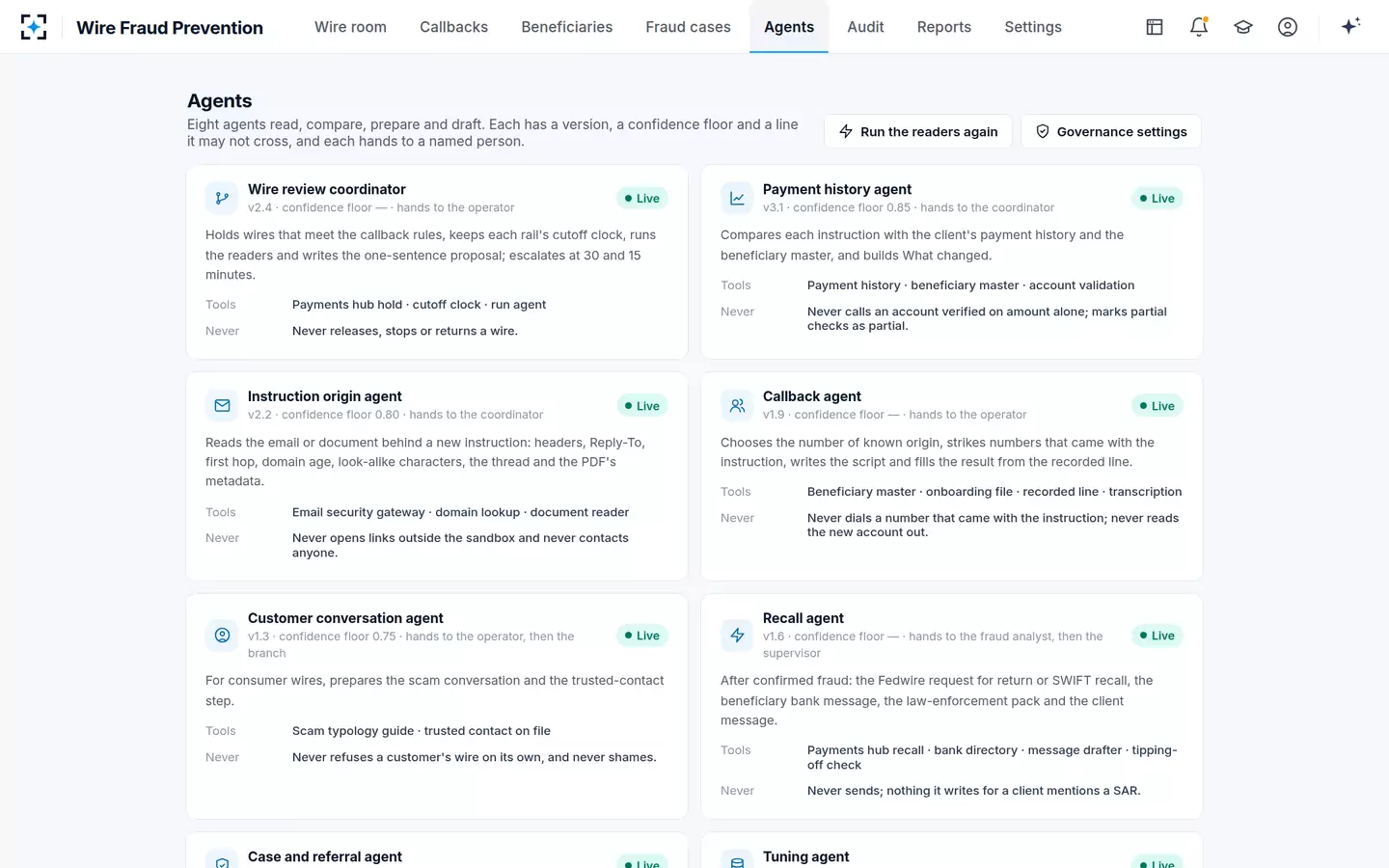
Coordinator agentHolds the wire because it meets a callback rule, starts the cutoff clock and runs the readers.
Never: releases, stops or returns a wire
Agent
Payment history agentSets the last 11 payments to the supplier beside today's instruction: 3 of 6 fields changed, the bank and account among them.
Never: calls an account verified on amount alone
Agent
Instruction origin agentReads the email and PDF behind the change: a look-alike domain nine days old, a different Reply-To, a letter created the night before.
Never: contacts anyone, or opens a link outside its sandbox
Agent
Callback agentTakes the supplier's number from the client's beneficiary template, strikes the number in the letter and writes a five-line script.
Never: dials a number that came with the instruction
A person decides
Operator (maker)Makes the recorded call, confirms the answers the agent filled in, and proposes Stop with a reason code.
A person decides
Supervisor (checker)Reviews the evidence and adds the second name; at $250,000 and above the checker must be a supervisor.
Never: checks a decision of their own
How is AI used to prevent wire fraud?
AI prevents wire fraud by doing three reading jobs before a person decides: comparing the wire with the client's history, reading where a new instruction came from, and finding a number to call that the instruction did not supply. None of the three is new work. Each used to be done by hand, partly, under time pressure, and often skipped.
The fraud they target is growing in a way that suits reading. The FBI's Internet Crime Complaint Center reported $3,046,598,558 in business email compromise losses on 24,768 complaints in 2025, up from $2,770,151,146 in 2024. The same report counted more than 22,000 complaints reporting AI-related information, and it describes the threat in the wire room's own terms: chat generators "can quickly create official-sounding emails mimicking a company's CEO", and "Voice cloning can also be used to request wire payment".
The fraud is already using AI; the defence is a reading problem
$3.05B
reported lost to business email compromise in 2025, on 24,768 complaints
22,000+
complaints to the FBI in 2025 reporting AI-related information
$893M
adjusted losses on those AI-related complaints
$30M+
lost by businesses in 2025 to business email compromise involving AI
The asymmetry is the point. A fraudster can generate a convincing letter in seconds; a wire room needs most of an hour to check one by hand, by Botminds' estimate. Agents close that gap on the reading side, which is where it is widest, and leave the judgement where it was.
Can AI approve a wire transfer?
It can be built to, and it should not be. An agent that releases wires turns every error it makes into a payment, and FinCEN warns that such transactions are "often irrevocable". An agent that prepares the decision turns its errors into a question a person can catch.
There is also a supervisory history. In 2022 the CFPB and the OCC took action against Bank of America over prepaid card claims it had decided with an automated filter. The CFPB found it acted unfairly in rejecting cardholders' error notices and freezing their accounts on nothing but a faulty filter's output, and the two regulators fined it $100 million and $125 million. That case was about claims, not wires, but the lesson carries: a filter may flag; a person decides, and the decision must rest on more than the filter's say-so.
In the solution, no agent has a release, stop or return action at all. The wire review coordinator holds and escalates; it alerts the supervisor 30 minutes before a cutoff and the wire operations manager at 15. If an operator disagrees with what the agents found, they record an override with a reason code and a note, and the override is part of the trail.
What is maker-checker for wires when an agent is in the loop?
Maker-checker means one person makes a decision and a second, independent person checks it before money moves. Adding agents does not change who the maker and checker are. It changes what they look at: both sign against the same evidence, laid out the same way, instead of against a free-text note.
Three rules keep the split honest. The agent is never the maker: it proposes nothing that moves money, and the operator's proposal carries the operator's name and reason code. The checker is never the maker: the system will not accept a second name from the person who proposed. And the checker's authority rises with the amount: at the sample bank, any second name will do below $250,000, a supervisor's above. Banks set the line where their own policy says; what matters is that the system enforces it.
What the agents may do, and what stays with people
Agents: Hold a wire that meets a written callback rule, and keep the cutoff clock.
People: Write the rules; only the wire operations manager signs a change, after a backtest.
Agents: Compare with the payment history, read the email and the document, cite every value to its source.
People: Judge what the evidence means for this client today.
Agents: Choose a number of known origin, write the script, fill in answers from the recording.
People: Make the call, hear the answers, confirm or correct what the agent wrote.
Agents: Write a one-sentence proposal of what the evidence shows.
People: Propose release, stop or return with a reason code; a second person signs.
Agents: Draft a plain-words message, checked for blame and confidential wording.
People: The relationship manager approves it and a supervisor checks it before it goes.
Agents: Open a case with the evidence and draft the referral facts.
People: The fraud analyst approves the referral; the BSA team decides on any filing.
Can AI make callbacks?
Technically, yes; a voice agent could dial a number and run a script. In this solution the callback agent chooses the number and writes the script, and a person makes the call. The reason is that a callback is a test of a relationship, and the person on the other end may themselves be an imitation.
FinCEN warned banks in 2024 that criminals "have reportedly used GenAI tools to target companies by impersonating an executive or other trusted employee and then instructing victims to transfer large sums or make payments to accounts ultimately under the scammer's control". A cloned voice defeats a callback that relies on recognising the voice. It does not defeat a callback that relies on where the number came from and on asking the other side to state facts only the real party knows. Those two safeguards are exactly what the agent prepares, and the judgement about whether the answers ring true stays with someone who can ask a follow-up question.
A note on numbers you will see quoted. In an April 2025 speech, Federal Reserve Governor Michael Barr put the rise in deepfake attacks over the previous three years at twentyfold. His footnote cites a press release from an identity-verification vendor, not a government or academic measurement. The concern is real; that particular figure is a vendor's, and this page does not rely on it.
Every agent with its version, its floor and the line it may not cross
How does AI read a wire instruction email?
It reads the email the way a careful fraud analyst would if they had twenty minutes: the headers, the Reply-To address, the first server hop, the authentication results, the age of the sending domain, the thread the message sits in, and the metadata of any attached document. It then compares the sending domain with the client's known counterparties character by character.
In the sample wire, the client's clerk acted on a reply inside the real invoice thread. The reply came from kesslersteeI.com: a capital I (Unicode U+0049) where the supplier's real domain has a lower-case l (U+006C). The domain had been registered nine days earlier. Replies went to an address at a different domain, and the email's authentication checks passed, but only for the look-alike domain, which proves the fraudster controls it, not that the supplier sent it. The attached letter was created at 11:52 p.m. the night before, on the supplier's 2023 letterhead.
The email behind the change, read letter by letter
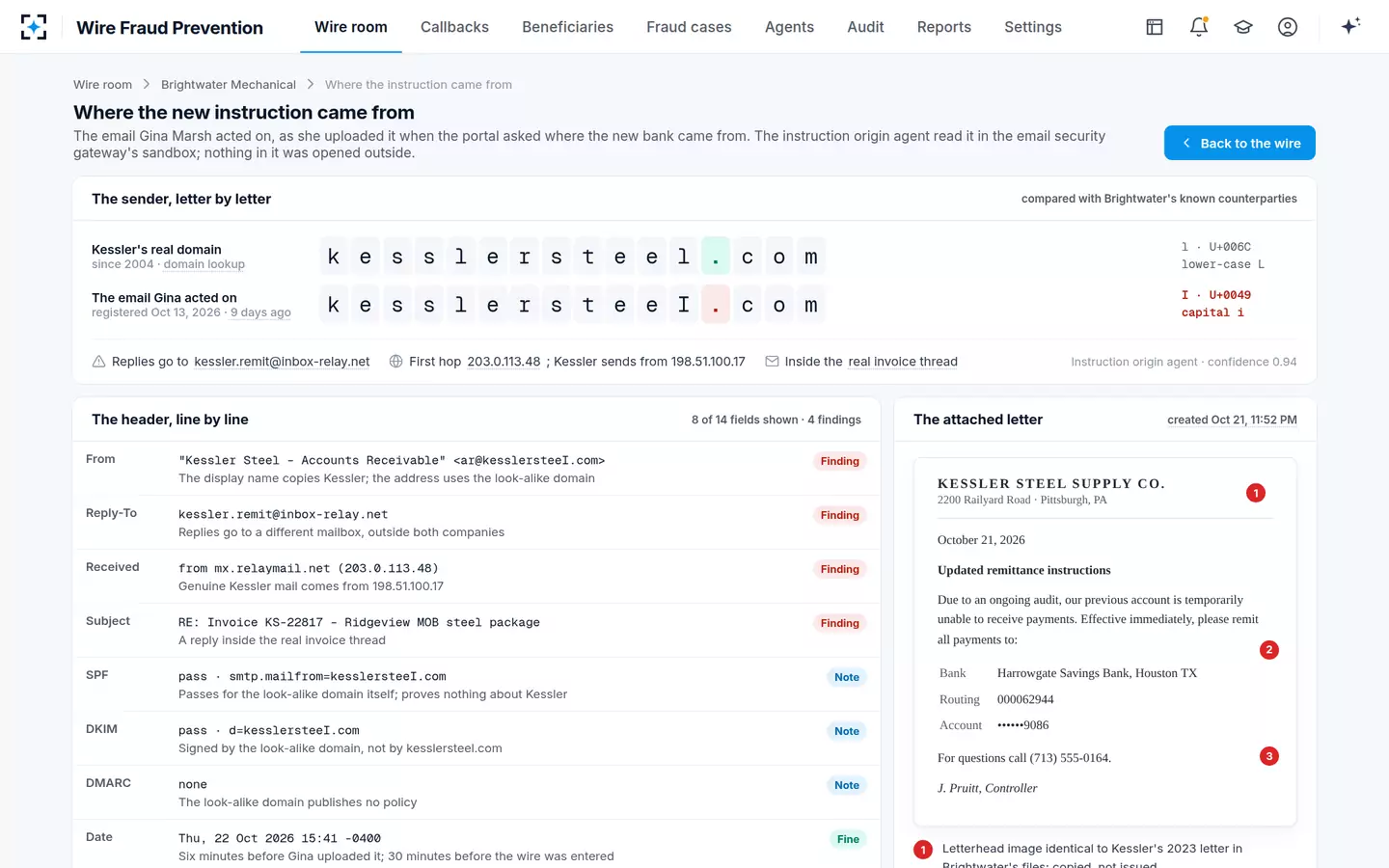
None of this is a verdict. A nine-day-old domain could belong to a supplier that rebranded; a letter written late at night could be genuine. The agent's job is to put the facts where the operator can weigh them, and the operator's job is to decide whether they justify a stop.
What does AI flag on a wire?
The agents flag differences from the client's own history and from the bank's written rules, never a bare risk score. A flag names what changed and cites where the old value came from.
What the agents flag, and the limit each one works under
| Agent | What it flags | Limit it cannot cross |
|---|---|---|
| Payment history | A new bank, routing or account number for a known payee; an amount far outside the client's range with that payee; a first wire to a new payee | Never calls an account verified on amount alone; marks a check partial when a source does not answer; confidence floor 0.85 |
| Instruction origin | A look-alike or newly registered sender domain; a Reply-To that differs; urgency or secrecy wording; a document created just before the request | Never opens links or attachments outside its sandbox; never contacts anyone; confidence floor 0.80 |
| Callback | A callback number that came with the instruction; a template whose number of known origin is missing | Never dials a number that came with the instruction; never reads the new account out |
| Customer conversation | For a consumer wire with scam signals: questions for investment, romance, impersonation and exploitation scams | Never refuses a customer's wire on its own; the customer decides |
| Tuning | Rules that hold unchanged wires and never catch an attempt, from a monthly count | Never changes a rule; proposes a version for the wire operations manager to sign |
Flags from different agents add up. In the sample wire, the payment history agent found a new bank after 11 payments to the old one, and the instruction origin agent found the look-alike domain. Neither alone proves fraud; together, and with the supplier's controller saying on the recorded line that nothing had changed, they made the stop easy to sign.
Do regulators allow AI in wire operations?
Nothing in US banking law forbids a bank from using AI to review wires, and nothing gives AI a special pass either. What has changed is the model-risk guidance. On 17 April 2026 the OCC, the Federal Reserve and the FDIC replaced the 2011 model risk guidance, and the new text leaves generative and agentic AI outside its scope, on the ground that both are new and changing fast. The same guidance says the word "model" does not cover fixed, rule-based processes, and says the agencies plan to issue a request for information on banks' use of AI, including agentic AI.
The agent prepares the case, one person makes the call, and a different person releases the money. No step that moves funds belongs to software.
Out of scope is not the same as unregulated. A bank still answers for the outcome of every wire under its funds transfer agreements and Article 4A, for fair treatment of consumers, and for third-party risk in whatever it buys. The practical reading for a head of wire operations is that the bank has to set its own controls for agents: written limits, pinned versions, confidence floors, human decisions on anything that moves money, and a trail an examiner can test. Those are the controls this solution ships with, and they are the questions to put to any wire fraud detection vendor before you buy.
What the trail has to prove when a client disputes a stop
A stopped wire can be disputed as easily as a released one. A client whose genuine payment missed the cutoff may ask why; a client who lost money may ask why the bank did not stop it. In both cases the bank's answer is its record.
For business wires, Article 4A puts the burden on the bank: where it relies on a security procedure, it must prove that it accepted the order in good faith and in compliance with that procedure and the customer's written instructions. A record that says "callback done, OK" proves little. A record that shows the number dialled and where it came from, who called, what was said, who proposed the decision and who signed it proves a great deal. In the solution every hold, call, proposal, signature, override and recording is kept with who, what, when, why and the evidence, cannot be edited, and is retained for seven years at the sample bank's setting. How Article 4A divides the loss when something goes wrong is a question for counsel, and the record is what counsel will ask for first.
That is the whole case for keeping the caller and the releaser apart, and both of them apart from the agents. Each person's name sits on one decision they could see and understand. To see the held-wire screens and the trail together, start from Wire Fraud Prevention.
Questions people ask
Is wire fraud AI the same as a fraud score?
No. A score says how unusual a wire looks; the agents here say what changed and where each value came from. An operator can act on "new bank after 11 payments to the old one, instruction from a nine-day-old look-alike domain" in a way they cannot act on "risk 0.87".
What happens when the agents are unsure?
Each reading agent works under a confidence floor (0.85 for payment history and 0.80 for instruction origin at the sample bank). Below the floor, or when a source does not answer, the check is marked partial and run again rather than reported as clean. A partial check never clears a wire on its own.
Can AI detect a deepfake voice on a callback?
Not reliably enough to rest a wire on it. The safer design does not depend on recognising the voice: it calls a number the bank already held before the instruction arrived, and asks the other side to state its own bank details rather than confirm them. FinCEN's 2024 alert lists impersonation of executives with GenAI tools among the schemes banks should expect.
Does AI reduce the number of callbacks a wire room makes?
It can, but only through a person's decision. In the solution a tuning agent counts holds, callbacks and confirmed attempts by rule each month and backtests changes that would avoid callbacks on unchanged wires without missing a confirmed attempt; the wire operations manager decides whether to sign the new version.
Who is responsible if the AI misses a fraudulent wire?
The bank, as it would be for any control. Using agents does not move liability to the software or away from the bank's procedures; what it changes is the quality of the evidence the bank's people see and the record the bank can produce afterwards.