Yes, a bank can hold a wire transfer before it sends it, and in the United States the legal reason is simple: under Article 4A of the Uniform Commercial Code a bank has no duty to accept a customer's payment order unless it agreed to, and an outgoing wire is not accepted until the bank executes it. What US law does not give a bank is a general power to delay a customer's payment because it suspects the customer is being scammed. The UK created one in 2024, allowing up to four business days; no federal US statute does. So a US bank holds a suspect wire using its account agreement, its procedures and, above all, the conversation with the customer, and the customer, if they insist, usually decides. Botminds' Wire Fraud Prevention holds wires that meet the bank's written rules, prepares the evidence and the questions, and leaves the decision to people: in business email compromise, the client can still cancel before the wire is sent.
The examples come from a fictional sample bank running the solution, Corvane National Bank. This guide explains the official texts; how they apply to a given account depends on the agreement and the governing state's law, which counsel should read.
The levers a US bank has to hold a suspect wire, and the limit of each
| Lever | Where it comes from | Its limit |
|---|---|---|
| Not accepting the order yet | UCC 4A-212: no duty to accept without an express agreement; 4A-209: an outgoing order is accepted when executed | A bank that agreed to execute owes the customer for failing to (4A-305(d)); an unaccepted order lapses after five funds-transfer business days (4A-211(d)) |
| Rejecting the order | UCC 4A-210: a notice of rejection, by any reasonable means | If the account had funds and no notice was given on the execution date, interest may be owed on a non-interest-bearing account |
| The account and funds transfer agreement | The bank's own contract: cutoffs, security procedures, rights to delay or refuse | Only what the contract says, read against Article 4A's rules that cannot be varied |
| The client cancelling | UCC 4A-211: a sender's cancellation is effective if received in time to act before acceptance | Needs the client to agree; after execution, cancellation needs the receiving bank's agreement |
| A state hold law for vulnerable or older adults | Some state statutes, such as Washington's RCW 74.34.215 | Only in states that have one, only for the people it covers, for a set number of days, with notices and reports |
| Reporting suspected elder exploitation | Federal Senior Safe Act (12 U.S.C. 3423): immunity for trained staff who report | Protects reporting, not holding |
Can a bank hold a wire transfer?
A bank can hold an outgoing wire until it executes it, because Article 4A imposes no duty to send a wire the bank has not agreed to send. Section 4A-212 says a receiving bank that has not accepted an order "does not otherwise have any duty to accept a payment order or, before acceptance, to take any action, or refrain from taking action, with respect to the order except as provided in this Article or by express agreement." For an outgoing wire, acceptance happens when the bank executes the order by sending its own payment order onward (4A-209).
A US bank may hold a wire it has not accepted. What it should not do is promise to send it, hold it without a written basis, and leave the client to find out.
The "express agreement" is the catch. Most business clients have a funds transfer agreement in which the bank promises to execute orders received before its cutoff and verified under the security procedure. A bank that holds an order it was obliged to execute does so at a price: under 4A-305(d) it is liable for the client's expenses and interest losses, and for more if the agreement says so. That is why agreements usually reserve the bank's right to delay or refuse a wire it suspects, and why a hold should be recorded with its reason.
Can a bank refuse to send a wire?
Yes, by rejecting the order, and Article 4A sets out how. Under 4A-210 a rejection needs no special words; it is sufficient if the notice "indicates that the receiving bank is rejecting the order or will not execute or pay the order", and it can be given orally, electronically or in writing. Once rejected, an order cannot later be accepted.
Rejection has a cost if it is silent. If the bank does not execute, the client's account had the funds, and the client got no notice of rejection on the execution date, the bank owes interest on the amount for each day until the client learns, where the account does not bear interest. So the operational rule is short: tell the client, the same day, that the wire is held and why, in words that do not reveal anything confidential.
How long can a bank delay a wire transfer?
No federal statute sets a fraud-hold period for wires, and Article 4A puts an outer limit on an unaccepted order rather than on a hold. Under 4A-211(d), "An unaccepted payment order is canceled by operation of law at the close of the fifth funds-transfer business day of the receiving bank after the execution date or payment date of the order." In practice a bank resolves a hold within hours: it calls, the client confirms or cancels, and the wire goes or does not.
Within the day, the clock is the cutoff. A wire held at 4:30 p.m. for a callback that cannot be completed before the bank's client cutoff goes the next business day if released at all; the Federal Reserve's own cutoff for customer transfers is 6:45 p.m. Eastern. A hold that rolls a wire to tomorrow costs the client a day; a wire released to a fraudster may cost the whole amount.
Is there a US rule like the UK payment delay?
No. Since 30 October 2024 a UK payment service provider may delay an outgoing payment if, by the end of the business day after it receives the order, it establishes reasonable grounds to suspect the order follows fraud or dishonesty by someone other than the payer. The delay may last only as long as the enquiries need, and never past the end of the fourth business day after the order arrived (the guide to the UK delay rules works through both clocks), and the payer must be told of the delay, the reasons and any action needed from them. The power applies to payments executed wholly within the UK in sterling.
Holding a suspect payment: the UK's statutory delay and the US position
United Kingdom (since 30 October 2024): Payment Services Regulations 2017, reg. 86(2A)–(2D), added by SI 2024/1013
United States: No federal statute; Article 4A (no duty to accept), the account agreement and, for some older adults, state law
United Kingdom (since 30 October 2024): Reasonable grounds to suspect fraud or dishonesty by someone other than the payer, established by the end of the next business day
United States: Whatever the agreement and the bank's procedures allow
United Kingdom (since 30 October 2024): No longer than necessary, and at most to the end of the fourth business day after receipt
United States: No set period; an unaccepted order lapses after five funds-transfer business days (4A-211(d))
United Kingdom (since 30 October 2024): Required: the delay, the reasons and any action needed, by the end of the next business day
United States: Not required by statute for a hold; silence before rejection can cost interest (4A-210(b))
United Kingdom (since 30 October 2024): Payments executed wholly within the UK in sterling
United States: Any outgoing wire the bank has not yet executed
The difference matters most for the customer who is being scammed and wants to pay. A UK firm can say: we are delaying this for up to four business days while we check, and the law says so. A US bank has to rely on what its agreement says, and on persuading the customer.
Holds for older customers: federal law first, then state law
Federal law protects a bank that reports suspected exploitation of an older customer; it does not authorise a hold. The Senior Safe Act gives trained individuals immunity when they report suspected exploitation of a senior citizen to a covered agency, where a senior citizen is someone 65 or older, and extends that protection to the institution when the staff concerned were trained. Its subject is the report, not the transaction.
Holds come from state law, where they exist at all. The federal agencies' Interagency Statement on Elder Financial Exploitation, issued in December 2024 and revised in June 2026, notes that some state laws let institutions hold a transaction, or delay paying out funds, for a time when they suspect any kind of financial exploitation, elder fraud included. The statement is guidance: it says it imposes no new requirements. It also notes that institutions may let account holders name trusted contacts, whom staff can call when exploitation is suspected.
One state's rule shows how specific such laws are. Washington's statute says that if a financial institution reasonably believes financial exploitation of a vulnerable adult may be occurring, it may refuse a transaction that pays out funds, though it need not, must make a reasonable effort to notify everyone authorised on the account, must report to adult protective services and local law enforcement, and that the refusal ends after five business days unless a court extends it, or ten for securities transactions. Other states differ in who is covered, for how long and what must be reported; a bank must apply the law of each state where it holds the account.
What happens if the customer insists on sending?
Usually the customer sends. Unless the agreement or a state hold law allows the bank to refuse, an adult customer can direct their own money, and a bank that refuses without a basis risks a complaint and liability under its agreement. The bank's real lever is the conversation, and its job is to make that conversation count.
FinCEN's 2022 advisory on elder financial exploitation describes what a scam looks like at the counter or on the phone. Among its red flags: an older customer who seems to be taking instructions from someone on the phone and is nervous or unwilling to hang up, and a customer frantic to send money at once for a loved one's supposed emergency when the money would go to an unconnected third party. Those signs are reasons to slow down, ask and, where the customer has named one, call the trusted contact.
A conversation with a customer who may be being scammed
- Ask how they came to make this payment, and who suggested it
Investment, romance and impersonation scams each have a story; let the customer tell it.
- Ask whether anyone told them to keep it secret or to lie to the bank
Scammers often coach victims on what to say to bank staff.
- Ask whether they have met the person they are paying, or spoken to them on a number they found themselves
Someone posing as a bank or government official will have supplied their own number.
- Say plainly what you see, and why you are concerned
Without shaming; the decision is theirs, and they should feel free to come back.
- Offer to call the trusted contact, or to wait a day
A day's pause costs little if the payment is genuine.
- Record what was asked, what was said, and who decided
If the customer sends anyway, the record shows the bank did its part.
What did the Heartland Tri-State Bank failure show?
It showed that the hardest wire to hold is one sent by someone the staff cannot say no to. Between 30 May and 7 July 2023, Heartland Tri-State Bank's chief executive initiated ten outgoing wires totalling about $47.1 million of the bank's own funds, in what the Federal Reserve's Inspector General called an apparent cryptocurrency "pig butchering" scam. The requests named a cryptocurrency platform, six of them broke the bank's daily wire limits, and they were approved anyway. The bank failed on 28 July 2023.
Heartland Tri-State Bank, from the first wire to the failure
- Ten wires, about $47.1M30 May – 7 Jul
- SAR, exam, closure7 – 28 Jul
The Inspector General's explanation is about people, not systems: "the CEO's dominant role in the bank and prominent role in the community contributed to a reluctance on the part of Heartland employees to question or report the alleged fraudulent activities earlier." A hold works only if the person holding can say why in terms that survive pressure. That means written triggers, a reason code on the record, and a second person whose name goes on the decision, whoever the customer is.
A held wire, worked with Wire Fraud Prevention
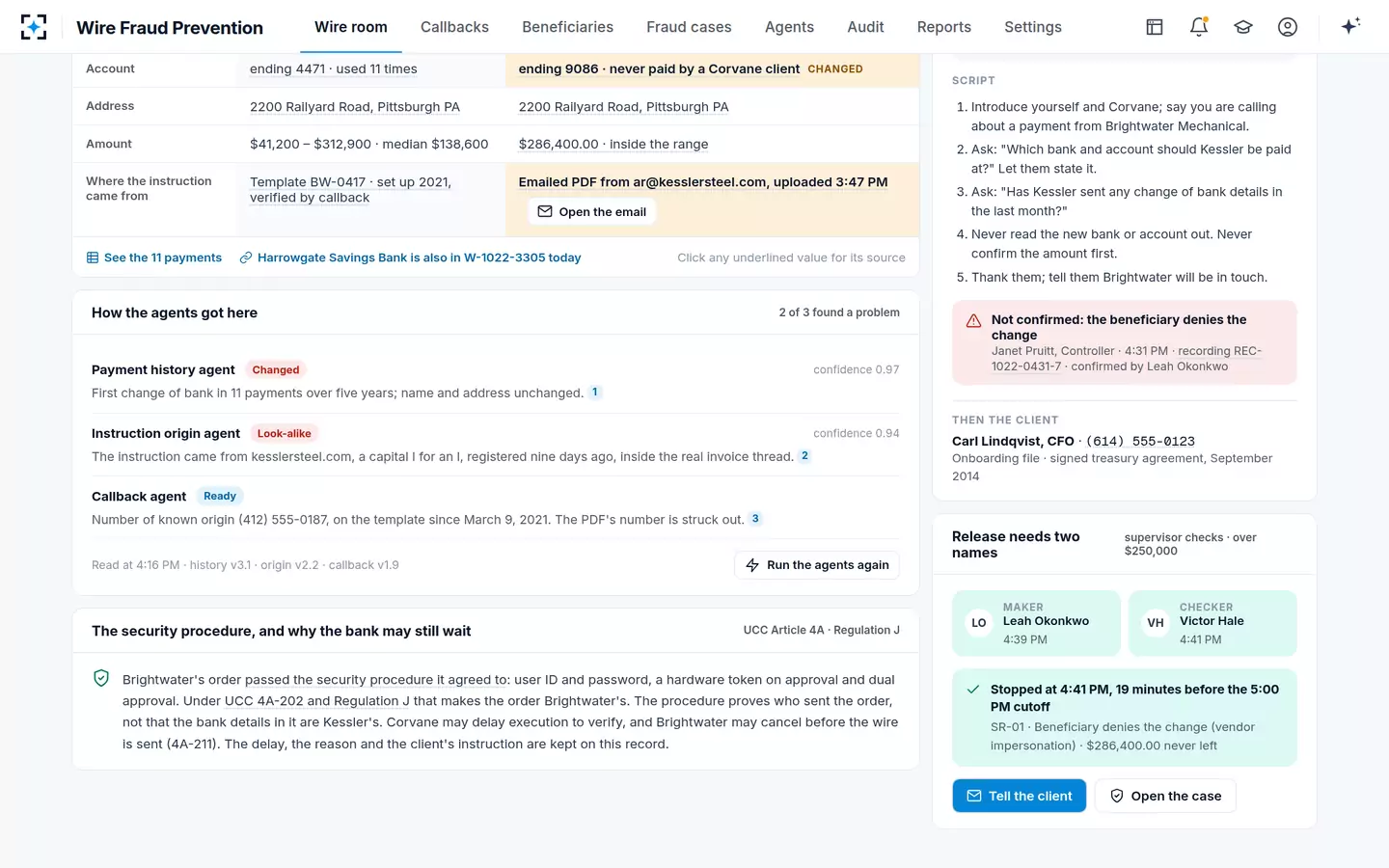
In the solution, a wire is held because it meets a written rule, not because someone felt uneasy: at the sample bank, a first wire to a payee over $10,000, an amount over three times the client's 12-month median to that payee, and any change of payee details. The agents gather what changed, read the email behind it and prepare a callback to a number of known origin. A person makes the call and proposes release, stop or return with a reason code, and a second person signs.
For business clients, the decision is usually the client's. In the sample wire, the supplier denied the change of bank details on a recorded call, and the client's CFO, called at the number on file, asked the bank to cancel the $286,400.00 wire before it was executed, which Article 4A allows. The operator proposed a stop with reason code SR-01 and the supervisor added the second name. How a bank verifies a wire seat by seat and which red flags justify a hold are covered in their own guides.
Stopped with two names and a reason, before the cutoff
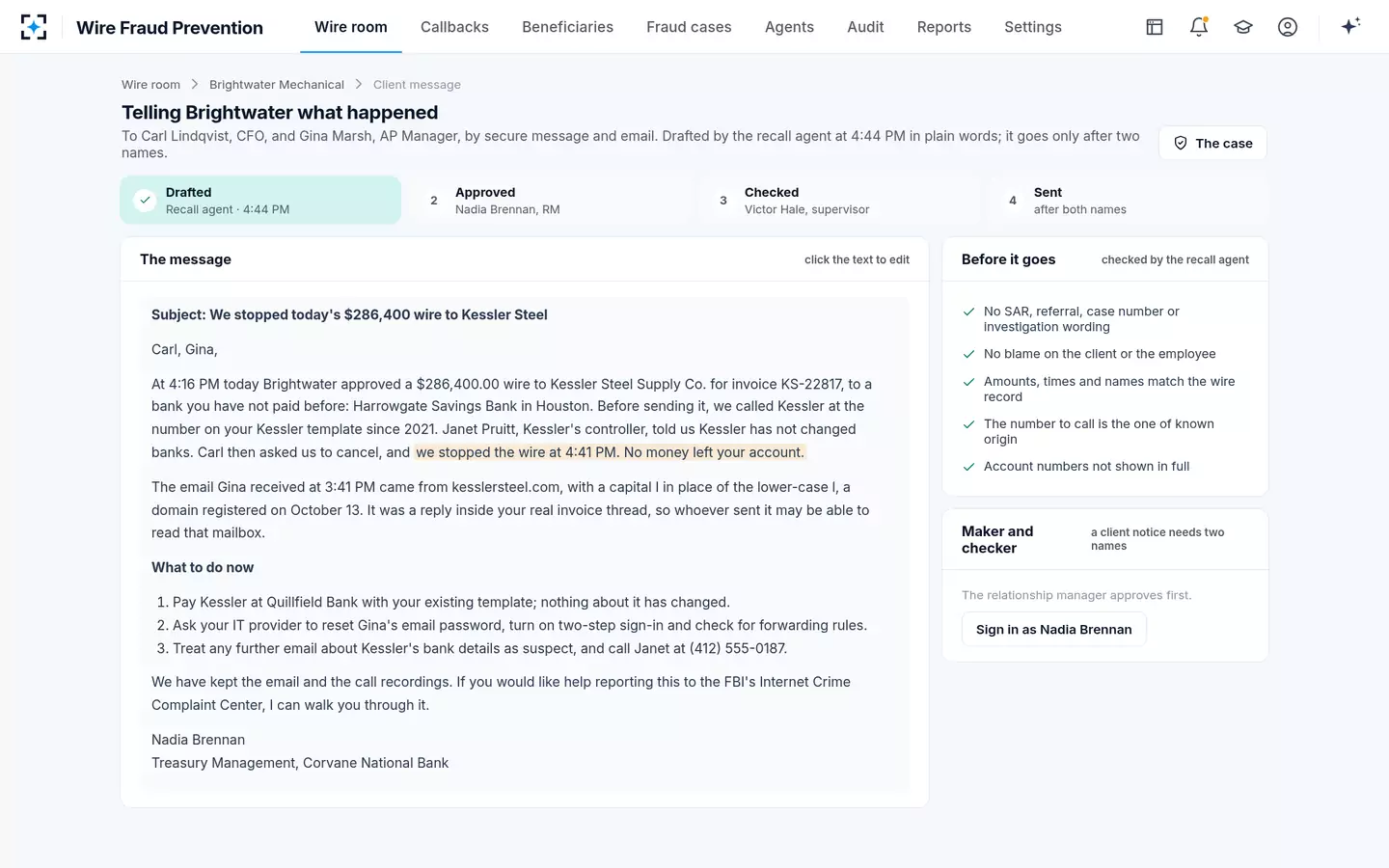
Telling the client is part of the hold. The relationship manager approves a plain-words message, drafted by the agents and checked by a supervisor before it goes, that says what happened, what the bank did and what to do now, with no blame and nothing that would reveal a referral to the BSA team. If a wire has already gone when the scam comes to light, the work turns to recall and tracing, which Wire Recall Management covers; holds for sanctions reasons belong to Payment Sanctions Screening. To see the held-wire screens, start from Wire Fraud Prevention.
The client told in plain words, after a hold becomes a stop
Questions people ask
Can a bank hold a wire for fraud without the customer's consent?
Before execution, a bank has no Article 4A duty to send a wire it has not agreed to send, and many agreements reserve the right to delay or refuse a suspect payment. Where the bank has agreed to execute, holding without a contractual basis can make it liable for the client's expenses and interest. The agreement is the first document to read.
How long can a bank hold a wire transfer?
No federal rule sets a period for a fraud hold. An order the bank never accepts is cancelled by operation of law at the close of the fifth funds-transfer business day after its execution date (UCC 4A-211(d)); some state elder-protection laws allow holds of set lengths, such as Washington's five business days.
Can a bank stop a wire to a scammer after it has been sent?
Not on its own. Once the bank has executed the wire, cancellation needs the receiving bank's agreement, and recovery depends on reaching that bank before the money moves. The FBI's advice is that "time is of the essence": the customer should call the bank at once and report to ic3.gov.
Does a bank have to warn a customer that a payment looks like a scam?
No federal statute requires a warning before a US wire. Many banks warn as a matter of practice and record the conversation, and in the UK a firm that delays a payment must tell the payer why. A clear, recorded warning is also the bank's evidence if the customer later disputes the loss.
Can a bank hold a wire because the customer is elderly?
Not because of age alone. A hold needs a basis in the agreement or, for suspected exploitation, in a state law that permits it, and those laws define whom they cover. A hold based on age alone has no basis in either; the federal Senior Safe Act protects reporting suspected exploitation of people 65 and older, not holding their money.