The UK bank payment delay rules let a payer's bank hold back an outgoing payment for up to four business days when it suspects the customer is being defrauded by someone else. Three conditions apply. The bank must establish reasonable grounds to suspect fraud or dishonesty by the end of the business day after it received the payment order; it must tell the customer about the delay, the reasons and what it needs from them by the same deadline; and it must not delay beyond the end of the fourth business day, or longer than it needs. The rules come from the Payment Services (Amendment) Regulations 2024, in force since 30 October 2024, and the Financial Conduct Authority's guidance on them, FG24/6. They exist to give banks time for a scam intervention; they are hard because the first deadline falls on the day after the payment, and the grounds must be real. Botminds' APP Fraud Detection helps a fraud team meet both: its agents state the grounds for each held payment with their sources the same morning, and draft the notice for a person to check and send.
The UK payment delay rules as a clock: what the bank must do, and may do, by when
D · the payment order is received
MustNothing yet required. The clock starts at the time of receipt.
MayScore the payment, hold it for review, gather evidence, call the customer.
By the end of D+1
MustEstablish reasonable grounds to suspect fraud or dishonesty by someone other than the payer. Tell the payer of the delay, the reasons and anything the bank needs, in an agreed manner and as soon as possible.
MayDelay crediting the payee’s bank, to contact the payer or other relevant third parties.
D+2 to D+4
MustDelay no longer than necessary: send the payment as soon as the enquiries show it should go.
MayKeep making enquiries; try to deter the payer from paying another way.
By the end of D+4
MustExecute the payment or refuse it. A refusal is notified no later than the end of D+4.
MayNothing further under the delay power.
Afterwards
MustPay any interest and charges the customer directly incurred because of the delay, whether or not the payment went.
MayKeep the grounds, length, outcome, value and vulnerability for Consumer Duty monitoring.
What are the UK bank payment delay rules?
They are a power, not a duty: a bank may delay a qualifying payment while it checks whether the customer is being scammed, and it must follow a strict timetable if it does. The regulation says the payer's bank "may delay crediting the amount of the payment transaction to the account of the payee’s payment service provider for the purpose of contacting the payer or other relevant third party to make further enquiries in order to establish whether it should execute the payment order". Two things follow from that sentence. The delay is for enquiries, so a bank that holds a payment and does nothing has misused it. And the third parties it may contact include, as FG24/6 lists them, "law enforcement agencies or the payee’s PSP or a PISP".
Before the change, banks had until the end of the next business day to execute a payment. The FCA described that in 2023 as "the currently permitted time period of D+1 (end of the next working day)", and the Treasury had committed to extend it. FG24/6 summarises the result: the regulations "enable PSPs to delay payments by up to 4 business days for the purpose of investigating transactions where the ‘reasonable grounds to suspect’ threshold is met". The new time was given to support the Payment Systems Regulator's reimbursement requirement, which began three weeks earlier.
When did the payment delay rules start? 30 October 2024, not 9 October
The rules came into force on 30 October 2024. The statutory instrument says so in its first regulation: "These Regulations come into force on 30th October 2024." It was made on 8 October and laid before Parliament on 9 October, which is where the wrong date in some summaries comes from. The PSR's mandatory reimbursement began earlier still, on 7 October 2024, for payments made on or after that date.
The difference matters for anyone reading a bank's history. A payment delayed for scam enquiries beyond the old execution deadline between 7 and 29 October 2024 was not covered by the new power; from 30 October it could be. FG24/6 records the same date in its opening line.
What counts as reasonable grounds to suspect fraud?
Reasonable grounds are more than a hunch and less than knowledge: a factual basis, specific to the payment, that would make a reasonable person suspect the customer is being deceived. FG24/6 puts it this way: "‘reasonable grounds’ to suspect fraud or dishonesty is more than mere speculation. It is based on an objective factual foundation, but falls short of knowledge". It adds that a bank should consider "the specific circumstances of the individual transaction", its own intelligence and any assessments from its technology.
Unusual is not enough. The guidance is explicit that "a payment order which appears unusual is not necessarily suspicious", because "even customers with a stable and predictable transaction profile will have periodic transactions that are unusual for them". An unusual payment is the start of an enquiry, not its conclusion. The FCA also removed from its final guidance a list of risk factors and scam types it had consulted on, after respondents warned that a fixed list would date quickly and would push banks to delay any payment that matched it.
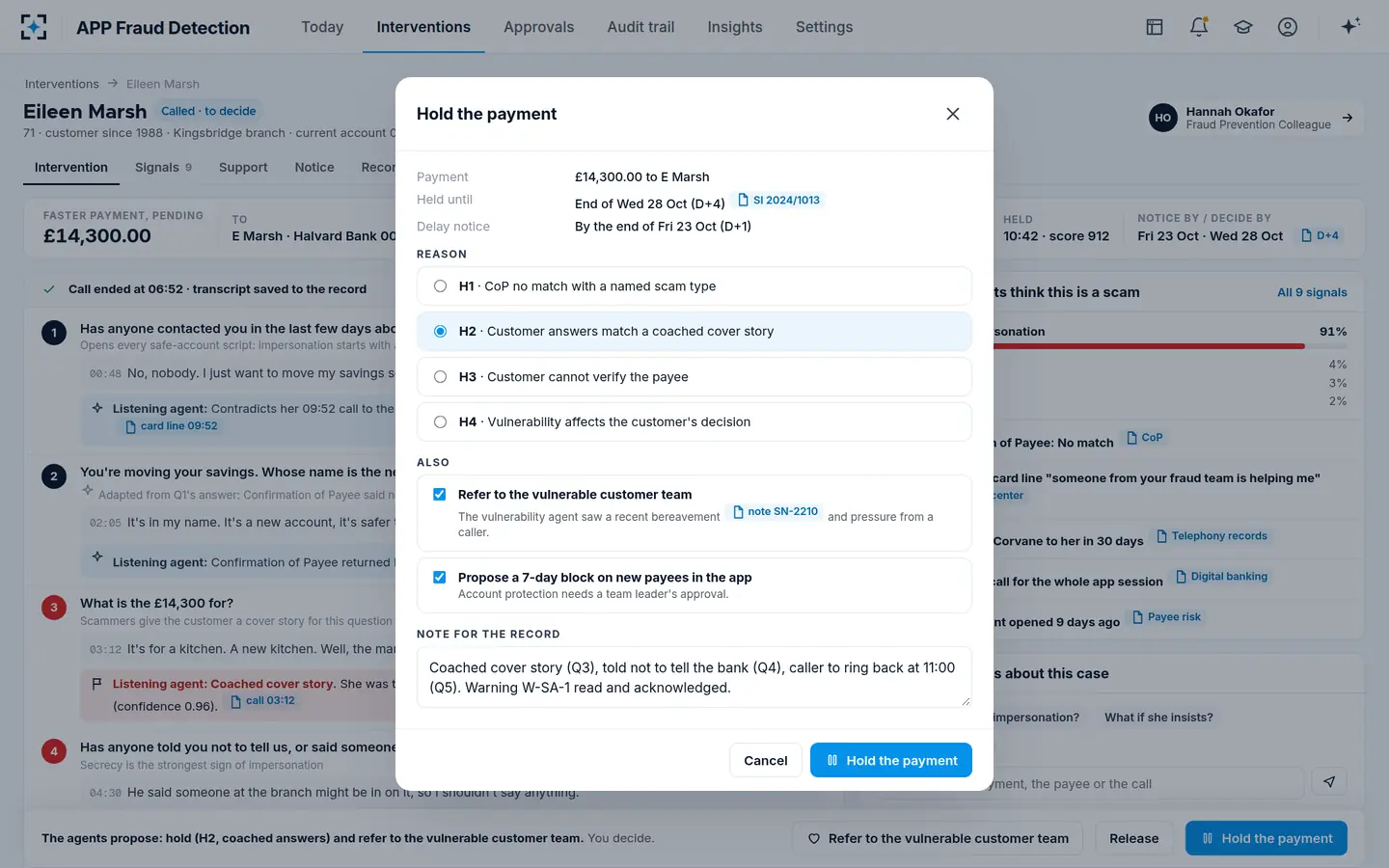
The sample bank's held payment shows what grounds look like in practice. Eileen Marsh, 71, sent £14,300.00 to a nine-day-old account in her own name at another bank, which the payee check said was not in her name; she had moved £12,000 out of savings eleven minutes earlier; she had told the bank's card helpline that a member of its fraud team was already helping her, and the bank had not called her in 30 days. Each of those is a stated, checkable fact with a source. Together they are grounds; the fraud engine's score of 912 on its own would not have been. The solution's typology agent assembles exactly that kind of statement for every held payment, and when its confidence falls below 0.70 it says "unclear" rather than inventing grounds.
The D+1 deadline: grounds and notice, both by the end of the next business day
Everything that makes a delay lawful has to be in place by the end of D+1. The grounds must be established "by no later than the end of the business day following the time of receipt of the payment order", and FG24/6 spells out the consequence: if a bank has not reached the threshold by then, "it will no longer be able to delay the payment transaction" under the new power. The notice to the customer runs to the same deadline.
One delayed payment on the calendar: two business days to state the grounds and notify, four to decide
- D: Thu 22 OctD · Thu
- D+1: Fri 23 OctD+1 · Fri
- WeekendSat–Sun
- D+2 and D+3Mon–Tue
- D+4: Wed 28 OctD+4 · Wed
For a fraud team the practical meaning is that detection must happen on the day of receipt or the next morning, for every held payment, not only the ones a colleague reaches first. That is why the sample bank sets its own target of calling the customer within 30 minutes of a hold, and why the solution escalates any held payment to a team leader four hours before its fourth day ends. Those are the bank's settings; the law sets only the two deadlines.
Holding a payment to the end of D+4, under a reason, with the notice due by the end of D+1
What is the D+4 rule?
The D+4 rule is the outer limit: a delayed payment must be sent, or refused, by the end of the fourth business day after the bank received it. The regulation says the delay must be "no longer than necessary to achieve the purpose described, and in any event, no longer than the end of the fourth business day following the time of receipt of the payment order".
Four days is a ceiling, not an allowance. FG24/6 reads "no longer than necessary" strictly: a bank "must execute a payment order as soon as it has contacted the payer or other relevant third parties and established that it should execute the payment order", rather than waiting until the end of the fourth business day as a matter of policy. A bank that routinely releases on day four whatever the call showed is not using the rule as written. While a payment is held, the FCA considers that the funds "should remain in the payer’s account for interest accrual purposes" but cannot be spent.
Must a bank tell me why my payment is delayed?
Yes, unless telling you would be unlawful or the bank suspects you are part of the fraud. The regulation requires the bank to notify the payer of "the fact of the delay", "the reasons for the delay" and "any information or action required of the payer", in an agreed manner, as soon as possible and by the end of D+1. FG24/6 adds that the notice should give the customer enough to "understand the risks that the PSP has identified, including the grounds for the PSP’s suspicion".
The exceptions are narrow. A bank should not notify the payer if its enquiries make it suspect the payer is complicit, or where notifying would be unlawful, "such as restrictions on tipping-off". The guidance also expects the bank to tell the customer once it has decided whether to send the payment, and notes that under the Consumer Duty a bank is likely to need "a real-time human interface, such as customer facing branch staff or a phone service" to answer the customer's questions.
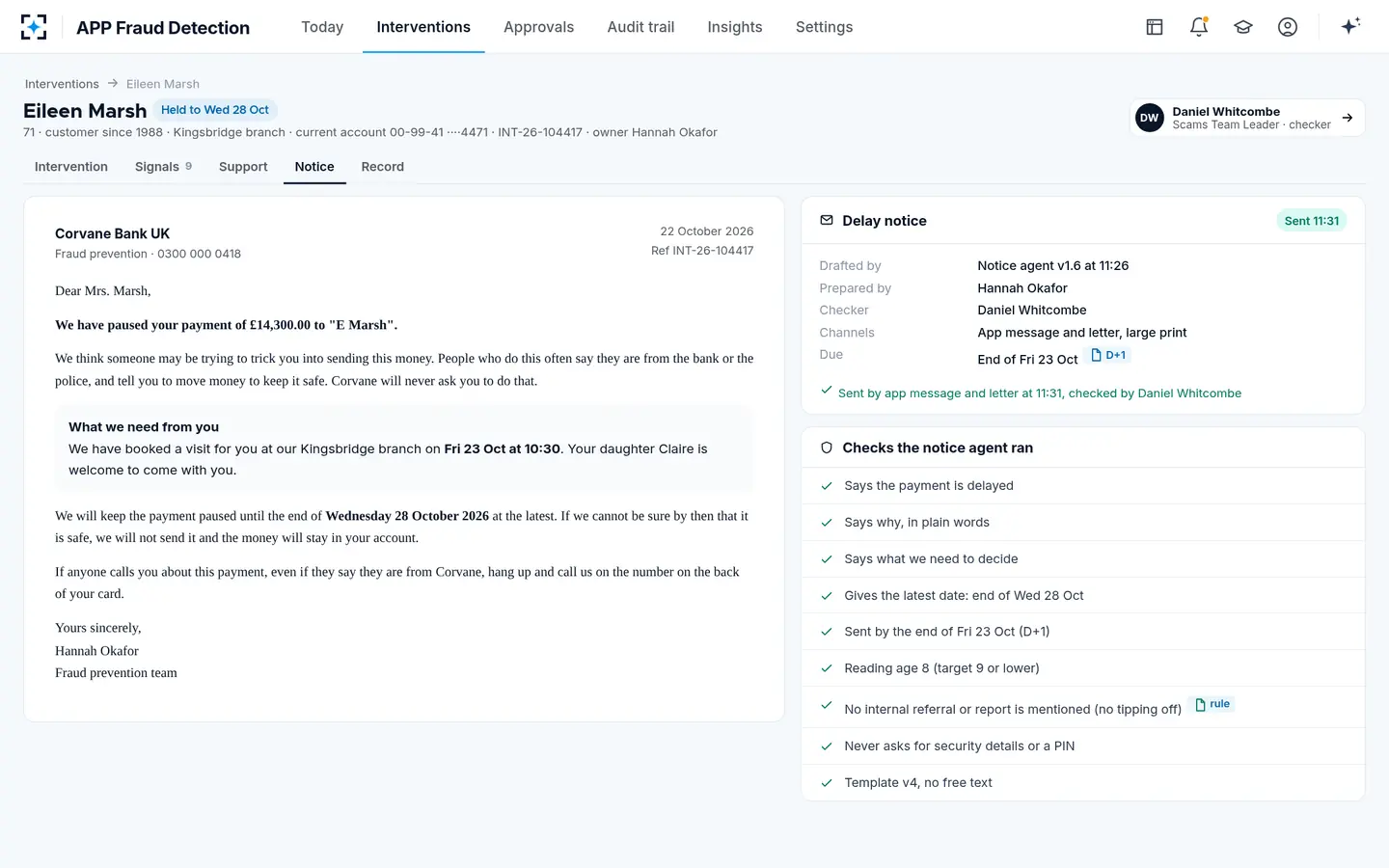
What a D+1 delay notice must contain, and what it must never say
- That the payment is delayed
The fact of the delay, stated plainly, with the payment it refers to.
- Why
The reasons, specific enough for the customer to understand the risk the bank has seen; not "for security reasons".
- What the bank needs
Any information or action required from the customer, such as a call or a branch visit.
- The latest date
Not required by the regulation, but the end of D+4 is the date a customer most needs to know.
- Sent in time, in an agreed manner
By the end of D+1, through a channel agreed with the customer.
- Never: an internal referral or report
Nothing that would amount to tipping off.
- Never: a request for security details
A notice that asks for a passcode teaches the customer to trust exactly the message a scammer would send.
A notice that meets the D+1 rule, checked before it is sent
Do the delay rules apply to international payments?
No. The power applies only to a payment transaction that is "executed wholly within the United Kingdom in sterling", that is authorised by the payer, and that is "not initiated by or through a payee". An international payment or a euro payment is outside it, as is a card payment the merchant initiates. The rules do not exempt payments started through an open banking payment initiation service; FG24/6 says such orders should be treated like any other "unless there are objective and duly evidenced reasons" to do otherwise.
Which payments the UK delay power reaches
Within the power: Executed wholly within the UK, in sterling
Outside it: International payments; payments in other currencies
Within the power: The payer, directly or through a payment initiation service
Outside it: Payments initiated by or through the payee, such as card payments a merchant takes
Within the power: Fraud or dishonesty by someone other than the payer
Outside it: Suspected fraud by the payer; anti-money-laundering law applies instead
Within the power: Consumers, micro-enterprises and charities, always
Outside it: Larger businesses that agree with their bank to opt out
Within the power: Outgoing payments, from the payer’s bank
Outside it: Incoming payments; the receiving bank relies on other rules
Two exclusions catch fraud teams out. If the bank suspects the payer of the fraud, the delay condition is not met; FG24/6 says the bank "would not be able to rely on Regulation 86(2B)" and points it to its money laundering obligations instead. And a payer that is not a consumer, micro-enterprise or charity may agree with its bank that the delay provisions do not apply. A fraud tool that treats every held payment the same way will misapply the rule to both.
What happens at the end of D+4?
At the end of D+4 the bank must have made its decision: send the payment, or refuse it under its existing powers and tell the customer. FG24/6 is clear that delaying a payment "does not change the terms under which the PSP can refuse it", and that a refusal of a delayed payment is notified "no later than the end of the fourth business day following the time when the payment order was received". There is no extension. The guidance also confirms that a bank may still try to persuade the customer not to pay the scammer by another route, during or after the delay.
On the sample case, the notice told the customer in plain words what would happen: if the bank could not be sure by the end of Wednesday 28 October that the payment was safe, it would not send it and the money would stay in her account. The customer's branch visit with her daughter was booked for the Friday, three business days before the limit, so the decision would not be made in a rush on the last afternoon. Questions for that visit, and for the call before it, are in scam intervention: a day on a bank's fraud prevention line.
What a delay costs the bank: interest, charges and a file for each payment
A bank that delays a payment under the power is liable for the interest and charges the customer incurs because of the delay, "irrespective of whether the payment order is ultimately executed". FG24/6 says that liability is narrow: it covers interest and charges directly incurred, including a third party's late-payment charge, and not wider losses such as a missed investment. Against that, a scam that gets through costs the sending bank half of any refund under the PSR's 50:50 reimbursement rules, up to half of the £85,000 maximum; APP fraud prevention sets out that comparison.
The other cost is evidence. FG24/6 expects banks to record, for each delayed payment, the grounds for suspicion, the length of the delay, whether it was completed or refused, its value and whether the customer showed characteristics of vulnerability, and it plans to consult on a permanent monitoring regime. Botminds' APP Fraud Detection writes those fields as the work happens: the grounds with their sources when the payment is held, the reason code at the decision, the notice and its checks when it is sent, and the outcome at release or refusal, on an append-only trail. What the agents may and may not do along the way is set out in scam detection software; the whole case is on the APP Fraud Detection page.
Questions people ask
Can a UK bank delay a payment for more than four business days?
Not under this power: the regulation sets the end of the fourth business day after receipt as the absolute limit. A bank may still refuse a payment under its existing powers, which it must notify by the same point for a delayed payment, and other laws, such as anti-money-laundering rules, have their own procedures.
Does the payment delay rule apply to CHAPS as well as Faster Payments?
The regulation is not limited to one payment system: it applies to authorised payments executed wholly within the UK in sterling that are not initiated by or through the payee. Its scope is set by those conditions, not by the scheme the payment runs on.
Will I be charged if my bank delays my payment?
The bank is liable for any charges and interest you incur as a direct result of the delay, even if the payment is eventually sent. FG24/6 says this does not extend to wider losses, such as an investment opportunity missed because the money arrived late.
Can my bank delay a payment because it is unusual?
Not for that reason alone. FG24/6 says an unusual payment is only a basis for further enquiry; the bank needs an objective factual foundation for suspecting fraud by someone other than you, established by the end of the next business day.
What is the difference between delaying and refusing a payment?
A delay pauses a payment while the bank makes enquiries, within the D+1 and D+4 limits. A refusal is a decision not to make it at all, under the bank's existing powers and terms. FG24/6 says a delay does not change when a bank can refuse.