APP fraud prevention means stopping an authorised push payment scam while the money is still in the customer's account: a held payment, a call that surfaces the scam, and a customer who keeps everything. Since 7 October 2024, UK victims of in-scope APP scams have had a right to reimbursement, and the regulator's data show it working; but reimbursement is capped, may carry an excess, can be refused, depends on the customer claiming, and does not reach international payments or scams outside the scheme's definition. For the bank, each reimbursed claim costs the sending and receiving firms half each. Prevention is worth more to the customer than any refund, and usually cheaper for the bank than its half of one. Botminds' APP Fraud Detection is built for that step: its agents name the scam behind each held payment, write the questions for it and flag coaching on the call, so a colleague can stop the payment with reasons that stand up later.
The rules and data on this page come from the Payment Systems Regulator (PSR), the Financial Conduct Authority and the UK Supreme Court, linked where they appear. Examples from the solution use its fictional sample bank, Corvane Bank UK; every figure about it is sample data, not a customer's result. How claims are decided and recovered between banks is covered by the separate APP Fraud Reimbursement solution; this page stays on the money that never needs a claim.
A £100,000 scam payment: what the customer ends up with, route by route
How do banks prevent APP fraud? By stopping it while it is still a held payment
Banks prevent APP fraud by spotting the payments a customer is being talked into, pausing them, and talking to the customer before the money leaves. Detection alone is not prevention: a fraud score can hold a payment, but only a conversation can show the customer that the person on the other end of their phone is not who they claim to be. The FCA's review of firms found that this kind of staff intervention helps prevent some fraudulent payments, by putting a trained person between the customer and the confirm button.
Since 30 October 2024 the law has given a sending bank time to have that conversation. A bank with reasonable grounds to suspect a payment follows a scam may delay a UK sterling payment to the end of the fourth business day, provided it established those grounds by the end of the first and tells the customer why. FG24/6, the FCA's guidance on the power, says the delay window may also be used to try to talk the customer out of paying by another route, because a customer who still trusts the scammer can simply try another bank. The UK bank payment delay rules sets out the clock in full.
Before the reimbursement rules, the courts declined to impose a duty to do any of this. In 2023 the Supreme Court held, in a case where a couple were deceived into sending £700,000 abroad, that a bank instructed by its customer must carry out the instruction promptly, and that whether victims or banks should bear such losses "is a question of social policy for regulators, government and ultimately for Parliament to consider". Parliament and the PSR answered with reimbursement. Academic work on the UK reforms describes the result as "a perceptive shift in the responsibility for fraud prevention and detection".
What is the maximum APP reimbursement, and who falls outside it?
The maximum is £85,000 per claim, a level the PSR expects to cover more than 99% of claims. A firm may deduct an optional excess of up to £100, which may not be charged to vulnerable consumers, and may choose to pay more than the cap. Above it (the APP fraud reimbursement limit has its own guide), the PSR points customers to the Financial Ombudsman Service, "which has a compensation limit of £430,000".
The bigger limit is scope. The protections cover individuals, microenterprises and charities paying from one UK account to another over Faster Payments or CHAPS, for payments made on or after 7 October 2024. They do not cover payments by card, cash or cheque, which have their own protections, and they do not cover a civil dispute with a genuine seller who fails to deliver. They "don’t include credit unions, municipal banks and national savings banks". And they do not cover international payments: the Supreme Court noted that the scheme "does not extend to international payments and therefore would not have applied to this case", the £700,000 sent abroad. A customer is expected to report as soon as possible and within 13 months of the payment.
What a refund does not reach: the limits of UK APP reimbursement
| Limit | What the rules say | What a stopped payment does instead |
|---|---|---|
| The cap | £85,000 per claim; firms may pay more | Keeps the whole amount, however large |
| The excess | Up to £100, at the firm’s choice; never for vulnerable customers | Nothing deducted |
| The exceptions | No refund if the customer was complicit or grossly negligent | No argument about the customer’s conduct |
| The claim | Report within 13 months; decision in 5 business days, up to 35 if the clock is stopped | No claim to make, no wait |
| The scope | UK accounts over Faster Payments or CHAPS; not international payments, card, cash or cheque | The delay power reaches qualifying UK sterling payments; a call can still stop the others |
What share of APP claims are reimbursed?
In the first 18 months, to 31 March 2026, the PSR reports that 88% of the money lost to in-scope APP scams, £316 million, has gone back to victims. It also reports that "82% of claims were closed within five business days – and 98% within 35 business days". Before mandatory reimbursement, the PSR's own data for the largest banking groups showed 60% reimbursed by value, with "a significant gap of 61 percentage points between the firms with the highest and lowest reimbursement levels".
The 88% is measured on in-scope money, and the PSR's notes say what is left inside the remaining 12%: the reimbursable total includes value "below the £100 excess, above the maximum cap (£85,000)" and transactions rejected within a claim that is otherwise reimbursable. A customer whose payment is stopped is not in this arithmetic at all.
Where the money and the claims went in 18 months of UK reimbursement
Claims reported (438,300)
- In scope · 69%
- Out of scope · 31%
Value of reimbursable claims
- Returned to victims (£316m) · 88%
- Not returned · 12%
Can a bank refuse reimbursement for lack of care?
Yes, but rarely, and never for a vulnerable customer. The PSR's rules allow a refusal where the customer was complicit or grossly negligent, and it describes gross negligence as "a high bar" that "does not apply to vulnerable consumers". In its first 18 months, "3% of claims were rejected due to the customer not taking enough care over the transaction or their claim".
The refusal depends on what the sending bank did before the payment. The PSR's guidance on the consumer standard of caution says interventions must be specific to the customer, the scam and the transaction, not boilerplate, so a bank that never held the payment or read a specific warning has little to point to. That makes the evidence gathered during prevention valuable twice: it is how the payment gets stopped, and if a scam still gets through, it is what a claims handler reads. What separates a warning that counts from one that does not is the subject of bank scam warnings that work.
What a refund does not return: the claims never made and the confidence lost
A refund returns money to the customers who claim it, and many do not. In its survey a year after the rules began, the PSR found that "49% of victims of fraud did not attempt to access reimbursement and 71% say they are unaware of the policy". Every one of those losses stays with the customer. A stopped payment needs no awareness of any policy.
The harm is also not only financial. The PSR's research found that "victims’ confidence in making payments drops after being a victim of an APP scam", and that "a third say they have also lost confidence in using new payment methods". Reimbursement helps: in the same survey, "half of victims who were reimbursed report trusting their bank more compared to around 1 in 3 of those who were not reimbursed". A customer who was never scammed has nothing to rebuild.
"APP scams cause immense suffering and harm to consumers and society, damage confidence in payments and lead to permanent loss of trust in institutions."
Payment Systems Regulator, on APP scams
What does the 50:50 split mean for the bank that sent the payment?
It means the sending bank pays half of every in-scope claim it reimburses, and the bank that received the money into a scammer's account pays the other half. In the PSR's words, "both sending and receiving firms splitting the costs of reimbursement 50:50", and its consumer page adds that this brings in, for the first time, the firms that bank the fraudsters.
For the sending bank the split changes the arithmetic of prevention in a simple way: every scam it stops saves half the refund it would otherwise have paid, plus the cost of handling the claim. For the receiving bank, it puts a price on each mule account it lets through. How each bank's performance on sending and receiving now shows up in public data is covered in PSR APP fraud performance data; how the two halves are calculated and settled between banks is set out in the APP fraud reimbursement scheme and its 50:50 split.
Is prevention cheaper than reimbursement? The cost of a hold against the cost of a miss
Usually, because the law prices a mistaken hold narrowly and a miss broadly. When a bank delays a payment under the new power, it is liable for the interest and charges the customer incurs because of the delay, and the FCA's guidance says that liability is "narrowly constructed": it covers interest and charges directly incurred, "and not to wider losses that a customer may experience from a payment delay", such as a missed investment. The money also stays in the customer's account for interest while it is held. A miss on an in-scope scam costs the sending bank half the refund, plus the claim's handling.
That does not make holding free. A held genuine payment costs the customer time and annoyance, and the bank a colleague's time; FG24/6 expects banks to keep, for each delayed payment, the grounds, the length of the delay and whether it was finally sent or refused, so they can show good outcomes under the Consumer Duty. The economic case for prevention is therefore a case for precise holds, not more of them: a hold with stated reasons, a short call, and a fast release when the reasons do not survive the conversation.
The bank's side of one decision: a hold that turns out wrong, against a scam that gets through
| A genuine payment held for a day | A scam payment let through | |
|---|---|---|
| Money the bank may owe | Interest and charges directly caused by the delay | Half of the reimbursement, up to half of £85,000, if the claim is in scope |
| Who else pays | No one | The receiving firm pays the other half |
| Work | A call, a notice, a release | A claim decided within 5 business days, a recovery from the other bank, possibly a complaint |
| Customer outcome | A delay, explained | A loss until reimbursed, if the customer claims; none of it back if out of scope |
| What the bank must keep | The grounds, the delay, the outcome | The claim file and the interventions made before the payment |
How much is lost to APP scams in the UK?
The PSR puts losses at "£459.7 million" in 2023, and its report on the largest banking groups found £145 million lost in the first half of 2024, "an 18% drop compared to H1 2023". Since the reimbursement rules began, customers have reported around 438,300 claims, of which 301,500 were in scope. Those figures count reported scams on UK payments; the PSR's own notes warn that wider measures of APP fraud, for example involving crypto, are broader than Faster Payments.
The scale of UK APP scams in the regulator's figures
£459.7m
lost to APP scams in 2023
−18%
losses in the first half of 2024 against the first half of 2023
438,300
claims reported, 7 October 2024 to 31 March 2026
£72.6m
reimbursed in the first quarter of 2026, the highest since the policy began
What a stopped payment looked like in APP Fraud Detection's sample bank
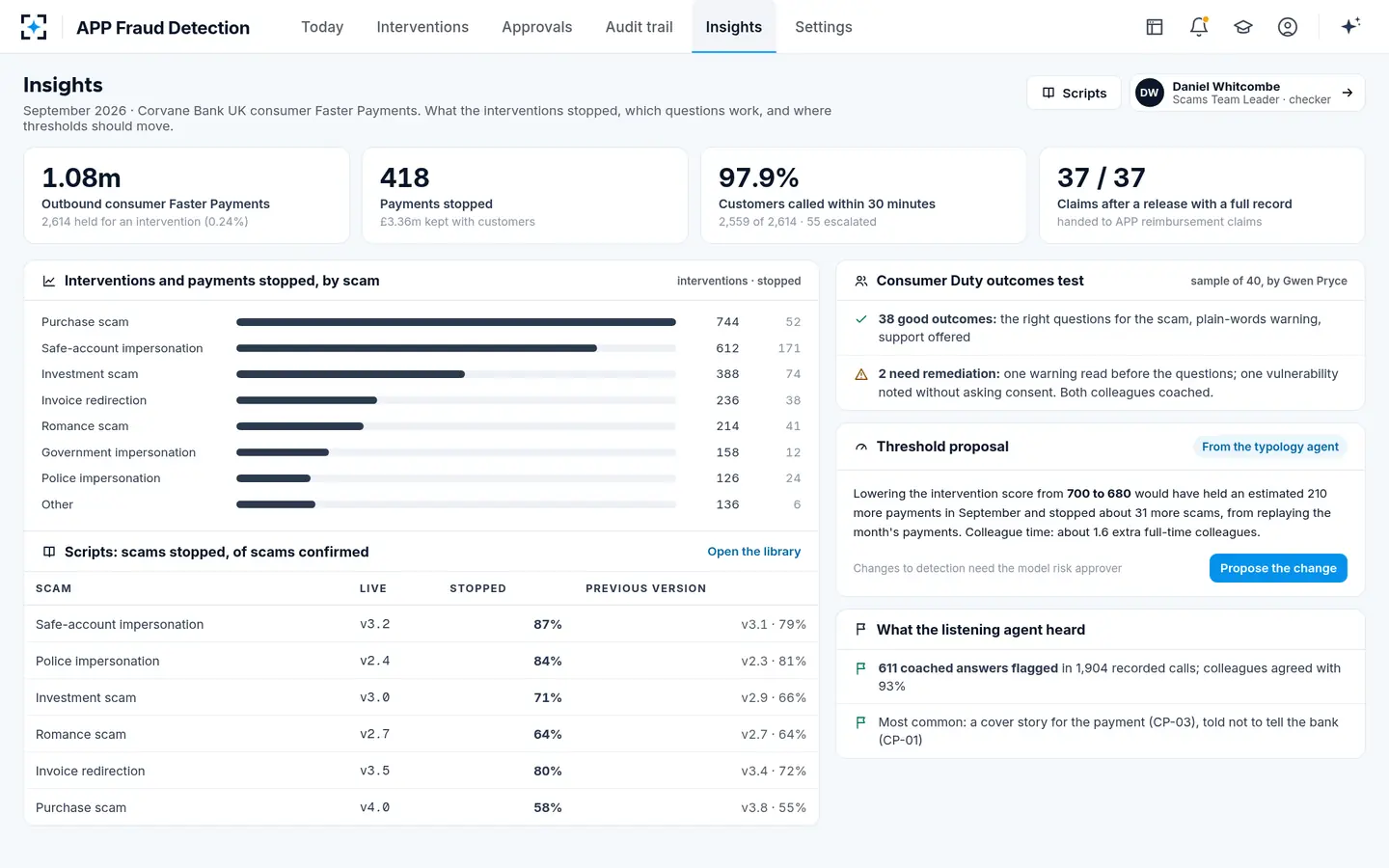
At the sample bank in September, Botminds' APP Fraud Detection worked on 2,614 payments held for an intervention out of 1.08 million outbound consumer Faster Payments, and colleagues stopped 418 of them, keeping £3.36 million with customers. Each of those customers kept the whole amount, with no claim, no excess and no wait. The same month, 37 claims followed payments that colleagues had released, and every one was handed to the reimbursement team with the full intervention file, which is what a claims handler needs when a stop fails.
A month at the sample bank: payments stopped, by scam, and the scripts that stopped them
One stopped payment shows what the number means. Eileen Marsh, 71, was sending £14,300.00 to an account a caller had told her to open in her own name at another bank. The payment was held at 10:42, the colleague's questions surfaced the cover story the caller had given her, and the payment was held to the fourth business day while a vulnerable customer specialist booked a branch visit with her daughter. She kept the £14,300.00. Had it gone, she would have had to make a claim, and the bank's own file already noted that, with her vulnerability recorded, the gross-negligence exception would not be relied on. As it was, there was nothing to claim.
Prevention that outlasts the hold: support recorded with consent, a trusted contact and a branch visit
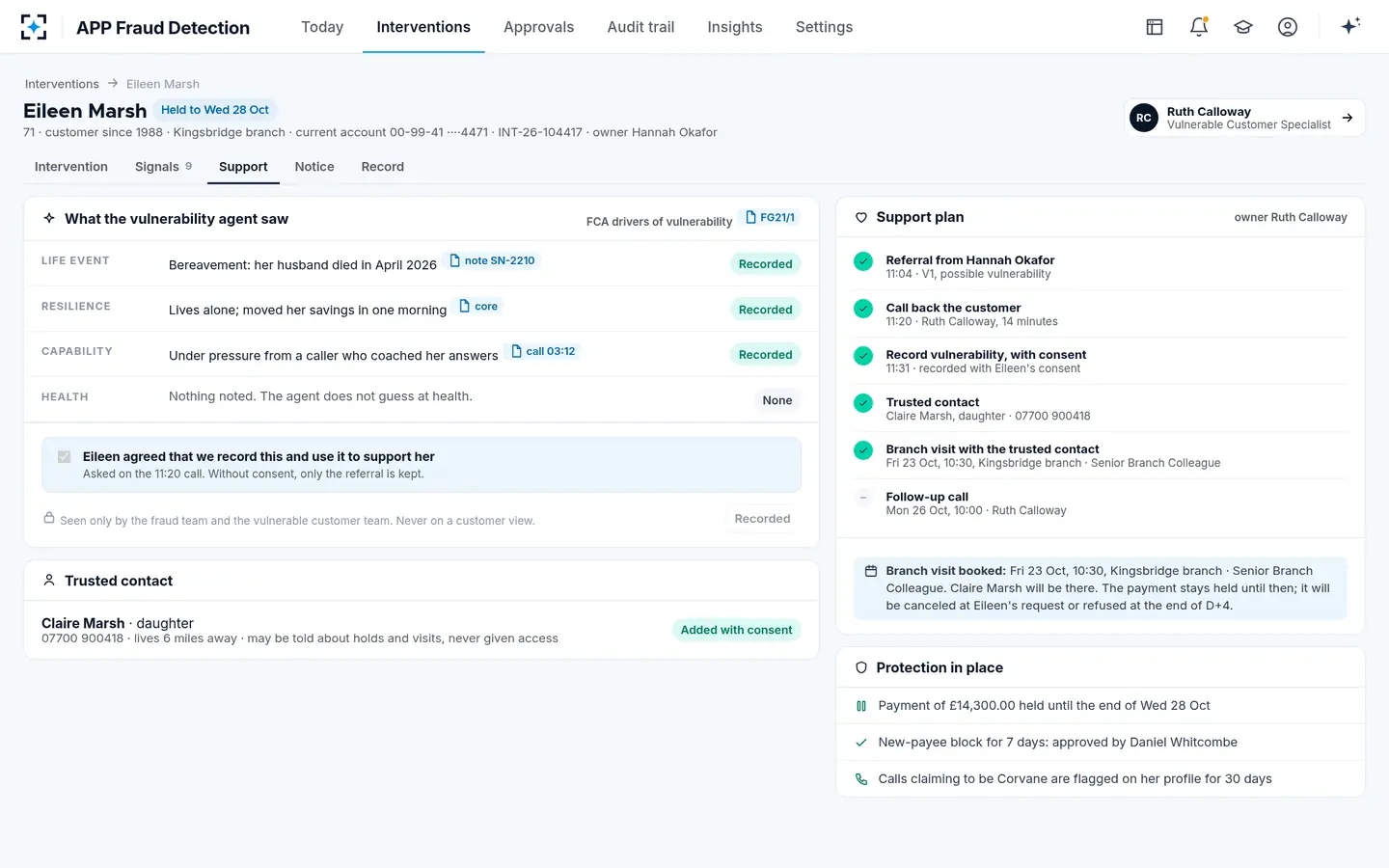
The solution's role in that outcome was preparation and evidence, not the decision. Its agents named the scam from nine cited signals, wrote the questions for it, flagged the coached answers and drafted the delay notice; the colleague decided, the team leader approved the block and the specialist arranged the support. To test that on your own payments before you buy, a pilot on last quarter's reimbursed claims sets out how. To see the case screen by screen, start from APP Fraud Detection.
Questions people ask
Is APP fraud reimbursement mandatory in the UK?
Yes, for in-scope payments made on or after 7 October 2024 by individuals, microenterprises and charities between UK accounts over Faster Payments or CHAPS. Payment firms must reimburse up to £85,000 per claim unless the customer was complicit or grossly negligent, and the sending and receiving firms share the cost 50:50.
Who pays for APP fraud reimbursement?
The sending firm and the receiving firm, half each. The PSR designed the split so that the bank whose customer received the money, often into a mule account, has the same incentive to prevent the scam as the bank whose customer sent it.
Does reimbursement cover international payments?
No. The scheme covers payments between UK accounts over Faster Payments or CHAPS; the Supreme Court noted it would not have applied to the £700,000 sent abroad in Philipp v Barclays. The UK delay power is also limited to payments executed wholly within the UK in sterling.
Does reimbursement make customers careless?
The PSR's data so far say no: it reports no indication of people being significantly less cautious, and the share of claims rejected for insufficient care was about 2% in the first quarter of 2026, against an average of about 3% over the previous four quarters.
How fast must a bank reimburse an APP scam?
Within five business days of the claim, unless the firm stops the clock to gather information, and in any case by the 35th business day. The PSR reports 82% of claims closed within five business days in the first 18 months.