The APP fraud reimbursement scheme is the UK's mandatory regime, in force since 7 October 2024, under which the bank that sent a scam payment over Faster Payments or CHAPS reimburses the victim, up to £85,000 per claim, and the bank that received the payment then pays the sending bank 50% of the amount reimbursed. A sending bank may take an excess of up to £100 from the customer, unless the customer is vulnerable, and the excess rules decide exactly how the cost is shared. The scheme has returned £316 million, 88% of the money lost in reimbursable claims, in its first 18 months, and the PSR's figures on reimbursement, speed and caution have become the scorecard every firm is read against. Botminds' APP Fraud Reimbursement handles both halves for a bank: the customer's claim, and the claim against each receiving bank for its share, calculated with the excess rule and tracked to payment.
This guide is for the executives and finance teams who carry the cost. It sets out who pays what, works the split on three invented claims, and lists the published measures a bank's own numbers will be compared with. No UK figure here is an estimate of ours unless it says so.
Who bears a £9,000 claim, and a £100,000 one
£9,000, £100 excess taken: the customer bears £100, and the £8,900 refund is split
- Sending bank £4,450 · 50%
- Receiving bank £4,450 · 50%
£9,000, excess waived
- Sending bank £4,550 · 50.56%
- Receiving bank £4,450 · 49.44%
£100,000, excess taken
- Sending bank £42,450 · 42.45%
- Receiving bank £42,450 · 42.45%
- Customer £15,100 · 15.1%
Who pays under the APP reimbursement scheme?
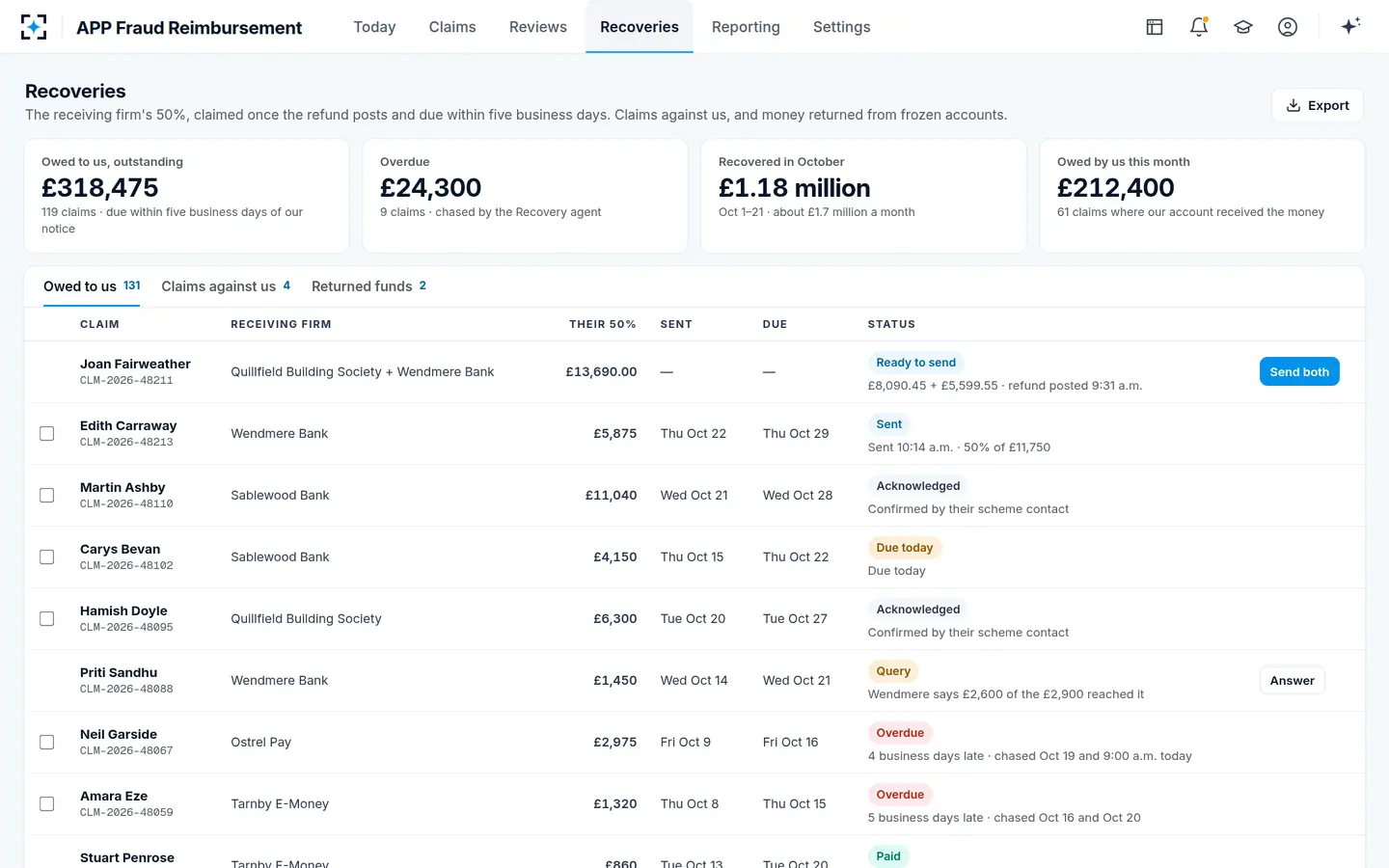
The sending bank pays the customer first, and the receiving bank then pays the sending bank half. The order is fixed: "They cannot request this contribution unless and until they have reimbursed the consumer." Once the refund is made, the receiving bank must pay its share within the period the scheme operator sets, which the Faster Payments rules put at five business days after the sending bank's notice that the amount is payable (PS25/5, footnote 26).
The split exists to change behaviour at the receiving end. The PSR's reasoning is that receiving banks "need adequate financial incentives to do more to detect fraud and prevent fraud losses, because they provide the accounts that fraudsters control and use." Before October 2024, reimbursement rested on the voluntary Contingent Reimbursement Model Code, and the PSR found that customers of its ten signatory firms were much more likely to be reimbursed. In the scheme's first three months, 60 firms that received a claim reimbursed victims.
The customer bears two things at most: an excess of up to £100, and anything above the £85,000 maximum. Neither applies where the customer's vulnerability had a material impact on their ability to protect themselves, for the excess; the maximum applies to every claim. Life above the cap, including the Financial Ombudsman route, is covered in the APP fraud reimbursement limit.
How is the 50:50 split calculated?
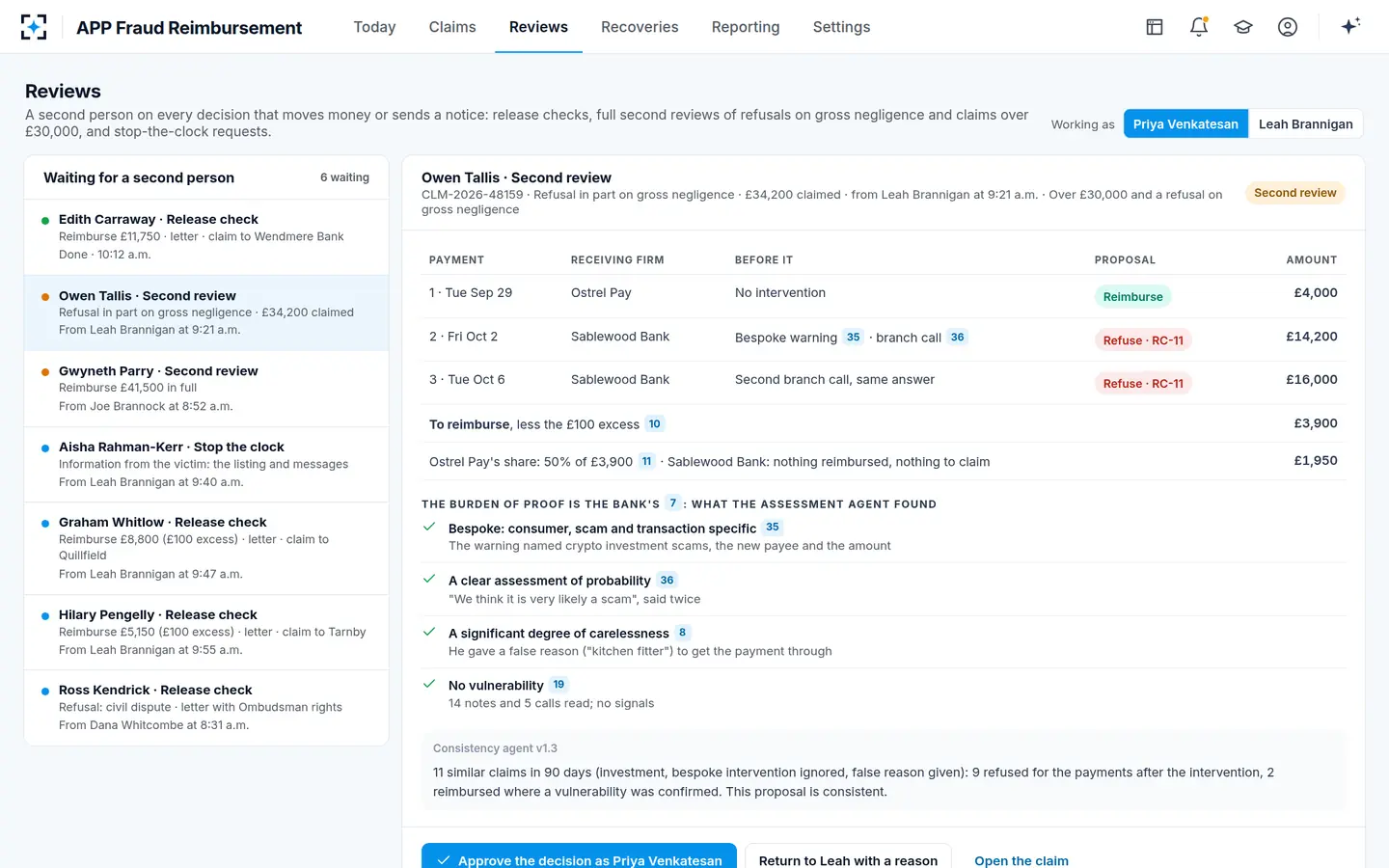
The receiving bank pays 50% of the lower of two amounts: what the sending bank actually paid the victim for payments that went to that receiving bank, and the required reimbursement amount for those payments. The required reimbursement amount is the full value of the claim up to the £85,000 maximum, less any excess the sending bank imposed (SR1 para 5.2). Using the lower of the two stops a sending bank from passing on half of a voluntary payment above what the rules require.
The receiving bank's contribution, term by term
What was paid
Refund to the victim for payments to this receiving bank
Only after the refund has been made; a payment after the claim closed does not count.
What was required
Claim value up to £85,000, less any excess imposed
For payments to this receiving bank. The lower of the two terms is used.
Half
50% × the lower of the two
The specified amount the sending bank may claim.
SR1 para 5.12
Excess deduction
− 50% of £100, if the sending bank chose not to take the full excess
Split pro rata where there are several receiving banks.
SR1 para 5.15
Work it on the first invented claim: £9,000 sent to one receiving bank, the customer not vulnerable, the £100 excess taken. The customer receives £8,900. Both the amount paid and the required amount are £8,900, so the receiving bank owes half, £4,450, and the sending bank bears the other £4,450. The customer's £100 is the only part of the loss not shared.
What happens when the sending bank waives the excess?
The sending bank pays for its own generosity. If it chooses to take no excess, the customer receives the full £9,000. The receiving bank's half would be £4,500, but because the sending bank chose not to apply the maximum excess, the receiving bank may deduct 50% of £100 and pay £4,450 (SR1 para 5.15). The sending bank bears £4,550. In effect the split is always worked as if the full excess had been taken, and a bank that waives it funds the waiver alone.
Where there are two or more receiving banks, each may deduct a share of that £50 in proportion to its liability for the reimbursable part of the claim. Multiplied across a year's claims, a policy of waiving the excess is a small, predictable cost to the sending bank; a policy that is applied inconsistently is a source of reconciliation disputes with every receiving bank. The choice, and how to write it down, is covered in APP fraud reimbursement policy.
What does the receiving bank never pay for?
Anything the rules call voluntary, and anything paid after the claim closed. Specific Requirement 1 says the receiving bank is not liable for "Any payment the sending PSP makes to its consumer after it has closed a claim, whether by reimbursement or rejection." That expressly includes payments resulting from a court or alternative dispute resolution decision after closure.
Three common situations fall on the sending bank alone. A reimbursement above the £85,000 maximum is voluntary. So is reimbursing a claim reported more than 13 months after the final payment. And a bank that rejects a claim and later reconsiders it, perhaps after a complaint, reopens it outside the scheme: the PSR's answer to that question is that it "would not be entitled to claim any contribution from the receiving PSP(s)". A wrong rejection therefore costs the full amount, not half, which is the strongest financial argument for getting the first decision right.
How much has been reimbursed under the scheme?
£316 million, 88% of the money lost in reimbursable claims, between 7 October 2024 and 31 March 2026, according to the PSR's dashboard. Consumers reported about 438,300 claims in that period, of which 301,500 were in scope.
Money returned to APP scam victims, cumulative since October 2024
The rate has held. In the first quarter of 2026 the share of reimbursable claim value returned was 89%, and the quarter's £72.6 million was the highest since the policy began. For calendar year 2025 alone the PSR's annual report gives 87% (£215 million). The PSR's definition matters when a bank compares its own figure: the denominator includes value below the excess, above the £85,000 cap and in rejected payments within an otherwise reimbursable claim, so a bank's rate on in-scope money alone will be higher.
Has APP fraud fallen since the scheme?
The independent evaluation commissioned by the PSR found that it has. The PSR summarised the findings on 1 July 2026: "APP fraud losses have fallen by an estimated £73 million per year and the number of APP scams have fallen by nearly 35,000 due to the policy." Reimbursement rates for all claims rose from 54% to 65%, and for in-scope claims firms are reimbursing 97%.
What the independent evaluation found, as the PSR reported it
£73m
a year less lost to APP fraud, estimated
35,000
fewer APP scams, nearly, due to the policy
54→65
per cent: the reimbursement rate for all claims, before and after
97%
reimbursed on claims in scope of the policy
The PSR added that "The biggest improvements have been seen by firms that had the highest APP fraud levels before the policy came into force", which is the receiving-bank incentive doing what it was designed to do. Volumes also fell early: about 126,000 claims were made between October 2024 and June 2025, around 15% fewer than in the same months a year before (PSR, October 2025).
What does the scheme cost banks?
The PSR has not published a cost per claim, but its evaluation found the scheme worthwhile after costs. Frontier estimated that "even after accounting for increased costs to PSPs, the policy is delivering a positive short term net benefit of £17m–£29m", a figure it called conservative. For an individual bank the cost has three parts: its half of each reimbursement it sends, its half of each claim against accounts it provides, and the cost of running claims to the rules.
The third part is the one a bank controls most directly. Botminds' own estimate puts the people's time on one claim handled by hand at about six hours, and about 1.2 hours with the solution, excluding time waiting on the customer or the receiving bank. That is an estimate, not a measured result, and a bank should replace it with its own time study before building a business case on it.
What are the PSR's APP measures? A bank's scorecard
The measures the PSR publishes for the industry are the ones a bank will be compared with: reimbursement by value, speed, caution rejections, receiving-bank payment and data quality. Firms report the underlying data to Pay.UK monthly, and the PSR has said it monitors outliers.
The industry figures a bank's own numbers will sit beside
| Measure | Industry figure | Period | Published in |
|---|---|---|---|
| Reimbursable value returned to victims | 88% (£316m) | 7 Oct 2024 to 31 Mar 2026 | PSR dashboard |
| Claims closed within five business days | 82% | same | PSR dashboard |
| Claims closed within 35 business days | 98% | same | PSR dashboard |
| Claims rejected for lack of customer care | 3%; about 2% in Q1 2026 | same | PSR dashboard |
| Claims passed to the receiving firm within two business hours | 86% | first three months | PSR, May 2025 |
| Receiving firms that paid their share within five days | 67% | Oct 2024 to Jun 2025 | PSR, October 2025 |
| Firms submitting accurate data on time | 95% | first year | PSR, October 2025 |
Two lines on that table are where receiving banks are weakest. Only 67% paid their share within five days in the first nine months, and the PSR's supervision team has called improving that "a priority". Every late contribution is money a sending bank has already paid out and not yet recovered.
Where the money leaks inside a bank
Most of the scheme's cost is set by the rules. The leaks are operational, and four recur. Contributions claimed late, or not claimed at all, because nobody owns the second claim. Contributions calculated without the excess rule, so the receiving bank queries and pays late. An excess taken from a customer later confirmed vulnerable, which must be refunded. And claims rejected wrongly and reopened, which fall entirely on the sending bank.
In Botminds' solution the Recovery agent computes each receiving bank's 50% with the excess rule and pro rata across banks, claims it once the refund posts, tracks the five-day contribution clock and chases overdue contributions in bulk; a second person approves any payment out to another firm. In the solution's fictional September, a bank recovered £1.69 million of £1.72 million due from receiving firms, and the Consistency agent found 11 claims where an excess had been taken from a customer whose vulnerability was later confirmed, with refunds drafted for approval. The mechanics of the claim between banks are covered on the reimbursement claims management system page.
The receiving firm's share, worked on a part refusal
Contributions owed to the bank, each on its five-day clock
Questions people ask
Is the APP reimbursement scheme the same as the Contingent Reimbursement Model?
No. The Contingent Reimbursement Model Code was voluntary and applied to its signatory firms; the PSR's requirement is mandatory for all in-scope firms and covers payments made on or after 7 October 2024. Firms may still reimburse earlier payments voluntarily, including under the old code.
Does the receiving bank pay half of the excess?
No. The split is worked as if the full £100 excess had been taken. If the sending bank chooses not to take it, the receiving bank may deduct £50 from its share, so the waiver costs the sending bank alone.
What happens to money the receiving bank manages to freeze and return?
If the victim has already been reimbursed, recovered funds are split 50% each to the sending and receiving banks, each capped by what it bore, and any remainder goes to the victim (SR1 para 5.17).
Do both banks pay when the customer was grossly negligent?
No. If the sending bank proves gross negligence against the consumer standard of caution and rejects the claim, nothing is reimbursed and there is no contribution to claim. If it reimburses anyway, the payment is voluntary and the receiving bank owes nothing.
Has the scheme made people less careful?
The PSR's data shows no sign of it: claims rejected for lack of care were around 2% in the first quarter of 2026, the lowest since the policy began, and the evaluation found no evidence of reckless consumer behaviour.