A reimbursement claims management system, in UK payments, means RCMS: the system Pay.UK procured so that banks and payment firms can communicate about APP scam claims, manage those claims, and report compliance data under the Faster Payments reimbursement rules. It has two parts. RCMS Core gives firms a directory for contacting each other and the route for reporting data, and Pay.UK requires firms to use it for reporting. RCMS Core plus claim management adds a system for filing and managing claims between firms, which the PSR has not made mandatory. Either way, every customer claim a bank reimburses becomes a second claim, against each bank that received the money, with its own notice, its own amount and its own five-day clock. Botminds' APP Fraud Reimbursement handles that second claim for the sending bank and the receiving bank alike: it notifies each receiving bank within two hours, claims each one's share once the refund posts, tracks the five-day contribution clock and keeps the reporting data, working beside the industry claims exchange rather than replacing it.
This guide is for operations and IT leads deciding how their claims process connects to other banks. It sets out what the PSR and Pay.UK require, follows a claim from the customer's report to settlement between banks, and lists what a bank's own systems still have to do.
From the customer's claim to settlement between banks
Agent
Notice to each receiving bankWithin two hours of the claim, through the claims exchange, with the payments made to that bank, so it can freeze what remains.
Agent
Evidence back from the receiving bankThe account’s history and any frozen funds; the receiving bank must answer requests in a timely and accurate manner.
A person decides
Sending bank decides and refundsWithin five business days, or by the 35th with permitted stops; a second person checks the release.
Agent
Contribution claimedHalf of what was paid for each receiving bank’s payments, worked with the excess rule and pro rata where there are several.
Never: Claims before the refund has posted
A person decides
Receiving bank paysWithin five business days of the notice that the amount is payable; queries handled by its own recoveries desk.
Agent
Recovered money split, data reportedAny funds later returned are apportioned under the rules; the closed claim goes into the monthly report to Pay.UK.
What is RCMS?
RCMS is Pay.UK's reimbursement claims management system for Faster Payments APP scam claims. The PSR describes it as a system "which will enable firms to communicate with each other, to manage APP scam claims and to report data to Pay.UK so it can monitor firms’ compliance with the FPS reimbursement rules." Pay.UK is the operator of Faster Payments and the body that monitors firms' compliance with the reimbursement rules.
The PSR names two levels of service. RCMS Core gives access to a directory supporting communication between firms and the route for reporting compliance data. RCMS Core plus claim management lets firms file new claims under the scheme, manage them to completion, and collect and report data on their actions. The directory was built from firms' registrations: every in-scope firm had to register with Pay.UK by 20 August 2024, giving its contact details and the account ranges it provides, so that a sending bank can find who to notify at the receiving bank.
RCMS is not the only way firms exchange claims. The PSR has acknowledged "the important role that existing industry claims management systems have played in implementation", and that some APP claims were being managed manually. A bank may therefore receive notices through more than one route, and its own process has to accept them all.
Is RCMS mandatory?
Partly. Pay.UK requires firms to use RCMS Core to report data to it: in the PSR's words, "Pay.UK are requiring that firms use RCMS Core to report data to them." Using RCMS to manage claims between firms is not required by the PSR, and on its latest published position it does not intend to require it.
The history explains the position. The PSR consulted in April 2024 on requiring firms to use RCMS, then decided in July 2024 not to impose the requirement before the regime started. It planned a new consultation for April 2025, then changed course. Its April 2025 update said the consultation "will not propose placing a regulatory mandate on PSPs to use a particular system for managing claims or for meeting the Reporting Standard B requirements", while making clear its view that all firms using the same system would drive consistency. Its 2025/26 annual report then recorded that the consultation "is on hold until the independent review of our rules is concluded." The review was published on 1 July 2026; as of 26 October 2026 the PSR's list of consultations shows no RCMS consultation (PSR consultations).
RCMS and the alternatives, by what each does for a bank
| What a bank needs | RCMS Core | RCMS Core plus claim management | The bank’s own case system |
|---|---|---|---|
| Finding the receiving bank’s contact | Yes, the directory | Yes | Only by connecting to the directory or an exchange |
| Reporting compliance data to Pay.UK | Yes; required by Pay.UK | Yes, with data collected from claim actions | Prepares the data; reports through RCMS Core |
| Filing and managing claims between banks | No | Yes | Through an exchange, or manually |
| The customer’s claim: evidence, decision, letter | No | No | Yes, this is where the decision is made and evidenced |
| Notes, warnings, calls and vulnerability | No | No | Only if connected to core banking, the fraud system and call transcripts |
How do sending and receiving banks share an APP claim?
The sending bank decides and refunds; the receiving bank informs and pays half. The rules give the sending bank sole responsibility for deciding whether a claim qualifies, and require it to notify every receiving bank and give each "an opportunity to provide evidence that has a bearing on the determination of a claim." The notice is due within two hours, so the receiving bank can freeze what remains.
The notice has worked well, the payment less so. In the regime's first three months, 86% of claims reached the receiving firm within two business hours, but the PSR heard that the information shared was sometimes limited (PSR, May 2025). For a receiving bank, the useful response is fast: whether the account received the payments, what is left, what is frozen, and when the account was opened. The solution's fictional receiving bank replied the next morning that the payee account had been opened online seven weeks earlier, that most of the money had moved out within hours of each payment, and that £2,140 was frozen.
How fast must the receiving bank pay its share?
Within five business days of being told the amount is payable. The PSR's consolidated policy statement cites the Faster Payments rule: payment is due "within five business days following the notification from the sending PSP that the reimbursable contribution amount is payable". The sending bank can notify only after it has refunded the customer.
This is the weakest link in the regime. The PSR's supervision team reported that over £74 million was reimbursed to sending firms between October 2024 and June 2025, but "only 67% of receiving firms paid the reimbursement contribution to sending firms within the five-day limit." Firms gave two reasons: difficulty paying within five days, and difficulty reconciling contributions because receiving firms did not always use the correct reference numbers. Both are process failures a claims system should prevent: a contribution paid with the claim's reference, against a due date the system tracks, from an approval queue that someone owns.
The bank-to-bank claim, in the PSR's numbers
86%
of claims passed to the receiving firm within two business hours
first three months
£74million
reimbursed to sending firms by receiving firms
Oct 2024 to Jun 2025
67%
of receiving firms paid their share within the five-day limit
same period
95%
of firms submit accurate compliance data on time
first year
What data is reported to Pay.UK?
Every closed claim, monthly, under the PSR's Compliance Data Reporting Standards. Sending firms report under reporting standard A, which applied from the regime's first day, and must notify Pay.UK when they had no in-scope claims in a period. A fuller reporting standard B is due to start on a date still to be confirmed.
Reporting dates that shaped the first two years
| Date | What happened or applies |
|---|---|
| 20 August 2024 | Deadline for in-scope firms to register with Pay.UK, creating the directory of contacts and account ranges |
| 7 October 2024 | Reimbursement rules in force; reporting standard A and record-keeping obligations apply |
| 6 January 2025 | First report due, covering claims closed from 7 October to 30 November 2024 |
| Monthly since | Each report covers claims closed in the previous calendar month |
| April 2025 | PSR says its consultation will ask about adopting reporting standard B no later than December 2026 |
| 2025/26 | That consultation put on hold until the independent review concluded |
| Still to be confirmed | The date reporting standard B takes effect |
The PSR has tied reporting standard B to a common system: its April 2025 update said the fuller standard "requires PSPs to be using the same system for claims management (or systems which can process compliance data)." A bank choosing a claims system now should ask whether it can produce standard B data, whatever system it uses to talk to other banks. The PSR's supervision team has said 95% of firms submit accurate data on time and that it is monitoring outliers.
What if there are several receiving banks?
Each pays half of the reimbursement attributable to the payments it received, and they share the excess deduction in proportion. Specific Requirement 1 works the receiving bank's liability payment by payment, and Pay.UK sets the method for apportioning liability between receiving banks in the scheme rules. Where the sending bank chose not to take the full excess, the £50 deduction is split between the receiving banks in proportion to their liability for the reimbursable part of the claim.
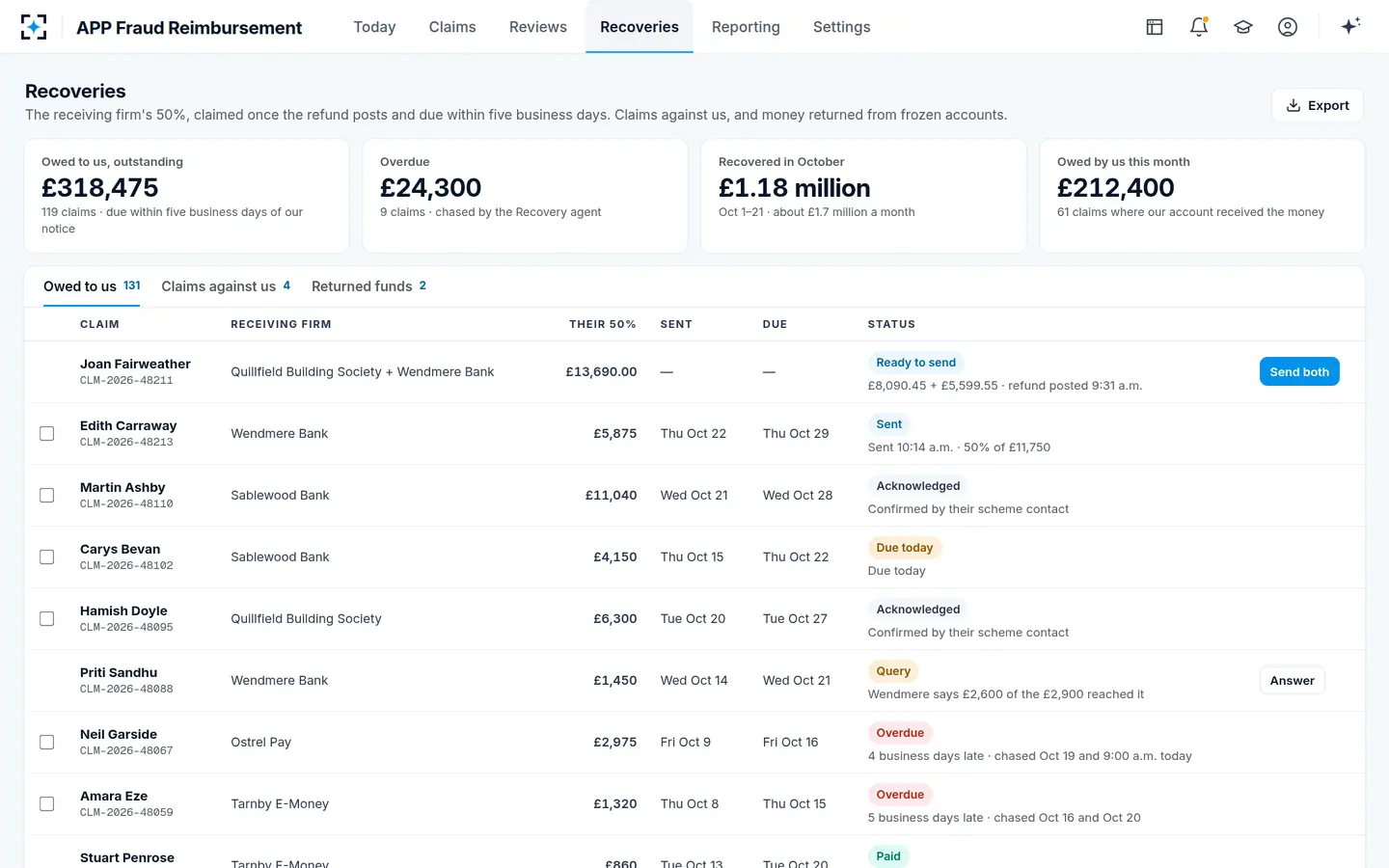
The solution's fictional queue shows the arithmetic. A bank-impersonation claim of £27,480 across five payments went to two receiving firms. After the £100 excess, half of the reimbursement is £13,690, split pro rata into £8,090.45 and £5,599.55, ready to send to both firms once the refund posted.
Contributions owed to the bank and by it, each on its own clock
What happens to money recovered from a frozen account?
If the victim has already been reimbursed, it is split between the two banks, each up to what it bore, and anything left goes to the victim. Specific Requirement 1 paragraph 5.17 sets the order: 50% each to the sending and receiving banks, with the sending bank's share capped at the required reimbursement less the receiving bank's contribution, and the receiving bank's capped at its contribution, then any remainder to the victim.
Two invented examples show how it works. On a £10,000 claim refunded at £9,900 after the excess, each bank bore £4,950. If the receiving bank recovers £3,000, each bank receives £1,500 and the victim nothing more. If it recovers all £10,000, each bank receives its £4,950 and the victim receives the remaining £100, their excess. On a £100,000 claim refunded at the £84,900 maximum, a full recovery returns £42,450 to each bank and £15,100 to the victim, the loss above the cap. Recovery is the one route by which a victim above the cap can get the rest of their money back under the scheme.
What a case system has to do around RCMS
Everything RCMS does not: build the customer's claim, gather the evidence, decide it, write to the customer, and turn the decision into the right notices, contributions and data. The PSR's supervision team added one requirement that applies whatever system a bank uses: "If you use a third party for these interactions, ensure you have an alternative in place to remain compliant with SD20 and the reimbursement rules in case the provider fails."
What to require of the systems around the bank-to-bank claim
- Send the two-hour notice from intake
With every payment to that receiving bank, so it can act at once.
- Accept notices from every route
RCMS, other industry exchanges and manual notices, into one queue for claims against the bank.
- Calculate the share with the rules
Half of the lower of paid and required, the excess deduction, and pro rata across several banks.
- Claim only after the refund posts
And track the five-business-day due date from that notice.
- Pay with the claim’s reference
Reconciliation failures were one reason firms gave the PSR for late contributions.
- Split recovered money by the rule
Between the banks up to what each bore, then to the victim.
- Produce the monthly data, and standard B when it comes
From the claims themselves, not a spreadsheet assembled afterwards.
- Keep a fallback
An alternative route if a third-party provider fails, as the PSR has asked.
Where APP Fraud Reimbursement sits beside the claims exchange
Beside it, on the bank's side. Botminds' solution works with the systems a claim already runs on, including the industry claims exchange for notices, responses, contributions and returned funds, and the general ledger for reimbursements and recoveries receivable. It does not replace RCMS or any exchange, and it does not report to Pay.UK on its own account; it prepares the claim, the contributions and the data so the bank's people can send them.
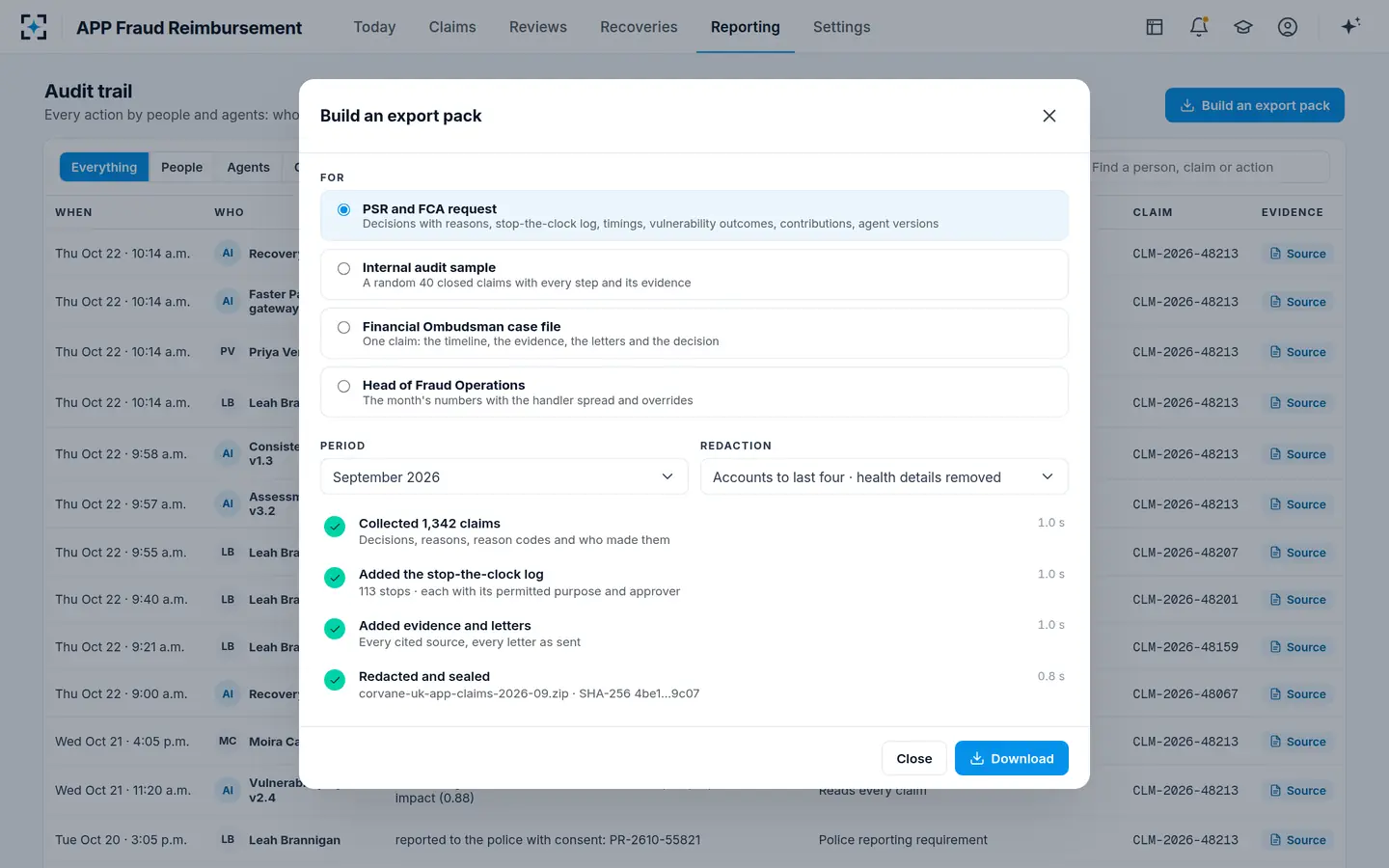
The Recovery agent computes each receiving bank's share, pro rata and with the excess rule, claims it once the refund posts, tracks the contribution clock, chases overdue contributions in bulk, answers claims against the bank and splits returned funds. Any payment to another firm needs a second person. Every step goes into an audit trail that can be exported for Pay.UK, the PSR or the Financial Ombudsman. How the seat that owns this work fits a claims team is set out in PSR mandatory reimbursement, and what the split costs each bank in the APP fraud reimbursement scheme.
The month's claims, stops and contributions, in one export
Questions people ask
Who runs RCMS?
Pay.UK, the operator of the Faster Payments system, which procured RCMS and monitors firms' compliance with the Faster Payments reimbursement rules. The PSR regulates Pay.UK and sets the reimbursement requirement.
Does RCMS cover CHAPS claims?
RCMS was built for the Faster Payments scheme. CHAPS claims fall under the Bank of England's CHAPS reimbursement rules, and CHAPS participants report monthly to the Bank, which may share the data with the PSR; firms with no CHAPS claims in a period need not send a nil return.
Can a receiving bank refuse to pay its 50%?
Not where the sending bank has reimbursed a reimbursable payment and asked for the specified amount; the receiving bank must pay within the time the scheme sets. It owes nothing on voluntary reimbursements or on payments made after the claim closed.
What is Reporting Standard B?
The more comprehensive of the PSR's two compliance data reporting standards. Its start date is still to be confirmed; the PSR has said it needs firms to use the same claims system or systems that can process the compliance data.
Do banks have to register with Pay.UK?
Yes. In-scope firms had to register by 20 August 2024, identifying themselves as in or out of scope and giving contact details and account ranges, which built the directory sending banks use to notify receiving banks.