The APP fraud reimbursement limit is £85,000 per claim. Under the UK's mandatory rules, a bank must reimburse an eligible APP scam victim up to £85,000 for all the payments in one scam, sent by Faster Payments or CHAPS on or after 7 October 2024, less any excess of up to £100. The limit applies to vulnerable customers too. A bank may choose to pay more, but it is not required to, and the receiving bank shares only the first £85,000. Above the limit, the customer's route is a complaint to the bank and then to the Financial Ombudsman Service, which can award up to £455,000 on complaints referred from 1 April 2026 if it finds the bank should have prevented the loss. Few claims are affected, but those that are tend to be the largest and most damaging. Botminds' APP Fraud Reimbursement pays up to the limit within the five-day clock, sends every claim over £30,000 to a full second review, and writes the customer's Ombudsman rights into the outcome letter.
This guide is for claim handlers, customers with large losses and the lawyers who advise them. It covers the limit, how it was set, what lies above it, and how a bank should handle a claim that crosses it.
Above £85,000: few scams, a large share of the money
What is the maximum APP fraud reimbursement?
£85,000 per claim, for Faster Payments and for CHAPS. The PSR set the Faster Payments maximum and the Bank of England set the same figure for CHAPS. With the optional £100 excess, the most a customer can receive under the rules is £85,000 if the bank waives the excess or the customer is vulnerable, and £84,900 if it does not. The PSR is explicit that the maximum covers vulnerable consumers too: it "applies to all APP scams claims made over Faster Payments and CHAPS, including claims from vulnerable consumers."
The PSR chose the figure for coverage and for the banks' sake. At £85,000 it expected "99.8% of all Faster Payments APP scams by volume, and 90% by value, are fully reimbursed, providing they fall in scope of the policy." It also said the lower level would "mitigate possible prudential risks to PSPs", a concern smaller payment firms had pressed. The figure matched the deposit-protection limit then in force, which made it recognisable to consumers.
The numbers that frame a claim above the limit
£85,000
maximum reimbursement per claim, Faster Payments and CHAPS
99.8%
of APP scams fully reimbursed at that level, by number
PSR estimate, 2024
£455,000
Ombudsman award limit, complaints referred from 1 April 2026
£120,000
deposit protection since 1 December 2025, which the APP limit no longer matches
Does the limit apply per payment or per claim?
Per claim. Specific Requirement 1 says the maximum "applies to each FPS APP scam claim", and defines a claim as one or more APP scam payments made as part of an APP scam. A romance scam paid in twenty instalments over a year is one claim, with one limit and one excess, however many payments it took.
On that definition, a customer who falls for two unrelated scams makes two claims, each with its own limit. The harder cases are scams that change shape: a romance that becomes an investment pitch, or a "recovery" scam that targets someone already defrauded. Whether those are one scam or two is a judgment for the sending bank on the facts, and it should be written down with its reasons, because it can move tens of thousands of pounds between the customer and the bank.
Was the limit ever £415,000?
Yes, on paper, but it never applied to a claim. In December 2023 the PSR set the maximum at £415,000 per claim, then the Financial Ombudsman's award limit. In September 2024, a month before the rules began, it consulted on lowering it, and on 25 September 2024 it confirmed £85,000 from the start date of 7 October 2024. The Bank of England made the same change for CHAPS.
The change was contested. The PSR received 147 responses; the 100 from individual consumers "unanimously opposed the consultation proposal". Consumer groups warned that more victims would have to go to the Ombudsman, adding "a layer of complexity, stress and uncertainty to an already difficult situation." Industry respondents had raised the risk that large claims could threaten the solvency of smaller firms. The PSR weighed both and chose £85,000, with a promise to review the level as part of its evaluation of the whole policy.
Who loses more than £85,000 to APP fraud?
Very few victims, but they carry a fifth of the losses. The PSR's review of 2023 data found that cases above £85,000 were "19% of loss by value and 0.2% by volume", and that an £85,000 maximum would leave 10% of the value lost unreimbursed once the first £85,000 of each large case was repaid.
Investment scams are the type most often named. The PSR said in December 2023 it had "some concerns about the value of investment fraud in particular", and respondents to the 2024 consultation warned that a significant share of investment scams would exceed £85,000. Large purchases, such as property deposits paid by CHAPS, are the other common case; the PSR notes that consumers use CHAPS for high-value and time-sensitive payments, including asset purchases. Academic work has questioned the regime's reach for the same reason: Jo Braithwaite's 2024 analysis found the UK scheme "valuable, but also that its specific coverage is problematic given the broad nature of this threat."
What if I lost more than £85,000?
The bank should still reimburse up to £85,000, less any excess, within five business days, unless an exception applies. For the rest, the customer can complain to the bank and then to the Financial Ombudsman, which looks beyond the reimbursement rules at whether the bank should have prevented the loss. The PSR's consumer page sets out the route: "Where more than £85,000 is lost and not reimbursed, you can raise your case with the Financial Ombudsman Service". The award limit has since risen: it is £455,000 for complaints referred on or after 1 April 2026 about acts on or after 1 April 2019 (Financial Ombudsman Service), and interest can be awarded on top.
The Ombudsman's own guidance to firms works an example. A customer sends £120,000 to an investment scam; the bank reimburses £85,000 less the £100 excess, £84,900. If the Ombudsman finds the bank could and should have prevented the customer falling for the scam:
"For those reasons, we’ll tell you to reimburse your customer the additional £35,100."
Financial Ombudsman Service, guidance to firms on APP fraud
The Ombudsman can also consider complaints against the receiving bank from people who were not its customers, looking at whether anything should have alerted it to the account. In 2024, when the award limit was £430,000, the PSR noted that a consumer could in theory recover up to £945,000 through awards against both banks on top of the £85,000 reimbursement (PS24/7 para 3.52). Those awards are outside the scheme: the receiving bank owes no 50% contribution towards any payment the sending bank makes after closing a claim, including one the Ombudsman orders.
Two routes for the same loss: the scheme, and the Ombudsman
The reimbursement rules: Reimburse unless first-party fraud or proven gross negligence; no fault by the bank needed
The Financial Ombudsman Service: What is fair and reasonable, including whether the bank could and should have prevented the loss
The reimbursement rules: £85,000 per claim, less any excess
The Financial Ombudsman Service: £455,000 on complaints referred from 1 April 2026, plus interest
The reimbursement rules: Five business days, or up to 35 with permitted stops
The Financial Ombudsman Service: After the bank’s final response; the customer has six months to refer
The reimbursement rules: The sending bank, which recovers half from the receiving bank
The Financial Ombudsman Service: The firm the award is made against, sending or receiving, with no sharing under the scheme
Can I go to the Financial Ombudsman?
Yes, once you have complained to your bank. The bank has a short time to answer: the Ombudsman says a business has only 15 days to consider complaints about fraud and scams or payment services, against up to 8 weeks for most complaints. Then "You will need to make a complaint to us within 6 months from the date on your final response." The service is free, and if the bank does not answer in time, the customer can go to the Ombudsman without waiting.
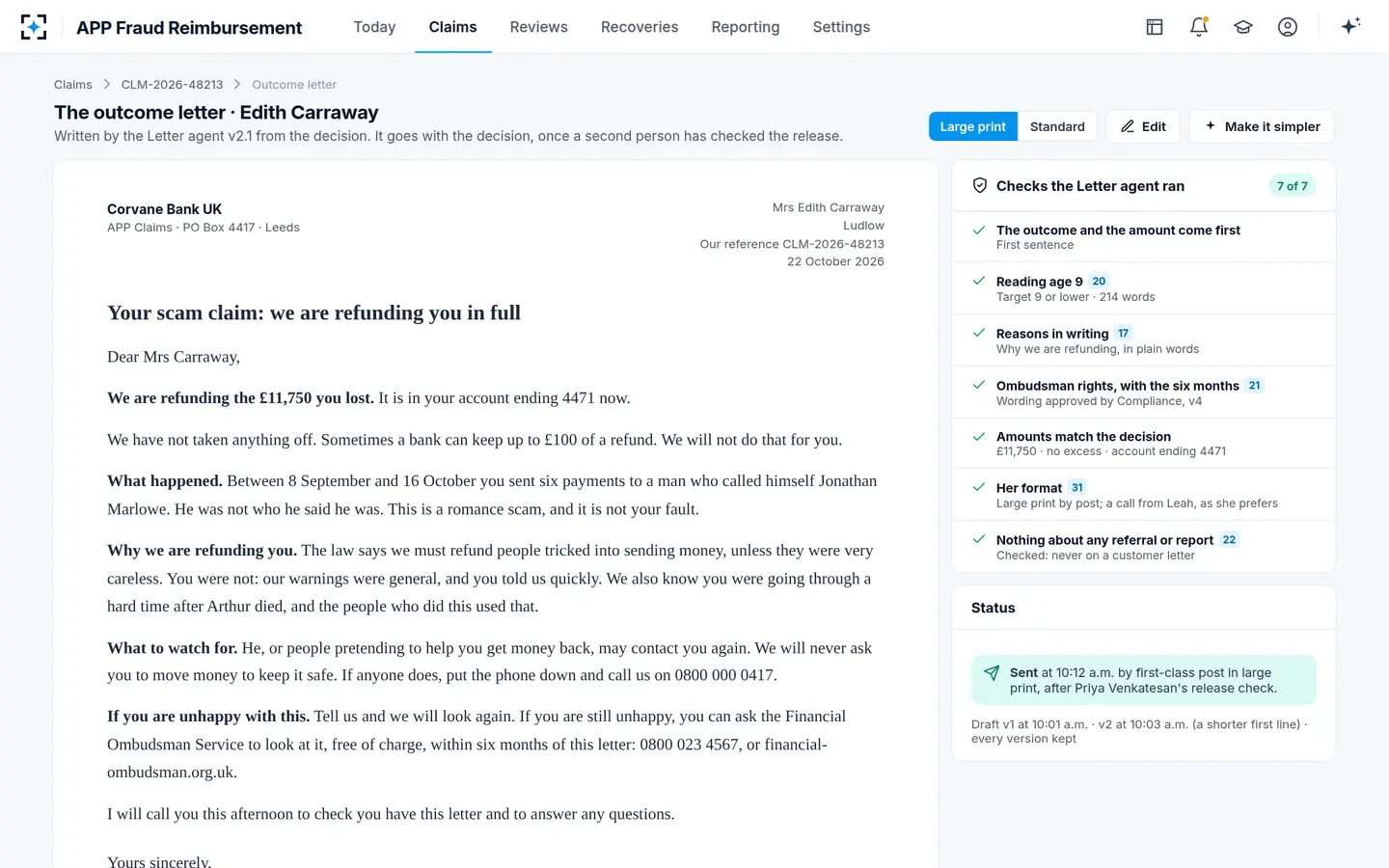
For a bank this means the outcome letter is the start of a clock, not the end of the claim. A letter that tells a customer above the cap only what the rules paid, without explaining their right to complain and the six months they have, invites a complaint about the letter as well as the loss. In Botminds' solution, the Letter agent checks that every outcome letter states the Ombudsman referral rights, including the six months, in wording approved by compliance.
The Ombudsman route, in the letter itself
What was Philipp v Barclays about?
Whether a bank owes its customer a duty not to carry out a payment the customer instructed if it has reason to believe the customer is being scammed. In 2018 Mrs Philipp and her husband were deceived into instructing Barclays to transfer £700,000 to accounts in the United Arab Emirates. On 12 July 2023 the Supreme Court unanimously held that the bank did not owe her the duty she alleged. The court's reasoning, in its press summary, is short:
"Provided the customer’s account is in credit, the ordinary duty of the bank when instructed by its customer to make a payment from the account is to carry out the instruction and make the payment. In making the payment, the bank acts as the customer's agent. Its duty is strict." Unless the two have agreed otherwise, it has to carry the instruction out without delay.
The court left room for one argument: Mrs Philipp's alternative claim, that the bank failed to act promptly to try to recall the payments once the fraud was discovered, was allowed to proceed to a fuller investigation. It also noted that the new mandatory scheme would not have covered her case, because it does not extend to international payments. For a loss above £85,000 today, Philipp is the legal backdrop: the scheme's no-fault reimbursement stops at the limit, a court claim for the rest faces the strict duty to pay, and the Ombudsman's fair-and-reasonable test asks a different, wider question.
Will the £85,000 limit change?
Possibly, but no change has been announced. When it confirmed £85,000, the PSR said the level "will not automatically track any changes to the FSCS limit", but that if the deposit-protection limit changed it would review the maximum within a reasonable period. That limit has changed: the FSCS says that "On 1 December 2025 the deposit limit rose to £120,000".
As of 26 October 2026, the PSR's consumer page still gives £85,000, and its roadmap for the consultation planned in December 2026 does not list the maximum level among its topics, though the PSR has said the consultation's scope may be refined. Responsibility for the rules is also moving to the FCA under the Financial Services and Markets Bill, which would carry the existing requirements across. A bank should plan on £85,000 and watch both; the transfer is covered in APP fraud reimbursement and the FCA.
How should a bank handle a claim above the cap?
Pay what the rules require on time, decide any extra as a separate, recorded decision, and prepare the file for the Ombudsman from the start. A large claim is not a reason to slow the first £85,000: the five-day clock and the permitted stops apply as for any other claim.
Handling an APP claim above £85,000
- Reimburse up to the limit within the clock
Less any excess, unless an exception is proven; the size of the claim does not stop the clock.
- Put it to a second reviewer
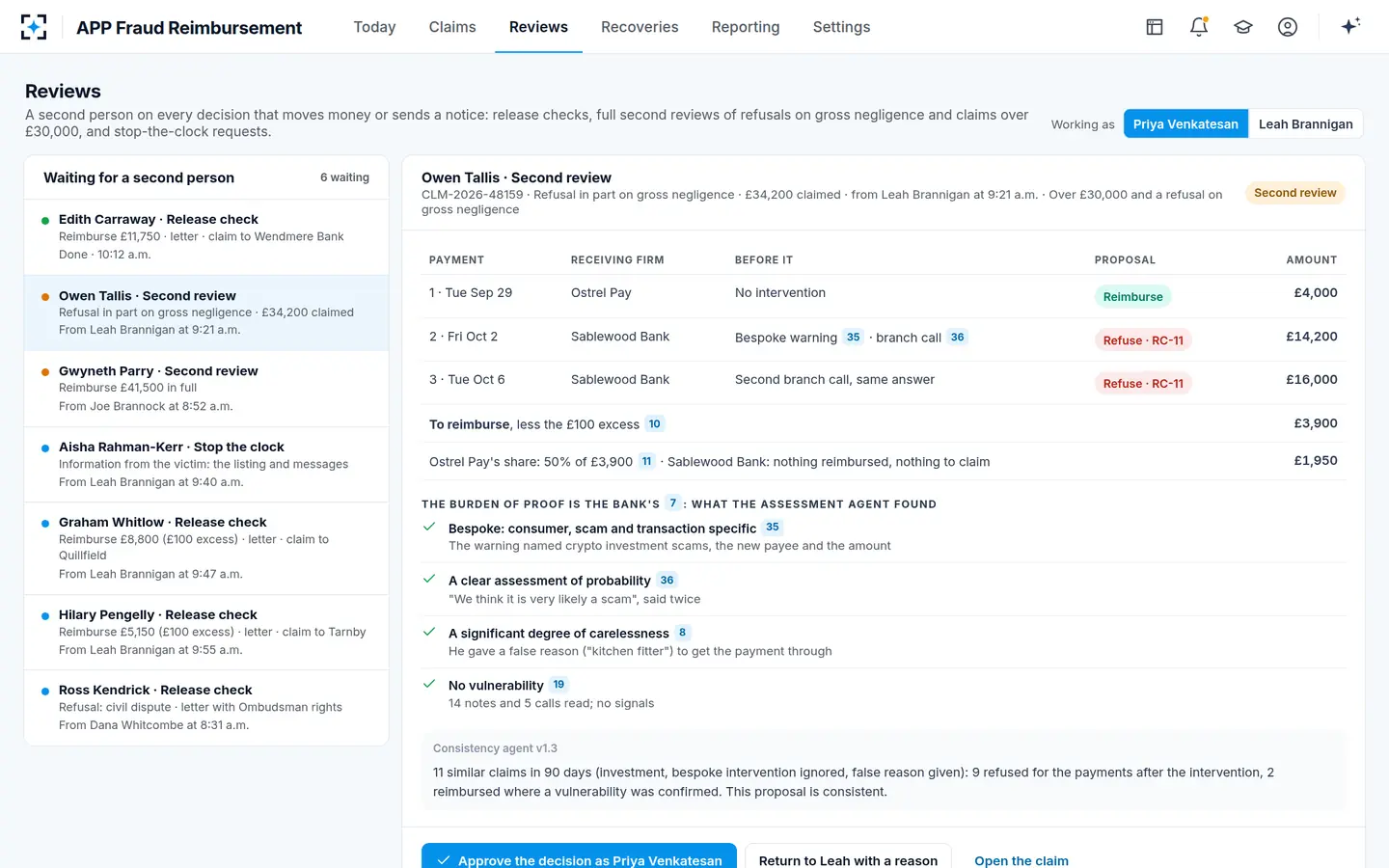
Large claims attract complaints; a second reading before the letter goes is cheaper than one after.
- Decide any voluntary payment separately
Above £85,000 it is the bank’s alone; the receiving bank shares none of it.
- Review your own controls honestly
Should the payments have been stopped or questioned? That is the Ombudsman’s question for the rest.
- Claim the receiving bank’s share on the reimbursed amount
Half of up to £85,000, less the excess rule; any later recovery is split by the rules, with the remainder to the victim.
- Tell the customer about the Ombudsman, plainly
Their right to complain, the six months, and that the service is free.
In Botminds' solution, any claim over £30,000 gets a full second review by a claims quality reviewer, and so does every refusal on gross negligence. The Recovery agent claims the receiving bank's half on the reimbursed amount and, if frozen funds come back, splits them under the rules; for a claim above the cap, recovered money can return part of the loss above £85,000 to the victim, as the reimbursement claims management system guide works through. Whether to pay above the limit voluntarily is a bank's policy decision, covered in APP fraud reimbursement policy.
A claim over £30,000, read twice before anything is sent
The limits that meet a large APP claim
| Limit | Amount | What it covers |
|---|---|---|
| APP reimbursement maximum | £85,000 per claim | Mandatory reimbursement under the PSR and Bank of England rules, since 7 October 2024 |
| Claim excess | Up to £100 per claim | Optional deduction; not for a vulnerable customer whose vulnerability had a material impact |
| Original APP maximum | £415,000 per claim | Set in December 2023 and replaced before the rules began |
| Financial Ombudsman award limit | £455,000 | Complaints referred from 1 April 2026 about acts from 1 April 2019; interest can be added |
| Deposit protection | £120,000 | FSCS protection if a bank fails, since 1 December 2025; not a scam protection |
Questions people ask
Is the £85,000 limit per person or per scam?
Per claim, and a claim is all the payments made as part of one APP scam. A customer defrauded in two unrelated scams would make two claims, each with its own limit and excess.
Can a bank refund more than £85,000 for an APP scam?
Yes. Any amount above the maximum is a voluntary reimbursement, outside the rules, and the receiving bank owes no share of it. The Ombudsman may also order a bank to pay more if it finds the bank could and should have prevented the loss.
Does the £85,000 limit apply to vulnerable customers?
Yes. Vulnerability removes the excess and the consumer standard of caution exception, but the PSR says the maximum applies to all claims, including those from vulnerable consumers.
Is the APP limit the same as FSCS protection?
No. They were set at the same £85,000 in 2024, but FSCS deposit protection rose to £120,000 on 1 December 2025, while the APP maximum stayed at £85,000. The two protect against different things: a bank's failure, and a scam.
Does the limit apply to CHAPS payments, such as a house deposit?
Yes. The Bank of England set the same £85,000 maximum for CHAPS APP scam claims, so a large CHAPS payment to a fraudster is reimbursed up to that level, with the Ombudsman route for the rest.