APP fraud reimbursement is moving from the Payment Systems Regulator to the Financial Conduct Authority, but it has not moved yet. The Financial Services and Markets Bill, introduced in the House of Lords on 19 May 2026, would abolish the PSR and transfer its functions to the FCA, and the Treasury has said transitional provisions will carry the mandatory reimbursement requirements across. As of 26 October 2026 the Bill has completed its Lords stages and had its first reading in the Commons on 15 September; its Commons second reading has not yet taken place, and the PSR expects Royal Assent in 2027. Until then, and after it until the FCA decides otherwise, the rules banks apply to each claim are unchanged. Botminds' APP Fraud Reimbursement is built so that a bank can answer either regulator from the same evidence: every decision, stop of the clock and contribution is kept with the rule it rests on, and an export for a PSR and FCA request can be assembled from the claims themselves.
This guide is for compliance and policy teams. It covers the Bill's status, what the Treasury has said about APP reimbursement, the PSR's own consultation due before the handover, and what is worth doing now.
What stays and what changes when the FCA takes over APP reimbursement
Stays, unless and until the FCA changes it
The rules a claim is decided by
Five business days, stops for five purposes, the 35th-day long stop, the £85,000 maximum, the optional £100 excess, the caution exception and its exemption for vulnerable customers.
The 50:50 split
Receiving firms still owe half of each reimbursement, on the scheme operator’s timetable.
The scheme rules and their operators
Pay.UK’s Faster Payments rules and the Bank of England’s CHAPS rules, with Pay.UK monitoring compliance.
Monthly reporting
Compliance data to Pay.UK under the existing reporting standards.
The customer’s route to complain
The bank first, then the Financial Ombudsman Service.
Changes, or is about to
Who regulates
The FCA instead of the PSR, once the Bill is law and its provisions commence.
The legal home of the requirements
Existing PSR requirements, instruments and guidance are to be carried across by transitional provisions.
Who can change them next
The FCA, which will then decide its approach under the new framework.
What the PSR is changing first
A consultation planned for December 2026 on day 35, investment returns, data and consistency, with a decision planned for May 2027.
Is the PSR being abolished?
Yes, once Parliament passes the Bill. The government first announced its intention in March 2025, as part of its Regulation Action Plan, to abolish the PSR and consolidate its functions primarily within the FCA. It consulted in September 2025 and published its response in April 2026. The Bill followed on 19 May 2026. In the words of the PSR's own annual report, it "contains provisions to abolish the PSR and transfer our functions to the FCA, preserving their substance and scope."
The PSR still exists and still decides. Its annual report notes that, ahead of consolidation, it remains an independent regulator with its own board and decision-making committees, while staff who have already moved to the FCA deliver PSR work under a service agreement. Its managing director, David Geale, is also the FCA's executive director of consumers, payments and competition (PSR, July 2026).
Where does the Financial Services and Markets Bill stand?
It has passed the House of Lords and is waiting for its second reading in the Commons. The UK Parliament's record of the Bill shows these stages as of 26 October 2026:
The Financial Services and Markets Bill [HL], stage by stage
| Stage | House | Date |
|---|---|---|
| First reading | Lords | 19 May 2026 |
| Second reading | Lords | 8 June 2026 |
| Committee stage, six sittings | Lords | 22 June to 8 July 2026 |
| Report stage | Lords | 7 and 9 September 2026 |
| Third reading | Lords | 15 September 2026 |
| First reading | Commons | 15 September 2026 |
| Second reading | Commons | Not yet held at 26 October 2026 |
| Royal Assent | — | Expected in 2027, according to the PSR |
After the Commons second reading come committee, report and third reading, then any exchange of amendments between the Houses, Royal Assent and commencement. The transfer takes effect only when the relevant provisions are commenced, which may be later than Royal Assent. Until then, the PSR's directions are the law a bank must follow.
Will the FCA take over APP reimbursement?
Yes. The Treasury's consultation response names APP reimbursement as an example of what will move:
Two phrases in that passage carry the planning. "Transfer" means the requirements arrive at the FCA as they stand, so a bank does not rebuild its process on the day of transfer. "The FCA will then determine its approach" means change is possible afterwards, under the FCA's own procedures. The Treasury also noted that some respondents wanted legislative assurance that payments fraud would remain a focus, and said it sees effective action on APP fraud as central to its commitments.
Do the reimbursement rules still apply?
Yes, unchanged. Specific Requirement 1, which put the rules into the Faster Payments scheme, "shall continue in force until such time as it is varied or revoked by the PSR." The consumer standard of caution exception carries the same provision. The Bank of England's CHAPS rules sit under the PSR's direction to CHAPS participants, and Pay.UK continues to run the compliance monitoring regime.
For a claim reported today, nothing in the merger affects the decision: five business days, the permitted reasons to stop the clock, the £85,000 maximum, the excess, the caution exception and the 50:50 split all apply as before. Banks also remain subject to FCA rules they already follow, including the Consumer Duty, which the PSR's policy statement tells firms to keep in mind when assessing vulnerability (PS25/5 para 3.53).
Four dates for a compliance calendar
19 May
Bill introduced in the House of Lords
2026
15 Sep
Lords third reading and Commons first reading
2026
Dec
PSR consultation on the APP policy planned
2026
2027
Royal Assent expected; PSR decision planned for May
subject to Parliament
What is the PSR consulting on next?
A package of changes to the APP policy itself, planned for formal consultation in December 2026. The PSR published its roadmap in response to the independent evaluation, which found the policy had cut losses by an estimated £73 million a year but that outcomes still varied by bank (PSR, 1 July 2026). The roadmap groups the consultation in three parts.
On policy parameters, it will cover claims still open after 35 business days, and how returns from an investment are treated (the first is the subject of stop the clock). On data, it will consider requiring annual collection of data on the platforms and services fraudsters most often use, the future of the PSR's fraud performance data and changes to compliance data reporting. On consistency, it will consider new guidance on how the consumer standard of caution is applied, on civil disputes, and on payments between a customer's own accounts. Its summer engagement also covered some types of investment scam and the 13-month reporting requirement.
The roadmap then plans a decision and revised legal directions in May 2027, with implementation dates set within six months of the decision. As of 26 October 2026 the PSR's list of consultations shows no APP consultation published yet; its most recent paper, dated 15 October 2026, concerns access to payment systems (PSR consultations). Whether the decision is made by the PSR or, after transfer, by the FCA depends on when the Bill takes effect. What the current guidance on caution requires is covered in the consumer standard of caution exception.
Will the £85,000 limit change under the FCA?
Nothing announced says so. The roadmap's list of consultation topics does not include the maximum level, and the PSR's consumer page still gives £85,000. The PSR did say in 2024 that it would review the maximum if the deposit-protection limit it was set to match changed, and that limit has since risen. That history, and what a customer can do above the cap, are in the APP fraud reimbursement limit.
When will the PSR merge into the FCA?
In practice the merger is under way; in law it waits for the Bill. The PSR's annual report describes a phased transition: PSR and FCA teams have moved closer together, some colleagues have formally transferred to the FCA, and the two regulators responded jointly to the government's consultation. The legal abolition, and the transfer of the APP requirements, follow Royal Assent and commencement, expected from 2027.
For banks the merger mostly changes who supervises. Supervision of APP compliance already draws on Pay.UK's monitoring and on the PSR's supervision team, which has agreed remediation plans with firms. After transfer, that work will sit with the FCA, which already supervises the same firms' conduct, complaints handling and treatment of vulnerable customers.
Where the FCA already touches APP claims
Three FCA frameworks reach every APP claim today. The definition of a vulnerable consumer in the reimbursement rules is the FCA's own, from its guidance on the fair treatment of vulnerable customers, which describes vulnerability as "a spectrum of risk". The Consumer Duty applies to how firms treat scam victims, including money recovered outside the scheme (PS25/5, question 5). And complaints follow the FCA's dispute resolution rules: the Financial Ombudsman tells consumers that a business has only 15 days to consider complaints about fraud and scams and payment services, against up to 8 weeks for most complaints, and that they then have 6 months from the final response to go to the Ombudsman.
That overlap is why the handover is less disruptive than it sounds. A bank that already evidences vulnerability decisions to the FCA's standard, handles complaints on the FCA's timetable and keeps a clear file for the Ombudsman is most of the way to being ready for an FCA-supervised reimbursement regime.
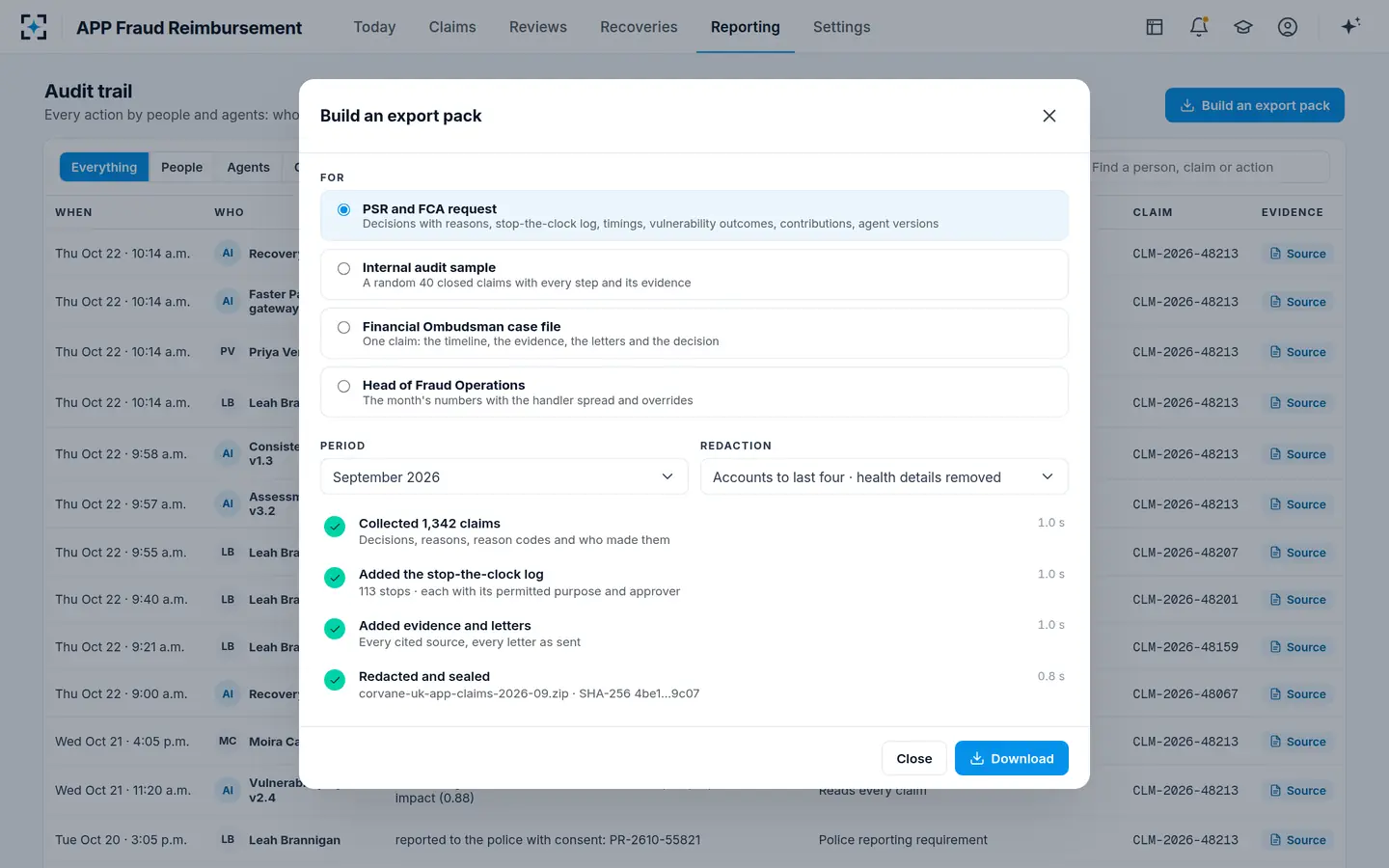
One export, built from the claims, for a PSR and FCA request
What to do before the handover
Little that a well-run claims operation is not already doing, plus two pieces of housekeeping. Treat the transfer as a change of supervisor, not of rules, and prepare to answer the December consultation.
Before the PSR's APP functions move to the FCA
- Map each policy setting to the paragraph it rests on
Specific Requirement 1, the caution exception and guidance, and the scheme rules. When instruments are carried across or renumbered, the mapping is what you update.
- Keep every decision exportable with its reasons
Decisions, stops with their purposes, vulnerability outcomes, contributions and letters, for whichever regulator asks.
- Prepare to respond in December
Day 35, investment returns, caution guidance, civil disputes and me-to-me payments all touch daily claim handling.
- Track the Commons stages and commencement
The transfer has effect only when the provisions are commenced.
- Keep monthly reporting to Pay.UK unchanged
Nothing in the Bill pauses it; a new reporting standard is still to be confirmed.
- Version your policy, and keep a second approver on changes
Any change after May 2027, by either regulator, should show which claims were decided under which version.
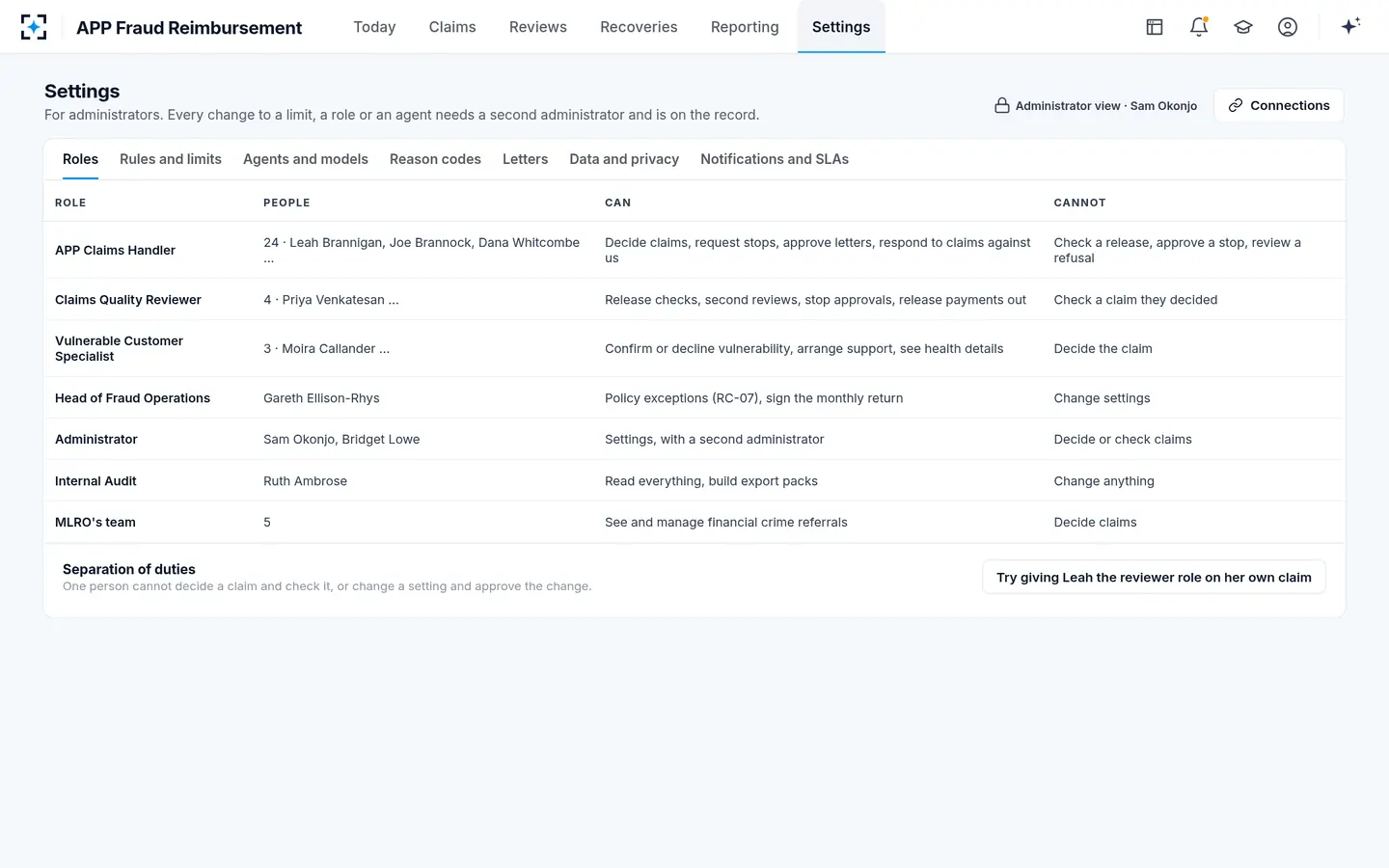
Botminds' solution keeps the policy as settings that need a second administrator to change, and each claim keeps the rule passage behind every answer. When a requirement is renumbered or reworded, the setting and its citation change once, on the record of who approved it.
Policy settings and roles, each change approved by a second administrator
Questions people ask
Is the PSR merging with the FCA?
Yes. The Financial Services and Markets Bill would abolish the PSR and transfer its functions to the FCA, preserving their substance and scope. As of 26 October 2026 the Bill has passed the Lords and awaits its Commons second reading, with Royal Assent expected in 2027.
Will APP fraud reimbursement end when the PSR is abolished?
No. The Treasury has said transitional provisions will transfer the PSR's requirements, including those for the mandatory APP reimbursement regime, to the FCA, which will then decide its own approach.
Who do I complain to about an APP scam claim now?
Your bank first, then the Financial Ombudsman Service, within 6 months of the bank's final response. The PSR does not handle individual complaints, and that does not change with the merger.
Is the FCA consulting on APP reimbursement?
The consultation planned for December 2026 is the PSR's, under its July 2026 roadmap, covering day 35, investment returns, data and consistency. If the transfer has happened by the time decisions are due, they would fall to the FCA.
Does the merger change the 50:50 split between banks?
Not by itself. The split is part of the requirements being carried across; only a later decision by the regulator could change it, and the PSR's published consultation topics do not include it.