A romance scam intervention is a bank's attempt to stop a payment that a customer is sending to someone they believe loves them, by holding the payment and talking to the customer before it leaves. It is the hardest intervention on a scams line because the customer is not afraid, as an impersonation victim is, and not mistaken about a seller, as a purchase victim is. They are loyal. By the time money is asked for, a romance scammer has spent time building trust, and may have told the customer that the bank will try to stop them and what to say when it does. A yes-or-no question about the payee gets the scripted answer. Open questions about the relationship, asked in the right order, let the customer hear the pattern in their own words. Botminds' APP Fraud Detection supports that call: its agents name the likely scam from the evidence, write the questions for it from the bank's approved scripts and flag coached answers as they are heard, while the colleague decides.
The research and rules on this page come from peer-reviewed criminology, FinCEN, the FBI and the UK's regulators, linked where they appear. Examples from the solution use its fictional sample bank, Corvane Bank UK; its customers are invented and every figure about them is sample data, not a customer's result.
Six open questions for a romance scam intervention, and what each answer tells you
1
How did you two meet?
Why it works: Opens the story in the customer’s own words. A first contact online that moved quickly to a private messaging app is the common pattern in FinCEN’s analysis.
What a scam sounds like: Met on a dating site, social media or by text message, then moved to a private messaging app.
2
Have you met in person, or spoken on a live video call?
Why it works: A romance scammer’s identity is borrowed. The answer and its excuses matter more than yes or no.
What a scam sounds like: Never met, and there is always a reason a video call cannot happen.
3
What is this payment for, in their words?
Why it works: Whitty’s victims were asked for money through a sudden crisis or a series of small requests. In investment-romance scams it is an opportunity.
What a scam sounds like: Travel costs for a visit, a medical bill, a repair, a family emergency, money to release restricted funds; or a trading platform showing large returns.
4
Is this the first time they have asked for money?
Why it works: Small first requests are the foot in the door; the amounts grow.
What a scam sounds like: A small gift first, then larger sums.
5
Who told you which account or platform to use?
Why it works: A payee chosen by the new contact, sometimes in a third person’s name, is a direction, not a choice.
What a scam sounds like: An exchange, a kiosk or a wallet address they supplied, or an account in a third person’s name.
6
Has anyone told you what to say to us, or not to tell anyone?
Why it works: Secrecy is a red flag in any scam; on the sample bank’s calls, being told not to tell the bank was among the most common coaching flags.
What a scam sounds like: Being asked to keep the relationship private, or to give the bank a different reason for the payment.
What is a romance scam intervention, and why is it different?
It is a scam intervention in which the bank's evidence points to a relationship, not an impostor or a fake seller, and so the conversation has to be about the relationship. The Federal Reserve's ScamClassifier, a US reference model, defines a romance impostor scam as "the use of a fictitious online identity to establish a trusted relationship", with the intent to request money. The UK regulator's definition is similar: a scammer "feigns a romantic interest in the victim to win their trust and manipulate them into sending money".
What makes it different is time. Monica Whitty's study of online dating romance scams, based on interviews with victims, describes a grooming stage before any money is mentioned: "Similar to grooming a child, scammers groom their victims until they are ready to give money." By the time a bank sees a payment, that work is done. An impersonation scam can run its course in a single morning, as the sample bank's safe-account case did; a romance has been built over time, and the customer is defending it.
Romance and relationship scams in government data
$929m
confidence and romance scam losses reported to the FBI’s IC3 in 2025, from 23,159 complaints
33,904
suspicious activity reports on digital asset investment scams, Sept 2023 to Dec 2025, often built on an online relationship
£5.1m
lost in 1,590 UK romance scams that started on Meta’s platforms in 2023
What are the signs of a romance scam in a payment?
The signs are a new or unfamiliar payee chosen by someone the customer has never met, a reason that is either an emergency or an investment, and a customer who is anxious to pay quickly. FinCEN's alert on relationship-based investment scams lists, among its behavioural red flags, a customer interested in a virtual currency opportunity "that they were told about from a new contact who reached out to them unsolicited online or through text message", and a customer who "appears distressed or anxious to access funds to meet demands or the timeline of a virtual currency investment opportunity". It adds that no single flag is decisive.
Its 2026 analysis of the reports that followed describes the conversation a bank actually has: "scam victims often justified changes to their normal financial activity based on guidance from a romantic partner, close friend, investment guide, mentor, or business partner they met online". The money and the payee are the bank's evidence; the justification is the customer's, and it is the part the call can test. In the UK, the PSR found that romance scams start on social media as often as on dating sites: Meta's platforms "were used in more romance scams (31%) than all dating websites combined".
Why do scam victims lie to their bank?
Most are not lying in the way the word suggests: they are repeating what someone they trust told them, because they believe it. The FBI's Operation Level Up, which contacts victims of cryptocurrency investment fraud, reported for 2025 that "78% of those victims were unaware they were being scammed" when the FBI reached them. A customer who does not know they are a victim will defend the payment, and a cover story supplied by the scammer feels to them like discretion, not deception.
Whitty's model explains why the defence can survive even a direct warning. She proposes that a "near-win" keeps victims in the scam, and among her interviewees, "In the majority of cases, where the victim was informed about the scam by law enforcement, they reverted back to the scam", to the same scammer or to a new one. Her sample was small, 20 people, but the pattern is the one a scams line sees when a customer released after one call returns a week later with a new payee.
"Those who were originally presented with a crisis in Stage 3 were presented with a new crisis in Stage 5."
Monica T. Whitty, The Scammers Persuasive Techniques Model, British Journal of Criminology (2013)
What is a coached customer?
A coached customer is one who has been told by the scammer what to say if the bank asks about the payment. The coaching is usually a cover story for the purpose, an instruction not to mention the relationship, or a warning that the bank will try to keep the customer's money. FinCEN's red flags for older customers describe the scene at a branch counter: a customer who "appears to be taking direction from someone with whom they are speaking on a cell phone". On a phone call the bank cannot see that, so it has to hear it.
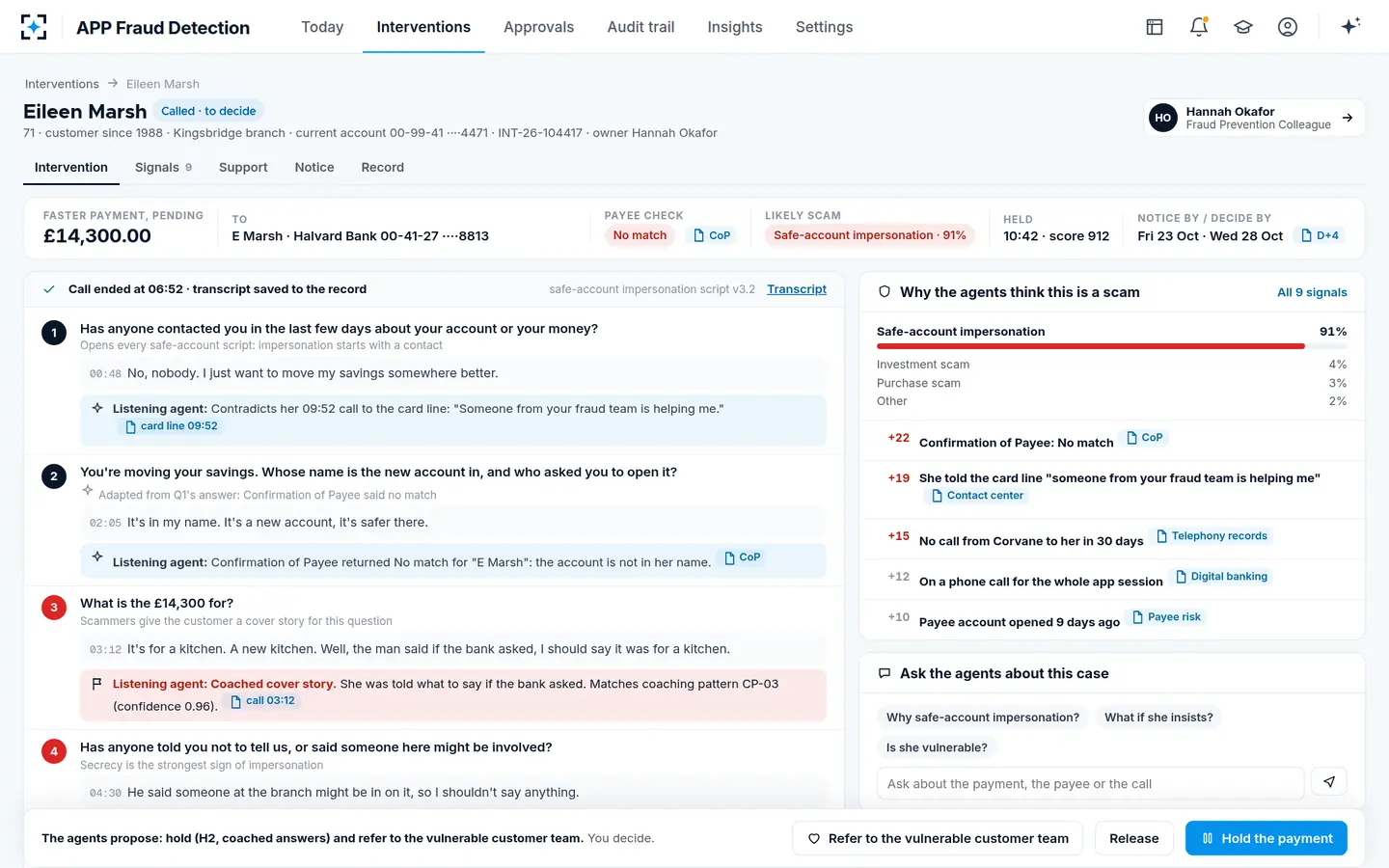
The tells are in how answers are given as well as what they say: an answer that arrives too quickly and too completely, a purpose that does not fit the customer's history, a payee whose name the customer is unsure how to spell, a contradiction with something the customer told the bank earlier. In the solution, the listening agent flags coached answers, secrecy, urgency, a caller who will ring back and contradictions with the bank's own records, each tied to the second of the call, and leaves the judgement to the colleague. On the sample bank's safe-account case it flagged the cover story at 3 minutes 12 seconds, when the customer let slip that the caller had told her what to say the money was for.
Coaching heard on a call: the flag, the words and the second they were spoken
What questions reveal a romance scam?
Open questions about how the relationship began, whether the two have ever met, what the money is for in the other person's words, and who chose the account reveal a romance scam; closed questions about the payee do not. "Do you know this person?" invites "yes". "How did you two meet?" invites a story, and the story is where the pattern appears: an online first contact, a quick move to a private app, a person who cannot meet, a request that began small. The six questions at the top of this page follow the stages Whitty describes, from the ideal profile to the crisis and the repeated request.
Order matters. Starting with the relationship rather than the payment lets the customer talk about someone they care about before they feel accused. The question about coaching comes last, once the customer has described the relationship in their own words; by then a cover story either fits what they have said or visibly does not. The PSR's guidance on the reimbursement rules recognises that a customer may be under a scammer's spell, and that this bears on whether they can be expected to heed a warning.
Closed questions about a payee, against open questions about a relationship
What a generic script asks: Do you know the person you are paying?
What a romance intervention asks: How did you two meet, and how long have you been talking?
What a generic script asks: Have you checked the payee’s details?
What a romance intervention asks: Have you met in person, or spoken on a live video call?
What a generic script asks: Is this payment for goods or services?
What a romance intervention asks: What is this money for, in their words, and has the reason changed?
What a generic script asks: Have you paid this person before?
What a romance intervention asks: Is this the first time they have asked? What did they ask for first?
What a generic script asks: Has anyone asked you to make this payment?
What a romance intervention asks: Who told you which account or platform to use?
What a generic script asks: Has anyone told you to lie to us?
What a romance intervention asks: Has anyone said what to tell the bank, or asked you to keep this private?
What should staff say to a romance scam victim?
Staff should explain what they have seen in plain words, say clearly what the bank believes, avoid blaming the customer, and offer a next step that keeps the conversation going. The PSR's guidance on the reimbursement rules expects an intervention to be specific to the customer, the scam and the payment, and FG24/6 expects the notice of a delayed payment to explain the risks the bank has found, including its grounds. "This has the pattern of a romance scam, and here is why" is specific; "please be careful" is not.
Tone carries as much as content. In its review of firms, the FCA criticised decision letters with "unhelpful and, on occasion, accusatory language"; a customer who feels accused on the call will defend the relationship harder. The FCA's vulnerability guidance notes that "older consumers who may be lonely are more likely to be at risk of being scammed", which is why a referral to a vulnerable customer specialist, a trusted contact and a branch visit often do more than a refusal. In the solution, the vulnerability agent proposes such a referral by the FCA's four drivers, and a specialist records anything only with the customer's consent.
Can a bank stop a romance scam payment?
Yes, for a time, and that time is the point. A UK bank with reasonable grounds may delay a qualifying sterling payment until the end of the fourth business day after receipt, provided it establishes the grounds and tells the customer why by the end of the first. It may also refuse under its existing powers. What it cannot do is stop the customer trying elsewhere, and in a romance scam the customer often will.
FG24/6 records that firms asked for exactly this situation: where the customer "has developed a trust in the fraudster", a refusal could push them to another bank. Its answer is that the regulation does not prevent a bank "from seeking to deter the payer from making the payment by another means". In practice that means the four days are for the conversation: a call back from a specialist, a branch visit with someone the customer trusts, and protective steps such as a temporary block on new payees, which in the solution needs a team leader's approval. The rules on timing are in UK bank payment delay rules.
When the relationship survives the call: the second payment and the other bank
A stopped romance payment is often followed by another request, because the relationship is still there. Whitty's stage model has a continuation stage of new crises and smaller requests and a re-victimisation stage in which some victims return to the scam, or are approached by a fake recovery agent. FinCEN's 2026 analysis describes the same: perpetrators, or "other unrelated scammers posing as recovery specialists, revictimized victims by offering to recover stolen funds for an additional fee".
After the call: what a romance case needs on the file, and why
| What to keep | Why it matters next time |
|---|---|
| The customer’s own account of how they met and what the money is for | The next request will come with a new story; the old one is the comparison. |
| The coached answers flagged, with the time in the call | Shows a pattern of direction, not a single unusual payment. |
| The warning given, and the customer’s response | A specific warning on this scam type; generic text proves little. |
| Any vulnerability recorded, with consent | The PSR’s guidance says repeated scams of a similar kind may indicate vulnerability. |
| Protective steps and who approved them | A new-payee block, a trusted contact, a flag on calls claiming to be the bank. |
The PSR's guidance makes the link to vulnerability explicit: a customer caught by the same kind of APP scam again and again may be showing a vulnerability, and banks should not mistake that for gross negligence. A file that shows the second request arrived three weeks after the first, with the same pattern, is evidence for support, not for refusing a later claim.
A romance case in APP Fraud Detection's sample queue
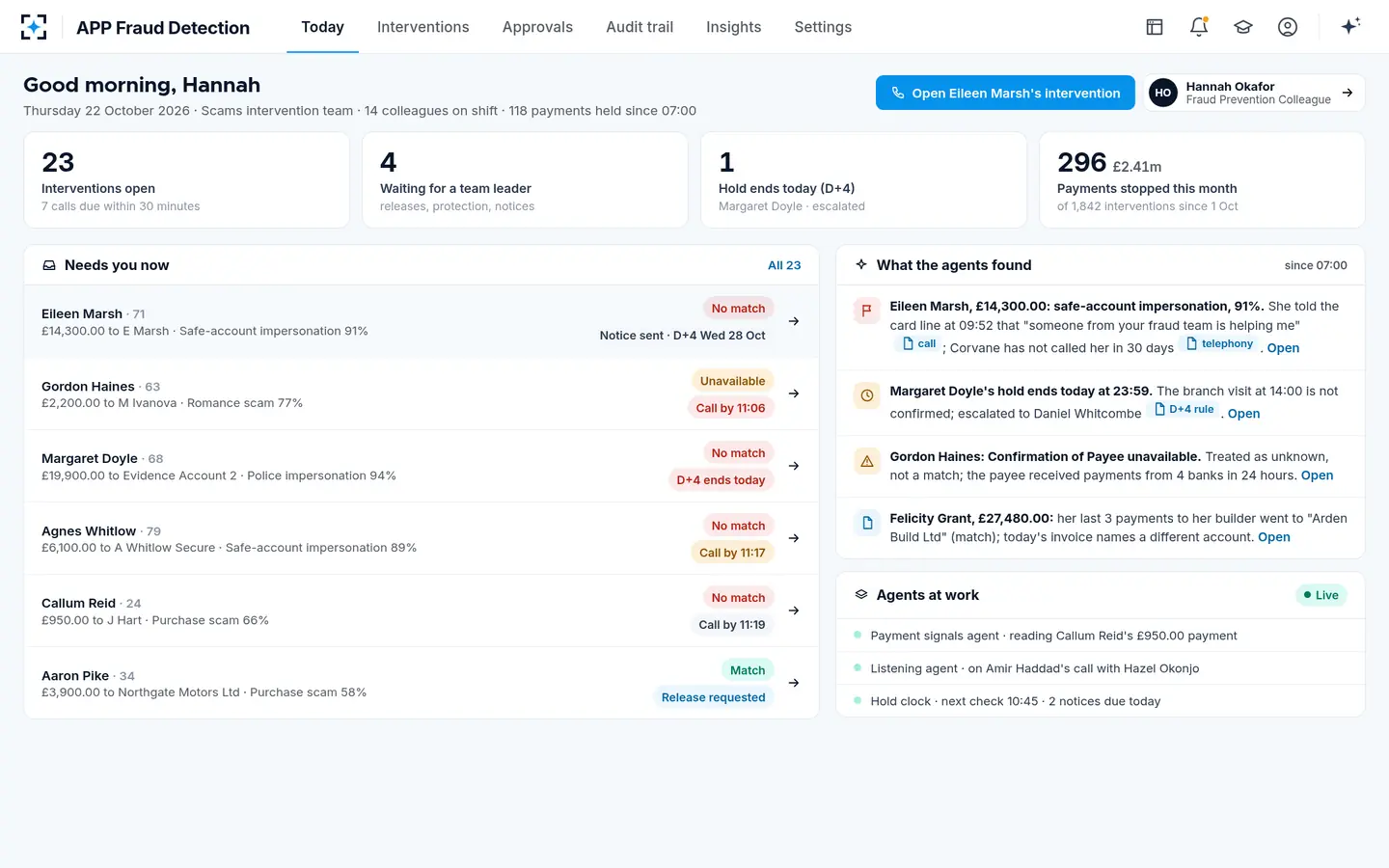
On the sample bank's queue one Thursday, Gordon Haines, 63, was sending £2,200.00 to an M Ivanova. The payee name check was unavailable, so the agents treated it as unknown rather than as a match, and noted that the receiving account had taken payments from four banks in 24 hours. The typology agent named a romance scam at 77% and the call was due within the bank's 30-minute target. That is the moment the questions above are written for.
A romance scam in the queue: the payee check unavailable, the likely scam named, the call due
Romance cases are also where the sample bank's numbers are least flattering, which is why they are worth measuring. In its September, 214 payments were held as likely romance scams and 41 were stopped, and the romance script stopped 64% of the confirmed romance scams it was used on. Every other script except the purchase-scam one stopped more. Those are sample figures, not a customer's result, and they make the point a head of fraud needs: romance interventions are slower to improve, and need their own script, their own measures and the specialist support around the call. How the evidence behind a held payment is assembled is in scam detection software, and how warnings are written so they count is in bank scam warnings that work. The full case is on the APP Fraud Detection page.
Questions people ask
How do banks intervene in romance scams?
They hold the payment, call the customer, and ask open questions about the relationship rather than closed questions about the payee. In the UK a bank may delay a qualifying payment up to the end of the fourth business day to make those enquiries, and FG24/6 confirms it may also try to deter the customer from paying by another route.
Can a bank refuse a payment to a romance scammer?
A bank may refuse a payment under its existing powers and terms, and a delay does not change those powers. In romance scams a refusal alone can push the customer to another bank, which is why the FCA's guidance on delays emphasises deterring the customer, not only blocking the payment.
Are romance scams covered by UK APP reimbursement?
Yes, where the payment is in scope: the PSR says all types of APP fraud are covered, naming romance scams as an example. Cover depends on the payment route and the other conditions of the scheme, and a vulnerable customer cannot be refused for gross negligence.
How do you talk to a family member in a romance scam?
The same principles apply: ask how they met and whether they have met in person, avoid blaming them, and keep the conversation open. A bank can, with the customer's consent, add a trusted contact, which in the sample case was the customer's daughter, invited to a branch visit.
Do romance scams often involve cryptocurrency?
Some do. FinCEN's 2026 analysis of digital asset investment scams found victims often justified their payments by guidance from a romantic partner or a friend they met online, and the FBI reported $7.2 billion lost to cryptocurrency investment fraud in 2025.