Confirmation of payee (CoP) works by asking the receiving bank, before a payment is sent, whether the name the payer typed matches the name on the account at the sort code and account number given; the payer is then told it is a match, a close match or no match, and decides whether to go on. The UK's Payment Systems Regulator required it to stop payments going to the wrong account, by mistake or because a fraudster redirected them, and it now runs on almost every Faster Payment and CHAPS payment. What it cannot do is judge why the money is being sent. A customer who pays an account genuinely in the scammer's name, or in their own name at another bank because a caller told them to, can pass the check or be talked past it. Botminds' APP Fraud Detection treats the payee check as one signal behind a held payment, weighed with the customer's own contacts with the bank, the receiving account's behaviour and the call.
The examples on this page come from the solution's fictional sample bank, Corvane Bank UK; its customers and payees are invented, and every figure about them is sample data, not a customer's result.
Two scams, one name check: where confirmation of payee helps and where it passes
Deceived about who is paid
- The scam: an invoice from the customer’s builder arrives naming a new account.
- The name typed: the builder’s, as on every earlier invoice.
- The check: the account is not in the builder’s name.
- No match. The payer is warned before anything is sent. The check has done its job.
Deceived about why they pay
- The scam: a fake investment desk, a romance, a seller with nothing to sell.
- The name typed: the one the scammer gave, on an account opened in that name.
- The check: the name and the account agree.
- Match. The payer is reassured, and the money goes to the scam.
How does confirmation of payee work, step by step?
The check runs when a customer sets up a new payee or changes an existing one. In the PSR's words, "banks can check the name on a new payee’s account as well as the sort code and account number". The sending bank passes the name the customer typed to the receiving bank, which compares it with the name on the account and returns an answer before the customer is asked to confirm the payment.
The PSR describes the result simply: "Alerts notify the payer whether there has been a match, a close match, or no match, meaning corrections can be made before the payment is sent." The customer then chooses. The PSR's 2022 consultation put the consequence plainly: where there is no match or a close match, "the payer will need to decide whether to proceed with the transaction at their own risk". The check informs the decision; it does not block the payment.
It was built in two stages. In August 2019 the PSR directed the six largest banking groups, whose payment providers are "involved in around 90% of FPS and CHAPS transactions", to offer it by March 2020. In 2022 it directed "around 400 more financial firms to provide CoP", with the last of them due by 31 October 2024.
Confirmation of payee in 2026: almost universal, and here to stay
320+
payment providers offering the check in the UK
99%+
of providers that send Faster Payments now offer it
2m+
checks completed every day
£3.7m
fine on one bank for not complying with the direction
What does confirmation of payee check, and what does it never see?
Confirmation of payee checks one thing: whether the name the payer typed belongs to the account they are paying. It does not see who told the payer to pay, what the payment is for, how old the receiving account is, or what has gone through it this week. The PSR's own description is careful about this: the service "is designed to prevent misdirected payments as well as fraudulent ones", and its July 2026 consultation calls it "a valuable tool in reducing certain types of authorised push payment (APP) scams". Certain types is the exact phrase.
What the payee name check sees, against what a scam depends on
What confirmation of payee checks: Does the typed name match the account at this sort code and number?
What the scam depends on: Who chose this payee, and how the customer came to trust them.
What confirmation of payee checks: Not checked.
What the scam depends on: An investment, a "safe account", a partner’s emergency, goods that will never arrive.
What confirmation of payee checks: Its name only.
What the scam depends on: How new it is, and whether money arriving from many banks leaves within minutes.
What confirmation of payee checks: Shown the result and asked to decide.
What the scam depends on: Often on the phone to the scammer, who has told them what the screen will say.
What confirmation of payee checks: Match, close match, no match, or no answer.
What the scam depends on: Whether the payment should leave at all.
What is a close match in confirmation of payee?
A close match is an answer between a match and a mismatch: the name is nearly right, and the payer is shown the name actually on the account so they can judge. The PSR wrote in 2019, and repeated in 2022, that Pay.UK's rules "specify that, in the case of a close match, the actual name associated with the proposed payee’s account will be returned to the payer", and asked banks to make sure their matching coped with names transliterated from other alphabets. A typo, a missing middle name or a business trading under a slightly different name is the ordinary case.
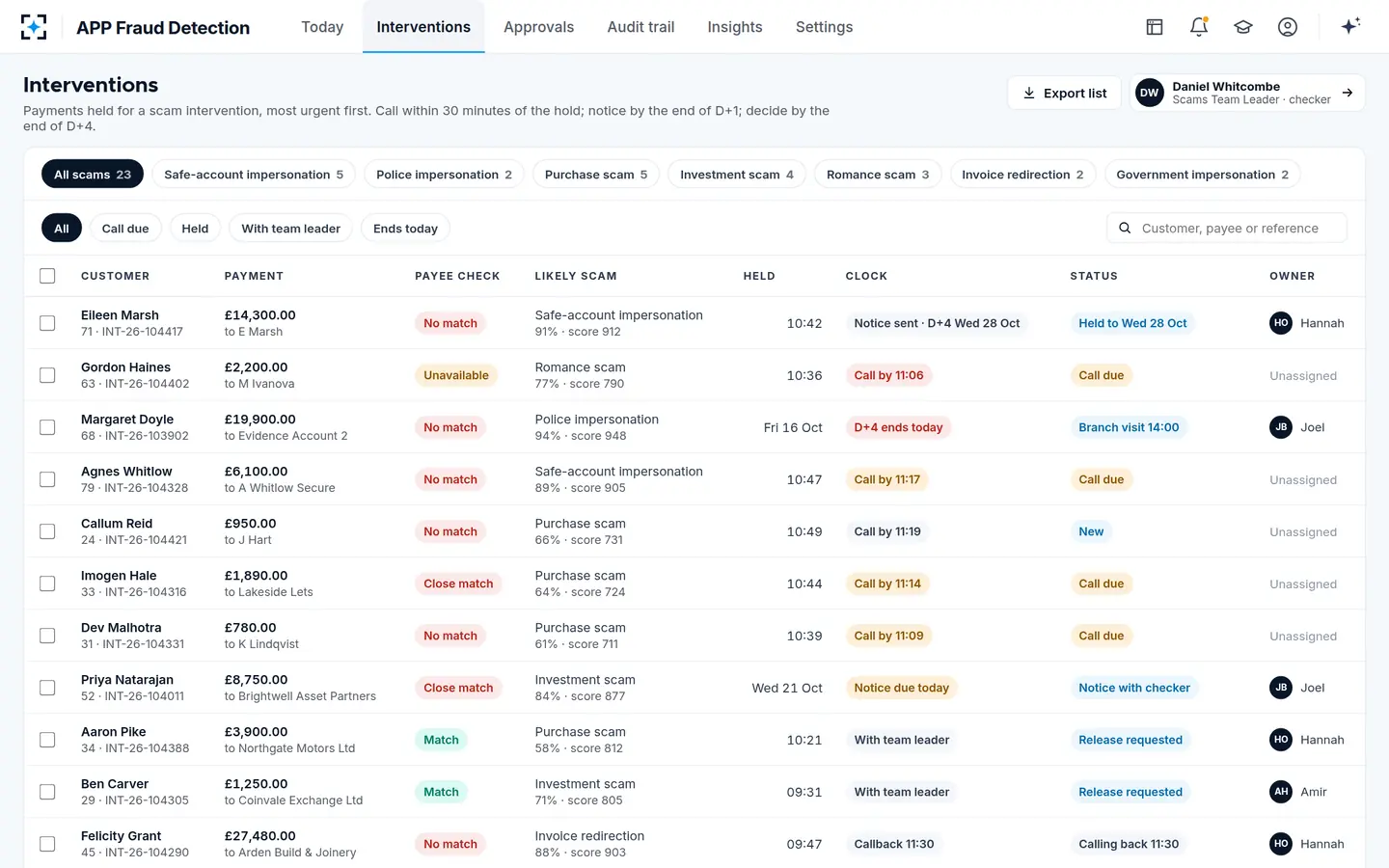
For a fraud team a close match is a weak signal in either direction. On the sample bank's queue two held payments came back as close matches, one to a lettings agent the typology agent rated a 64% purchase scam and one to an asset management firm it rated an 84% investment scam. The queue shows the close match next to the likely scam so the colleague sees both; on its own, a close match says nothing about which scam, if any, is behind a payment.
What happens if confirmation of payee says no match?
A no match means the name typed is not the name on the account. The payer is warned and can correct the details, cancel, or carry on at their own risk. For an honest mistake the warning works well, as Pay.UK's figures below suggest. For a coached customer it can be the moment the scam was built for, because the scammer has already explained it away.
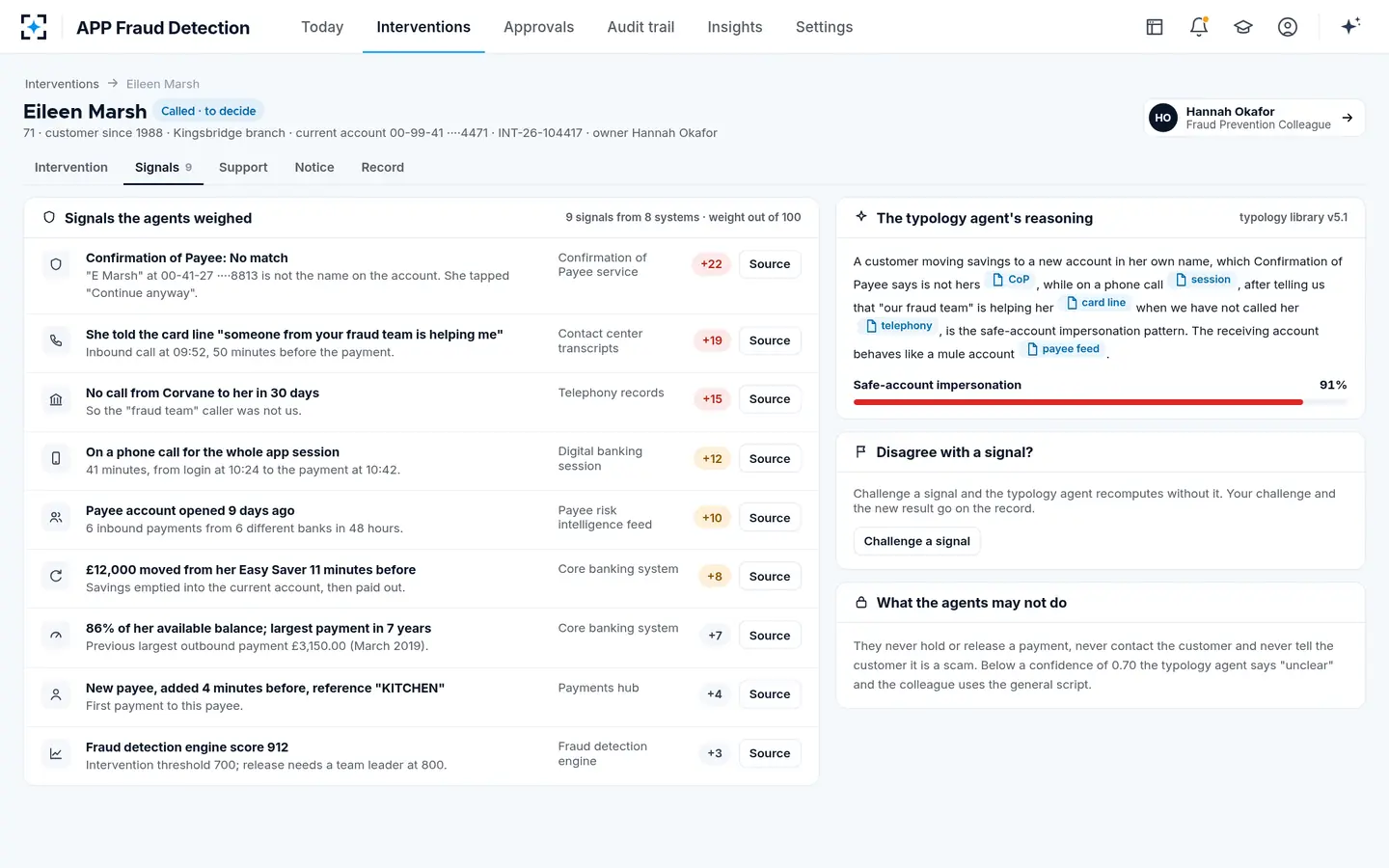
On the sample case Eileen Marsh, 71, was sending £14,300.00 to "E Marsh" at another bank. The check said no match: the account was not in her name. She tapped "Continue anyway". When the colleague later asked whose name the new account was in, she said, "It's in my name. It's a new account, it's safer there." The caller had also told her that someone at her branch might be in on it, so a warning from the bank's own systems confirmed his story instead of breaking it.
The four answers a payee check can give, and how a fraud team should read each
| Answer | What the payer sees | What it shows | What it does not show |
|---|---|---|---|
| Match | Reassurance that the name is right | The account is held in the name typed | That the person or business is genuine, or that the payment is for what the payer thinks |
| Close match | The name actually on the account | A near miss: a typo, an initial, a trading name | Anything about fraud on its own; weigh it with the receiving account and the customer |
| No match | A warning that the money may reach someone else | The account is not in the name typed | Whether the customer was told to expect the warning and to ignore it |
| No answer | No result, or an unavailable message | Nothing: the check could not be made | Safety. Treat it as unknown, never as a match |
Does confirmation of payee stop scams?
It stops some, and the evidence says which. In costing the service, the PSR assumed, as its May 2019 consultation restates, that confirmation of payee would prevent 90% of "maliciously misdirected payments where the name entered does not match the account details". That is a precise and narrow promise: payments sent to an account in another name, where the name entered is the true one. Pay.UK's figures since launch, as the PSR's July 2026 consultation records them, point the same way: a "59% reduction in claims for payments to the wrong account" and "a 20-40% reduction in losses to end users for some types of fraud".
The gap between those two numbers is the gap between misdirection and deception. The PSR's definition of an APP scam payment has two limbs, and the check is built for one. It covers a payer who "intends to transfer the funds to a person other than the recipient, but is deceived into transferring the funds to the recipient", and also a payer who "intends to transfer the funds to the recipient but is deceived as to the purposes for which they are transferring the funds". The FCA's names for them are just as useful: "malicious payee" and "malicious redirection". A name check can only help with a redirection, and only when the name typed is not the name on the receiving account.
The money follows the second limb. Before mandatory reimbursement, purchase scams made up nearly three quarters of cases at the 14 largest banking groups, and investment scams a quarter of the money lost. In both, the payer means to pay the person or business whose name they type, so the check has nothing to object to unless that account is held in another name. A match is entirely consistent with either scam.
Can a scammer pass confirmation of payee?
Yes, in two ways: by receiving money into an account genuinely in the name the victim is given, and by persuading the victim to ignore a mismatch. The first is open to any scammer who controls an account in the name they give the victim, including a company name that sounds right. The second is the method of impersonation scams, in which the caller can warn the victim in advance and stay on the line.
The sample bank's queue on a single Thursday morning shows both. A £3,900.00 payment to a motor dealer and a £1,250.00 payment to an exchange company both returned a match, and the agents still rated them a 58% purchase scam and a 71% investment scam on other evidence. A £19,900.00 payment to an account called "Evidence Account 2" and a £6,100.00 payment to "A Whitlow Secure" both returned no match, and both were rated impersonation scams, police and safe-account, the kinds in which a caller tells the customer to move money. In none of the four did the name check settle the question.
The sample bank's held payments: matches on likely scams, mismatches on coached customers
Is confirmation of payee mandatory in the UK?
For payment providers, yes. The PSR's Specific Direction 17 "requires most payment service providers (PSPs) to provide the Confirmation of Payee (CoP) service" for Faster Payments and CHAPS, and the regulator enforces it: in February 2026 it fined one bank "over £3.7 million" for failing to comply. The direction was due to lapse on 1 November 2026. In October 2026 the PSR removed the expiry date, saying "CoP will continue to protect people and businesses as it does now".
For the customer, the check is a prompt, not a barrier to the payment. The customer is shown the result and decides. Payment providers may also let some account holders opt out of being checked, for example where showing the name could put a vulnerable person at risk, following Pay.UK's guidance, as the PSR noted when it extended the service.
What is verification of payee, and how does it differ?
Verification of payee is the European Union's equivalent, required by the Instant Payments Regulation for euro credit transfers. Payment providers "shall offer the payer a service ensuring verification of the payee to whom the payer intends to send a credit transfer", free of charge, for standard and instant transfers alike, and payers receive "a result (i.e. “match”, “close match”, “no match” or “other”) before initiating the payment", as the European Central Bank summarises it. The design question is the same as in the UK, and so is the limit: it checks the name against the account identifier, not the reason for the payment.
Reading the payee check as one signal among nine
Botminds' APP Fraud Detection reads the payee check alongside everything else the bank knows about a held payment, and weighs it. On Eileen Marsh's payment it was the heaviest of nine signals, 22 points out of 100, because a mismatch on a payment to an account in her own name, sent while she was on the phone, after she had told the card helpline that someone from its fraud team was helping her, is exactly the pattern of a safe-account scam. The sample bank's first reason code for a hold is not "no match" but a no match together with a named scam type.
Why the agents think it is a scam: the payee check weighed with eight other signals
The same logic runs the other way. When the check was unavailable on Gordon Haines's £2,200.00 payment to an M Ivanova, the agents treated it as unknown, not as a match, and noted that the payee's account had received payments from four banks in 24 hours; the typology agent named a likely romance scam. How the questions differ for that kind of customer is the subject of romance scam intervention; what the other eight signals are and where they come from is in scam detection software. To see the payee check inside a full case, start from APP Fraud Detection.
Questions people ask
Does confirmation of payee check the account number?
It checks the name against the account at the sort code and account number given. The receiving bank compares the name with the one it holds for that account; the sort code and account number identify which account to check.
Why does confirmation of payee say no match when the name is right?
It can happen when the account is held under a different form of the name, such as a business's registered name rather than the one it trades under, or a name rendered from another alphabet, which the PSR asked banks to handle carefully. A close match shows the name actually held so the payer can judge; a no match leaves the payer to check with the payee by a trusted route before paying.
Does confirmation of payee work for international payments?
The UK service covers payments over Faster Payments and CHAPS between UK accounts. In the EU, verification of payee covers euro credit transfers under the Instant Payments Regulation.
If confirmation of payee says match, is the payment safe?
No. A match shows only that the account is in the name typed. In investment, romance and purchase scams the payer can be paying an account genuinely held in the name they were given, so the check matches; on the sample bank's queue, two payments with a match were still rated likely scams on other evidence.
When did confirmation of payee become mandatory?
The six largest banking groups were directed to offer it by the end of March 2020, and around 400 more firms by 31 October 2024. In October 2026 the PSR removed the direction's expiry date so the requirement continues.