The Reg CC presumption of alteration is a rule in Regulation CC, at 12 CFR 229.38(i), that took effect on 1 January 2019. When two banks dispute whether a substitute check or electronic check passed between them was altered, or instead came from an original check issued with a forged or unauthorized drawer's signature, the check is presumed to contain an alteration. The bank on the other side of that dispute, usually the depositary bank, can overcome the presumption only by proving by a preponderance of the evidence that the check was not altered or was a forgery, and the presumption falls away if the original paper check is made available to every bank in the dispute. It matters because the type decides who pays: under the UCC the depositary bank generally bears an altered check and the paying bank a forged one. With checks now collected almost entirely as images, the presumption settles the question a missing original used to leave open. Botminds' Check Fraud Claims cites it in every warranty claim on an image item and answers "counterfeit, not altered" denials with it, beside the evidence that the check was the customer's own.
The rule is quoted from the current eCFR text and the Federal Reserve Board's 2018 final rule; the screens show the solution's sample data on fictional banks.
Before and after 1 January 2019: the paid check whose original no one has
Before the rule: No rule. Courts had reached opposite conclusions on whether a paid fraudulent check should be presumed altered or forged.
Since 12 CFR 229.38(i): A rebuttable presumption that the substitute or electronic check contains an alteration.
Before the rule: Unsettled; it depended on the court and the evidence.
Since 12 CFR 229.38(i): The bank that wants the item treated as a forgery, usually the depositary bank, by a preponderance of the evidence.
Before the rule: Usually the original check, which by then was often destroyed.
Since 12 CFR 229.38(i): The original check made available to all banks in the dispute: the presumption no longer applies.
Before the rule: Any party, under whatever rule a court chose.
Since 12 CFR 229.38(i): Disputes between banks only, over items transferred between them as electronic or substitute checks.
Before the rule: Evidence like any other.
Since 12 CFR 229.38(i): Does not overcome the presumption.
What is the presumption of alteration?
It is an evidentiary rule for one kind of interbank dispute. The regulation says it applies "with respect to any dispute between banks arising under Federal or State law as to whether a substitute check or electronic check transferred between those banks contains an alteration or is derived from an original check that was issued with an unauthorized signature of the drawer", and that when such a dispute arises "there is a rebuttable presumption that the substitute check or electronic check contains an alteration."
The presumption does not create a new warranty or move liability by itself. The Board's commentary is explicit that it does not alter the UCC's transfer and presentment warranties, which still allocate the loss. What it changes is the starting point: when the evidence is in doubt, the item is treated as altered, and the UCC then puts an altered item on the bank that warranted it had not been altered. The full chain of who pays for which type is in who is liable for altered checks.
Why the Board wrote it: a split in the courts and a paperless system
Because the courts disagreed and the evidence that would have settled each case had stopped existing. The Board's final rule put the problem directly: "Courts have reached opposite conclusions as to whether a paid, but fraudulent, check should be presumed to be altered or forged in the absence of evidence (such as the original check)." It cited two 2006 appellate decisions, Chevy Chase Bank v. Wachovia Bank in the Fourth Circuit and Wachovia Bank v. Foster Bancshares in the Seventh.
Those cases were decided when the paying bank had at least received the paper. By 2017, the Board noted, the Reserve Banks received more than 99.99 percent of checks electronically and presented more than 99.99 percent electronically, and in today's system the original "is typically truncated by the depositary bank or a collecting bank before it reaches the paying bank." A rule that waited for the original would wait for evidence that, in most disputes, the paying bank never saw.
The numbers behind the 2019 rule
99.99%
of checks the Reserve Banks received electronically by the beginning of 2017
0.015%
of forward items collected through the Reserve Banks returned on a claim of alteration or forgery, March 2018
1 Jan2019
the date the presumption of alteration took effect
“The presumption was intended to create a uniform starting point that recognized the operational realities of check fraud in the absence of evidence.”
Federal Reserve Board, 83 FR 46849 (2018)
When did the Reg CC presumption of alteration take effect?
On 1 January 2019. The Board proposed the rule on 2 June 2017, after commenters raised the question on a 2011 proposal and the Board asked about it in 2014, received eleven comments, ten of them generally supportive, and published the final rule on 17 September 2018 at 83 FR 46849. The text has not changed since, and the eCFR shows paragraph (i) in force as added in 2018.
The final rule is broader than the proposal in one useful way. The proposal covered only changes to the amount and the payee. After commenters pointed out that fraud can change any field, the Board used the UCC's own definition of alteration, so the presumption also reaches a changed date, for example a postdated check moved forward so it can be paid at once, and changes to other terms of the check.
Does the presumption of alteration apply to paper checks?
No, not where the paper itself passed between the two banks in the dispute. It applies only to a substitute check or electronic check transferred between those banks, and the commentary says it does not apply to a dispute between banks where one bank sent the original check to the other, even if the receiving bank later truncated and destroyed it. A paying bank that received the original on direct presentment, which commenters told the Board happens for very high-dollar or doubtful items, cannot then destroy it and claim the presumption.
Where in the chain the paper was converted to an image does not matter otherwise. The Board said the presumption applies "regardless of where in the chain, or by whom, the original check was truncated." A check deposited by mobile phone, imaged at a branch scanner or converted by a collecting bank is covered in each case, as long as the item moved between the disputing banks as an image or a substitute check.
Does the presumption apply to this claim? Six questions
- Is the dispute between two banks?
It does not apply between a bank and its customer.
- Did the item pass between those banks as an electronic or substitute check?
If the original paper passed between them, it does not apply, even if destroyed later.
- Is the question altered versus forged?
Whether the item contains an alteration, or derives from an original issued with an unauthorized drawer’s signature.
- Has the original been made available to all banks in the dispute?
If so, the presumption no longer applies; the original decides.
- Does another federal rule govern the item?
It applies “in the absence of a Federal statute or regulation to the contrary”, such as Treasury’s rules for Treasury checks.
- Have the banks agreed otherwise?
The commentary allows the presumption to be varied by agreement to the extent 12 CFR 229.37 permits.
How do you rebut the presumption of alteration?
By proving, by a preponderance of the evidence, one of two things. The regulation allows the presumption to be overcome by showing either that the item carries no alteration, or that it comes from an original check the drawer never validly signed. The bank that wants the item treated as a forgery carries that burden. The Board declined to list what evidence suffices or to set a time to request the original, leaving both to a court or other dispute process.
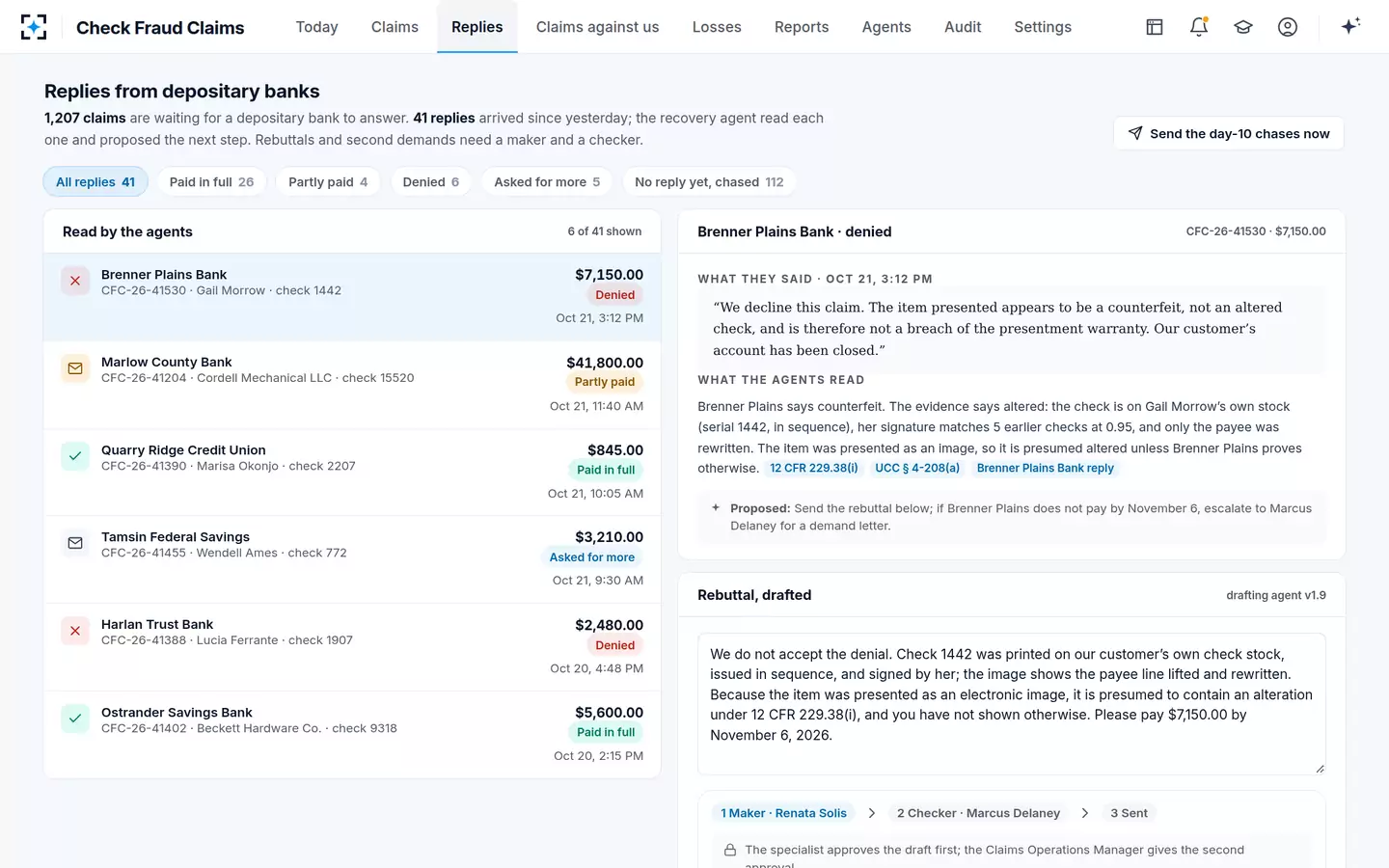
In practice the contest is over the issued record, because the image cannot settle it alone. A depositary bank that wants to show a counterfeit points to stock the customer never ordered, a serial number outside her range, a MICR line or printing that differs from her checks, or a signature unlike any she has used. A paying bank defending the presumption points to the opposite: the customer's own stock, a serial in sequence, her signature on six earlier checks, and her copy showing the original payee and amount. The marks that separate a counterfeit from an altered check are the same in both directions; who must prove them is what the rule changed.
Evidence in a presumption dispute, and what it can do
| Evidence | Can it rebut the presumption? | Why |
|---|---|---|
| The original paper check, made available to all banks | It ends the presumption | Under 229.38(i)(3) the presumption no longer applies; the paper is examined instead |
| A scanned image of the original | No | The Board said it generally provides no better evidence than the electronic or substitute check |
| Check stock and serial range against the customer’s order | It can support either side | Stock she never ordered suggests a counterfeit; her own stock in sequence suggests alteration |
| Signature against the customer’s earlier paid checks | It can support either side | A forged drawer’s signature is the other branch of the rebuttal |
| The customer’s duplicate copy, register or issue file | It supports alteration | It shows the original payee and amount the paid item departs from |
| The depositor’s account history at the depositary bank | Rarely on its own | It shows who took the money, not what the drawer issued |
Does a check image count as the original check?
No, and the Board said why. A commenter asked to let a scanned image of the original stand in for it. The Board refused: "A scanned image of the original check would generally provide no better evidentiary value than a substitute check or an electronic check, and thus the final rule does not permit such an image to overcome the presumption of alteration." An image is what the dispute is already about; a second image of the same paper adds nothing the first did not show.
That cuts hardest against remote deposit capture. When a check is deposited by phone, the depositary bank never holds the paper: the depositor keeps it, and in a fraud case the depositor is gone. The Board saw this coming. It wrote that a depositary bank offering remote deposit "may not be able to obtain the original check to overcome the presumption of alteration", and said it expected depositary banks to examine their remote deposit protocols, "such as limiting the amount of money that may be deposited remotely."
A counterfeit denial, read and answered with the presumption and the customer's own stock
Who benefits from the presumption of alteration?
The paying bank, generally, and every bank in that role. The Board said so plainly: "a presumption of alteration generally favors the paying bank (the depositary bank is generally liable for alterations)". The cost falls on the bank that warranted the item had not been altered and cannot prove otherwise, which the Board described as a depositary or collecting bank that destroys all original checks after truncation.
The same banks sit on both sides. A bank that accepts mobile deposits is a depositary bank for its depositors' checks and a paying bank for its own customers'. The Board expected banks to weigh the cost of keeping originals, for example for large items, so that the presumption would not apply, and noted that in their roles as paying banks the same institutions could benefit. The practical lesson for a claims team is symmetrical: cite the presumption when you claim, and expect it to be cited against you when other banks claim on deposits you took.
What the presumption does not do
It does not reach the customer. One commenter asked the Board to make sure the presumption applied only between banks, and the final rule says so in its first sentence. A customer who claims her check was altered still deals with her own bank under the UCC's rules on what is properly payable and on her duties to review statements.
It also stops where other law starts. The presumption applies in the absence of a contrary federal statute or regulation, and the commentary names the Treasury's rules for Treasury checks as an example. It can be varied by agreement between banks to the extent Regulation CC allows. And it leaves the UCC's defenses untouched: a depositary bank that cannot rebut the presumption can still argue that the drawer's negligence contributed to the alteration or that the customer reported too late. Those replies, and the answers to them, are in the altered check claim denied.
Using the presumption in a warranty claim with Check Fraud Claims
Cite it in the claim, not only in the rebuttal. A warranty claim on an image item that states the presumption up front tells the depositary bank, before it drafts a counterfeit denial, that the denial will need proof. In Check Fraud Claims the liability agent adds the citation whenever the item was presented as an electronic or substitute check, the drafting agent states it in the notice of breach beside the evidence of the customer's stock and signature, and the recovery agent answers a counterfeit reply with a rebuttal drafted the same day for two people to approve.
The liability reasoning in Check Fraud Claims, ending with the presumption for an image item
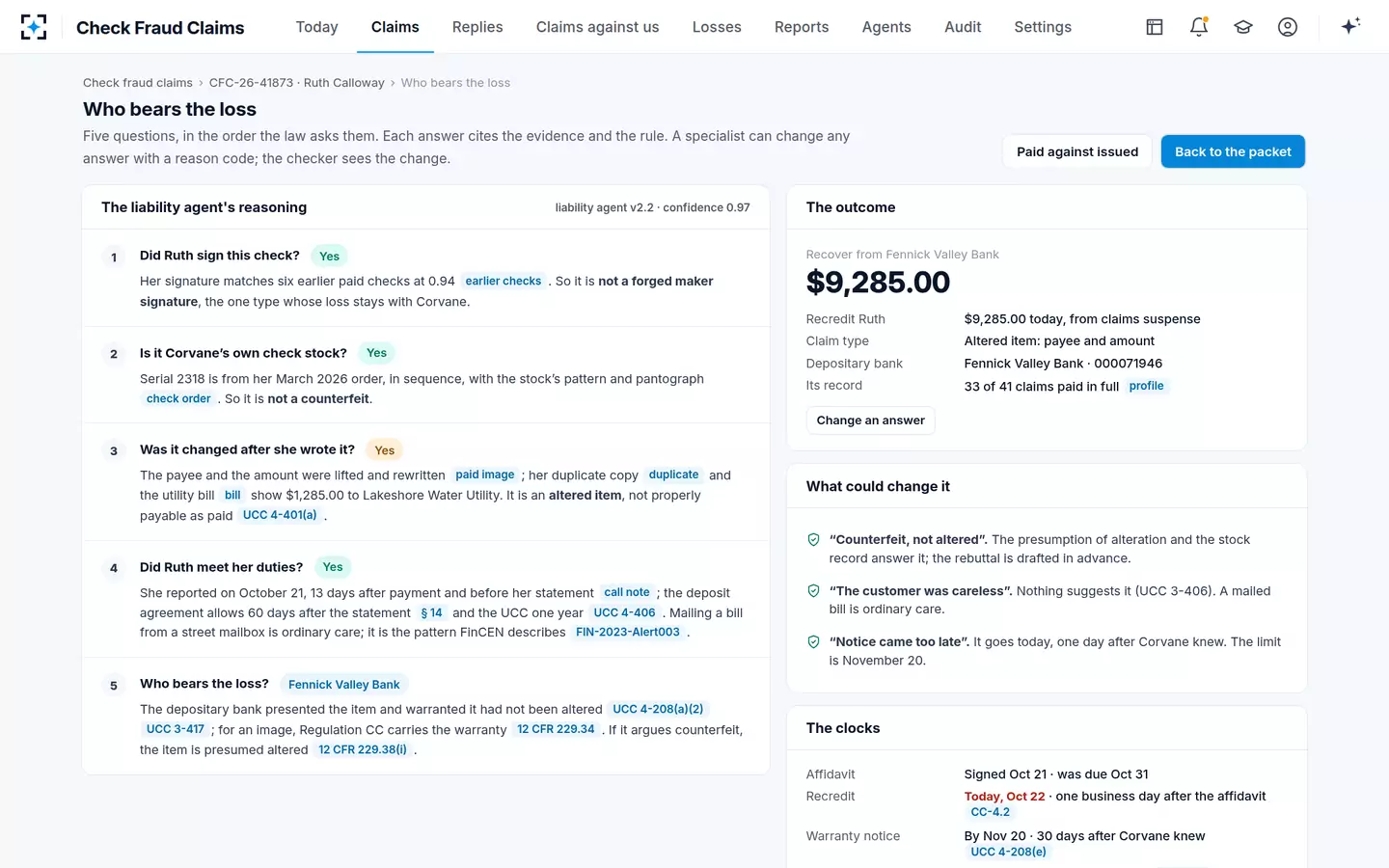
The presumption is strongest beside good evidence and weakest alone. A claim that rests only on the rule invites the depositary bank to produce whatever it can and test the preponderance; a claim that shows the customer's own stock, her signature and her copy leaves little to rebut. The UCC presentment warranties carry the claim, Regulation CC's own warranty for electronic checks at 12 CFR 229.34 adds a promise that the image accurately represents the original, and the presumption decides the doubt. To see both on a live claim, start from Check Fraud Claims.
Questions people ask
Where is the presumption of alteration in Regulation CC?
In 12 CFR 229.38(i), in the liability section of subpart C, which governs check collection and return. Paragraph (i)(1) sets the presumption, (i)(2) says how it is rebutted and (i)(3) ends it when the original check is made available to all banks in the dispute. The Board's commentary is in Appendix E to Part 229.
Does the presumption of alteration apply to forged indorsements?
No. It addresses one question: whether an item contains an alteration or derives from an original issued with an unauthorized drawer's signature. A forged payee indorsement is a different breach, of the warranty that the presenter was entitled to enforce the check, and it is proved on its own evidence.
Can a depositary bank rebut the presumption by saying its customer is a victim too?
Not by that alone. The rebuttal must show that the item was not altered or that it came from an original issued with an unauthorized drawer's signature. Who the depositor was, or what happened to the money, does not answer either question.
Does the presumption apply to a check the paying bank asked to see?
If the paying bank asks for and receives the original check after an image dispute, the presumption no longer applies, because the original has been made available. The Board gave that example itself: the paper then decides the type.
Did the 2025 payments fraud request for information change the presumption?
No. The June 2025 request from the Federal Reserve Board, the FDIC and the OCC asked whether amendments to Regulation CC could help resolve interbank check disputes, and said the Board was not proposing changes to Regulation CC at that time. Section 229.38(i) reads as it did when it took effect in 2019.