The time limit for a check fraud claim depends on whose claim it is. A paying bank can return a fraudulent check unpaid only until its midnight deadline, generally midnight of the banking day after it receives the check. A customer must report an altered check or forged signature with reasonable promptness, and is barred against her own bank after one year. The paying bank must give the depositary bank notice of a breach of warranty within 30 days after it has reason to know of the breach and who the warrantor is. And a lawsuit on the claim must start within three years under the UCC, or one year for a claim under Regulation CC's own rules. Each clock decides different money, and the 30-day notice is the one most easily misread: missing it does not end the claim, it discharges the other bank only to the extent the delay caused it a loss. Botminds' Check Fraud Claims starts the clocks when the customer calls, keeps each one on the claim and works the paying bank's side fast enough that the money is still there.
Where the examples use the solution's screens, they show sample data on fictional banks and customers; the dollar scenario in the middle of the page is illustrative arithmetic, labelled where it appears.
The four clocks on a check fraud claim, and what each one decides
| Clock | Starts | Length | What missing it costs | The rule |
|---|---|---|---|---|
| 1. Return window | The paying bank receives the check | Generally until midnight of the next banking day | The chance to return the item unpaid; after it, only a warranty claim | UCC 4-301 and 4-302; Regulation J; Reserve Banks’ Operating Circular 3 |
| 2. Customer’s report | The statement or items are made available | Reasonable promptness; 30 days for repeat items by the same wrongdoer; one-year outer bar | The customer’s right to be recredited, and with it the bank’s warranty claim | UCC 4-406(c), (d) and (f), and the deposit agreement |
| 3. Warranty notice | Reason to know of the breach and who the warrantor is | 30 days | Not the claim: the warrantor is discharged only to the extent the delay caused it loss | UCC 4-208(e) and 4-207(d); 12 CFR 229.34(k) |
| 4. Time to sue | Accrual, reason to know of the breach (UCC); the violation (Regulation CC) | Three years under the UCC; one year for a Regulation CC claim | The claim itself | UCC 4-111 and 3-118(g); 12 CFR 229.38(g) |
Why a check fraud claim has four time limits, not one
Because a check fraud claim is several claims stacked on one check, each between different parties. The customer's claim runs against her own bank. The paying bank's claim runs against the bank that presented the check. The depositary bank's claim runs against its depositor. Each relationship has its own rule, and each rule has its own clock. The Federal Reserve's check fraud toolkit tells banks to "Promptly file a bank-to-bank or breach of warranty claim, adhering to time limits based on the type of fraudulent check." The type matters because it decides which clock is even running: there is no warranty notice to give on a counterfeit the presenting bank had no knowledge of, because there is no warranty to breach.
The clocks also start at different moments. The return window starts when the check arrives; the customer's clock when her statement does; the notice clock when the paying bank has reason to know. A claims team that tracks only "days since the customer called" will miss the clock that started earlier, and misjudge the one that started later.
How long does a bank have to return a fraudulent check?
Until its midnight deadline: generally midnight of the banking day after the day it received the check. Under UCC 4-301 a paying bank that settled for a check may revoke the settlement and return the item if it acts before that deadline, and under 4-302 it becomes accountable for the check if it holds it past the deadline without paying, returning or giving notice. The Federal Reserve Banks repeat the rule for checks they handle: the deadline "applies to checks returned with entry for any reason, including forged endorsement or forged drawer signature".
For most consumer check fraud the window closes long before anyone knows. A washed check is typically paid on presentment, and the customer often finds out from a statement or a creditor's past-due notice weeks later. The return window matters most for business accounts with positive pay, where an exception can be returned the next day, and for in-clearing fraud the paying bank catches itself. Once it has passed, the operating circular is explicit that a late return is not a back door: "A bank must not attempt to recover on a warranty or indemnity claim by including the item in a paper or electronic cash letter or return letter after the return deadline." After the window, the route for an altered or wrongly indorsed check is a warranty claim.
How long do I have to report check fraud?
The UCC gives a customer three overlapping limits, and the deposit agreement may shorten them. She "must exercise reasonable promptness in examining the statement" and report what she should have found. If she does not, later checks forged or altered by the same wrongdoer and paid after she had a reasonable period, at most 30 days, to review and report may become her loss. And whatever the care on either side, she cannot assert an altered check or her forged signature against the bank if she has not reported it within one year of the statement.
For a claims team, the customer's clock is more than her problem. The one-year bar in UCC 4-406(f) ends the paying bank's own warranty claim for the same item, so the date the customer received her statement and the date she called are evidence in the bank's recovery. How the preclusion works, and how comparative fault divides a loss when both sides were careless, is set out in UCC 4-406 and the customer's late report.
What is the 30 day rule for check warranty claims?
It is a notice rule, not a deadline that kills the claim. The UCC puts it in one sentence, repeated for transfer warranties in 4-207(d) and for Regulation CC's own warranties in 12 CFR 229.34(k):
“Unless notice of a claim for breach of warranty is given to the warrantor within 30 days after the claimant has reason to know of the breach and the identity of the warrantor, the warrantor is discharged to the extent of any loss caused by the delay in giving notice of the claim.”
Uniform Commercial Code § 4-208(e), official text
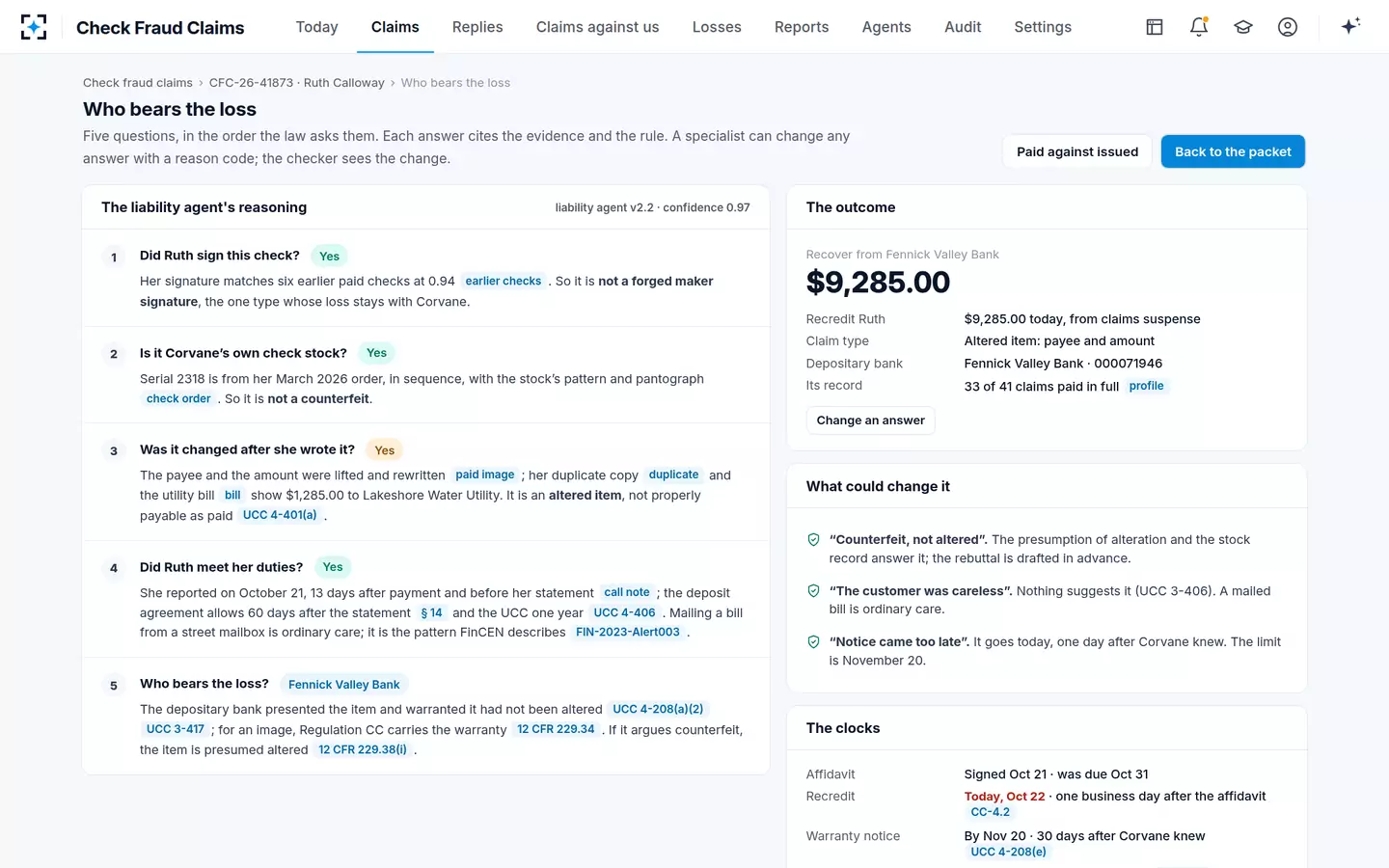
Read closely, the sentence has three parts that claims teams routinely compress into "30 days or it's gone". The clock starts at reason to know, which for an altered check is usually the customer's report, and needs both the breach and the warrantor's identity, which for most checks is printed on the back of the image as the depositary bank's indorsement. The penalty is a discharge, not a bar. And the discharge reaches only the loss caused by the delay: the money the depositary bank could have recovered from its depositor if notice had come on time, and could not because it came late.
Two clocks a claims team has to watch in the first 60 days
- Days 1–30: notice in time; the claim is owed30 days
- Day 31 on: discharged for loss the delay causedlater
- Up to 30 days to review and reportat most 30 days
- Later items by the same wrongdoer can become herslater
What happens if a warranty claim is late?
The claim survives, but the depositary bank keeps whatever the delay cost it. Suppose, as an illustration, a check written for a few hundred dollars is washed and paid for $9,000, and on the last day a timely notice could have arrived, the depositor's account at the depositary bank still held $4,500 that could have been frozen. If notice comes on day 45 and $1,500 of that was withdrawn in the extra fifteen days, the depositary bank's argument is that it is discharged for $1,500. If notice comes on day 90 and the account is empty, it argues for the whole $4,500. The paying bank's claim shrinks in step with the depositor's balance.
An illustrative $9,000 altered check: how a late notice shrinks the claim
Notice within 30 days
- Claimable from the depositary bank: $9,000 · 100%
Notice on day 45; $1,500 left the depositor’s account after day 30
- Claimable: $7,500 · 83%
- Discharged by the delay: $1,500 · 17%
Notice on day 90; the remaining $4,500 is gone
- Claimable: $4,500 · 50%
- Discharged by the delay: $4,500 · 50%
Two things follow for the economics of a claims desk. A late notice is never worth abandoning: on the day-90 row the bank still has $4,500 to claim, and the depositary bank has to show what the delay cost it. And every day of the paying bank's own processing is a day of the depositor's balance at risk, which is why a desk that takes a week to type a check and write a letter is giving money away even when it sends inside 30 days. The sample bank in Check Fraud Claims sets its own target at 25 days, a margin inside the 30, and sent its sample customer's claim the morning after she reported.
Check Fraud Claims: who bears the loss, with the clocks beside the answer
How long does a bank have to make a warranty claim?
Thirty days to give notice without risk of a discharge, and three years to sue. UCC 4-111 says an action under Article 4 "must be commenced within three years after the [cause of action] accrues", and 4-208(f) says a warranty claim accrues when the claimant has reason to know of the breach; UCC 3-118(g) gives the same three years for warranty and conversion claims under Article 3. Regulation CC sets a shorter limit for its own rules: an action under its subpart C "shall be brought within one year after the date of the occurrence of the violation involved".
Two different one-year rules therefore sit on a check claim, and they are easy to confuse. The UCC's one-year rule, in 4-406(f), is the customer's bar against her bank and starts from her statement. Regulation CC's one-year rule, in 229.38(g), is a limit on suing under Regulation CC and starts from the violation. A claim built on the UCC warranty and the Regulation CC presumption of alteration should be filed, chased and, if it comes to it, sued on with both in view.
Claims against the Federal Reserve Banks themselves carry a stricter notice term. Operating Circular 3 asks for notice of a warranty claim against a Reserve Bank within thirty calendar days of reason to know, and says the Reserve Bank's liability is discharged to the extent of loss caused by a later notice "notwithstanding any longer period for requesting adjustments or filing suit". That rarely affects an altered-check claim, which goes to the depositary bank, but it does matter for a bank that collects through the Reserve Banks and finds a problem with the Reserve Bank's own handling.
How long does a check fraud claim take?
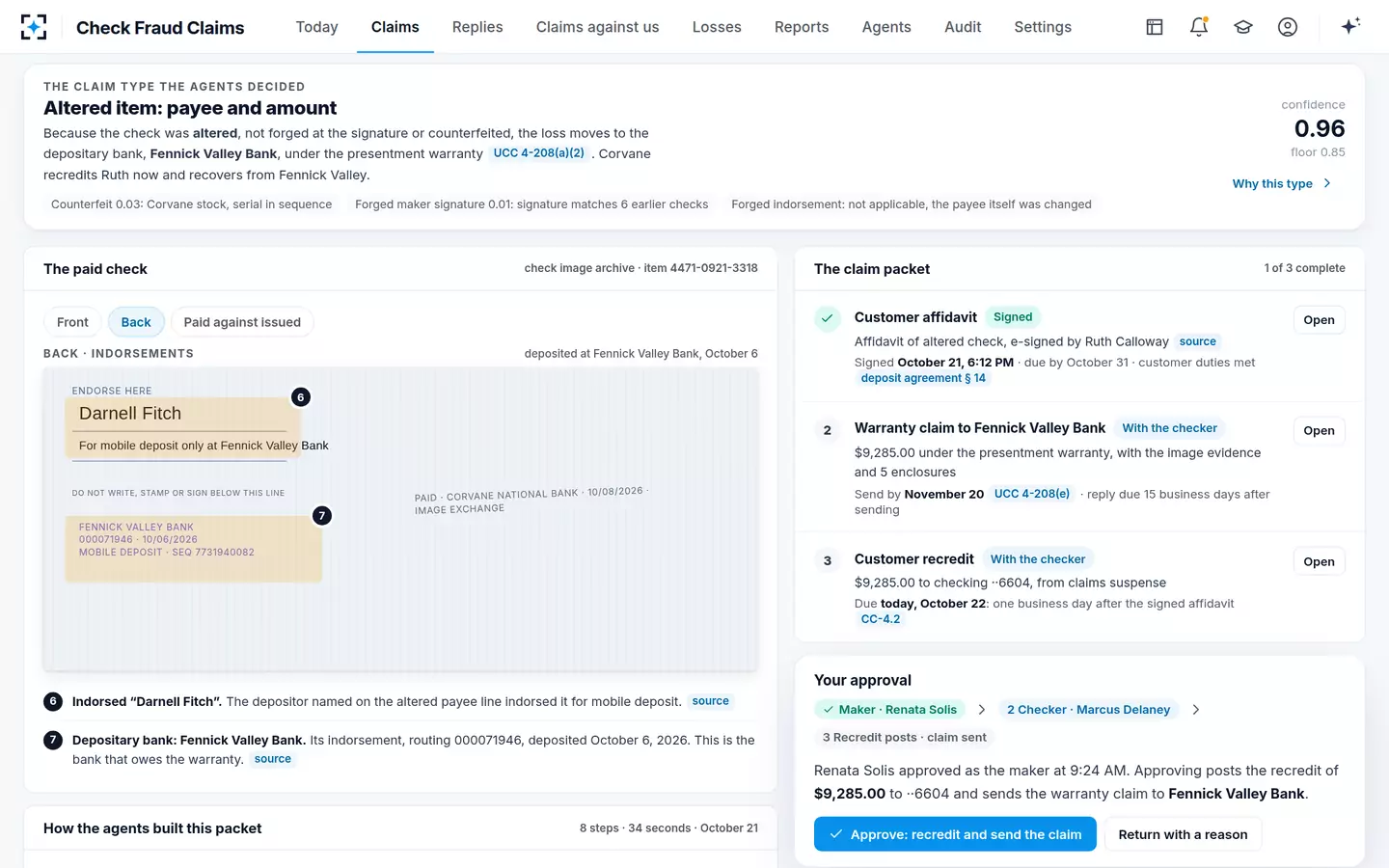
The paying bank's part can take a day; the whole claim usually takes weeks, because the reply is on the other bank's time. No rule sets a deadline for a depositary bank to answer a warranty claim, so each paying bank sets its own reply date and chases to it. In the sample bank the customer was recredited the day after she called, the claim went out the same morning, and the reply is due 15 business days later, with chases at day 5 and day 10 and an escalation to the manager when the date passes. On the day the replies screen was captured, 1,207 claims were waiting on another bank and 112 had been chased without an answer.
The customer's part has no federal clock at all. Regulation E's 10-business-day investigation rule covers electronic transfers and excludes transfers originated by check, so how fast a bank recredits a check fraud claim is a matter of its deposit agreement and its own policy. The sample bank's policy recredits altered items and forged indorsements one business day after the signed affidavit, up to $25,000. What a customer can expect, and the narrow exception for substitute checks, is in my check was stolen and cashed.
The second approval in Check Fraud Claims: what the manager's click will post and send
Pricing the days: where a claims desk loses money to the clock
Put the four clocks together and the losses fall into three kinds. The first is the claim never sent: a check typed as a forgery when it was altered, so no warranty claim goes out at all; that is a typing error, not a timing one, and it is covered in who is liable for altered checks. The second is the claim sent late, where the depositary bank argues that the delay cost it the depositor's balance. The third is the claim never finished: sent, unanswered, chased by email for months and quietly written off long before the three years ran.
Each has a control. Typing errors fall when the type is decided from the evidence and a person approves it. Late notices fall when the notice clock starts at the customer's call rather than when a specialist opens the file, and when the bank's target sits inside the 30 days. Unfinished claims fall when every unanswered claim has a chase date, an escalation and, at the end, a demand letter or a decision to write off with a second approval. The checks themselves keep coming; the check fraud losses in 2025 guide sets out what the public data says about how many.
Check Fraud Claims builds those controls into the claim. The intake agent starts the clocks the moment the claim opens; the liability agent writes the notice date into the packet; the recovery agent sends the approved claim, chases it before the reply is due and escalates when it is not answered; and every clock, limit and target is a versioned setting a claims administrator proposes and the head of claims approves. To see the clocks on a live claim, start from Check Fraud Claims.
Questions people ask
Is there a statute of limitations on a check warranty claim?
Yes. Under the official UCC text, an action on a warranty claim must start within three years after the claimant has reason to know of the breach (UCC 4-111, 4-208(f) and 3-118(g)). A claim under Regulation CC's own rules must be brought within one year of the violation (12 CFR 229.38(g)). States enact the UCC with variations, so the bank's own state law governs.
When does the 30-day warranty clock start?
When the claimant has reason to know of the breach and of the warrantor's identity. For an altered check, that is usually the day the customer reports it, because the depositary bank's identity is on the back of the paid image. If the image does not show which bank presented it, the clock waits for that second fact, and the claim file should record when it was found.
Can banks agree to a different time limit?
For some rules, yes. UCC 4-103 lets parties vary the effect of Article 4 by agreement within limits, and Regulation CC allows variation between banks under 12 CFR 229.37. The warranties themselves cannot be disclaimed for checks (UCC 4-208(e)), but clearing-house rules and bilateral agreements can set procedures between banks.
Does the customer's 60-day deposit agreement period replace the UCC's one year?
It may. UCC 4-103(a) lets a bank and its customer vary Article 4 by agreement, but not disclaim the bank's good faith or ordinary care, so whether a shorter reporting period holds is a question of state law and of the clause itself. The UCC's own limits still apply alongside it. A claims team should record which period the deposit agreement sets and whether the customer met it, because a customer precluded under 4-406(f) also ends the bank's warranty claim for that item.
How fast must a bank recredit a stolen check?
No federal rule sets a deadline for an ordinary check claim: Regulation E's investigation clock excludes transfers originated by check. The exception is a consumer who was given a substitute check: under 12 CFR 229.54, a bank that has not decided a complete claim by the 10th business day must by the end of that day recredit the lesser of the check's amount or $2,500, and the rest by the 45th calendar day.