The bank that took the deposit is usually liable for an altered check. When a check's payee or amount is changed after the customer wrote it, the customer's own bank, the paying bank, must put the money back because the item was not properly payable, and it then recovers from the depositary bank, which warranted under UCC 4-208(a)(2) that the check had not been altered. A counterfeit check or one with a forged drawer's signature works the other way: the presenting bank only promises it knows of no forgery, so the loss usually stays with the paying bank. A forged indorsement goes back to the depositary bank. The customer carries a loss only if her own carelessness contributed or she reported too late. Because one fact, the type of fraud, moves the money between banks, the hardest part of a claim is deciding the type from the evidence. Botminds' Check Fraud Claims gives that decision to a comparison agent that reads the paid image against what the customer issued, scores every type, and asks a person when it is unsure.
The examples are the solution's sample data, on fictional banks and customers: Corvane National Bank paid the checks, and its customer Ruth Calloway is the drawer of the altered one.
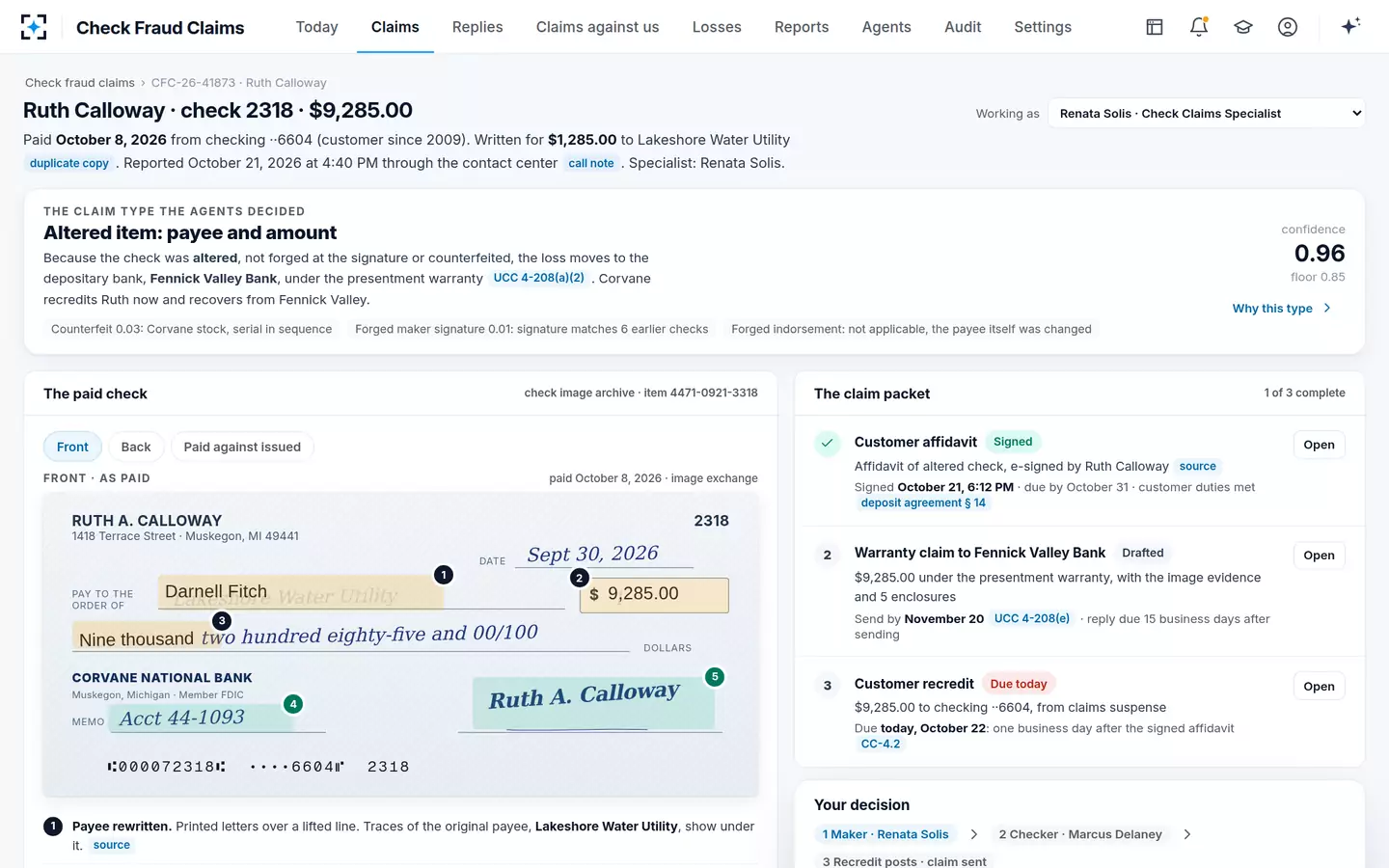
One altered check, typed: five findings on the front, and why the other types were rejected
What the agent found on the paid image
Payee line changed
Printed letters over a lifted line; traces of “Lakeshore Water Utility” show under “Darnell Fitch”.
Amount box changed
$1,285.00 written; $9,285.00 paid. The first digit is rewritten.
Written amount changed
“Nine thousand” over “One thousand”; the rest of the line is the customer’s hand.
Memo same
“Acct 44-1093”, unchanged.
Signature same
Matches six earlier paid checks at 0.92 to 0.96.
The four types, scored
Altered item: payee and amount0.96
Three fields changed over the customer’s own writing
Counterfeit0.03
The bank’s own stock, from her March 2026 order, serial in sequence
Forged maker signature0.01
Signature matches six earlier checks
Forged indorsementn/a
The payee itself was changed, so no true payee indorsed
Who is liable for an altered check?
The depositary bank, in most cases, through the presentment warranty. Every bank that presents a check for payment warrants to the paying bank, under UCC 4-208(a)(2), that the check has not been altered. An altered check breaks that promise whatever the presenting bank knew, so the paying bank recovers the amount it paid, less anything it may still charge its own customer, plus expenses and lost interest. The depositary bank then looks to its depositor, who made the same promise to it when the check was deposited.
The rule is old and deliberate. In its 2018 rule on altered checks, the Federal Reserve Board explained why the UCC splits the two frauds as it does. Forgery stays with the paying bank because of an eighteenth-century English case, Price v. Neal, and the reasoning behind it still holds:
“The Price v. Neal rule reflects the assumption that the paying bank, rather than the depositary bank, is in the best position to judge whether the drawer’s signature on a check is the authorized signature of the account-holder.”
Federal Reserve Board, final rule amending Regulation CC, 83 FR 46849, 17 September 2018
The depositary bank, the same notice continues, is "arguably in a better position than the paying bank to inspect the check at the time of deposit and detect an alteration to the face of the check". The paying bank knows its customer's signature; the depositary bank knows its depositor and sees the item come in. Each carries the fraud it was placed to catch.
What is the difference between an altered and a forged check?
An altered check is a genuine check that someone changed after it was issued; a forged check carries a drawer's signature the account holder never made. The UCC defines alteration as "an unauthorized change in an instrument that purports to modify in any respect the obligation of a party", which covers a washed payee, a raised amount and a changed date. A counterfeit is a new check printed to look like a real one, usually on stock the customer never ordered and with a signature copied or invented, so in law it is treated with forgery: the drawer did not sign it.
The Federal Reserve's check fraud toolkit lists the marks each type tends to leave. For an altered check: "Erasure, washing, dried liquid marks", uneven or faded printing, a different font or size in the payee or amount than in the date or memo, and handwriting inconsistent with the rest of the check. Those are detection signals, and the counterfeit check vs altered check guide covers how a depositary bank reads them on the way in. After the loss, the same marks become evidence, and the question changes from "should we hold this?" to "which bank owes the money?"
Who is liable for altered checks, counterfeits and forgeries: the type moves the loss
| Type | What happened | Who usually bears the loss | The rule | Evidence that settles the type |
|---|---|---|---|---|
| Altered item | The customer’s real check; payee, amount or date changed afterwards | Depositary bank, which recovers from its depositor if it can | UCC 4-208(a)(2) and 3-417(a)(2): the check has not been altered | The customer’s duplicate copy or register, the bill it paid, her signature on the paid image |
| Forged indorsement | The real payee never signed; someone indorsed in the payee’s name | Depositary bank, unless the indorsement is effective | UCC 4-208(a)(1): warrantor entitled to enforce; defenses in 3-404 and 3-405 | The payee’s statement that it never received or indorsed the check; the indorsement and deposit account |
| Forged maker signature | The customer’s real stock, but she did not sign it | Paying bank (and its customer only if her care contributed) | UCC 4-208(a)(3): presenter warrants only that it knows of no forgery | Signature against earlier paid checks; stock and serial range |
| Counterfeit | A new check printed to imitate the customer’s | Paying bank, as with a forged signature | Same as forged maker signature; Price v. Neal | Stock, serial range, MICR and printing against the customer’s check order |
Who is liable for a counterfeit check?
Usually the paying bank. A counterfeit has no genuine drawer's signature, and the presenting bank's only promise about the signature, in UCC 4-208(a)(3), is that it does not know the signature is unauthorized. Unless the paying bank can show the depositary bank knew, there is no warranty to claim on. The paying bank's other route, recovering a payment made by mistake, is closed against the people who matter most: under UCC 3-418(c) it "may not be asserted against a person who took the instrument in good faith and for value", which describes most depositary banks.
That is why a depositary bank that receives an altered-check claim so often replies that the item was a counterfeit. If the claim is recast as forgery, the warranty falls away. Two things stand in the way of that reply: the evidence that the check is on the customer's own stock and signed by her, and, when the dispute concerns an electronic image, the Regulation CC rule that the item is presumed altered until the depositary bank proves otherwise. What the 2019 presumption of alteration settled is set out separately.
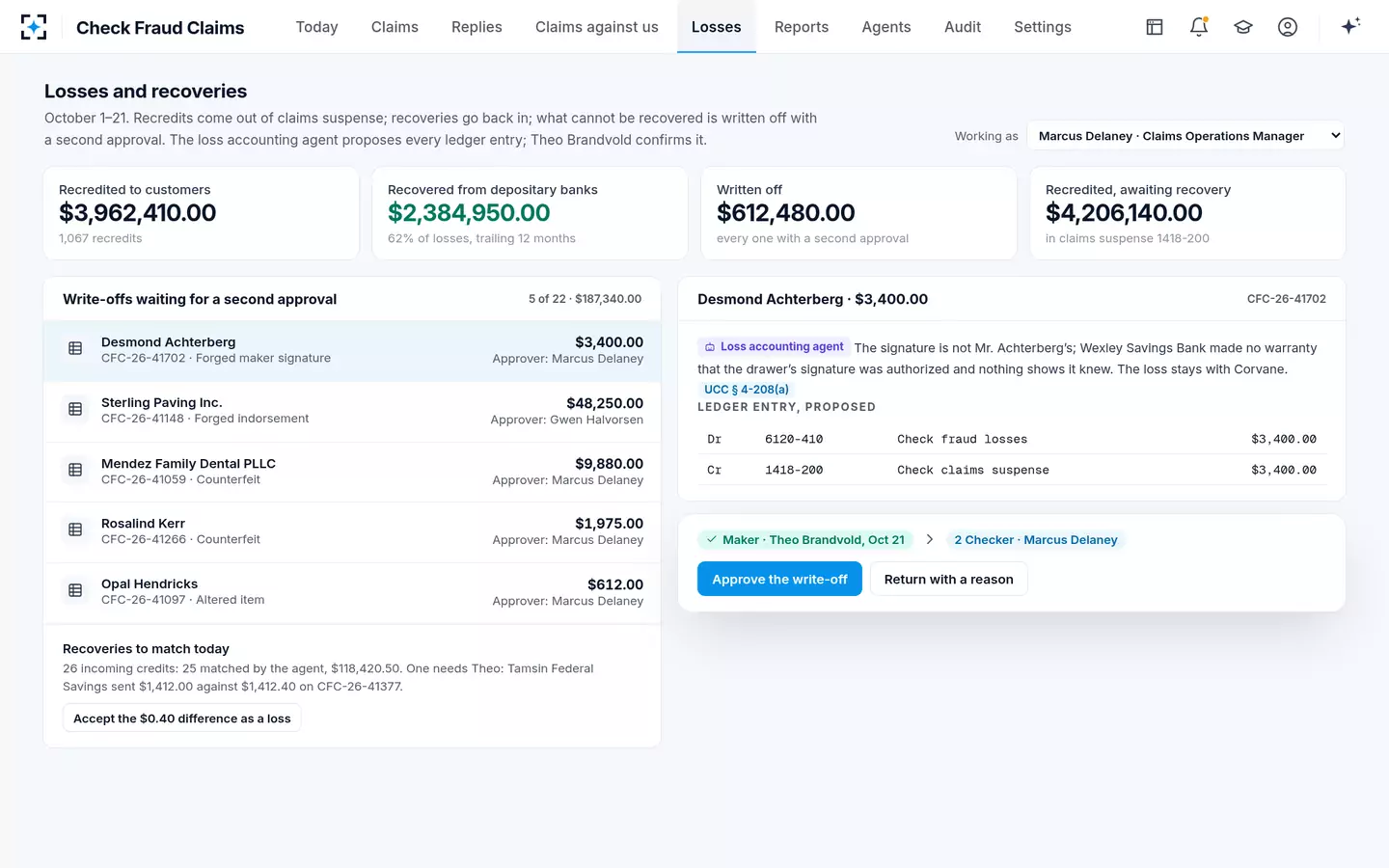
A forged maker signature: the write-off stays with the paying bank
Who is liable for a forged endorsement?
The depositary bank, again through the warranties, but on a different promise. A thief who signs the payee's name on the back of a stolen check is not a person entitled to enforce it, so the bank presenting the check breaks the warranty that it was entitled to collect. Each collecting bank has its own claim further back: a depositor warrants to its bank that "all signatures on the item are authentic and authorized".
The defenses are different too. A depositary bank can answer a forged-indorsement claim by showing the indorsement was effective after all: the drawer was tricked into issuing the check to an impostor posing as the payee, the payee was fictitious, or an employee the drawer entrusted with its checks made the indorsement. The third case arises in business accounts, and when it applies it puts the loss back on the employer. These defenses, and how to answer them, are in the replies banks send to an altered check claim.
Is the bank responsible for a forged signature on a customer's check?
Toward its own customer, usually yes. A check the customer did not sign is not properly payable from her account, so the paying bank must recredit her and, as above, usually cannot pass the loss on. The bank can resist only on the customer's own conduct: if her failure to exercise ordinary care "substantially contributes" to the forgery, or she did not report it in time under UCC 4-406, she may be precluded, and if the bank was careless too the loss is shared.
For the claims desk the consequence is plain. A forged-signature claim is a loss to book, not a claim to send, and a specialist who sends a warranty claim on one wastes the other bank's time and the bank's credibility for the next claim. A specialist who books an altered check as a forgery gives away money the bank was owed. Both mistakes start with the type.
How do banks decide the check fraud type?
By comparing what was paid with what the customer issued, from the best evidence available. The original paper is rarely available, because most checks are now collected as images and a mobile deposit leaves the paper with the thief. So the comparison runs on secondary records: the customer's duplicate copy or check register, the bill or invoice the check was meant to pay, her earlier paid checks for the signature and handwriting, her check order for the stock and serial range, and, for business customers, the positive pay issue file.
The issue file is the strongest of these when it carries the payee. The Federal Reserve's toolkit describes a business customer whose $14,750 check to a vendor was stolen, altered and deposited under a different payee name, and the paying bank's payee validation "immediately flagged the mismatch between the payee on the check and the payee listed in the customer’s file". Caught in clearing, the check was returned unpaid. After payment, the same file is the cleanest proof that the item was altered rather than forged.
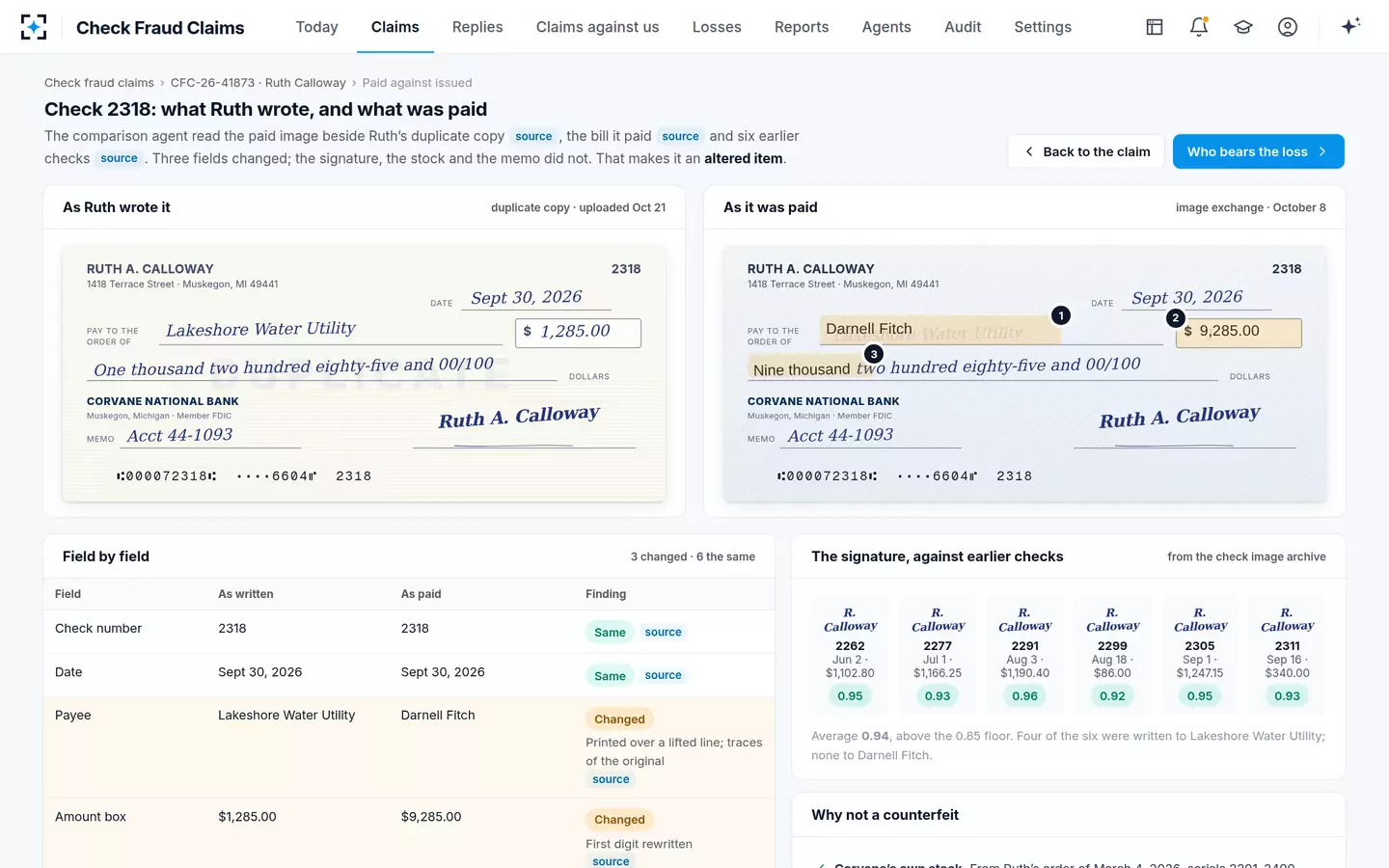
What the customer wrote, beside what was paid, field by field
Inside the Check Fraud Claims comparison agent: one check, every type scored
The comparison agent does the specialist's first hour of work and shows it. It reads the paid image, front and back, from the check image archive, then the issued record: the duplicate copy the customer uploaded with her affidavit, the bill, six earlier paid checks and the check order. It compares field by field, records each difference as a finding pinned to the place on the image where it appears, and scores all four types side by side rather than naming one.
How the comparison agent in Check Fraud Claims types a check, and where a person takes over
Agent
Intake agentFinds the paid item in the core banking system from the customer’s report and pulls the front and back images.
Never: decides the type or what the customer is owed
Agent
Comparison agentReads the image against the duplicate copy, the bill, earlier paid checks, the check order and any positive pay file; pins each finding; scores altered, counterfeit, forged signature and forged indorsement.
Never: classifies below its 0.85 floor; it offers its readings and asks
Agent
Liability agentApplies UCC 3-417, 4-207, 4-208, 4-401 and 4-406, Regulation CC and the deposit agreement to say who bears the loss, how much and by when.
Never: waives a customer duty or grants a policy exception
A person decides
Check claims specialistReads why, accepts the type or changes it with a reason code, and approves the packet as the maker.
A person decides
Claims operations managerGives the second approval; a changed type waits for this checker.
Never: approves his own work
The rejected scores matter as much as the winning one. A depositary bank that replies "counterfeit, not altered" is arguing for the second line of the table, and the agent has already written down why that line scored 0.03: the stock came from the customer's own order, in serial sequence. The specialist starts the claim with the rebuttal's evidence in hand.
Below the floor, a person decides the type
Every agent in the solution works to a confidence floor, and the comparison agent's is 0.85. Below it the agent does not type the check; it lists its readings and the specialist picks one. A check with a payee lifted but a signature the archive cannot match well, or a business check with no issue file and an unfamiliar signer, lands here, and so it should: these are the claims where the type is a judgment.
The floor is a setting, from 0.60 to 0.99, proposed by a claims administrator and approved by the head of claims before it is in force. Setting it is a trade the bank should measure rather than guess, by replaying closed claims whose outcome is known, as check image analysis, tested by replay describes.
The type the agents decided, with the rejected types beside it
Can a bank refuse to refund an altered check?
A bank can refuse its own customer only on her conduct, not on the type. If the check was altered and she wrote it with care and reported it in time, the item was not properly payable and she is owed the recredit, whatever the bank later recovers from the other bank. The defenses are narrow and the bank must prove them: that her lack of ordinary care substantially contributed to the alteration, as with a check left with a wide blank space before the amount, or that she failed the review duty in UCC 4-406, for example by reporting more than a year after the statement. The second is the subject of UCC 4-406 and the customer's late report.
Carelessness is the depositary bank's argument to prove, and the sample bank's liability agent answers it in its own reasoning before it is raised: it treats a bill mailed from a street mailbox as ordinary care, and notes that the theft matches the pattern FinCEN described in its 2023 alert on mail theft-related check fraud. To see the comparison, the liability reasoning and the packet on one claim, start from Check Fraud Claims.
Questions people ask
Who is liable if a check is altered after it is deposited?
The answer is the same: the bank that presented the altered check to the paying bank warranted it had not been altered, wherever in the chain the change happened. Each bank in the collection chain gives its transferee the same warranty, so the loss travels back to the depositary bank and from there to its depositor if the money is still there.
Is the paying bank liable if it should have spotted the alteration?
Not toward the depositary bank. UCC 4-208(b) says the paying bank's right to recover for breach of warranty is not affected by its own failure to exercise ordinary care in paying. The paying bank's care matters only toward its own customer, where it can reduce a preclusion based on the customer's negligence.
Who is liable for a check with a changed date?
A changed date is an alteration under UCC 3-407, for example a postdated check moved forward so it can be paid at once. The Federal Reserve Board's 2018 commentary to Regulation CC gives that example of an alteration, so the depositary bank's not-altered warranty covers it like a changed payee or amount.
Who pays when a stolen blank check is filled in and cashed?
If the customer signed a check and left the payee or amount blank, a thief who fills it in has completed an incomplete instrument rather than forged a signature, and a bank that pays in good faith may charge the customer according to the completed terms (UCC 4-401(d)(2)); the CFPB warns that people usually cannot get their money back when they lose a signed blank check. If the thief also signed it, it is a forged signature and the paying bank bears it toward its customer.
Does it matter whether the check was deposited by phone or at a branch?
It matters for the evidence, not the rule. A branch deposit may leave an original paper check that settles the type; a mobile deposit leaves only images, which is when the Regulation CC presumption of alteration applies in a dispute between the banks. The Federal Reserve Board told depositary banks in 2018 to examine their remote deposit capture protocols for exactly that reason.