Positive pay works by matching. A business sends its bank a file of the checks it has issued, with each check's number, amount and date and often the payee; overnight, the bank compares every check presented for payment against that file, pays the ones that match, and asks the business to decide, pay or return, on each one that does not. ACH positive pay does the same for electronic debits, against the list of companies and amounts the business has authorized. The hard part is not the match but the exception it leaves: a person has to see what moved on the check and decide before the bank's cutoff. Botminds' Positive Pay Exceptions is agent software for that part, and the trace below follows one altered check through it.
The check belongs to a fictional client of a fictional sample bank, Tessaly Community Bank; every person named is fictional. The rules each step answers to are real and linked.
The sample day the trace comes from
28,460
checks and ACH debits presented overnight
1,180
business clients with positive pay
95
exceptions after the match: about one item in 300
4
signs of washing on the one check traced below
How does positive pay work in banking? The regulators' version
The supervisors' description is short. The FDIC, publishing the FFIEC's 2021 authentication guidance, describes positive pay as a technique in which a business customer sends its bank files on every check it has issued, the bank compares them with the checks presented for payment, and a check missing from the file goes back to the business for a pay/no pay decision (FDIC FIL-55-2021). The same guidance puts it first among the customer controls: "Positive pay, debit blocks, and other techniques are available to business customers to monitor and control transactions on their accounts" (FDIC FIL-55-2021).
An older interagency booklet, written by a working group that included the OCC, the FDIC, the Federal Reserve Board and the FBI, says what the bank rejects. Its list is three lines: “Checks not on the company’s list”, “Checks that exceed a specific dollar amount” and “Checks that carry dates long past due (stale checks)”, after which “The financial institution pays only exception items approved by the company” (Check Fraud: A Guide to Avoiding Losses, 1999). Twenty-seven years later the shape is the same; what has changed is how much of the check the match can see.
Three kinds of positive pay, and what each one compares
| Service | What the client sends | What the bank compares | What it cannot see on its own |
|---|---|---|---|
| Check positive pay | Issued checks: number, amount, issue date | The presented check's number and amount, and often its date, against the file | A changed payee on a check whose number and amount still match |
| Payee positive pay | The same, plus the payee name on each check | The payee line as well, read from the image | A check stolen and deposited in an account opened in the payee's own name |
| ACH positive pay | Authorized originators: company ID, entry class, a cap per debit | Each incoming debit's company ID and amount against the list | A debit from an authorized company for an amount inside its cap |
Step 1: the client's issue file reaches the bank before the match
Everything that follows depends on a file the business sends. The Federal Reserve's check fraud mitigation toolkit describes it as a list provided “on a daily basis by the customer” that includes “the issued checks’ serial number, amount and often, the payee” (FedPaymentsImprovement.org). If the payee is in the file, the bank can compare it; if it is not, the service is check positive pay only, whatever the brochure calls it.
At the sample bank the check in this trace, number 10482 from Bramwell Dental Group, sits on row 184 of the client's file of October 20, filed at 7:42 AM: $1,284.00 to Lakeshore Medical Supply, dated October 15, 2026, and noted as mailed from the client's office that day. The timing matters as much as the content. A file that arrives after the match turns every genuine check into an exception; the positive pay file format guide shows one client whose late file did exactly that to twelve checks.
Step 2: overnight, every presented item meets the file
The match is mechanical and should stay that way. At 6:30 AM the solution's match agent compared 28,460 presented checks and ACH debits with 1,180 clients' issue files and authorization lists, field by field, citing the zone on the image and the row in the file for every comparison. Ninety-five items did not match. Check 10482 was one: it arrived at 11:58 PM on Wednesday, October 21, by a depositary bank 420 miles from the client, as a mobile deposit.
A mismatch on any of the compared fields makes an exception: a number not in the file, an amount or payee that differs, a date that makes the check stale or post-dated, or a number already paid. The bank's rule book sets the amount tolerance; the sample bank's is $0.00, so even a fifty-cent difference the depositary bank encoded becomes an exception, which a person then clears.
What happens when a check doesn't match positive pay?
It becomes an exception: the bank holds its decision and asks the business, which has until the bank's cutoff to say pay or return. What the business is shown at that moment decides how good its answer is. A portal row that names a field gives it a word; Positive Pay Exceptions gives it the check, with the client's issue data drawn over the image as a translucent layer, so the two fields that moved are marked where they sit on the paper and the two that match are marked too.
The check that was presented, with the client's issue file laid over it
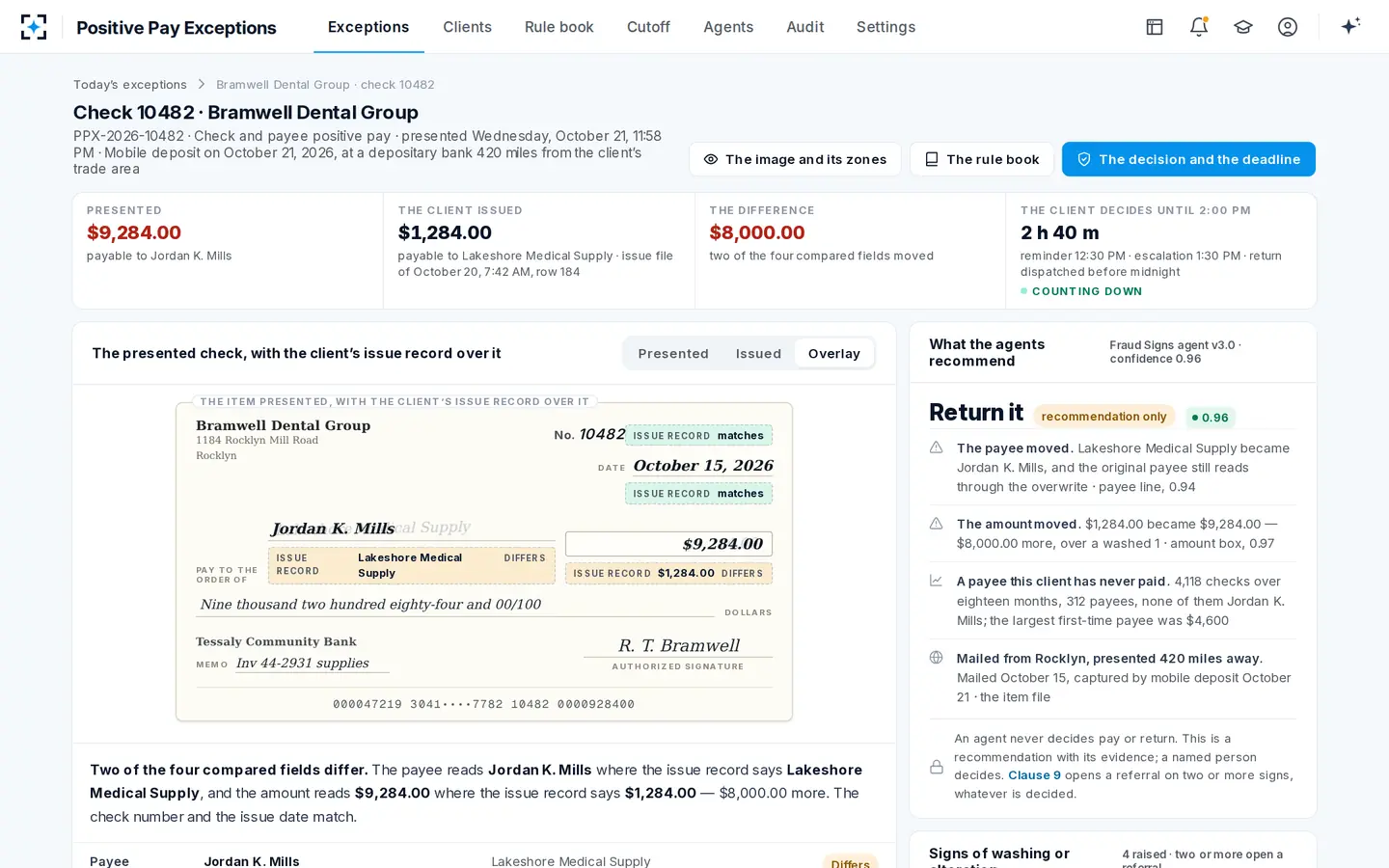
The sentence under the image is the part a client reads first: the payee reads Jordan K. Mills where the issue file says Lakeshore Medical Supply, and the amount reads $9,284.00 where it says $1,284.00, $8,000.00 more; the check number and the issue date match. Behind it, the payee agent read six zones off the image, each with the characters it read and a confidence: check number 0.99, date 0.98, payee line 0.94, amount box 0.97, amount in words 0.92, signature 0.96. The bank's threshold is 0.90. Anything below it goes to a person rather than into the sentence.
Step 4: the image is read for what the fields cannot show
A field match can say that the payee differs; it cannot say whether the check was washed, and that is the question that decides whether the next check from the same mailbox is at risk. The fraud signs agent looks at the image for one ink over another, compares the item with what this client has issued before, and reasons over eighteen months of its payees. On check 10482 it raised four signs, each with the evidence behind it and the published red flag it matches.
A sign, with what the agent looked at, and never a verdict
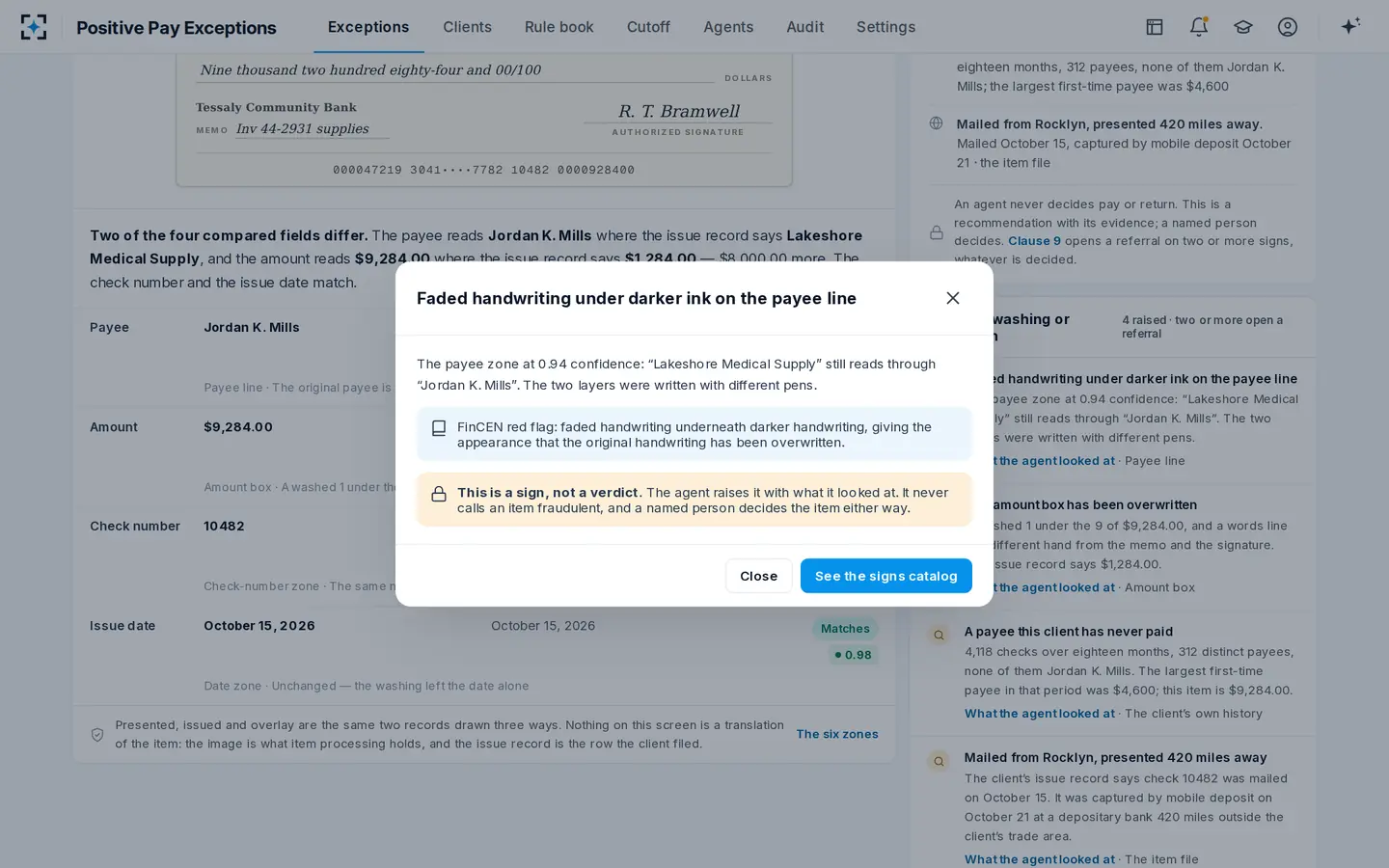
The first sign is FinCEN's own wording. Its 2023 alert on mail theft-related check fraud lists, among the red flags, examination of suspect checks that “reveals faded handwriting underneath darker handwriting” (FinCEN Alert FIN-2023-Alert003). The same alert lists large check withdrawals to a new payee that are out of character for the customer, which is the third sign, made arithmetic: 4,118 checks to 312 payees over eighteen months, none to this payee, and a largest first-time payment of $4,600 against $9,284.00 now. The agent raises each sign with what it looked at and hands the item on; it never calls an item fraudulent and never rejects one.
Step 5: the client decides, with a reason it must give
Inside its window, the decision is the client's and nobody else's. At 11:20 AM Danielle Okonkwo, the controller at Bramwell Dental Group, opened the same overlay, the same sentence and the same recommendation the analyst had, chose to return the check, and picked a reason from the codes that fit a return. The screen refuses a decision without a reason, because a reason is what lets the bank choose the right return reason on the item and lets anyone explain the decision later.
A field match can tell a client that the payee differs. Only the image can tell her how it came to differ, and that is the question she is really answering.
Step 6: two people at the bank, and a return before midnight
Returning the check is the bank's act, so it carries maker-checker even though the client chose it. At 11:24 AM the return agent built the instruction with the item-processing reason for an altered or fictitious item, and the analyst prepared it; because $9,284.00 is above the bank's $5,000 review amount, the treasury operations supervisor checked and signed it at 11:31 AM. At 11:34 AM the analyst dispatched it. The agents prepared it and stopped: an agent may never send an instruction.
Two rules govern what leaves the building. Under the UCC the paying bank must return the item, or send notice of dishonor, before its midnight deadline to recover its settlement (UCC 4-301(a)); on the sample day that deadline was midnight on Thursday, and the return left with 12 hours and 26 minutes to spare. Under Regulation CC the returned check must clearly show the reason for return on its front, and a paying bank that decides not to pay a check of $5,000 or more must also send the depositary bank a notice of nonpayment (12 CFR 229.31(c) and (e)).
One altered check through Positive Pay Exceptions: what the agents do, and what only people may do
Agent
Match agentCompares the presented item with the client's issue file, field by field, and cites the zone and the row.
Never: decides, or changes the client's issue file.
Agent
Payee agentReads six zones off the image with a confidence each, allowing the client's registered abbreviations.
Never: “corrects” a payee or rejects an item.
Agent
Fraud signs agentRaises washing and red-flag signs with the evidence and the client's own history.
Never: calls an item fraudulent or files a report.
Agent
Client agentWrites the client what differs, with both images, and reminds before the cutoff.
Never: decides for the client or mentions a referral.
A person decides
Client controllerDecides pay or return inside the window, with a reason.
Agent
Return agentBuilds the return instruction with its reason and the deadline.
Never: dispatches anything.
A person decides
Analyst and supervisorOne prepares and dispatches, the other checks and signs; nobody checks their own work.
Five hours from match to return, and four and a quarter of them were the client's to use
- Match, zones, signs: 4 min
- Client told32 min
- Client's window, used4 h 14 m
- Prepared, signed, sent: 14 min
How does positive pay work for ACH debits?
The same way, with an authorization list in place of an issue file. The business tells its bank which companies may debit its account, by company ID, and usually caps the amount each may take; any debit outside that list or above the cap becomes an exception for the business to decide. On the sample day, Hollyhock Interiors LLC received a $2,960.00 debit from Pacific Rim Equipment Leasing, whose company ID appears on none of the six authorizations Hollyhock filed. A near name, Pacrim Fleet Services, is on the list with a $1,500 cap, and the agents named it as a different company rather than guess that it was the same one.
An ACH debit checked against the client's own authorizations
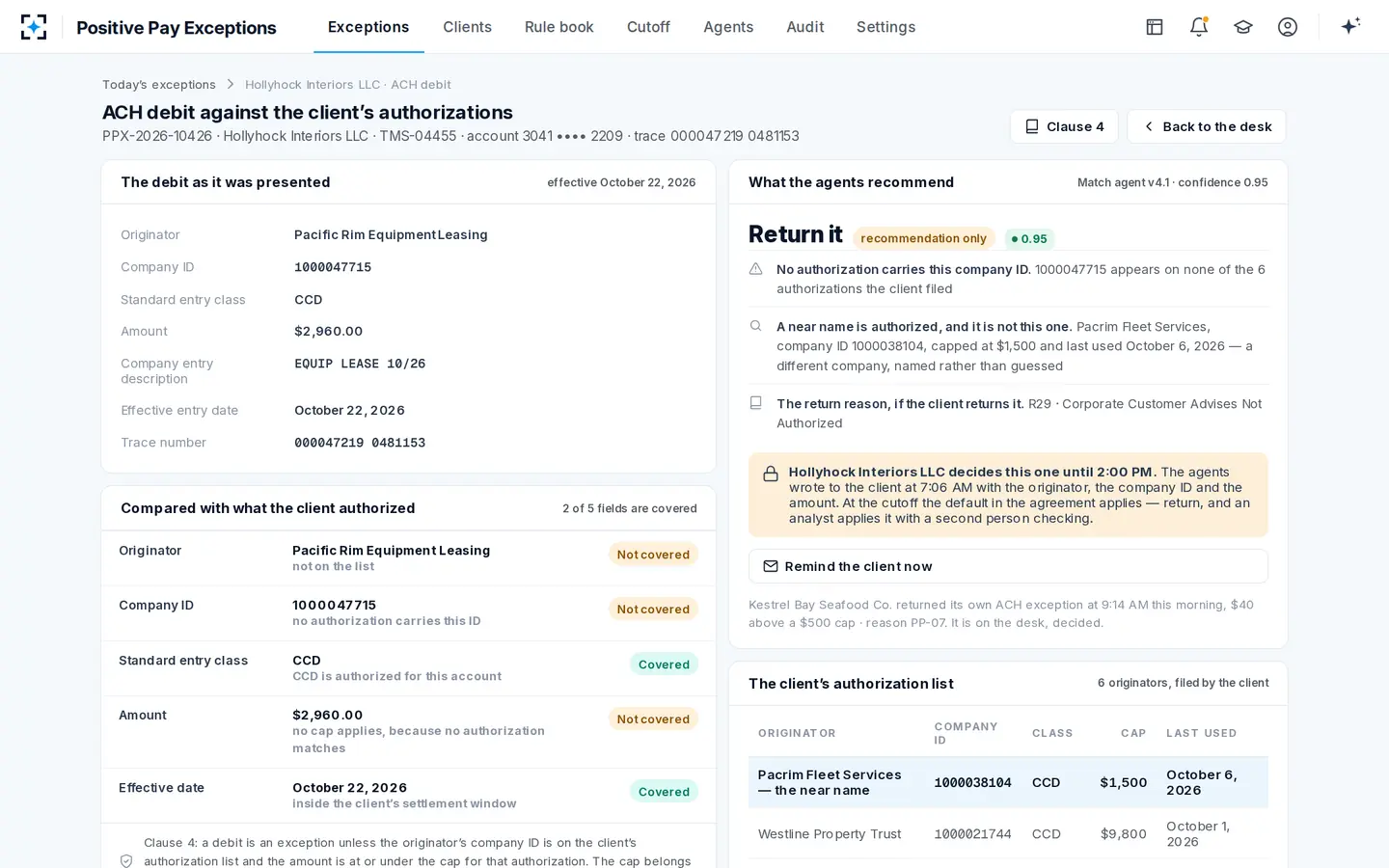
The return travels by different rules from a check's. Nacha, the non-profit that writes the ACH Operating Rules, kept R29 as the return reason for corporate CCD and CTX debits to business accounts (Nacha, Differentiating Unauthorized Return Reasons; how to tell whether each return carried the right code is in ACH return codes checked), and R29 is one of the return reasons Nacha counts toward an originator's unauthorized return rate (Nacha, ACH Network Risk and Enforcement Topics). A business returning a debit through ACH positive pay is therefore not only protecting itself; it is putting a mark against the originator that a bank's ACH risk team will see. Debit blocks and filters work alongside this, and what a debit block cannot see is covered in the ACH fraud series.
Does positive pay check the payee, and how does reverse positive pay differ?
Positive pay checks the payee only when the client sends payee names and the bank reads the payee line; without both, a check whose payee was changed but whose number and amount were left alone matches the file and is paid. That gap is large: in FinCEN's review of mail theft-related check fraud reports, the payee line was the part of a stolen check most often altered, ahead of the amount (FinCEN Financial Trend Analysis, 2024), and check positive pay vs payee positive pay tests the difference on ten planted checks.
Reverse positive pay turns the trace around: the bank sends the business a file of everything presented, and the business does the matching itself and tells the bank which checks to pay. The deadline is the same and the work moves to the client; check positive pay vs reverse positive pay sets the two side by side.
Questions people ask
What is positive pay in banking, in one sentence?
A fraud control in which a business tells its bank which checks it issued or which debits it authorizes, and the bank asks the business before paying anything that does not match. The FDIC and the FFIEC list it among the customer controls a business can use to watch and limit what is paid from its accounts.
How does a positive pay file work?
The business's accounting system exports a file of the checks it wrote, usually each day, with the account, check number, amount and issue date, and often the payee and a void flag, in the layout the bank specifies. The bank loads it before its match; a check that is presented before its row arrives becomes an exception even though it is genuine.
What happens to a check that is not on the positive pay file?
It becomes an exception, and the business decides whether to pay it or return it before the cutoff. If the business does nothing, the default in its agreement applies; the clause that sets it is shown in a positive pay agreement sample. A missing row often means a late file or a manual check that was never added, and sometimes a counterfeit with a number the business never used.
Does positive pay stop check washing?
Only partly. A washed check usually keeps its number, date and signature, so check positive pay catches it only if the amount was changed; payee positive pay catches a changed payee if the payee is in the file and readable. Reading the image for one ink over another, and the client's own payee history, is what raises washing as a question before the decision.
Is positive pay mandatory for business accounts?
No regulation requires it; it is a service a bank offers and a business chooses. But the choice can matter later: some deposit agreements say that a customer who declines an offered fraud service bears losses it would have prevented, and courts have tested such clauses against the UCC's rule that a bank cannot contract out of ordinary care.