A positive pay decision is a business's instruction to its bank to pay or return an exception, and it is due by the bank's positive pay deadline; when that passes without one, a default written into the business's positive pay agreement decides instead: either every undecided exception is paid, or every one is returned. The client's deadline is a contract term set to fit inside two legal ones. The paying bank must pay, return or send notice of dishonor by its midnight deadline or become accountable for the check, and under Regulation CC a returned check should reach the depositary bank by 2 p.m. on the second business day after presentment. A default is therefore not a neutral fallback: on a default-pay account every missed decision is a paid check, altered or not, and on a default-return account every missed decision is a dishonored one, genuine or not. Botminds' Positive Pay Exceptions treats the default as a bank decision like any other, quoted, applied and checked, and works to make it rare.
Examples come from a fictional sample bank, Tessaly Community Bank, and its fictional clients. The rules and the case are real and linked.
Three deadlines on one exception, and only the first is the client's
- Client decides6 AM to 2 PM
- Default appliesafter 2 PM
- Bank pays or returnsto midnight
- Decision dayto midnight
- Returned check travelsto 2 p.m.
What is a positive pay decision, and when is it due? Three clocks on one item
Three deadlines govern every positive pay exception, and they belong to different people. The client's cutoff is contractual, set by the bank in each treasury services agreement. The midnight deadline is the UCC's: midnight of the paying bank's next banking day after it received the item (UCC 4-104(a)(10)). The return test is Regulation CC's, measured at the other end, by when the depositary bank should normally receive the returned check (12 CFR 229.31(b)).
The order is not an accident. The cutoff is set early enough that, after the client answers, the bank can prepare each return, have it checked, send it, and apply and check the defaults for every client who said nothing, all before midnight. Positive pay cut off time follows one analyst through that day hour by hour; this guide is about what the deadlines mean when someone misses one.
The midnight deadline: when a late return becomes a payment
A paying bank that misses its midnight deadline has paid the check, whatever its condition. Under the UCC a payor bank that settles for an item may revoke the settlement only if it returns the item, or sends notice of dishonor, before it has made final payment and before its midnight deadline (UCC 4-301(a)), and a bank that does not pay, return or send notice by then is accountable for the amount, whether or not the item was properly payable (UCC 4-302(a)(1)).
The Federal Reserve Board's commentary on Regulation CC explains why that matters even with federal return rules on top. Its gloss is blunt: “Under UCC 3-418(c) and 4-215(a), late return constitutes payment and would be final in favor of a holder in due course or a person who has in good faith changed his position in reliance on the payment”, and “the UCC midnight deadline gives the paying bank an incentive to make a prompt return” (Regulation CC commentary, § 229.31(a)). For a positive pay desk, the midnight deadline is the line after which the client's decision no longer matters.
Regulation CC's two-day return test, the $5,000 notice and the extension
Regulation CC adds three rules on the same item, and a positive pay operation has to satisfy all three. The paying bank that decides not to pay must return the check expeditiously, so that the depositary bank would normally receive it by 2 p.m. its local time on the second business day after presentment. For a check of $5,000 or more it must also send a notice of nonpayment on the same timetable, which the returned check itself can serve as if it arrives in time. And the rule extends the UCC midnight deadline in one case, quoted below.
The paying bank's deadlines on a returned check, and what missing each costs
| Rule | What it requires | If the bank misses it |
|---|---|---|
| Midnight deadline (UCC 4-301, 4-302) | Return the item or send notice of dishonor before midnight of the next banking day after receipt | The bank is accountable for the item: in effect it has paid it |
| Expeditious return (12 CFR 229.31(b)) | Return so the depositary bank would normally receive it by 2 p.m. on the second business day after presentment | Liability for losses caused by a failure of ordinary care, up to the amount of the check (12 CFR 229.38(a)) |
| Notice of nonpayment (12 CFR 229.31(c)) | For a check of $5,000 or more, notice on the same timetable, by any reasonable means | The same ordinary-care liability |
| Reason on the item (12 CFR 229.31(e)) | The front of the returned check shows that it is returned and why | A return the depositary bank cannot act on properly |
| Extension (12 CFR 229.31(g)) | The midnight deadline extends to the time of dispatch if the return reaches the depositary bank by its next banking day as the rule describes | No extension: the UCC deadline stands |
The extension is narrow and useful to understand, not to plan around. The deadline for return under the UCC “is extended to the time of dispatch of such return or notice if the depositary bank (or the receiving bank, if the depositary bank is unidentifiable) receives the returned check or notice” on or before its next banking day following the otherwise applicable deadline, by the earlier of the close of that day or a 2 p.m. or later cutoff (12 CFR 229.31(g)). It rewards a bank that uses a fast means of return; it does not move the client's cutoff.
What happens if you don't decide a positive pay exception?
The default written in your positive pay agreement decides it for you, and it decides every exception you did not reach in the same way. That default is a choice the bank made when it wrote the schedule, sometimes one the client chose from options, and it applies whether the undecided item is a fifty-cent encoding difference or a check whose payee was washed and rewritten.
On the sample day, two other situations put the decision in the bank's hands, and both were written down in advance. Verrity Freight Lines had filed no issue file all week, and its agreement says that in that case the bank decides; the analyst applied the written rule and quoted the clause. And for every client that stayed silent after a reminder at 12:30 PM and an escalation at 1:30 PM, the default applied at 2:00 PM, with the analyst applying it under the reason the default in the agreement, no decision by the cutoff, and a second person checking it.
Default pay or default return: what each turns a missed decision into
A default of pay converts every missed decision into a paid item, and a default of return converts every missed decision into a dishonored one; which is worse depends on whether the undecided checks are fraudulent or genuine, and nobody knows that about an item nobody looked at.
What each default does to an exception nobody decided
Default pay
Every missed decision on an altered or counterfeit check becomes a paid item, with the client's agreement behind it. The service has done its work and the clock has undone it.
Genuine checks clear and vendors are paid. Silence costs nothing until the day it is a washed check.
Default return
The altered check goes back to the bank of first deposit, as it should. Nobody looked at it, so nobody referred it.
A vendor's check comes back unpaid under a rule the client agreed to: late fees, a strained relationship, and a dispute over whether the default was explained.
Two asymmetries are worth seeing. A default of pay fails silently: nobody hears about the paid fraud until a statement or a vendor's call weeks later. A default of return fails loudly: the vendor whose genuine check bounced calls the same week. That asymmetry is worth weighing when the default is chosen, and it is why a client with irregular attention on its exceptions should think hard about a default that hides its misses.
Who is liable if positive pay defaults to pay?
Usually the client, to the extent the agreement says the default is the client's decision, but only within the limit the UCC sets on such agreements. An agreement may change Article 4's defaults, but it cannot release the bank from good faith or ordinary care, and the standards it sets must not be manifestly unreasonable (UCC 4-103(a); the clause wording that does this is in a positive pay agreement sample, clause by clause). A default that pays a check the client never saw is a standard of that kind.
“regardless of the terms and conditions of the parties’ contractual relationship . . . Huntington cannot remove by contract its statutory duty to act in good faith and to exercise ordinary care toward its depositors.”
Alotech v. Huntington National Bank (N.D. Ohio 2014), as quoted by the Sixth Circuit in Majestic Building Maintenance v. Huntington Bancshares, 2017
In Majestic the Sixth Circuit let a customer's challenge to a clause shifting fraud losses onto customers who declined the bank's fraud products go forward, because the agreement did not say what the products were, what they cost or how anyone would decide what they would have caught. The same reasoning reaches a default: a client is in a stronger position if the default was never explained, the item was never shown to it, or the bank ignored a clear sign it had seen. And the client's own duty does not vanish: it must still review statements promptly, and is barred after a year from asserting an alteration it never reported (UCC 4-406(c) and (f)).
Can a bank pay a check after the positive pay cutoff?
Yes: until its midnight deadline the bank can still pay or return the item, and after the cutoff it acts under the agreement's default. What a bank should not do is improvise. A late call from a client asking to return a check after the cutoff can be honored if the agreement allows it and the return can still go out in time, but it is then a bank decision, and should carry a reason, a named person and a second person's check, like any other.
Returning is the riskier improvisation. If the bank returns a check the client's agreement says should be paid, and the check was properly payable, the bank has dishonored it wrongly, and a payor bank is liable to its customer for damages proximately caused by a wrongful dishonor, limited to actual damages proved (UCC 4-402(b)).
Choosing the default: questions for the treasury product owner
The default is a product decision with a risk allocation attached, and it deserves the same review as a fee. The questions below are the ones a bank should be able to answer in writing for every positive pay schedule it offers.
Before writing a default into a positive pay schedule
- Is the default pay or return, and can the client choose?
A chosen default is easier to defend than an imposed one.
- Is the default explained where the client decides?
The sample bank shows it on the decision screen: on this account, return.
- Does the default differ for a bank-raised fraud sign?
Paying an item the bank's own reading flagged is the hardest default to defend under UCC 4-103.
- Who applies it, and who checks?
A default is a bank action; it should have a name, a reason and a second signature.
- How often does it fire, by client?
A client that defaults weekly needs a call, not a reminder.
- What happens when the issue file is missing?
Write whether the bank decides, and on what rule.
- Is the version of the schedule in force on each date kept?
A default applied in March must be explainable in November.
Keeping the default the exception: how the solution handles silence
The solution's design target is that 98% of exceptions are decided by a named person before the cutoff. That is a target, not a measured result, and it depends on three things the bank sets: the client being told what differs early, a reminder and an escalation before the cutoff, and a default that, when it does fire, is applied by a person who quotes the clause and checked by another.
One written rule book, versioned, with the regulation behind every clause
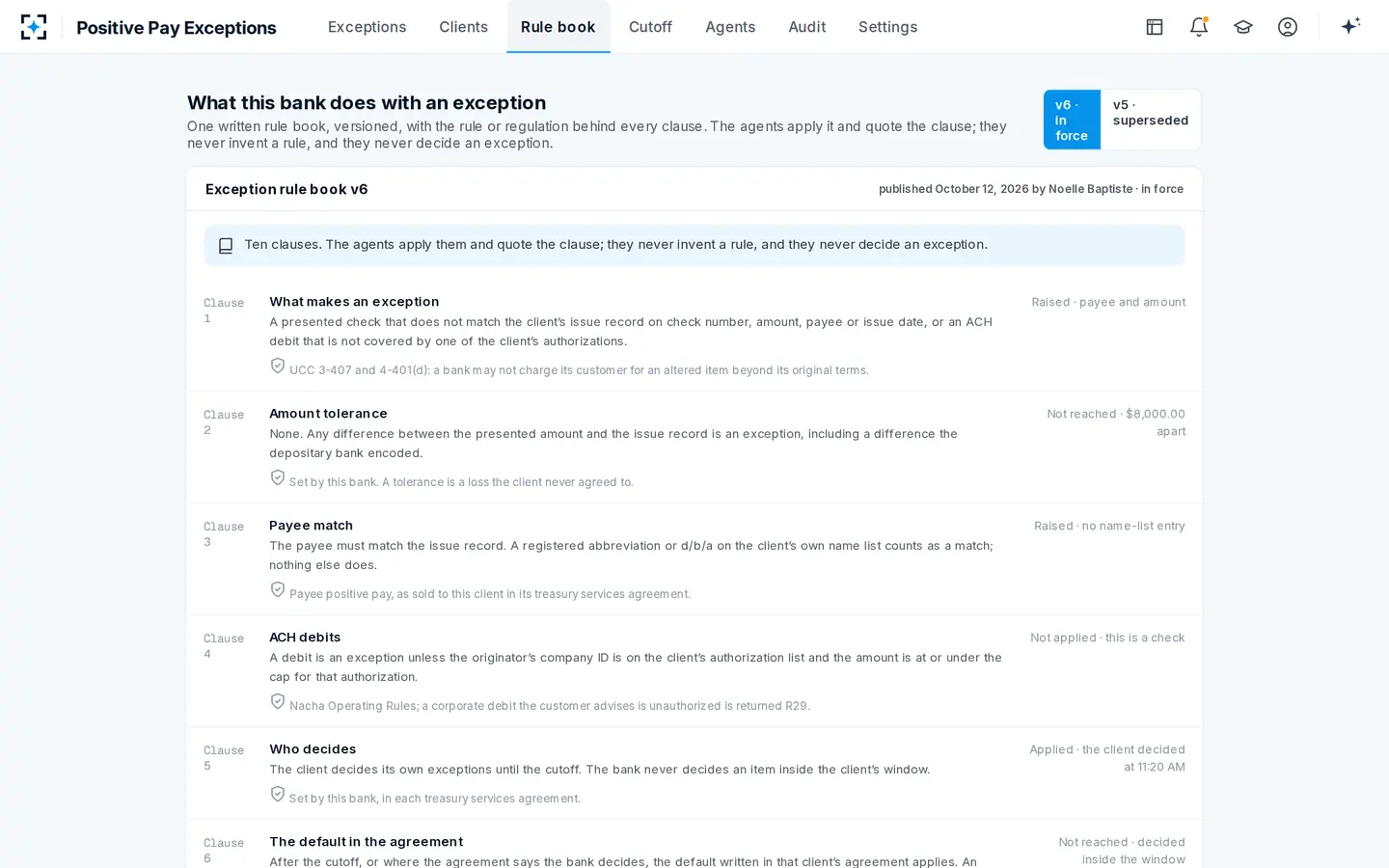
The rule book matters for defaults more than for anything else, because a default is the one decision nobody made at the time. When an examiner, an auditor or a client's lawyer asks why a check was paid, the answer has to be the clause in force that day, who applied it, and who checked it, not a recollection.
Who did what, when, why, and what they were looking at
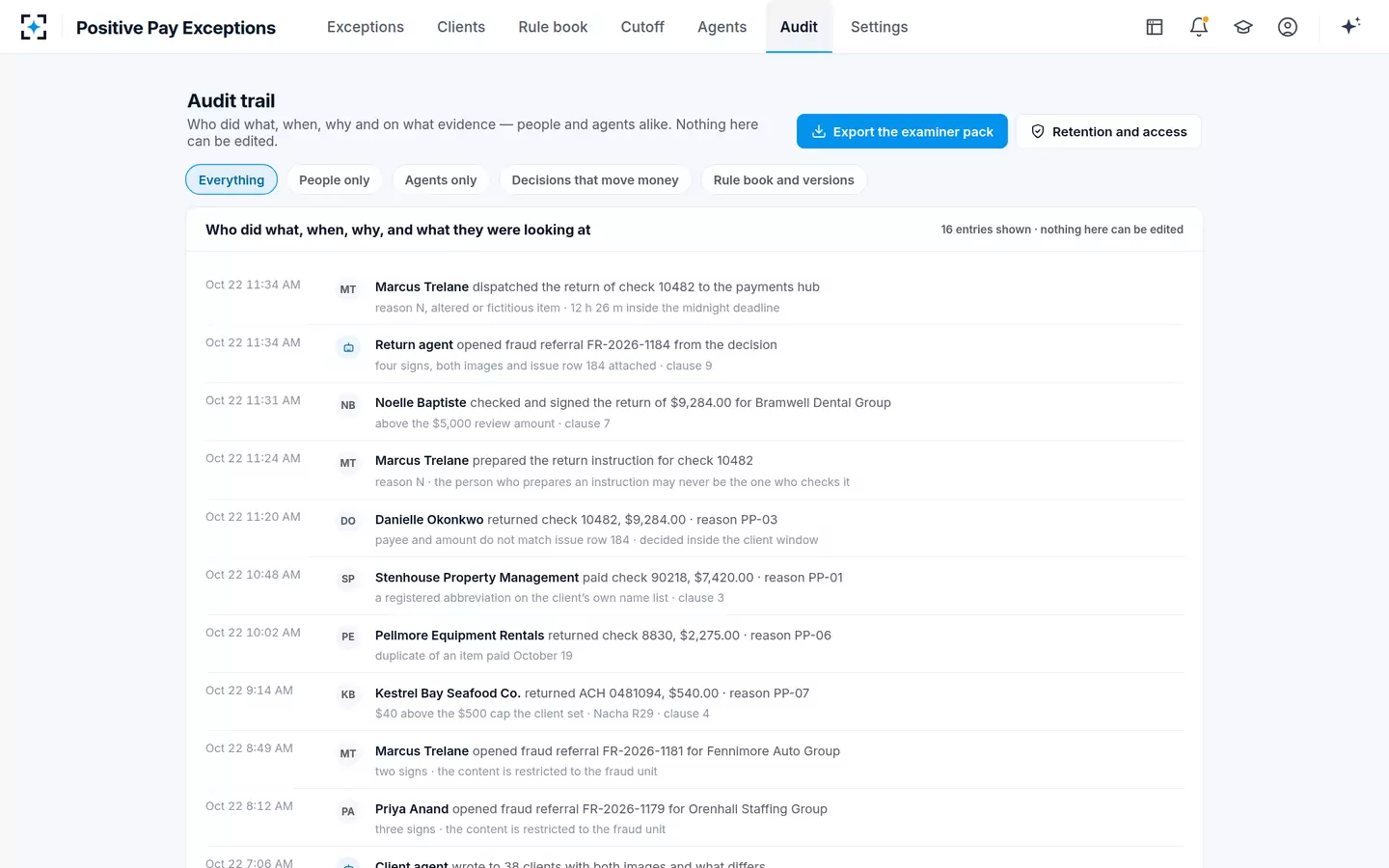
What the default costs a client also depends on what it would have decided. How much does positive pay cost sets a missed decision against the loss on one altered check paid, and check positive pay vs reverse positive pay shows why the default weighs far more under a service where the client must answer for every check.
Questions people ask
What is a positive pay decision of return?
The client's instruction to the bank not to pay an exception item, so that the bank returns it to the bank of first deposit before its midnight deadline. The bank then picks a return reason for the item that describes what happened, since Regulation CC requires the reason on the front of the returned check.
Is the positive pay default pay or return?
Whichever the client's agreement says; banks set it in the positive pay schedule, and some let the client choose. Read the schedule for the default on checks and, separately, on ACH debits, because they can differ.
What is the midnight deadline for returning a check?
Midnight of the paying bank's next banking day after the banking day on which it received the check, under UCC 4-104. A paying bank that has not paid, returned or sent notice of dishonor by then is accountable for the check under UCC 4-302.
Can the client change its decision after the cutoff?
Only if the agreement allows it and the bank can still act before its midnight deadline. A changed decision after the cutoff is the bank's to accept, and should be recorded with who asked, who agreed and why, like any decision the bank makes.
Does a default of return protect the client from fraud?
From paying an undecided altered check, yes; the check goes back. But it also returns every genuine check the client did not reach, and nobody looks at the returned fraud closely enough to refer it. A default is a safety net, not a review.