Check positive pay and reverse positive pay differ in who does the matching. In check positive pay the business sends its bank a file of the checks it issued, the bank compares every presented check with it, and the business decides only the exceptions. In reverse positive pay the business keeps its list to itself: the bank sends it a file of every check presented that day, and the business compares, then tells the bank which to pay and which to return. Both run against the same clock, the paying bank's midnight deadline, and both end in the same place when the business does not answer: the default written in its agreement. Botminds' Positive Pay Exceptions is built for the first model, and for ACH positive pay; this guide is honest about what that means for a business choosing between them.
Examples come from a fictional sample bank, Tessaly Community Bank, and its fictional clients. Rules and cases are real and linked.
What is the difference between positive pay and reverse positive pay?
The direction of the file. The interagency check fraud booklet that first set the two side by side puts it in one line: “Reverse positive pay is similar to positive pay, but the process is reversed”, and then the essential difference, “The company, not the financial institution, maintains the list of checks issued” (Check Fraud: A Guide to Avoiding Losses, 1999). In its account, the bank sends the company a file of the presented checks' account numbers, serial numbers and amounts, the company compares it with its own records and tells the bank which checks match, and the bank pays those.
Everything else follows from that. Under positive pay the bank sees the client's issue data and the client sees only what failed to match. Under reverse positive pay the client sees everything presented, and the bank sees only the client's answers. One puts the comparison on the bank's machines; the other puts it on the client's desk.
Check positive pay and reverse positive pay, row by row
Check positive pay: The bank, from the client's issue file, sent before each match
Reverse positive pay: The client, in its own accounting system
Check positive pay: The bank, overnight, against every presented item
Reverse positive pay: The client, each morning, against the bank's file of presented items
Check positive pay: Only the exceptions
Reverse positive pay: Every check presented that day
Check positive pay: An issue file for every check, on time
Reverse positive pay: A pay or return answer before the cutoff
Check positive pay: The agreement's default decides the exceptions
Reverse positive pay: The agreement's default decides every presented check
Check positive pay: Only with payee positive pay and a readable payee line
Reverse positive pay: Only if the bank sends images and someone looks
Check positive pay: Higher check volumes; clients that want to review only what is wrong
Reverse positive pay: Lower volumes; clients that will not share issue data or want to see every item
How does reverse positive pay work, step by step?
Five steps, all on the morning after presentment. The checks drawn on the account arrive overnight. Early next morning the bank sends the client a file, or a screen, of every check presented: serial number, amount, and in a modern service an image. The client compares each item with its own check register. It tells the bank, before the cutoff, which checks to pay and which to return. The bank pays the approved items and returns the rest before its midnight deadline.
The 1999 booklet added a step that is easy to forget: the bank does not simply obey a mismatch. In its account, the bank researches the checks that do not match, corrects any misreading or encoding errors, and determines whether any are fraudulent before paying only the exceptions that can be reconciled with the company's files (Check Fraud: A Guide to Avoiding Losses). That research is real work, and it lands on the bank in both services: a fifty-cent encoding difference looks like a raised amount to anyone who has only the numbers.
Both services run against one midnight deadline
Whichever service the client chooses, the bank's legal clock is the same. The midnight deadline is midnight of the paying bank's next banking day after it receives the item (UCC 4-104(a)(10)), and a payor bank that neither pays, returns nor sends notice of dishonor by then is accountable for the item (UCC 4-302(a)(1)). The client's cutoff sits inside that. What differs is how much work the client has to fit into its window.
Same deadline, different mornings: the client's work under each service
- Bank matches
- Client decides its exceptionsto 2 PM
- Bank returns, checks, defaultsto midnight
- Bank sends presented file
- Client compares every item, then answersto 2 PM
- Bank returns, checks, defaultsto midnight
The arithmetic is stark at volume. At the sample bank, 28,460 items were presented in one night against 1,180 clients, and 95 became exceptions, about one in 300. A client that writes 300 checks a month would review about one exception a month under positive pay and all 300 checks under reverse positive pay. A client that writes ten a month would review ten either way, and might prefer to see them all.
Which is better, positive pay or reverse positive pay?
Neither in general; each fits a different client. Positive pay is better when the client writes enough checks that reviewing every one each morning would be a job, and when its accounting system can send a reliable issue file before the bank's match. Reverse positive pay fits a client that writes few checks, cannot or will not send issue data, or wants to see every check before it is paid.
Choosing between the two services, by the client's situation
| The client's situation | Usually suits | Why |
|---|---|---|
| Hundreds of checks a month, an accounting system that exports issue files | Check or payee positive pay | The bank's match removes the matching work; the client reviews only mismatches |
| A few checks a month, written by hand | Reverse positive pay | No file to maintain, and every item is small enough in number to read |
| Checks mailed to many outside payees | Payee positive pay | The payee line is the part thieves change most, and only a payee match sees it |
| No one reliably available each morning | Positive pay with a default of return | Silence then returns exceptions rather than paying them; reverse positive pay would return everything |
| Mostly debited by other companies, few checks | ACH positive pay | The risk is in debits, which check services do not cover |
Is reverse positive pay safer? Only if someone reads every item
Reverse positive pay gives the client more information and more responsibility, and it is safer only if the client uses both every day. A client that compares every check against its register each morning will catch a counterfeit with an unused serial number and a raised amount as surely as any bank match. A client that skims a list of 40 checks at 1:50 PM will not, and the default then decides every item it did not reach, not just the mismatches.
The payee is the weak point of both. A list of serial numbers and amounts, which is what the 1999 booklet describes the bank sending, says nothing about the payee; a washed check with the original number and amount looks perfect on it. Reverse positive pay checks the payee only if the bank sends images and the client reads the payee line on each, and check positive pay only if it is payee positive pay. Check positive pay vs payee positive pay tests that gap on ten planted checks.
What declining both services can cost under the deposit agreement
Possibly the loss either would have prevented. Some banks write their deposit agreements so that a customer who declines an offered fraud service bears what that service would have caught, and the UCC allows agreements to set the standards by which a bank's care is measured, so long as the bank does not disclaim good faith or ordinary care and the standards are not manifestly unreasonable (UCC 4-103(a)).
“reasonable care was not used in declining to use our Check Positive Pay/Reverse Positive Pay services, which substantially contributed to the making of the forged item(s)”
A bank's letter refusing reimbursement, quoted in Majestic Building Maintenance v. Huntington Bancshares, 6th Cir. 2017
The customer in that case, a cleaning company that had lost $3,973.96 on four checks, sued; the district court dismissed the suit, and the Sixth Circuit reversed in 2017, holding that the customer had a plausible claim the clause unreasonably disclaimed the bank's duties where the products, their price and the test of what they would have caught were not explained. The court did not decide the merits. For a business, the practical point is that choosing neither is itself a choice with a cost, written in its agreement.
The statement duty survives either choice
Neither service replaces the client's duty to read its statements. Under the UCC a business must examine its statement or items with reasonable promptness for alterations and unauthorized signatures, must notify the bank promptly of what it should reasonably have found, and is barred after one year from asserting an alteration it did not report, whatever anyone's care (UCC 4-406(c) and (f)). Positive pay moves discovery earlier; it does not move the duty.
In one way reverse positive pay makes the duty easier to meet, because the client has already looked at every check. In another it raises the stakes: a client that approved a check in the morning will find it hard to say later that it could not reasonably have noticed the alteration.
Where Positive Pay Exceptions fits each service
The solution is built for bank-matched positive pay: check, payee and ACH. The bank's match runs overnight, and the client sees only its exceptions, each with the check image, the client's issue data drawn over it, a sentence naming the fields that moved, and a recommendation with the evidence. The client decides inside its window, with a reason; the bank never decides an item inside that window.
The client decides its own exception, with the evidence on the same screen
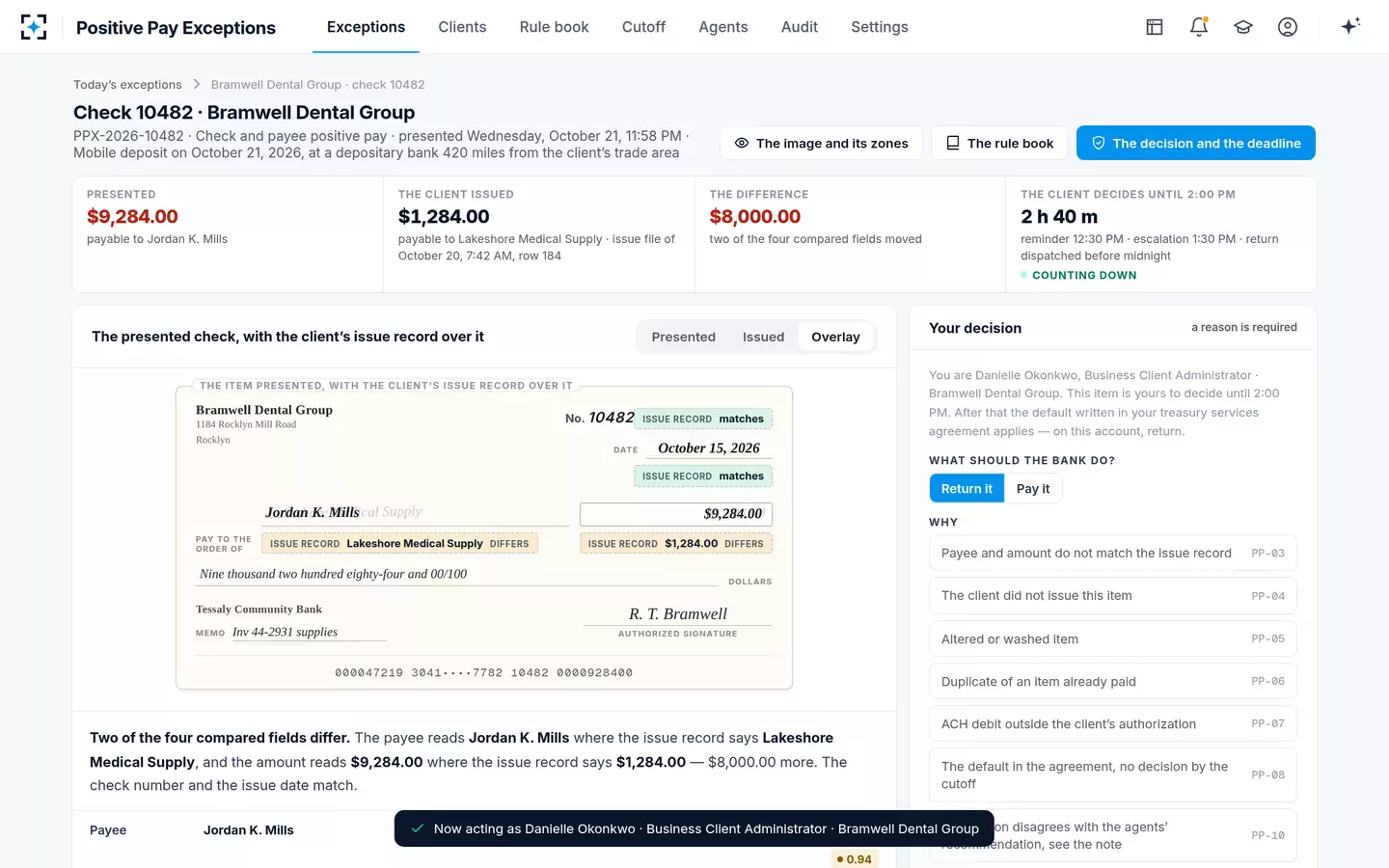
For a reverse positive pay client, the matching is the client's own, and the solution does not change that. What it offers such a client is the option the comparison above points to: let the bank match, and review only exceptions, each one explained. For a client that wants to keep every check in view, reverse positive pay with images remains a reasonable choice, provided someone reads every payee line.
The issue file is what lets the bank do the matching
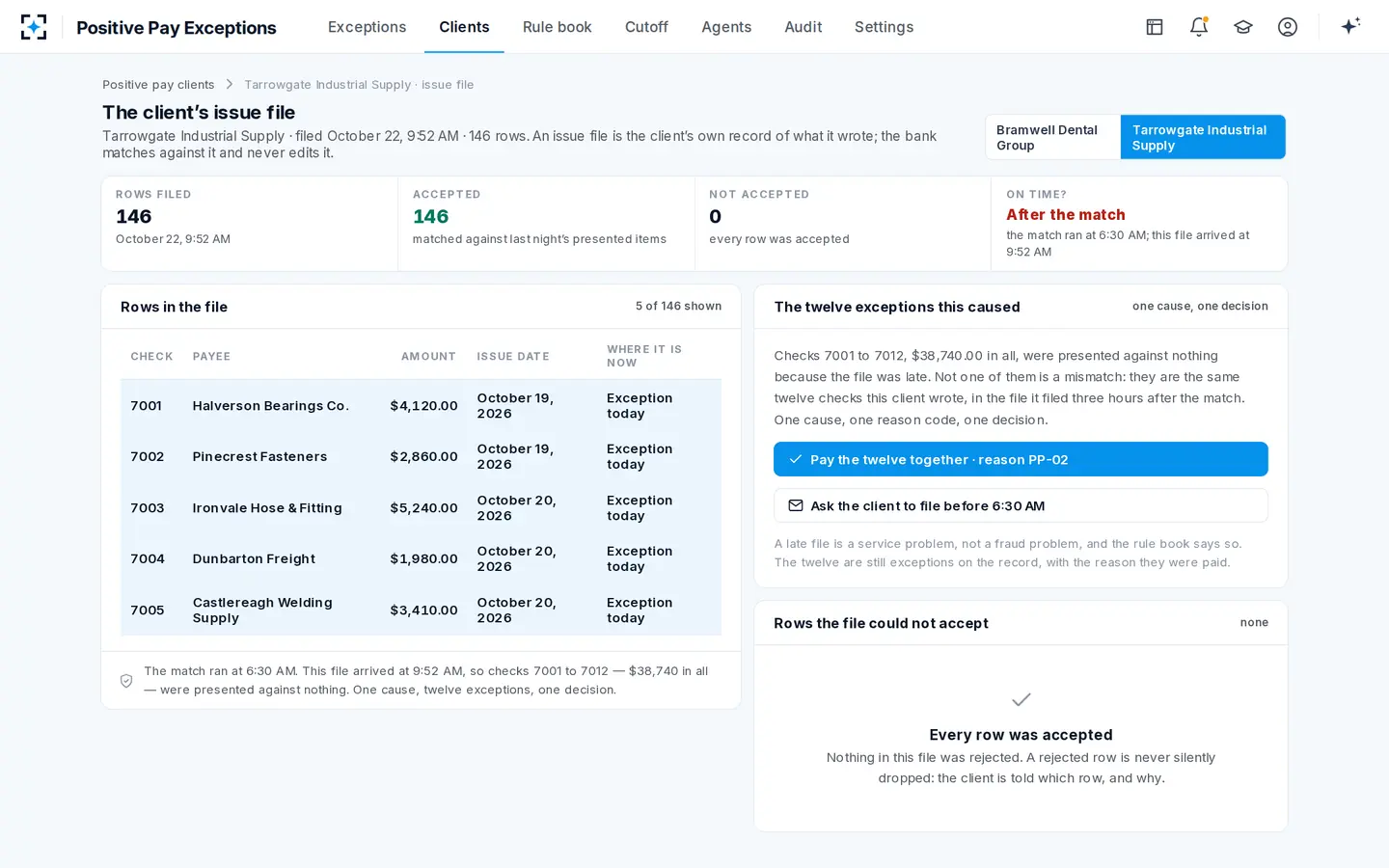
Questions a business should answer before choosing
- How many checks do we write a month, and to how many payees?
Volume decides whether reviewing every item is feasible.
- Can our accounting system send an issue file, with payees, before the bank's match?
If not, positive pay will raise genuine checks as exceptions.
- Who reviews each morning, and who covers when they are away?
Reverse positive pay depends on that person every day.
- What is the default in our agreement, pay or return?
It decides every item nobody answers.
- Does the service compare payees, and will we see images?
The payee is the line thieves change most.
- What does the agreement say if we decline?
Declining may shift the loss the service would have caught.
Questions people ask
What does reverse positive pay mean?
A check fraud service in which the bank sends the business a list of every check presented against its account each day, the business compares the list with its own records, and the business tells the bank which checks to pay and which to return before a cutoff. The business, not the bank, keeps the list of checks it issued.
Is reverse positive pay cheaper than positive pay?
Each bank sets its own prices, so compare the two in its fee schedule. The bigger cost difference is usually the client's time: reverse positive pay asks someone to review every presented check each morning, while positive pay asks for an issue file and a review of exceptions only.
Does reverse positive pay work for ACH?
The ACH equivalent is a review of incoming debits, or an authorization list the bank matches against, which is ACH positive pay. Either way the decision runs against the bank's cutoff, and an unauthorized corporate debit is returned through the ACH Network under Nacha's rules rather than as a returned check.
What happens in reverse positive pay if the client does not respond?
The default in the agreement applies, and it applies to every presented check, not only to mismatches. A default of pay means everything presented that day is paid; a default of return means everything is returned, including genuine checks to the client's own vendors. The deadline guide works through both.
Can a business switch from reverse positive pay to positive pay?
Usually, by agreement with its bank, once its accounting system can send issue files in the bank's layout. The switch moves the comparison from the client's desk to the bank's match, so the client's first task is making sure every check, including manual and replacement checks, reaches the issue file before the match. The positive pay file format guide covers the fields.