How much positive pay costs depends on the bank: each prices it in its own fee schedule or account analysis statement, as one or more service charges, and we found no regulator or independent survey that publishes a market price. So the honest way to answer the question is the other way round. FinCEN's review of mail theft-related check fraud put the median report at $14,215 and the average at $44,774; a year of positive pay fees is priced against one loss of that size, and against who would bear it. For a bank, there is a second cost hidden in the service: every exception decided wrong, or left to the default, costs the same as having no positive pay at all. Botminds' Positive Pay Exceptions is built for that second cost, and this guide is careful about where it does and does not change the first.
The examples come from a fictional sample bank, Tessaly Community Bank, and its fictional clients. The law and the loss figures are real and linked.
The size of the loss positive pay is priced against
$14,215
median amount per mail theft-related check fraud report to FinCEN
$44,774
average amount per report, pulled up by the largest reports
44%
of those reports involved altered checks, the largest single type
680,000+
check-fraud suspicious activity reports in 2022, nearly double 2021
How much does positive pay cost, and where is the price written?
In the bank's fee schedule and, for a client on account analysis, on the monthly analysis statement, where positive pay appears as one or more service lines. Ask which of these the bank charges: a monthly fee per account, a fee per item matched or per issue-file row, a fee per exception, and a separate fee for ACH positive pay. Ask for each, because a low monthly fee with a per-exception charge can cost more for a client whose issue file is often late.
Courts have noticed that the price is not always where the client can see it. In Majestic Building Maintenance v. Huntington Bancshares, the bank's counsel conceded at oral argument that its anti-fraud products cost extra but could not say how much the plaintiff would have paid, and the Sixth Circuit noted that the agreement did not say they cost extra or how the cost was calculated (6th Cir. 2017). A client comparing banks should ask for the price in writing and for the clause that applies if it declines the service, which is often worth more than the fee.
One altered check paid: what positive pay is priced against
The loss on a single check is large compared with most fees, and business checks are where it concentrates. FinCEN's 2023 alert explains why thieves prefer them: business accounts are often well funded, and a business may take longer to notice the fraud (FinCEN Alert FIN-2023-Alert003). The trend behind it is not slowing: the federal banking agencies, citing FinCEN data, reported in 2025 that suspicious activity reports on check, ACH and wire fraud rose 489% between 2014 and 2024, and called the rise in check fraud “particularly notable” (OCC, Federal Reserve and FDIC, June 2025).
The median matters more than the average for a pricing decision. The average, $44,774, is pulled up by the largest reports; half the reports were for $14,215 or less. A business pricing positive pay should use its own typical check and its largest, not either figure, but the median is the honest scale for a first look.
Who pays for an altered check the bank has paid?
It depends on what was altered, how quickly the customer reported it, and what the agreement says, which is why the answer to ‘is positive pay worth it’ is different for each client. The default rules come from Articles 3 and 4 of the UCC, and agreements may vary them within the limit that a bank cannot disclaim good faith or ordinary care (UCC 4-103(a)).
Where the loss on a paid altered check starts, and what moves it
| Situation | Who bears it first | What can move it |
|---|---|---|
| Amount raised, paid in good faith | The customer only for the original amount; the paying bank for the rest (UCC 4-401(d)(1)) | The paying bank's warranty claim against the bank that presented the check, which warranted it had not been altered (UCC 4-208(a)(2)) |
| Customer slow to review its statements | The customer, if the bank proves the delay cost it (UCC 4-406(d)) | The bank's own lack of ordinary care in paying, which splits the loss (UCC 4-406(e)) |
| Same thief, more checks, after 30 days | The customer, for checks paid after a reasonable period of up to 30 days to examine the first statement (UCC 4-406(d)(2)) | The same split for the bank's lack of ordinary care |
| Customer's negligence helped the alteration | The customer is precluded from asserting it against a bank paying in good faith (UCC 3-406(a)) | The bank's own failure of ordinary care, compared with the customer's (UCC 3-406(b)) |
| Not reported within a year | The customer, whatever anyone's care (UCC 4-406(f)) | Nothing in the UCC; the bank also loses its warranty claim |
| Customer declined an offered fraud service | Whatever the deposit agreement says, if a court finds the clause not manifestly unreasonable | UCC 4-103(a): the bank cannot contract out of ordinary care |
Two rows decide most business cases. The one-year bar ends the customer's claim on an alteration it did not report within a year of the statement, regardless of anyone's care. And the last row is where positive pay enters the law: a deposit agreement that says a customer who declines an offered fraud service bears what that service would have stopped. Who is liable for altered checks follows the warranty claims between banks in detail.
What declining positive pay can cost: Majestic v. Huntington
Declining positive pay can cost the whole loss, depending on the agreement and on how a court reads it. In 2014 a commercial cleaning company found four unauthorized checks, $3,973.96 in all, paid from its account. Its agreement said that a customer eligible for the bank's fraud products who chose not to use them bore any loss those products were designed to prevent, and the bank refused to reimburse, writing that the customer's decision not to use its check positive pay and reverse positive pay services had substantially contributed to the loss.
The district court dismissed the customer's suit. The Sixth Circuit reversed in 2017, holding that the customer had stated a plausible claim that the clause unreasonably disclaimed the bank's duties of good faith and ordinary care, and sent the case back for discovery. It was explicit that it was not deciding the merits, and it distinguished a 2010 Minnesota federal decision, Cincinnati Insurance v. Wachovia, which had upheld a similar clause where it was undisputed that the bank's program would have caught the fraud.
“Defendant could argue that every fraudulent transaction would have been discovered or prevented by the anti-fraud products even though there is no procedure for a customer, like Plaintiff, to be involved in or contest that determination.”
Majestic Building Maintenance v. Huntington Bancshares, 6th Cir. 2017
The lesson cuts both ways. For a business, the price of declining positive pay may be every loss the agreement says positive pay would have stopped, so the fee should be weighed against that, not against nothing. For a bank, a clause that shifts losses to customers who decline the service is safer when the service, its price, its eligibility and the test of what it would have caught are written down where the customer can read them.
Is positive pay worth it? The break-even on your own fee
Positive pay pays for itself if the losses it prevents, that the client would otherwise bear, exceed a year of fees and the client's own time on exceptions. Every term in that sentence is the client's own; the formula only puts them in one place.
Is positive pay worth it for one business? Each term is the client's own
Losses prevented that you would bear
chance of a paid altered or counterfeit check × its size × your share
Your share depends on the agreement and on how fast you review statements: often all of it if you declined an offered service.
The client's controller, with the deposit agreement
Time saved reconciling
hours no longer spent finding a paid fraud after the statement
A check stopped before payment is a call, not a claim.
Accounts payable
Fees
12 × monthly fee + items × item fee + exceptions × exception fee
From the bank's fee schedule or account analysis statement; ask for each line in writing.
The bank's treasury officer
Time deciding exceptions
exceptions a year × minutes each × your hourly cost
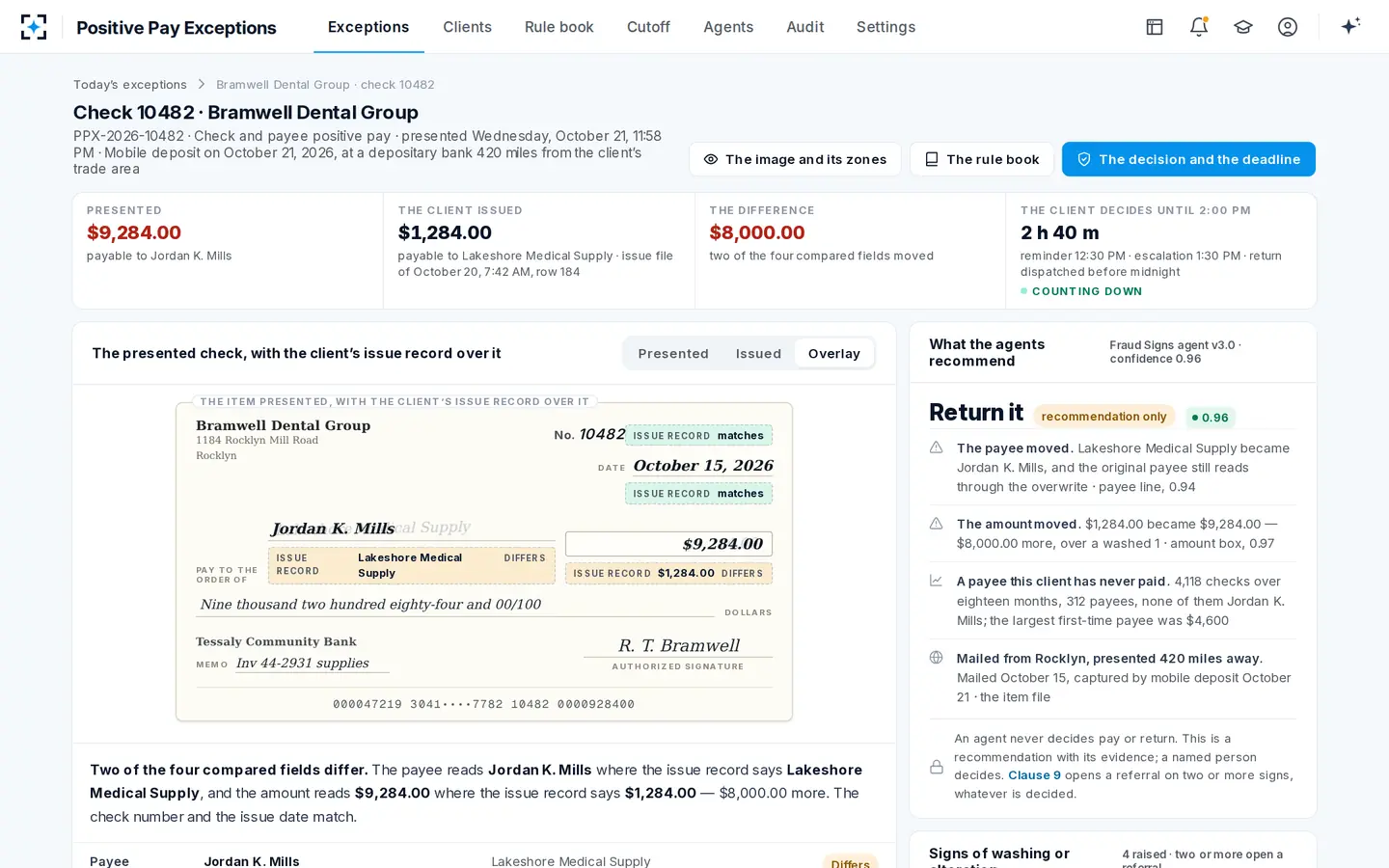
Falls when exceptions arrive explained, with both images and the fields that moved.
The person who decides them
The first term can be made concrete without inventing anything. For every $1,000 a year in fees, positive pay pays for itself if it prevents one median-sized loss, $14,215 at FinCEN's figure, that the client would otherwise bear, about once every fourteen years. A business that mails checks to many payees, or whose agreement shifts declined-service losses to it, will usually find the break-even easy to clear. A business that writes a handful of checks a year, all to the same payees, and reviews its statements every week, may reasonably decide it is not.
Is positive pay necessary, or just recommended?
No regulation requires a business to use positive pay or a bank to offer it. The interagency authentication guidance the FDIC published in 2021 names it, beside debit blocks, among the controls a business can use over its own accounts (FDIC FIL-55-2021; the service itself is explained in how positive pay works), and the FFIEC's retail payments examination procedures ask whether an institution is using it (FFIEC IT Handbook, Retail Payment Systems). That makes it an expected tool, not a mandate. What can make it necessary in practice is the deposit agreement: once a bank offers it and the client declines in writing, the client may have accepted the losses it would have caught.
An exception decided wrong costs what no positive pay costs
Positive pay only stops a check; a person still has to decide it, and a wrong decision undoes the service. A client that tells its bank to pay an altered check has made the decision the service exists to give it, and the bank will point to that instruction if the client later asks for its money back. A client that returns a genuine check it should have paid strains a vendor relationship, and if the bank returns a properly payable check on its own initiative, it risks liability for wrongful dishonor (UCC 4-402(b)).
What each decision on an exception turns into
If the check is altered or counterfeit: A paid fraud, now with the client's own pay instruction behind it. As costly as no positive pay, and harder to recover.
If the check is genuine: Correct. The cost is the minutes it took to decide.
If the check is altered or counterfeit: Correct. The loss moves back toward the depositor and the bank of first deposit.
If the check is genuine: A dishonored check to a real vendor: late fees, a strained relationship, and for a bank acting alone, a wrongful dishonor risk.
If the check is altered or counterfeit: Paid by the clock. The same loss as declining the service.
If the check is genuine: Correct by luck.
If the check is altered or counterfeit: Returned by the clock. Correct by luck.
If the check is genuine: Dishonored by the clock, under a rule the client agreed to.
That is why the quality of the decision is part of the cost, and why the sample bank's design target is that 98% of exceptions are decided by a named person before the cutoff rather than by the default. It is a target, not a result. What the default does to the other 2% is the subject of positive pay decision: when the default decides for the client.
The staff cost of an exception, by hand and with agents
For a bank, the largest controllable cost is the minutes each exception takes. The solution's designers estimated sixteen and a half minutes per exception by hand at the sample bank, most of it spent finding the image and the issue file, looking for washing and checking the client's history, against about two minutes and twelve seconds with the agents, most of which is the two people who must sign a return.
An analyst-day of exceptions: about 26 hours by hand, about 3.5 with the agents
Every exception arrives with the check and the issue row already in one picture
Can a business recover a paid altered check?
Often, if it reports quickly. A business must examine its statement with reasonable promptness and report an alteration it should have found; if it does not, and the bank proves the delay cost it, the business loses the claim, and checks paid by the same wrongdoer after a reasonable period of up to 30 days are lost with it (UCC 4-406(c) and (d)). After a year from the statement the claim is gone whatever anyone's care. What a late report does to an altered check claim works through the dates.
Positive pay changes the arithmetic by moving discovery from the statement to the morning after presentment. An exception decided before the cutoff never becomes a claim; the bank returns it, and the dispute moves to the depositary bank that took the check.
Where Positive Pay Exceptions changes the cost, and where it does not
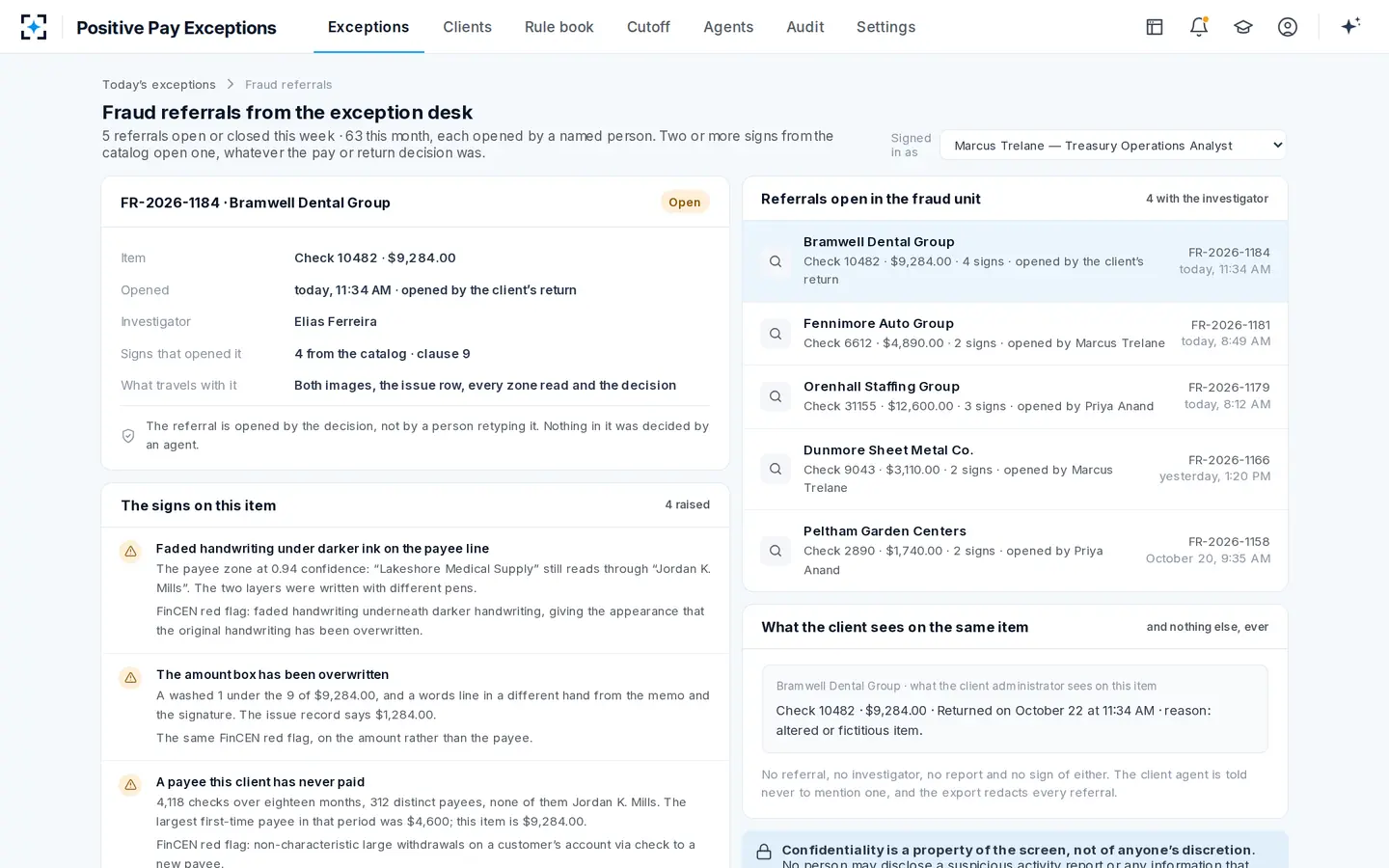
The solution does not change what a bank charges its clients, and it does not stop a check that matches the file in every field, such as a stolen check deposited unaltered in an account opened in the payee's name. It changes the cost of each exception: the minutes the analyst spends, what the client sees when it decides, how often the default decides instead of a person, and the evidence that is left when someone asks later why a check was paid.
The referral carries the evidence, and the client's own view never shows it exists
For a bank weighing the software itself, the question is the same one this page asks a business, one level up: what each exception costs today, decided by hand and sometimes by the clock, against what it would cost decided with the evidence. Positive pay software: pilot it on last month's exceptions shows how to measure that on the bank's own month before buying anything.
Questions people ask
How much do banks charge for positive pay?
Each bank sets its own price, and it is in the fee schedule or on the account analysis statement rather than in any public benchmark. Ask for every component in writing: monthly, per item, per exception, ACH positive pay and set-up. In Majestic v. Huntington the Sixth Circuit noted that the agreement never said the fraud products cost extra.
Is positive pay worth it for a small business?
It depends on how many checks it mails, to how many payees, and what its deposit agreement says about declined services. FinCEN's median mail theft-related check fraud report was $14,215, so for every $1,000 of annual fees, preventing one median loss about every fourteen years covers the cost.
Who pays for an altered check, the bank or the business?
Under the UCC a paying bank that pays an altered check in good faith may charge the customer only the check's original terms, and can claim against the bank that presented it. The customer can lose that protection by failing to review statements promptly, by negligence that helped the alteration, by reporting after a year, or under an agreement that shifts losses for declined fraud services.
Does positive pay cost extra for ACH?
Check the fee schedule for its own line, because it is a different service: it runs on a list of the companies allowed to debit the account and the cap for each, not on an issue file of checks. The 2021 interagency authentication guidance names debit blocks beside positive pay as separate customer controls. A client that writes few checks but is debited by many companies may need ACH positive pay more than check positive pay.
Can a bank refuse to reimburse a business that declined positive pay?
It can try, and some agreements say so. Whether the clause holds depends on the state's version of UCC 4-103 and on the facts: the Sixth Circuit in 2017 let a customer's challenge proceed where the agreement did not describe the products, their cost or how anyone would decide what they would have caught.