Positive pay exception codes name the reason a presented check or ACH debit failed the bank's match against the client's issue file or authorization list: the check was not on the file, its amount, payee, number or date differs, it was already paid, it was voided, or a debit came from a company the client never authorized. The letters differ from bank to bank. Searches for codes such as PNI or PVE are searches for one bank's or one system's labels, and two banks can use different letters for the same exception, so the meaning is in the bank's own user guide. What travels between banks is the exception itself, and each type has a likeliest cause, a first question and a usual decision: pay, return with a reason, or return and refer. Botminds' Positive Pay Exceptions raises each exception with the evidence for that first question already on the screen.
The examples are from one sample day at a fictional bank, Tessaly Community Bank, whose clients and people are fictional. The rules are real and linked.
One sample morning's exceptions, before anyone had decided
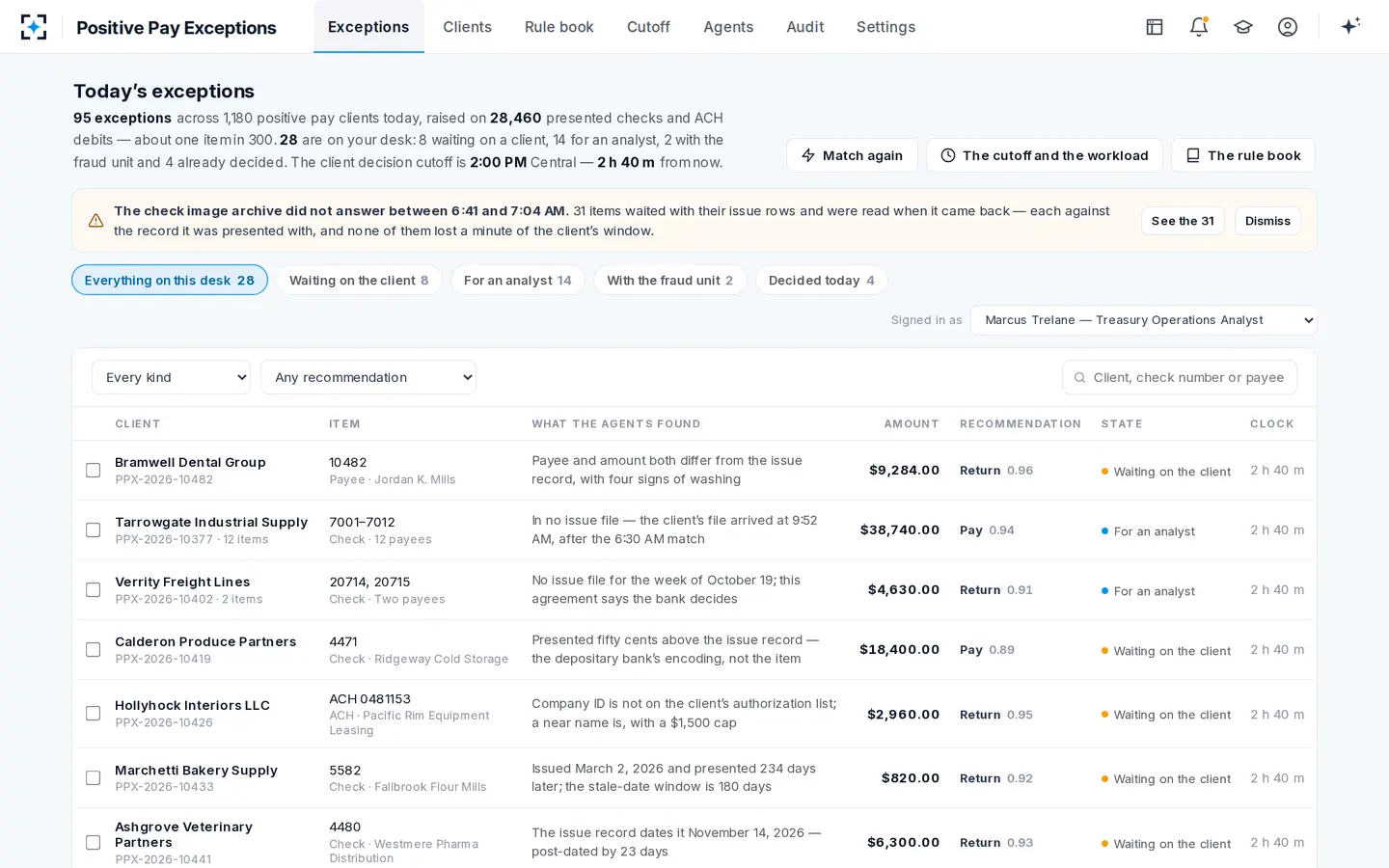
95
exceptions from 28,460 presented checks and ACH debits
6
different exception types on one analyst's first screen
50¢
the smallest difference raised, from a depositary bank's encoding
234days
the oldest check presented, against a 180-day stale window
What are positive pay exception codes, and why do they differ by bank?
They are labels, not law. No regulation or network rule sets a common list of positive pay exception codes for checks, so each bank, or the system it runs, chooses its own letters and descriptions. The underlying reasons are few, because the match compares only a few things: whether the check is in the issue file at all, and if so whether its number, amount, payee and date agree, whether it has already been paid, and whether the client voided it. ACH positive pay adds two more: whether the originator's company ID is on the client's list, and whether the amount is within the cap.
The sample bank uses its own decision reasons, PP-01 to PP-10, which the client picks from when it decides: payee and amount do not match the issue file, the client did not issue this item, altered or washed item, duplicate of an item already paid, ACH debit outside the client's authorization, the default in the agreement with no decision by the cutoff, and others. They are the bank's codes. What a check carries back to the depositary bank is a return reason, which is a different list with its own rules, covered further down.
Exception types, their likeliest causes, and the first question for each
| Exception | Likeliest innocent cause | Likeliest fraud | First question |
|---|---|---|---|
| No issue on file (often called paid no issue) | Late issue file; manual or replacement check never added | Counterfeit with a number the client never used | Did the client write it? |
| Amount differs | Depositary bank's encoding; client keyed the amount wrong | Raised amount on a washed check | What does the amount box on the image say? |
| Payee differs | Abbreviation, trade name, misread handwriting | Washed and rewritten payee | Is the name registered, or read wrongly? |
| Check number differs | Client keyed the wrong number | Counterfeit on the client's stock | Does it match another issued check? |
| Stale-dated | A slow payee depositing an old check | An old stolen check re-presented | Does the client still mean it to be paid? |
| Post-dated | Issue-file date typed wrong | Rarely fraud | Did the client mean it to wait? |
| Duplicate | The same item deposited twice, by image and on paper | A copy of a paid check | Is it the same item? |
| Void presented | A void filed after the check was mailed | A stolen voided check | When was it voided? |
| ACH debit not authorized | A known company under a new company ID, or a cap set too low | A debit from a company the client never dealt with | Does the client know this company? |
Paid no issue: what it means when the check is not on the file
It means the check was presented and the client's issue file has no row for its number, so the bank has nothing to compare it with. The innocent causes are mundane: the file arrived after the match, or a manual or replacement check was written outside the accounting system. On the sample day one client's file arrived at 9:52 AM, three hours after the 6:30 AM match, and twelve genuine checks, $38,740 in all, were raised as having no issue. One cause, one decision: pay the twelve together under one reason, and ask the client to file before the match.
The fraud case is the counterfeit printed with a number the client never used. Its giveaways are on the image rather than in the file: a stock different from the client's own checks, which FinCEN's 2023 alert lists among its red flags, and a payee the client has never paid. A no-issue exception on a check whose stock does not match the client's previous items should be returned and referred, not paid on the client's say-so over the phone.
Amount and payee mismatches: alteration, encoding or a typing error?
The image answers it. If the amount box on the presented check reads what the client issued, the mismatch is in the encoding or the issue file, not on the check; if it reads something else, the check was altered. On the sample day a check was presented fifty cents above its issue file, and the agents traced the difference to the depositary bank's encoding and recommended paying it, at a confidence of 0.89, which sent it to a person because the bank's threshold is 0.90. An encoding error is between the banks: each bank that presents or transfers a check warrants that the information encoded after issue is accurate (12 CFR 229.34(c)(3)).
A payee mismatch has the same two families. The innocent ones are names: an abbreviation, a trade name, a handwritten payee the reader got wrong. The sample bank counts a registered abbreviation or d/b/a on the client's own name list as a match, and nothing else, so a client that pays the same supplier under a short name registers it once. The dangerous ones are washed lines, and they look like this: an original payee still faintly legible under a darker overwrite, on the payee line, the section FinCEN found altered most often in its review of mail-theft reports. Check positive pay vs payee positive pay counts which service sees which.
Ninety-five exceptions, each with what the agents found and what they recommend
What does stale dated mean in positive pay?
A stale-dated exception is a check presented too long after its date, by the bank's stale-date setting. The UCC's line is six months: “A bank is under no obligation to a customer having a checking account to pay a check, other than a certified check, which is presented more than six months after its date, but it may charge its customer's account for a payment made thereafter in good faith” (UCC 4-404). That last clause is why stale checks become exceptions rather than automatic returns: the bank may pay, and positive pay asks the client whether it should.
On the sample day a check issued on March 2, 2026 was presented 234 days later, against the bank's 180-day window. The question for the client is not whether the check is old but whether it still owes the money. A vendor that sat on a check for eight months is harmless; a check stolen months ago and washed now is not, and the two look alike until someone reads the payee line and the client's own payables.
Post-dated, duplicate and voided items
Post-dated checks are the least dangerous exception, and the cause can be the issue file itself. The UCC lets a bank pay a check before its date unless the customer has given notice of the postdating describing the check with reasonable certainty, and makes the bank liable for the resulting loss if it pays early after such notice (UCC 4-401(c)). Positive pay turns that into a question for the client: on the sample day the issue file dated a check November 14, 2026, 23 days after it was presented, and the client had to say whether that date was intended or a typing error.
A duplicate is a check number the bank has already paid. Either the same item was deposited twice, for example by mobile capture and then on paper, or someone has copied a genuine paid check; on the sample day a client returned a check that duplicated one paid three days earlier. What is duplicate presentment follows the double-deposit case from the depositary bank's side. A voided check that is presented is the clearest signal of the lot: if the client voided it before it left the office, someone else has it.
An ACH debit checked against the client's own authorizations
ACH positive pay exceptions: unknown originators and amounts over the cap
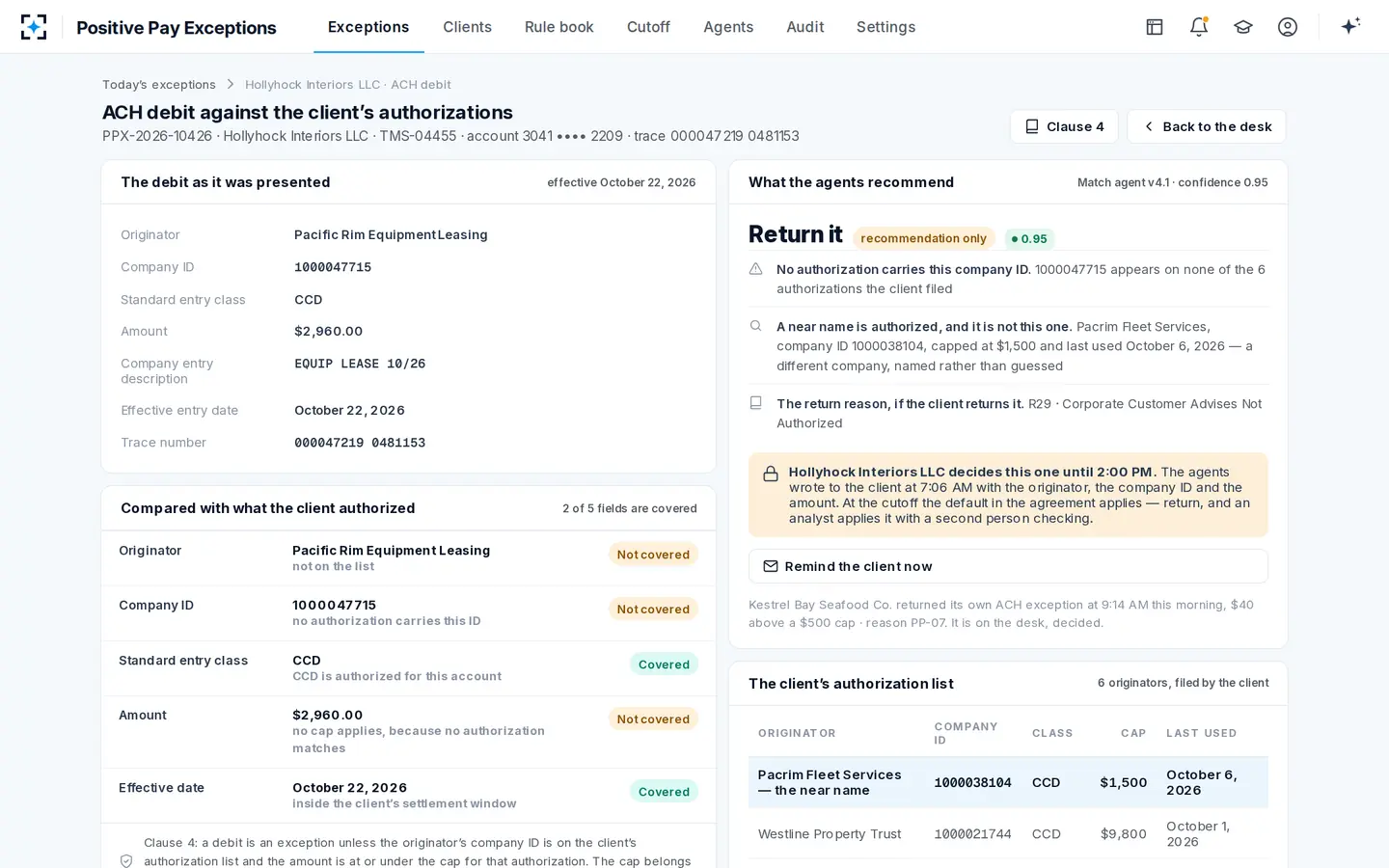
An ACH positive pay exception is a debit that the client's authorization list does not cover: an originator whose company ID is not on the list, or an amount above the cap the client set for that originator. On the sample day both happened. Hollyhock Interiors received a $2,960.00 debit from a leasing company whose ID was on none of its six authorizations, beside a near-identical name that was; and Kestrel Bay Seafood returned a debit $40 over the $500 cap it had set for that originator.
The first question is whether the client knows the company. A known vendor that changed its company ID, or a cap set too tightly for a seasonal bill, is fixed by updating the authorization. An unknown company is returned as unauthorized, and for a corporate debit the return reason is R29, which Nacha uses for CCD and CTX entries to non-consumer accounts (Nacha, Differentiating Unauthorized Return Reasons) and counts toward the originator's unauthorized return rate (Nacha, Risk and Enforcement Topics).
Positive pay check return reasons: which reason goes on the item
A returned check must carry its reason on its front, and the reason should tell the depositary bank what actually happened. Regulation CC requires a paying bank returning a check to “clearly indicate on the front of the check that it is a returned check and the reason for return” (12 CFR 229.31(e)). The Board's commentary then draws a line that matters for positive pay in particular.
“A reason such as “Refer to Maker” may be appropriate in certain cases, such as when a drawer with a positive pay arrangement instructs the bank to return the check.”
Regulation CC commentary, Appendix E to Part 229, on § 229.31(e)
The same passage rules the vague reason out for an item the bank has already paid, an altered check and an unauthorized one; it is quoted in full, for the case of a check paid twice, in what is duplicate presentment. The commentary's reasoning is that in those cases the payee, not the drawer, generally knows more about why the check is coming back. For a positive pay desk that means the client's decision and the item's return reason are two separate choices. A client returning a check it simply does not want paid, a stale check or one it stopped, may suit refer to maker. A client returning check 10482, with its washed payee and raised amount, is returning an altered item, and the return should say so; on the sample day it went back as an altered or fictitious item. A check the client wants stopped before it is presented is a stop-payment order instead, effective for six months under UCC 4-403(b).
One path per exception: pay, return with a reason, or refer
Each exception type reduces to one first question and two branches. The table below is the decision path the sample bank's clients and analysts follow; the agents put the evidence for the first question on the screen, and a person answers it.
The decision path for each exception type: one question, two branches
No issue on file
Ask firstDid the client write this check?
If yesPay, and fix the cause: a late file, or a manual check never added
If noReturn as not issued; a real-looking check with an unused number is a counterfeit to refer
Amount differs
Ask firstDoes the amount box on the image read what the client issued?
If yesAn encoding or keying difference: pay, and let the banks settle the encoding
If noReturn as altered; look at the box for one ink over another and refer on signs
Payee differs
Ask firstIs the name one the client registered, or a misread?
If yesPay, and add the name to the client's list if it will recur
If noRead the payee line for washing; return as altered and refer on signs
Check number differs
Ask firstDo amount and payee match another issued check?
If yesThe client keyed the wrong number: pay, and correct the file
If noTreat as a counterfeit: return and refer
Stale-dated
Ask firstDoes the client still mean this check to be paid?
If yesPay; a bank may pay an old check in good faith
If noReturn, with the client's reason
Post-dated
Ask firstDid the client mean it to wait, and tell the bank?
If yesReturn or hold as the agreement allows
If noPay, if the issue-file date was simply typed wrong
Duplicate of an item paid
Ask firstIs this the same item presented twice?
If yesReturn as a duplicate, and look for a deposit made twice
If noA copy of a genuine check: counterfeit, return and refer
Voided check presented
Ask firstWas the void filed before the check left the client?
If yesReturn; a voided check in someone else's hands was stolen
If noAsk the client which check is real before anything is paid
ACH debit not authorized
Ask firstIs it a company the client deals with, under another ID or above its cap?
If yesPay, and update the authorization so it does not recur
If noReturn as unauthorized; for a corporate debit that is R29
Before a return goes out on any exception
- The client's reason is kept with the decision
A decision without a reason cannot be explained later, and the sample bank's screen refuses one.
- The return reason matches what happened
Refer to maker for a client instruction; altered or unauthorized when the check was.
- A second person has checked a bank-made return
Above the bank's review amount, the supervisor.
- The deadline still has room
The midnight deadline, and Regulation CC's 2 p.m. second-business-day test.
- A $5,000-or-more check has its notice of nonpayment
12 CFR 229.31(c); the returned check can serve if it arrives in time.
- Signs have gone to the fraud unit, and nowhere else
The client sees the decision, never a referral.
Questions people ask
What does PNI mean on a positive pay exception?
Searches pair PNI with paid no issue, and where a bank uses those letters they label a check presented that is not in the client's issue file. The letters are the bank's own, so confirm them in its user guide. The usual causes are a late issue file or a manual check never added, and the case to watch is a counterfeit with a number the client never used.
What is a positive pay exception item?
A presented check or ACH debit that did not match the client's issue file or authorization list and so is held for a decision. The client decides it, pay or return, before the bank's cutoff; if it does not, the default in the agreement applies.
What does positive pay exception type PVE mean?
Banks and systems use different codes, and the meaning of a code like PVE is defined in the bank's own positive pay user guide, not by any regulation or network rule. Ask the bank which field it refers to; most codes map to one of the types in this guide: no issue, amount, payee, number, date, duplicate, void or an unauthorized debit.
What reasons can a business give for returning a positive pay exception?
The reasons the bank's screen offers for a return, such as payee and amount do not match, the client did not issue the item, altered or washed item, or a duplicate of an item already paid. The bank then chooses the return reason that goes on the item, which Regulation CC expects to describe what happened rather than default to refer to maker.
Can a stale-dated check still be paid through positive pay?
Yes. The UCC says a bank need not pay a check presented more than six months after its date but may pay it in good faith, and positive pay turns that into a question for the client: if it still owes the payee, it can tell the bank to pay.