The positive pay cut off time is the hour, written into each client's treasury services agreement, by which the business must decide its exceptions: pay this check, or return it. No regulation fixes the hour. Each bank chooses its own, and chooses it early, because the paying bank's own legal clock runs out at its midnight deadline, midnight of the banking day after the check arrived, and a return has to be prepared, checked and sent before then. Between the overnight match and that cutoff sits a treasury operations analyst whose morning goes mostly on finding things: the image, the client's issue file, the history. Botminds' Positive Pay Exceptions lays the client's issue data over the presented check and reads the image for signs of washing, so the morning goes on deciding instead.
The morning below belongs to a fictional sample bank, Tessaly Community Bank, and its analyst Marcus Trelane, as the solution runs one Thursday. Every client and person named is fictional. The law is real and linked where it appears.
One Thursday at the sample bank, and the clock it ran against
28,460
checks and ACH debits presented overnight, matched against 1,180 clients
95
exceptions left after the match, about one item in 300
2:00PM
the client decision cutoff, Central time
11:34AM
the day’s altered check returned, 12 h 26 m inside the midnight deadline
What is the positive pay cut off time, and who sets it?
The cutoff is a contract term, not a rule of law: the bank sets it in the positive pay schedule of its treasury services agreement (a sample schedule is annotated in the positive pay agreement sample), and the client agrees to decide its exceptions before it. Article 4 of the Uniform Commercial Code lets a bank and its customer vary the article by agreement, provided the bank does not contract out of good faith or ordinary care; within that limit, the parties may agree the standards that measure the bank's responsibility, so long as those standards are not manifestly unreasonable (UCC 4-103(a)). A cutoff is a standard of that kind, and so is the default that applies when the client misses it.
Do not confuse it with the 2 P.M. that appears in the code itself. Under UCC 4-108 a bank “may fix an afternoon hour of 2 P.M. or later as a cutoff hour” for handling items, and an item received after that hour may be treated as received at the opening of the next banking day. That hour governs when the bank's clock starts. The positive pay cutoff governs when the client's say ends. The sample bank happens to use 2:00 PM Central for both, which is a coincidence of habit rather than law.
The examiners' description of the service shows why a cutoff is needed at all. Positive pay, in the FFIEC's words, compares a business's file of issued checks with the checks presented, and if one is missing from the file “the institution requests the corporation to make a pay/no pay decision” (FFIEC IT Handbook, Retail Payment Systems). A request needs an answer by a time, or the bank is left holding a question it cannot afford to hold.
Why the cutoff sits ten hours before midnight
Because the paying bank's real deadline belongs to the bank, not the client, and the work of returning a check takes the hours in between. The UCC defines the midnight deadline as “midnight on its next banking day following the banking day on which it receives the relevant item” (UCC 4-104(a)(10)). A paying bank that does not pay or return the item, or send notice of dishonor, by then is accountable for its amount, whether or not it was properly payable (UCC 4-302(a)(1)).
Federal rules add a second clock on the same item. When a paying bank decides not to pay a check, Regulation CC requires it to send the check back so that the depositary bank would normally have it by 2 p.m., the depositary bank's local time, on the second business day after presentment, and, for a check of $5,000 or more, to send a notice of nonpayment on the same timetable (12 CFR 229.31(b) and (c)). The Board's commentary gives the plain case: a check presented on Monday should normally reach the depositary bank by 2 p.m. on Wednesday (Regulation CC commentary).
Three clocks run on every positive pay exception, and only one belongs to the client
Whose clock, and where it comes from: The bank's own setting, in each client's treasury services agreement. 2:00 PM Central at the sample bank, with a reminder at 12:30 PM and an escalation at 1:30 PM.
What happens when it runs out: The agreement's default applies, pay or return. At the sample bank an analyst applies it with the clause quoted, and a second person checks it.
Whose clock, and where it comes from: UCC 4-104(a)(10) and 4-302: midnight of the paying bank's next banking day after it received the check.
What happens when it runs out: A check neither paid nor returned, and with no notice of dishonor sent, becomes the paying bank's to pay, altered or not.
Whose clock, and where it comes from: 12 CFR 229.31(b): a returned check should normally reach the depositary bank by 2 p.m. on the second business day after presentment; (c) adds a notice for checks of $5,000 or more.
What happens when it runs out: A bank that fails to exercise ordinary care under the rule may be liable for the resulting loss, up to the amount of the check (12 CFR 229.38(a)).
Count back from midnight and the 2:00 PM cutoff makes sense. After the client decides, an analyst prepares the return instruction, a second person checks it, the return leaves for the payments hub, and the clients who said nothing have to be handled under their defaults with the same two-person check. Each of those steps needs a named person at a desk staffed for the business day, not the night. The cutoff is where the bank stops waiting for the client so that its own work fits inside the law's.
6:30 AM: the match, and the 95 exceptions it leaves
The analyst's day starts with a number, and on the sample Thursday it was 95. Overnight the bank received 28,460 checks and ACH debits drawn on 1,180 positive pay clients, and at 6:30 AM every one was compared with what its client had said it issued or authorized. Ninety-five did not match: about one item in 300. Twenty-eight landed on Marcus Trelane's desk, and by late morning eight were waiting on a client, fourteen were his, two were with the fraud unit and four were decided.
Ninety-five exceptions, one cutoff, and what the agents found on each
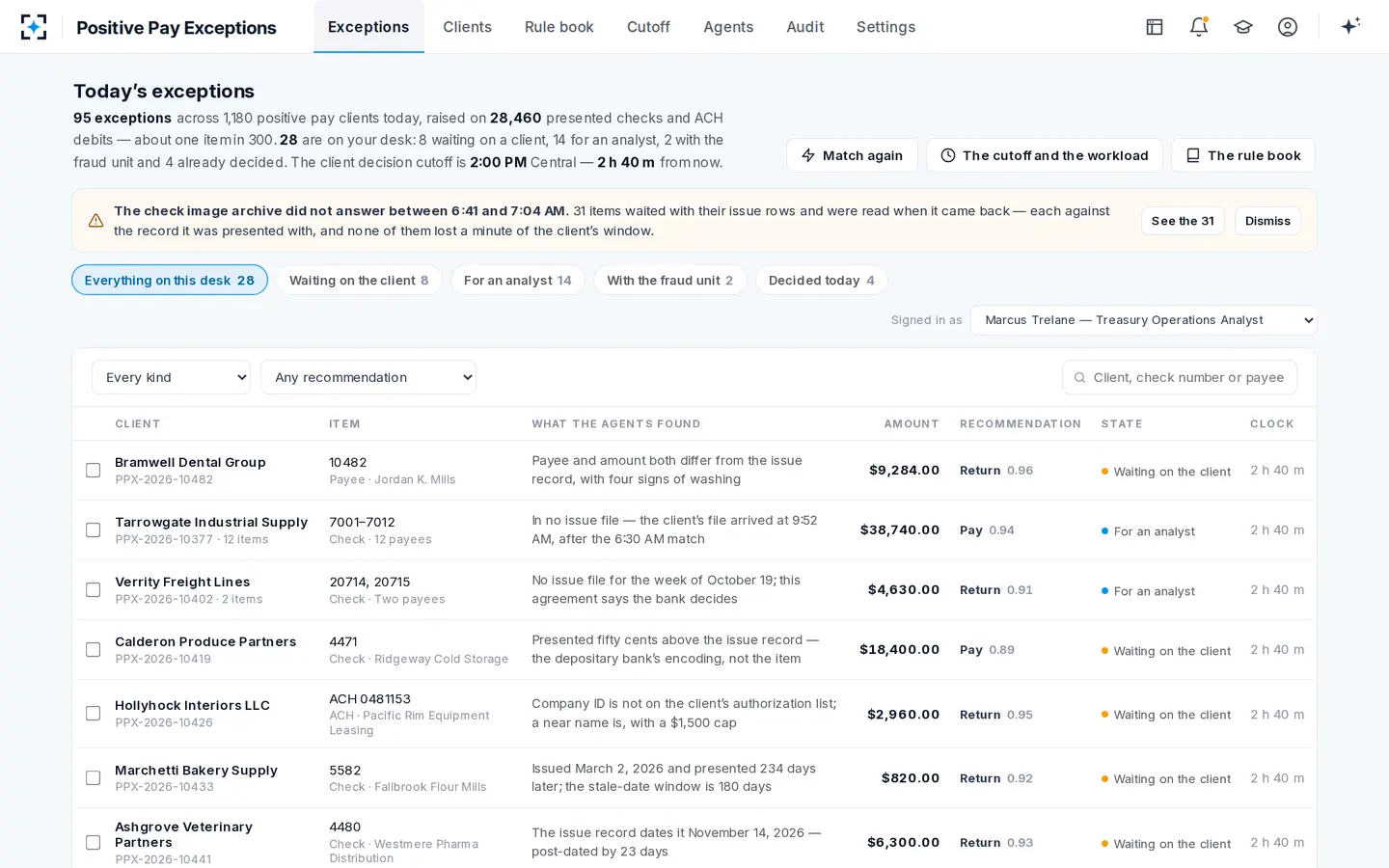
The first surprise of the morning was not an exception at all. Between 6:41 and 7:04 AM the check image archive stopped answering, and 31 items waited with their issue rows until it came back. A desk that works from images cannot start without them, which is a good reason to put the match hours, not minutes, before the cutoff: a 23-minute outage at 6:41 AM costs nothing; the same outage at 1:40 PM costs a client its decision. Regulation CC does extend its own time limits for delays caused by “interruption of communication or computer facilities”, but only if the bank “exercises such diligence as the circumstances require” (12 CFR 229.38(e)). That is an excuse to be proved after the fact, not a plan.
7:06 AM: every client is told what differs, in words
At 7:06 AM the solution's client agent wrote to 38 clients with exceptions to decide, each message carrying both images and a sentence naming the fields that moved. It is also the step a portal row leaves out. A client who sees only the words payee mismatch has to find its own payment run, its own copy of the check and its own vendor list before it can answer, and the hours it spends doing that come straight out of the window.
The sentence the client read for check 10482 from Bramwell Dental Group was specific: the payee reads Jordan K. Mills where the issue file says Lakeshore Medical Supply, and the amount reads $9,284.00 where the issue file says $1,284.00, $8,000.00 more; the check number and the issue date match. Two fields moved and two did not, which is the pattern of an alteration rather than a counterfeit. The reminder was set for 12:30 PM and an escalation for 1:30 PM, so silence would be noticed twice before the default could apply.
Where does an analyst's morning go on one exception?
Mostly on looking for things. The solution's designers estimated the minutes one exception takes by hand at the sample bank, and the step that takes longest is the one most desks skip: checking the client's own payment history for the payee. Opening the image and finding the client's issue row takes another two and a half minutes, and looking for signs of washing on the image three more.
Sixteen and a half minutes by hand, about two with the agents, and most of the two is signatures
- Find image and issue row2.5
- Compare four fields2
- Look for washing3
- Check the client’s history4
- Tell the client2
- Prepare, check, send the return3
- Reading, comparing, history, message0.7
- Two people sign and send1.5
Ninety-five exceptions at sixteen and a half minutes is about 26 hours of work, which is why a desk of three cannot do every step on every item and chooses which to drop. The history check goes first because it feels optional. It is not: a payee the client has never paid, for twice the largest first-time payment it has ever made, is one of the strongest reasons to return a check whose fields otherwise look plausible, and it takes a person four minutes to establish from statements. On check 10482 the agents had already counted it: 4,118 checks to 312 payees over eighteen months, none to Jordan K. Mills, and a largest first-time payment of $4,600.
9:52 AM: the exceptions that are not fraud
Many exceptions are housekeeping, as three on this desk show, and the cutoff is easier to meet when they are cleared as a group. At 9:52 AM Tarrowgate Industrial Supply filed its issue file, three hours and 22 minutes after the 6:30 AM match. Twelve genuine checks, numbers 7001 to 7012 and $38,740 in all, had been presented against nothing. One cause, one reason code, one decision: pay the twelve together, keep them as exceptions with the reason they were paid, and ask the client to file before the match tomorrow. The positive pay file format guide follows what a late or incomplete issue file does to every decision after it.
Twelve exceptions, one cause: the issue file arrived after the match
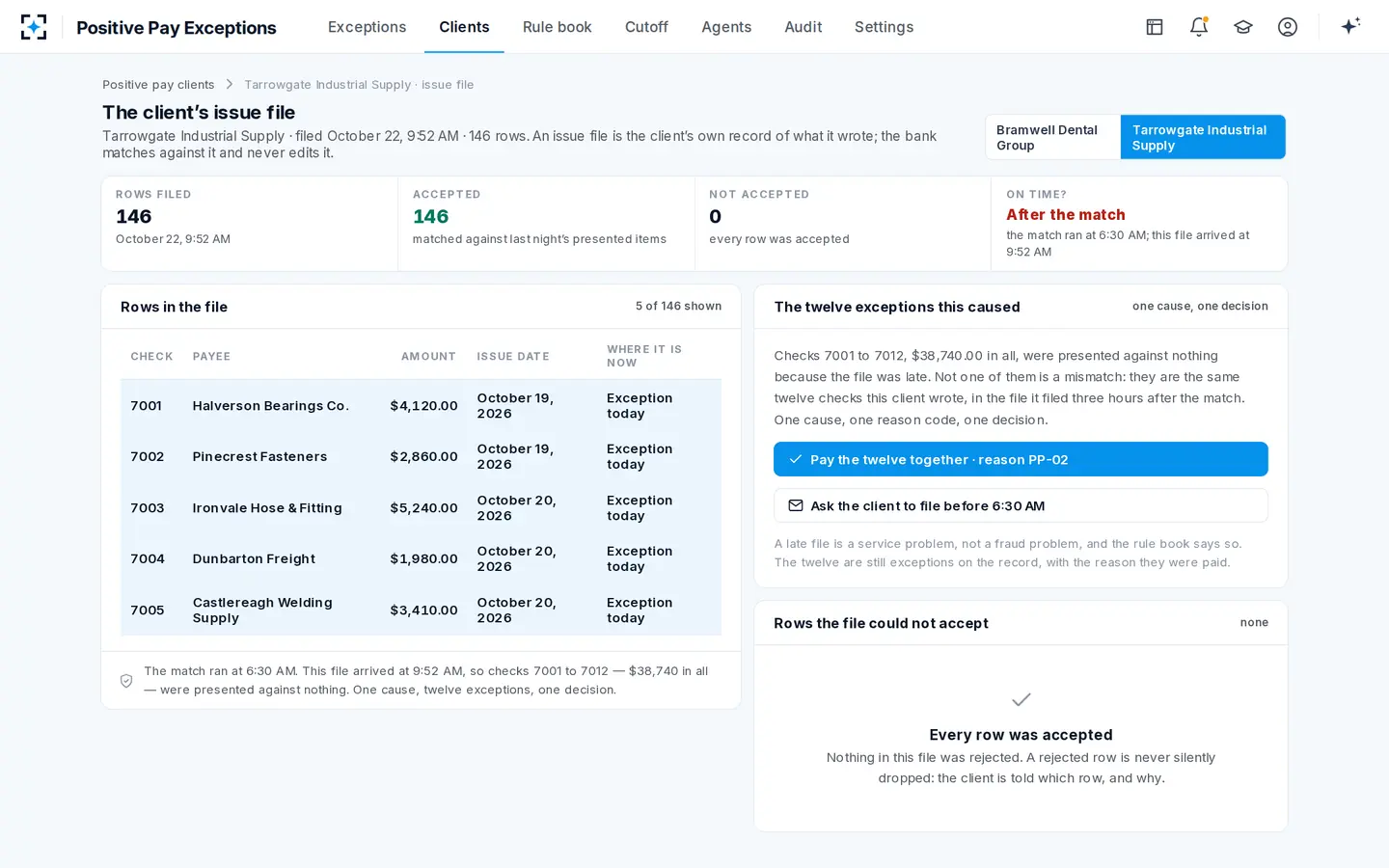
Two other housekeeping cases were on the same desk. Calderon Produce Partners' check 4471 was presented fifty cents above its issue file, and the agents traced the difference to the depositary bank's encoding rather than to the check itself, recommending payment at a confidence of 0.89. Because that is under the bank's 0.90 threshold, a person read it before anyone relied on it. Verrity Freight Lines had filed no issue file all week, and its agreement says that in that case the bank decides; the analyst applies the written rule and quotes the clause, rather than guessing what the client would want.
11:20 to 11:34 AM: one return, three people, fourteen minutes
The altered check took fourteen minutes from the client's decision to dispatch, and none of those minutes was spent finding anything. At 11:20 AM Danielle Okonkwo, the controller at Bramwell Dental Group, opened the same overlay the analyst had seen, chose to return the check and picked a reason from the codes that fit a return; the screen would not take a decision without one.
From the client's decision to the payments hub, with a person at every step that moves money
A person decides
Client controller, 11:20 AMReturns check 10482 inside her window, with the reason that payee and amount do not match the issue file.
Agent
Return agent, 11:24 AMBuilds the return instruction with the item-processing reason for an altered or fictitious item, the amount and the deadline.
Never: dispatches an instruction.
A person decides
Analyst, 11:24 AMPrepares the return from the agent's draft and sends it for checking.
A person decides
Supervisor, 11:31 AMChecks and signs, because $9,284.00 is above the bank's $5,000 review amount.
A person decides
Analyst, 11:34 AMDispatches the return to the payments hub with 12 hours 26 minutes left on the midnight deadline.
The client decides her own exception, with the evidence on the same screen
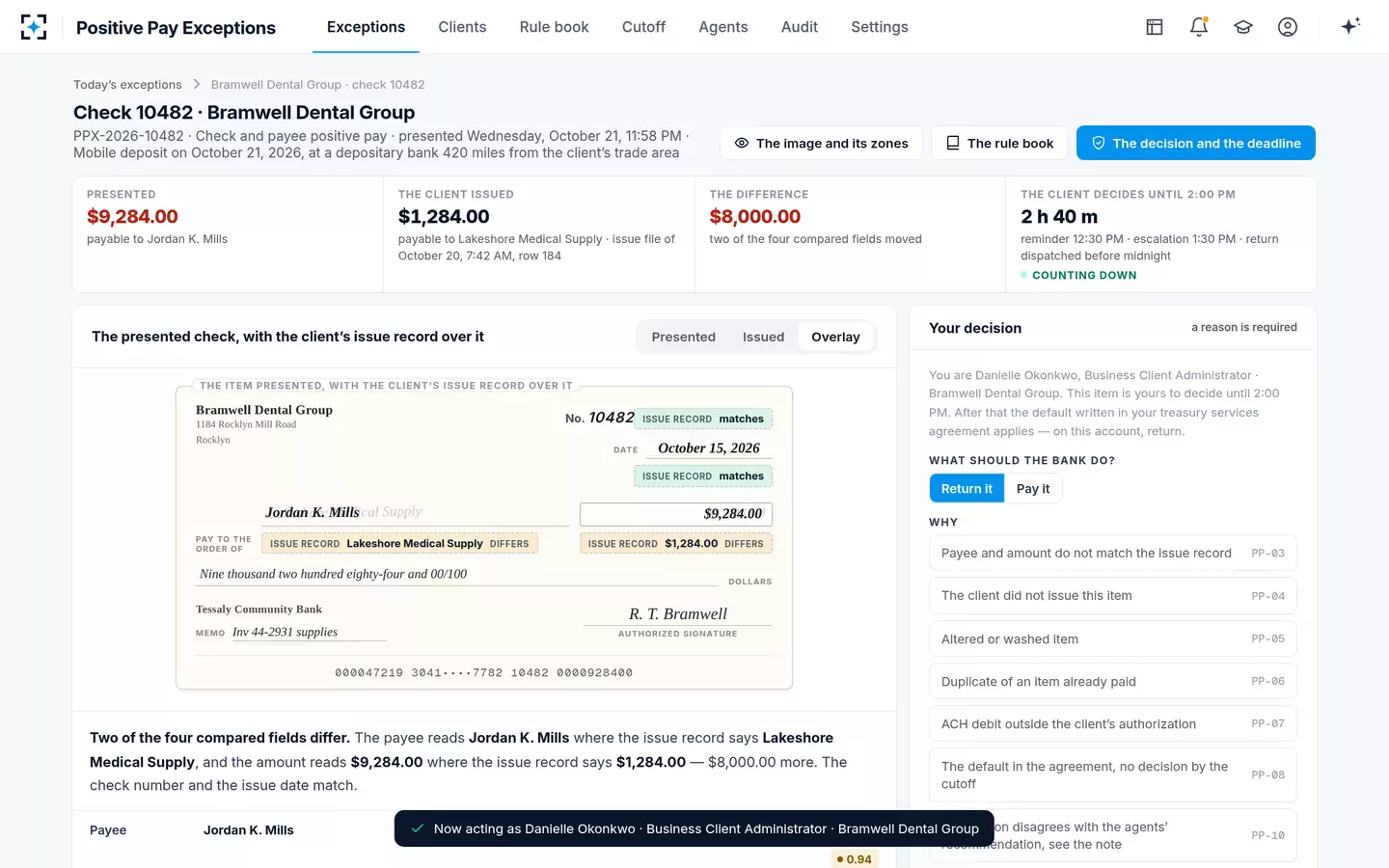
The decision also opened a referral to the bank's fraud unit, because the check carried four signs of washing and the bank's rule is that two or more open one. Nothing on the client's screen shows that a referral exists. Her view of the item says only that it was returned as an altered or fictitious item.
What happens after the positive pay cutoff?
At 2:00 PM the client's say ends and the agreement's default decides every exception still open, pay or return. The default is not a soft preference. On a default-pay account, every missed decision is a check paid; on a default-return account, every missed decision is a check dishonored, genuine or not. Either way the bank is acting, so the sample bank treats the default like any other bank decision: an analyst applies it with the clause quoted and a reason code, and a second person checks it.
The sample Thursday, hour by hour, against the 2:00 PM cutoff
| Time | What happened | Why it matters for the cutoff |
|---|---|---|
| 6:30 AM | Match of 28,460 presented items; 95 exceptions | The client window opens with seven and a half hours to run |
| 6:41–7:04 AM | Image archive outage; 31 items wait | An early match absorbs an outage that would sink a late one |
| 7:06 AM | Client agent writes to 38 clients with both images | The client starts deciding instead of searching |
| 9:14 AM | A client returns its own ACH exception, $40 over a $500 cap | ACH positive pay runs on the same cutoff |
| 9:52 AM | A late issue file explains twelve exceptions | One cause, one decision, no fraud work wasted |
| 11:20–11:34 AM | Altered check decided, prepared, signed, dispatched | 12 h 26 m to spare on the midnight deadline |
| 12:30 PM | Reminder to clients still undecided | The first of two warnings before the default |
| 1:30 PM | Escalation for clients still silent | Silence is noticed twice before the clock decides |
| 2:00 PM | Cutoff: defaults applied by an analyst and checked | The client's window closes; the bank's work begins |
The design target for the solution is that 98% of exceptions are decided by a named person before the cutoff, so the default is the exception rather than the routine. That number is a target, not a result, and the bank sets the reminder and escalation times that make it reachable. What happens to the 2% depends entirely on which default the bank wrote, and positive pay decision: when the default decides for the client works through what each default turns a missed decision into.
Who decides positive pay exceptions, the client or the bank?
The client, until the cutoff; after that, whatever the agreement says. The FFIEC's description puts the pay/no pay decision with the business, and the sample bank's rule book goes further: the bank never decides an item inside the client's window. That rule protects the bank as much as the client. A bank that returns a genuine check its client wanted paid has dishonored an item that was properly payable, and the code makes a payor bank liable to its customer for damages proximately caused by a wrongful dishonor (UCC 4-402(b)).
There are two exceptions to the client deciding, and both are written down. Where an agreement says the bank decides, as Verrity Freight's does when no issue file arrives, an analyst applies the written rule. And where the client says nothing by the cutoff, the default applies. Neither is an analyst's judgement call, which is why positive pay exception codes and their reasons matter: the code says which rule applied, and the reason says why.
Questions people ask
What time is the positive pay cutoff at most banks?
Each bank sets its own, and the hour is in the client's treasury services agreement or the bank's positive pay user guide; no regulation fixes it. Whatever the hour, it has to leave the bank time to prepare, check and send returns before its midnight deadline. The fictional sample bank in this guide uses 2:00 PM Central.
Can a client decide a positive pay exception after the cutoff?
Not as of right: after the cutoff the agreement's default applies. A bank may choose to accept a late instruction while it can still return the check inside its midnight deadline, but that is a favour the agreement may or may not allow, and it should be recorded as a bank decision with its reason.
How long does positive pay take, from presentment to a decision?
One banking day. Checks arrive overnight, the match runs early the next morning, the client decides by the cutoff and the bank returns or pays before midnight of that same banking day, which is its midnight deadline under UCC 4-104. On the sample day the altered check was received at 11:58 PM on Wednesday and returned at 11:34 AM on Thursday.
Does the positive pay cutoff apply to ACH debits too?
At most banks the same decision window covers ACH positive pay, though the return rules differ: an unauthorized corporate debit goes back through the ACH Network under Nacha's rules rather than as a returned check. On the sample day a client returned its own ACH exception at 9:14 AM, a debit $40 over the $500 cap it had set for that originator.
Why can't the cutoff be closer to midnight?
Because the bank still has work to do after the client answers: preparing the return, having a second person check it, dispatching it, and applying and checking the defaults for every client that stayed silent. Regulation CC also expects a returned check to reach the depositary bank by 2 p.m. on the second business day after presentment, and a notice for checks of $5,000 or more, so a late afternoon spent on returns is time the bank needs.