A positive pay agreement is the service schedule under which a business client sends its bank a list of the checks it has issued, and the bank pays only checks that match the list, referring the rest to the client as exceptions. The clauses that matter most are not the description of the service; they are the ones that decide what happens when nobody acts: the deadline for the client's decision, the default when the deadline passes, and what the client gives up if it declines the service altogether. UCC Article 4 lets a bank and a client set those terms by agreement, but not to disclaim the bank's good faith or ordinary care. Below is an annotated positive pay agreement sample built on those rules. Botminds' Treasury Management Agreement Search reads the positive pay schedule each client actually signed, with its signer and effective date, so the answer to "who carries this check?" starts from the right text.
The sample clauses are illustrative, written for this guide; they are not legal advice or any bank's form. The client examples come from a fictional sample bank running the solution, and the law is quoted from the uniform text and from the court's own opinion.
A positive pay agreement sample, clause by clause, with what each one decides
1
Issue file
Customer will send Bank an issue file listing the check number, amount, issue date and payee of every check before it is released, and a void file for any check cancelled.
What it decidesDefines what "matches" means. A file without payee names gives check positive pay only; with them, payee positive pay.
2
Exceptions and the decision deadline
Bank will make exceptions available by 9:00 a.m. on the banking day after presentment. Customer must decide pay or return for each exception by 11:00 a.m.
What it decidesSets the client's window inside the bank's own midnight deadline. The sample bank's cut-off is 11:00 a.m.
3
Default decision
Any exception Customer has not decided by the deadline will be returned unpaid.
What it decidesThe clause that decides the item nobody worked. The alternative, "will be paid," moves the loss on an undecided forgery to the client.
4
Standard of care
Bank exercises ordinary care when it compares presented checks with the issue file as described in this Schedule.
What it decidesAllowed if not manifestly unreasonable (UCC §4-103(a)). It cannot excuse a failure to follow the Schedule itself.
5
Declining the service
If Customer declines positive pay, Customer is precluded from asserting claims against Bank for paying any altered or counterfeit check the service was designed to detect.
What it decidesThe opt-out release. Upheld in Cincinnati Insurance v. Wachovia (D. Minn. 2010), but only so far as it does not excuse the bank's own lack of ordinary care.
6
What the agreement cannot do
Nothing in this Schedule limits Bank's responsibility for its own lack of good faith or failure to exercise ordinary care.
What it decidesRestates the floor in UCC §4-103(a). A severability clause, as in Wachovia, keeps the rest of the schedule alive if a court finds a clause too broad.
What is a positive pay agreement?
It is the part of a treasury management agreement that governs the positive pay service: what the client sends, what the bank compares, when exceptions are presented, how the client decides them and who bears the loss in each case. The court in the leading case described the service plainly: positive pay "enables a customer to transmit to its bank pertinent information about every check that the customer issues," so that when the information on a presented check does not match, "the bank can contact the customer before clearing the check" (Cincinnati Insurance v. Wachovia, D. Minn. 2010).
Regulators treat it as one of the controls available to business customers. The interagency authentication guidance names positive pay and debit blocks among the tools a business customer can use to watch and control what moves through its accounts (FFIEC, Authentication and Access, 2021); how the service works day to day is set out in how positive pay works. No rule requires a client to use it, which is why the agreement, and especially the clause about clients who decline it, carries so much weight.
Who is liable under a positive pay agreement?
Without an agreement, usually the bank. A bank may charge a client's account only for an item that is "properly payable": one the client authorized and that fits the agreement between them (UCC §4-401(a); the rule as a payer meets it is in my check was stolen and cashed). An altered or counterfeit check is not authorized by the client, so the default rule puts the loss on the paying bank.
Article 4 then lets the parties change that, within a floor: an agreement may vary the Article's effect, but it cannot excuse the bank from good faith or ordinary care (that sentence is quoted and applied to late reports in UCC 4-406 and the late report). The parties may, however, "determine by agreement the standards by which the bank's responsibility is to be measured if those standards are not manifestly unreasonable" (UCC §4-103(a)). A positive pay agreement is that kind of agreement: it sets the procedure, sets the standard and, through its default and opt-out clauses, moves specific losses to the client.
The UCC rules a positive pay agreement works inside
| Rule | What it says | What a positive pay agreement does with it |
|---|---|---|
| §4-401(a), properly payable | The bank may charge only items authorized by the client and in accordance with their agreement | The issue file becomes the client's statement of what it authorized |
| §4-103(a), variation by agreement | Terms may be varied; good faith and ordinary care cannot be disclaimed; standards may be set if not manifestly unreasonable | Sets the comparison as the bank's standard of care; allocates undecided and declined items |
| §3-103(a)(9), ordinary care | A bank processing by automated means need not examine an item if that does not violate its prescribed procedures | Positive pay becomes part of the bank's prescribed procedure, so skipping it is a lapse in care |
| §4-104(a)(10) and §4-302, midnight deadline | The bank must pay, return or dishonor by midnight of its next banking day, or it is accountable for the item | The client's decision deadline has to fall early enough for the bank to return in time |
| §4-406(c) and (f), statement review | The client must examine statements with reasonable promptness; one year bars claims of alteration or forged signature | Positive pay moves detection before payment, but the statement duties remain |
What does a positive pay agreement say about defaults?
It says what happens to an exception the client did not decide by the deadline, and there are only two answers: pay it or return it. The choice matters because the deadline sits inside a hard legal limit on the bank. A paying bank that has neither paid, returned nor dishonored a demand item by its midnight deadline is accountable for it (UCC §4-302(a)(1)), and that deadline is midnight of the banking day after the bank receives the item (UCC §4-104(a)(10)); the deadline's text, and how banks set a client cut-off inside it, are in the positive pay cut-off time guide. Every hour the agreement gives the client is an hour the bank no longer has.
One banking day in positive pay: the client's window sits inside the bank's deadline
The day after presentment, midnight to midnight
- Overnight matching, exceptions posted · 37%
- Client decides, to 11:00 a.m. · 9%
- Bank returns before its midnight deadline · 54%
Pay by default or return by default
Return by default protects the client from the forgery it did not have time to check, and costs it an occasional returned check that was genuine. Pay by default protects the client's payees and its relationships, and leaves it holding any forged or altered check it failed to decide. The sample client's schedule is the first kind: exceptions are decided by 11:00 a.m., and undecided exceptions are returned. How a bank chooses between the two defaults, client by client, is worked through in the positive pay deadline and default decision.
The default decision moves the loss on an undecided item
Undecided exceptions are returned: Returned unpaid. The fraud fails; the client loses nothing.
Undecided exceptions are paid: Paid. Under the agreement, likely the client's loss, unless the bank failed its own procedure.
Undecided exceptions are returned: Returned. The payee is unpaid and the client must reissue and explain.
Undecided exceptions are paid: Paid as the client intended.
Undecided exceptions are returned: A daily decision to avoid returning good checks.
Undecided exceptions are paid: A daily decision to avoid paying bad ones; a heavier duty.
Undecided exceptions are returned: Proof the exception was presented in time and returned before the midnight deadline.
Undecided exceptions are paid: Proof the exception was presented in time and the agreement allocated undecided items to the client.
Either default can be defended if the client chose it knowingly and the bank followed its own process. What cannot be defended is a bank that does not know which default a client signed, or reads the current standard schedule for a client still on an older one. A client that switched from pay-by-default to return-by-default in an amendment has two answers depending on the date of the check.
The positive pay opt-out (hold harmless) agreement
When a client declines positive pay, a bank may ask it to sign an opt-out or hold harmless agreement that shifts the losses the service would have prevented. The leading case on such a clause is Cincinnati Insurance Co. v. Wachovia Bank. Thieves stole a $153,856.46 check that Schultz Foods had issued, changed the payee and cashed it; Schultz had declined Wachovia's positive pay. The deposit agreement said that if the client failed to implement offered fraud-prevention products, it "will be precluded from asserting any claims against [Wachovia] for paying any unauthorized, altered, counterfeit or other fraudulent item that such product, service, or precaution was designed to detect or deter" (Cincinnati Insurance v. Wachovia, D. Minn. 2010).
"Under the plain language of the releases, Schultz Foods is precluded from asserting any claims against Wachovia for making that payment, and Wachovia is not required to re-credit Schultz Foods's account."
Cincinnati Insurance Co. v. Wachovia Bank, N.A., D. Minn., July 14, 2010
The court enforced the release, with two qualifications every drafter should note. First, it agreed the release was "overbroad": the parts that would excuse the bank's own failure to exercise ordinary care were invalid under §4-103(a), and the clause survived only because a severability clause kept the rest alive and the insurer did not allege the bank was careless. Second, it tested reasonableness on cost and feasibility: the insurer conceded positive pay was technically feasible for the client and could be set up "for less than $500," with fees offset by credits the bank gave in lieu of interest. An opt-out clause in a schedule that would cost a small client a fortune would face a harder test.
Reverse positive pay and ACH positive pay agreements
The same clause types appear with different owners. In a reverse positive pay agreement the bank sends the client the list of presented checks and the client does the matching, so the schedule must be clearer still about the decision deadline and the default, because the bank has not checked anything itself. Its standard of care is set by what the agreement says the bank does, and §4-103(a) still forbids disclaiming the bank's good faith and ordinary care.
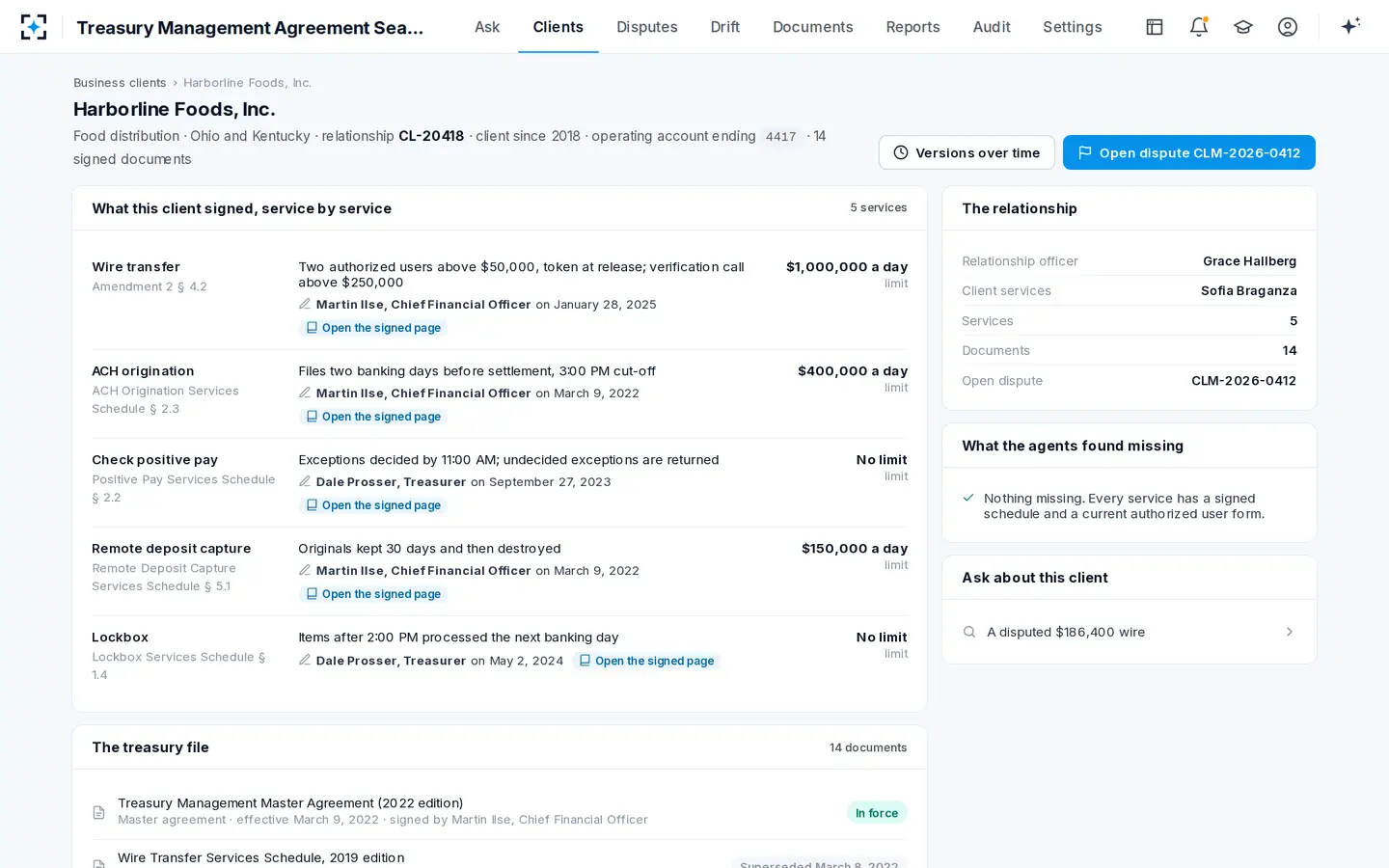
ACH positive pay, often called a debit filter or debit block, rests on different footing. An ACH debit is not a check, and the agreement and the ACH network's own rules carry more of the weight than Article 4 does; the FFIEC guidance names debit blocks beside positive pay as business-customer controls. For a bank's own records the point is the same: each service has its own schedule, its own signer and its own default, and an answer has to come from the right one. The sample client's file holds a separate schedule, signer and date for each of five services.
Everything one client signed, including its positive pay default
What the bank must still do, whatever the agreement says
Follow its own procedure, in good faith, every day. Article 3 defines ordinary care for a bank that processes items "by automated means" in a way that ties it to its own process: reasonable commercial standards "do not require the bank to examine the instrument if the failure to examine does not violate the bank's prescribed procedures" (UCC §3-103(a)(9)). Once positive pay is the bank's prescribed procedure for a client, a missed comparison or an exception never presented is a lapse the agreement cannot excuse.
The client's duties also survive the service. It must examine its statements promptly for alterations and unauthorized signatures (UCC §4-406(c)), and after one year an unreported alteration is barred whatever care either side took (§4-406(f)); the four clocks that run on a check claim are laid out in check fraud claim time limits. Positive pay moves detection earlier; it does not retire the statement.
Finding what each client actually signed
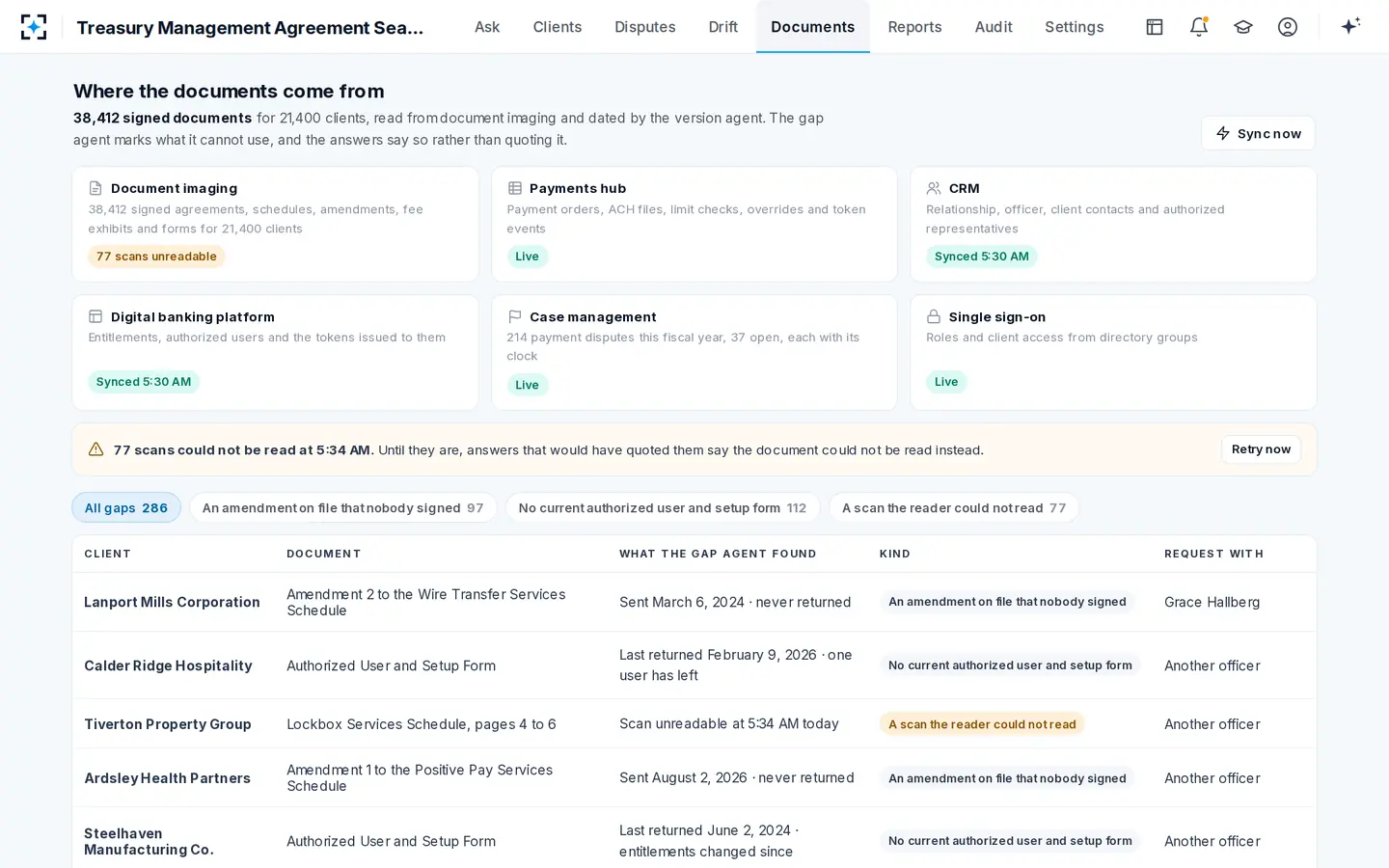
In a dispute about a paid check, the first question is which positive pay schedule governed on the day of presentment, and whether the client had declined the service in writing. Both are document questions, and both get harder with every amendment. In the sample bank, one gap the agents flag is a positive pay amendment sent to a client in August 2026 and never returned; until it is, the solution answers from the last signed schedule and says so.
The gaps that change a positive pay answer: unsigned amendments and unreadable scans
The solution's role is narrow: it finds the signed text and the dates, and puts them beside the bank's own records for the item. Deciding a check fraud claim is a different job, handled with the claim's own rules and deadlines. For the wire side of the same agreement, see the wire transfer agreement guide; for why the version matters, the version in force. The product is at Treasury Management Agreement Search.
Questions people ask
Is there a standard positive pay agreement template?
No regulator publishes one, and banks write their own schedules. The clauses that recur are the issue file, the exception deadline, the default decision, the standard of care, the opt-out release and the ordinary-care carve-out; the annotated sample above shows one way to write each.
Can a bank refuse to refund a forged check if the client declined positive pay?
It can, if the agreement clearly shifts that loss and the clause is reasonable. In Cincinnati Insurance v. Wachovia the court enforced such a release for a $153,856.46 altered check, but only to the extent it did not excuse the bank's own failure to exercise ordinary care.
What is a positive pay decision deadline?
The time by which the client must tell the bank to pay or return each exception, set in the schedule. It has to leave the bank time to return items before its midnight deadline, which is midnight of the banking day after it receives the item. The sample bank's deadline is 11:00 a.m.
Does positive pay change the client's duty to review statements?
No. Under UCC §4-406 the client still must examine statements with reasonable promptness, and after one year it is barred from asserting an alteration or unauthorized signature regardless of care. Positive pay catches most problems before payment; the statement duty covers what it misses.
Can the agreement say the bank is never liable for paying a fraudulent check?
Not entirely. Under UCC §4-103(a) the parties cannot disclaim the bank's responsibility for its own lack of good faith or failure to exercise ordinary care, or limit the damages for it. An overbroad clause may survive in part only if the agreement has a severability clause, as Wachovia's did.