UCC Article 4A has no general statute of limitations for lawsuits, but it sets two clocks that decide what a business client can recover after an unauthorized payment order. The first, in §4A-204, is about interest: a client that does not tell the bank within a reasonable time, not exceeding 90 days after it is notified of the order, still gets its refund but loses the interest on it. The second, in §4A-505, is about the money itself: a client that does not object within one year after receiving notification of the debit is precluded from claiming it back. New York's Court of Appeals called the second a "period of repose," held in 2005 that it "may not be modified by contract," and held that both clocks start with actual notice. A notice clause in a treasury agreement that gives the client 15 or 30 days therefore does less than it appears to. Botminds' Treasury Management Agreement Search reads that clause from the version in force for each disputed payment and counts every dispute on the window the bank's own agreement sets.
The worked dates use a fictional sample dispute: Harborline Foods' $186,400 wire of Wednesday, October 14, 2026, at a sample bank running the solution. The statutory text is the uniform act as published by Cornell's Legal Information Institute; Regatos is quoted from the New York Law Reporting Bureau's published opinion.
Two statutory clocks and one contract clause, from the same day
- Report to keep interest90 d
- Refund still owed; interest lost275 d
- Client may object to the debit365 d
- Clause window47 d
- Clause has run; the statute has not318 d
Is there a statute of limitations in UCC Article 4A?
Not in the usual sense. Article 4A has no section that sets a deadline for filing suit; its five parts cover definitions, issue and acceptance, execution, payment and miscellaneous provisions (UCC Article 4A, table of contents). What it does have is two notice rules that work like limitation periods for the most common dispute, an unauthorized payment order, and both run against the client, not the bank.
People searching for "the statute of limitations" usually mean the second of them, the one-year rule in §4A-505, and New York's highest court used exactly that language for it. The time to bring a lawsuit once a timely objection is made is a separate question for the governing state's law, and a treasury agreement may choose that law (UCC §4A-507(b)).
The 90-day clock in UCC 4A-204
The first clock decides interest, not liability. When a bank accepts an order that is neither authorized nor enforceable under the security procedure rules, it must refund the payment with interest. But "the customer is not entitled to interest from the bank on the amount to be refunded if the customer fails to exercise ordinary care to determine that the order was not authorized by the customer and to notify the bank of the relevant facts" within a reasonable time, capped at 90 days from the day the customer was told the order was accepted or its account debited (UCC §4A-204(a); what the same rule means for each side's liability in a fraud is in bank liability for wire fraud).
Two features matter in practice. The 90 days is a ceiling on a "reasonable time," so a client can lose its interest sooner if it was careless with information it had. And the penalty stops there: "The bank is not entitled to any recovery from the customer on account of a failure by the customer to give notification." A late client loses interest; it does not owe the bank for the bank's own exposure.
The one-year clock in UCC 4A-505
The second clock decides whether the client can object at all. If the bank received payment for an order issued in the client's name and "the customer received notification reasonably identifying the order, the customer is precluded from asserting that the bank is not entitled to retain the payment unless the customer notifies the bank of the customer's objection to the payment within one year after the notification was received by the customer" (UCC §4A-505).
The section sits in Article 4A's miscellaneous provisions, not beside the refund rule it limits, and that placement became the center of the leading case on whether a contract can shorten it.
"The one-year period of repose in UCC 4-A-505, governing the customer's time in which to notify the bank of the unauthorized transfer, may not be modified by contract."
Regatos v. North Fork Bank, 5 NY3d 395 (N.Y. Court of Appeals, October 20, 2005)
When does the clock start?
On actual notice, at least in New York. Tomáz Regatos's agreement required him to report "any irregularity" within 15 days after a statement was mailed or made available. The bank, by arrangement, held his statements until he asked for them. In March and April 2001 it transferred $450,000 and then $150,000 out of his account on orders it never confirmed by the agreed call. The statements showing the transfers were generated on March 23 and April 25; Regatos asked for them, and objected, on August 9 (Regatos, N.Y. 2005).
The court held that both the one-year period and the "reasonable time" for interest "begin to run when the customer receives actual notice of the improper transfer." It explained why constructive notice fails in electronic transfers: "an agreed 15-day notice period could run before a bank statement was even available for the customer's review," and "the crucial information could be sitting in the bank's possession for weeks, awaiting discovery by the customer." Regatos was within the year either way, and the court held he was entitled to recover at least his $600,000 principal.
Actual notice and constructive notice, as the Regatos court weighed them
Constructive notice (the bank's argument): When a statement showing the transfer is generated or made available, even if held at the bank.
Actual notice (the court's holding): When the customer actually receives notice of the improper transfer.
Constructive notice (the bank's argument): Could expire before the customer could see the statement.
Actual notice (the court's holding): Cannot cut the one-year period; the court called that result unreasonable.
Constructive notice (the bank's argument): The customer, if it did not ask in time.
Actual notice (the court's holding): The bank, which held the information and skipped its own call-back.
Constructive notice (the bank's argument): Finality for the bank.
Actual notice (the court's holding): "A bright line for banks and their customers, bringing reliability and certainty."
Can an agreement shorten the notice period?
It can fix the "reasonable time" for interest, and in New York it cannot shorten the one-year objection period. The statute says the first part plainly: "Reasonable time under subsection (a) may be fixed by agreement," but "the obligation of a receiving bank to refund payment as stated in subsection (a) may not otherwise be varied by agreement" (UCC §4A-204(b)). Article 1 adds the limit on any such agreement: "a time that is not manifestly unreasonable may be fixed by agreement" (UCC §1-302(b)).
The second part comes from Regatos. The bank relied on §4A-501, which lets most Article 4A rights be varied "except as otherwise provided" (UCC §4A-501(a)). The court disagreed: "The period of repose in section 4-A-505 is essentially a jurisdictional attribute of the 'rights and obligations' contained in UCC 4-A-204 (1). To vary the period of repose would, in effect, impair the customer's section 4-A-204 (1) right to a refund, a modification that section 4-A-204 (2) forbids." The district court had also found the 15-day period "unreasonable and invalid" in any event.
What a notice clause in a treasury agreement can and cannot do
| Clause | Effect | Authority |
|---|---|---|
| "Report within 30 days" for interest purposes | Can fix the reasonable time for keeping interest, if not manifestly unreasonable | §4A-204(b); §1-302(b) |
| "Report within 30 days or lose any claim" | In New York, cannot cut the one-year period to object to the debit | Regatos (N.Y. 2005); §4A-505 |
| "The bank need not refund" a late-reported order | Cannot remove the refund obligation for an order the bank cannot enforce | §4A-204(b) |
| "The statement is notice when made available" | In New York, both clocks start on actual notice | Regatos (N.Y. 2005) |
| "Client must review daily and object the same day" | Evidence on the client's ordinary care; its reach is limited by the rows above | §4A-204(a); compare the clause disputed in Patco (1st Cir. 2012) |
What a 30-day notice clause still does
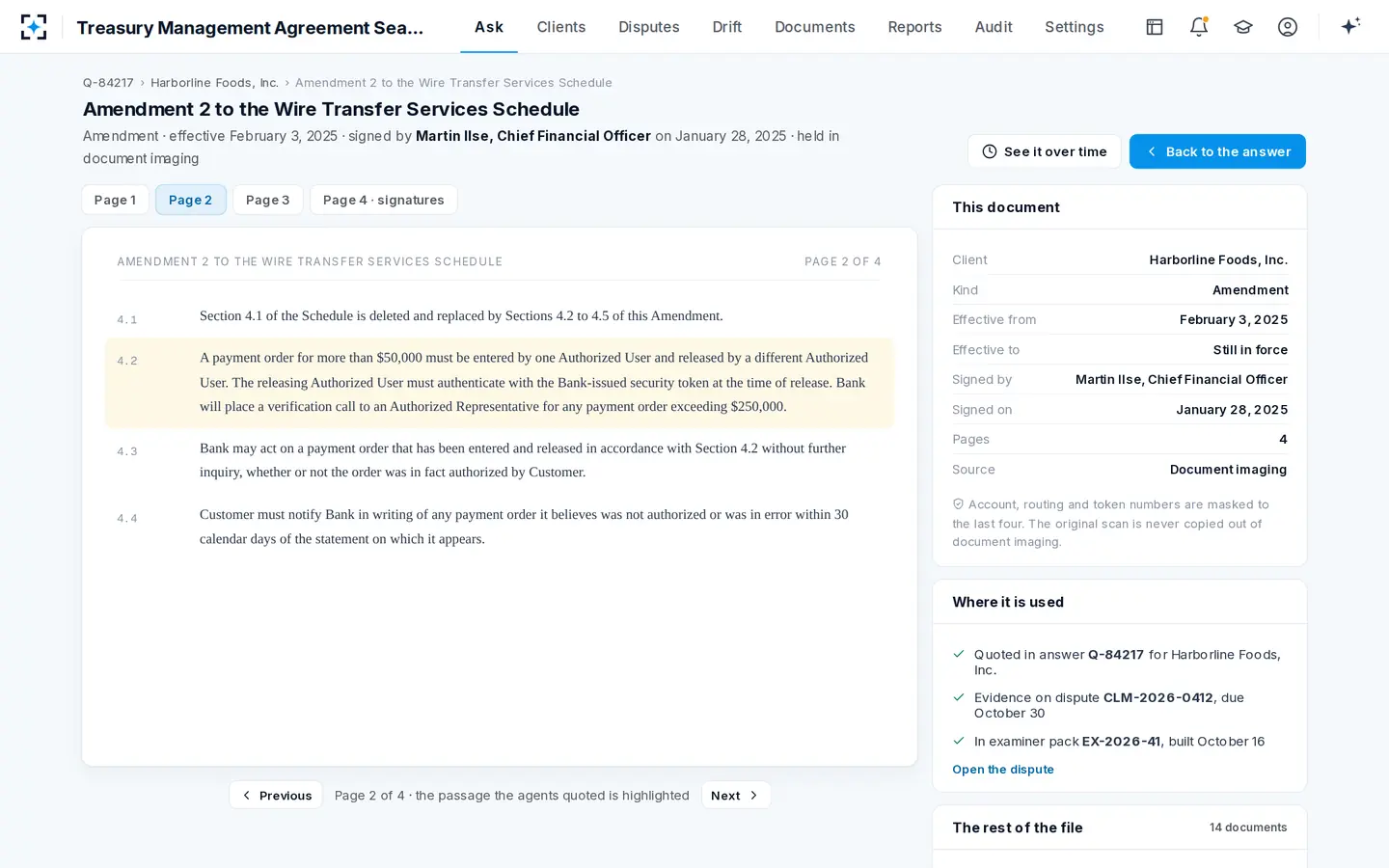
It still has work to do, just not the work its wording suggests. The sample client's 2025 amendment says the client "must notify Bank in writing of any payment order it believes was not authorized or was in error within 30 calendar days of the statement on which it appears." Read with §4A-204(b), that can set the reasonable time for keeping interest, provided a court finds 30 days not manifestly unreasonable for this client. Read with Regatos, it cannot shorten the year in which the client may object to the debit, wherever New York law governs.
It also does evidential work. A client that agreed to review statements within 30 days and did not has a harder argument that it exercised ordinary care, which is the condition for keeping its interest. A bank that wants to rely on the clause, though, has to show which version of the agreement contained it on the date the order was accepted. A clause added by amendment after the payment is a weak basis for answering a dispute about that payment.
The notice clause on the signed page, with its effective date
How long does a business have to dispute an unauthorized wire?
Up to one year from receiving notification of the order to object at all, and a reasonable time of no more than 90 days to keep the interest on a refund, subject to whatever the agreement validly fixes for the second. The client in the sample dispute objected in writing on October 16, two days after the wire, far inside both.
One disputed wire, four dates
Oct 16
client's written notice, two days after the October 14 wire
Oct 30
the bank's own response deadline: 10 business days, under the sample master agreement
Jan 12
in 2027: the 90 days for interest end, if notification came on October 14
Oct 14
in 2027: the one-year objection period ends, on the same assumption
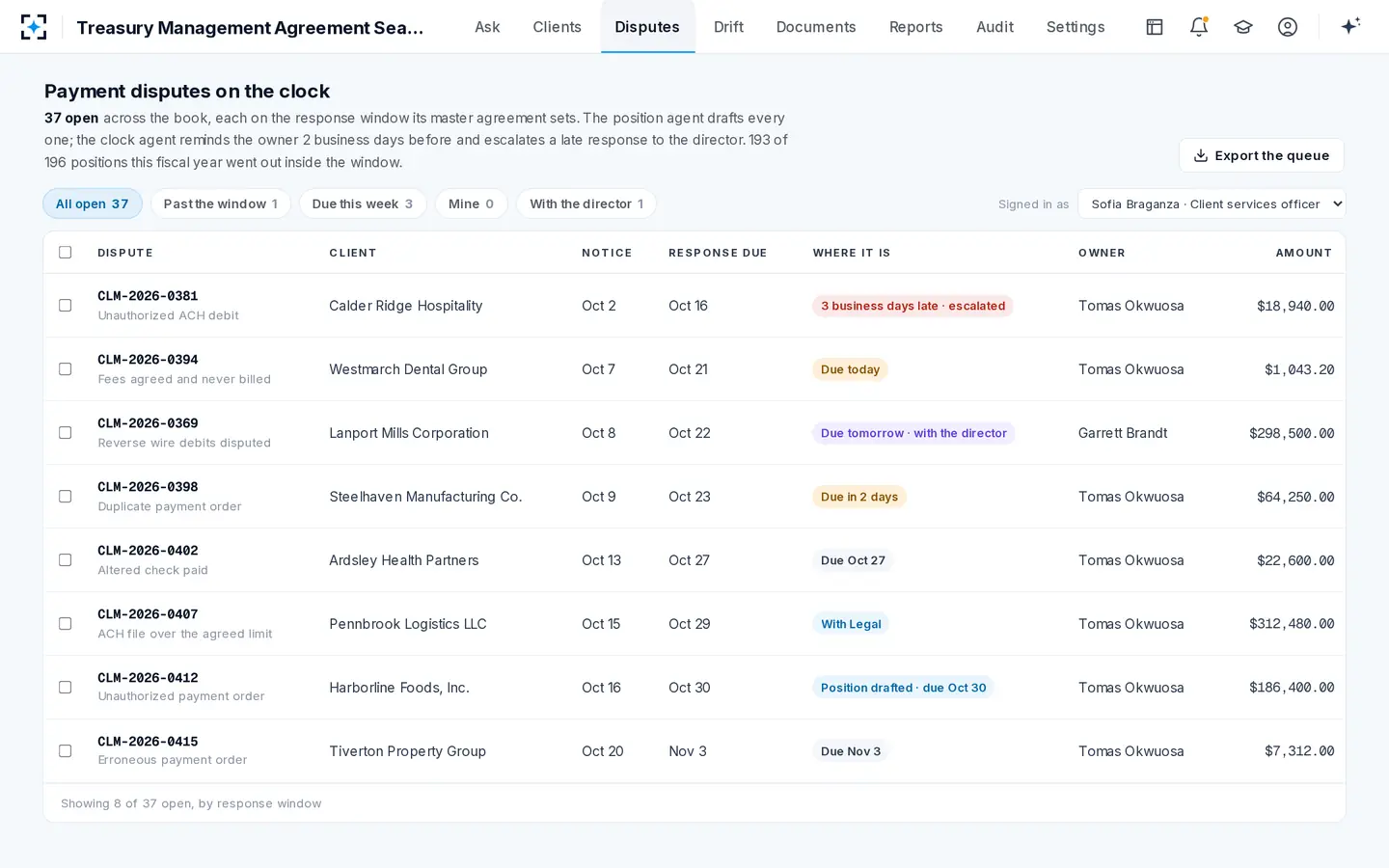
The clock the bank lives with day to day is none of these. It is the response window the bank's own master agreement promises the client, ten business days in the sample, counted from the written notice with bank holidays excluded. Article 4A sets no deadline for the bank's answer; the agreement does, and it is the one most likely to be missed.
Which version's clock?
Start from the version in force when the bank accepted the order, because a notice clause is part of the terms on which the bank took it; a later amendment reaches back only if its own text says so and the client agreed. That makes the version question unavoidable even for deadlines: a bank that answers a dispute from its current standard terms may cite a notice period the client never agreed to for that payment. How the version in force is worked out covers the method, and what a slow answer on a disputed wire costs prices the delay.
Every dispute on the window its agreement sets
How Treasury Management Agreement Search counts the clocks
The solution does three things with these clocks. It quotes the notice clause from the version of the agreement in force when the order was accepted, with page and signer. It records the date of the client's written notice and the payment order's dates from the payments hub, so the 90-day and one-year questions can be answered from evidence rather than memory. And it counts the bank's own response window, escalating a late answer to the director. Whether a clause is enforceable under the governing state's law stays with Legal. The product is at Treasury Management Agreement Search.
Questions people ask
Is UCC 4A-505 a statute of limitations or a statute of repose?
New York's Court of Appeals called it a period of repose in Regatos (2005): a fixed outer limit on objecting to a debit, running from the customer's receipt of notification, that a contract may not shorten. It is not a deadline for filing suit, which is a separate question of state law.
What happens to a refund if the client reports after 90 days?
The client keeps its right to the refund if the bank was not entitled to enforce the order, but loses the interest on it, provided the bank shows the client failed to exercise ordinary care and to notify within a reasonable time, which can never be more than 90 days. The bank cannot recover anything from the client for the late notice.
Does a bank statement count as notification under Article 4A?
In New York, only when the customer actually receives it: Regatos held that a statement held at the bank under a hold-mail arrangement did not start either clock. Electronic notifications raise the same question of when the customer received them.
Does the one-year rule apply to authorized wires?
Section 4A-505 applies to any payment order issued in the customer's name and accepted by the bank once the customer receives notification reasonably identifying it. In practice it matters for orders the customer later says were unauthorized, because those are the ones it has a reason to object to.
Can a treasury agreement choose another state's law to avoid Regatos?
An agreement may choose the governing law for the bank-customer relationship, whether or not the transfer has a reasonable relation to that state (UCC §4A-507(b)). Whether a chosen state's courts would read §4A-505 differently is a question for counsel in that state.