A treasury management master services agreement is the umbrella contract between a bank and a business client for cash management services. It holds the general terms, and it pulls in a service schedule for each service, every amendment to those schedules, fee exhibits, user guides and setup forms, many of them incorporated "as amended from time to time." That structure is efficient for the bank and unforgiving in a dispute, because the text that decides a disputed wire is the text in force on the day the bank accepted it, not the copy on top of the folder. Botminds' Treasury Management Agreement Search gives that job to a version agent: it builds each client's file as an effective-dated stack, marks the version that governed on the payment date, strikes what a later version replaced and quotes the passage with its page and its signer.
The client below is fictional: Harborline Foods, a food distributor in a sample bank's book, whose wire procedure changed three times between 2019 and 2026. The legal points come from Article 4A's uniform text and two federal court opinions, linked where they are used.
Seven years of one client's wire procedure: three texts, two user forms, one limit
- 2019 schedule §4.133 mo
- 2022 schedule §4.1: one user releases, call above $100,00035 mo
- Amendment 2 §4.2: two users20 mo
- Earlier forms33 mo
- 2022 user form37 mo
- Form returned April 11, 202518 mo
- Before Amendment 148 mo
- Amendment 1: $1,000,000 a day40 mo
What is a treasury management master services agreement?
It is the contract that sits above all the service-specific documents and tells a reader how they fit together. A master agreement usually holds the terms that apply to every service, such as liability, notice, indemnity, governing law and how the bank may amend, while each schedule holds the security procedure, limits and cut-off times for one service. Banks also call it a treasury management master agreement or, less precisely, the treasury management agreement; who signs each part of a treasury management agreement covers the signatures themselves.
Courts read these structures as a chain of incorporation. In Experi-Metal v. Comerica, the client's 2003 services agreement was "governed by the Comerica Treasury Management Services Master Agreement," published in August 2002, "and any applicable implementation documents and user guides as such documents are amended from time to time" (Experi-Metal, E.D. Mich. 2011). That last phrase means the agreement in force on a given day may include a user guide revised years after anyone signed anything. Somebody has to be able to say which revision.
Master, schedule, amendment: how the layers stack
An amendment often does not restate the schedule at all; it deletes or replaces a section from a date. The sample client's Amendment 2 opens with one line, "Section 4.1 of the Schedule is deleted and replaced by Sections 4.2 to 4.5 of this Amendment," which means every other section of the 2022 schedule is still in force and must be read with it. A reader who opens only the amendment misses the schedule's remaining terms; a reader who opens only the schedule misses that its central procedure is gone.
The layers also move on different clocks. Amendment 2 was signed on January 28, 2025 and took effect on February 3, 2025. The authorized-user form that named the people who could act under it was returned on April 11, 2025. For ten weeks the new procedure ran against the old list of users, and a payment in that window has to be tested against both documents together. None of this is unusual; it is simply the normal life of a relationship that has outlasted its first set of paperwork.
Which version of the agreement applies to a payment?
The version in force when the bank accepted the payment order. Article 4A makes the bank prove that it accepted the payment order in good faith and in line with the agreed security procedure (UCC §4A-202(b)), and an originating bank "accepts a payment order when it executes the order" (UCC §4A-209(a)). The procedure that counts is therefore the one in effect at execution, not on the date the dispute arrived, and not the one on the bank's current form.
Time of day can matter too. A bank may fix cut-off times and treat an order that arrives after one as received when the next funds-transfer business day opens (UCC §4A-106(a); how that plays against Fedwire's own hours is in the Fedwire cutoff time guide). An order entered late on the day before an amendment takes effect may be accepted under the new text. The version question is a date-and-time question, and the answer has to show its working.
The same disputed wire, read from the newest copy and from the version in force
Reading the 2022 schedule (superseded): Any one authorized user may enter and release a payment order.
Reading Amendment 2 (in force October 14, 2026): A payment order over $50,000 must be entered by one authorized user and released by a different one.
Reading the 2022 schedule (superseded): Not required at release under §4.1.
Reading Amendment 2 (in force October 14, 2026): The releasing user authenticates with the bank-issued security token.
Reading the 2022 schedule (superseded): Owed above $100,000, so a $186,400 wire needed a call.
Reading Amendment 2 (in force October 14, 2026): Owed only above $250,000; none was owed on $186,400.
Reading the 2022 schedule (superseded): That it missed a call: a concession the bank never owed.
Reading Amendment 2 (in force October 14, 2026): Agreed and followed: two users, a token at release, no call owed.
How do amendments change a treasury agreement?
By signature and by effective date, in the cleanest case. A signed amendment that names the section it replaces and the date it takes effect leaves no doubt, and a well-kept file holds the amendment, the schedule it amends and the signature page together. The disputes arise in the other cases: amendments sent and never returned, amendments signed by someone without authority, two amendments touching the same section, and terms the bank changed unilaterally under a reservation in the master agreement.
The sample bank's own file shows how common the first problem is: 97 amendments on file that nobody signed, across 21,400 clients. The solution treats each one as not in force and says so in the answer, because the alternative is an answer built on a document the client never accepted. It also opens a request to the relationship officer to get the signature, before a dispute turns a missing page into a contested one.
Can a bank change treasury terms by posting them online?
A master agreement may reserve the right, but a bank that relies on it has to prove what it posted and when. In Patco Construction v. People's United Bank, the bank had "reserved the right to modify the terms and conditions of the eBanking agreement at any time, effective upon publication," and claimed that before the May 2009 fraud it had added a clause making commercial clients "assume all liability and responsibility to monitor those commercial accounts on a daily basis" and object to any ACH debit "on the same day the debit occurs" (Patco, 1st Cir. 2012).
The client disputed that the modified agreement was published before the fraud, and argued it was therefore not effective between the parties. That is a factual fight a bank should never have to have. A version history that records each published text, the date it went live and how the client was told turns it into a lookup. The Patco decision and the cases decided around it sets out what else the court weighed.
The wire transfer procedure, version by version
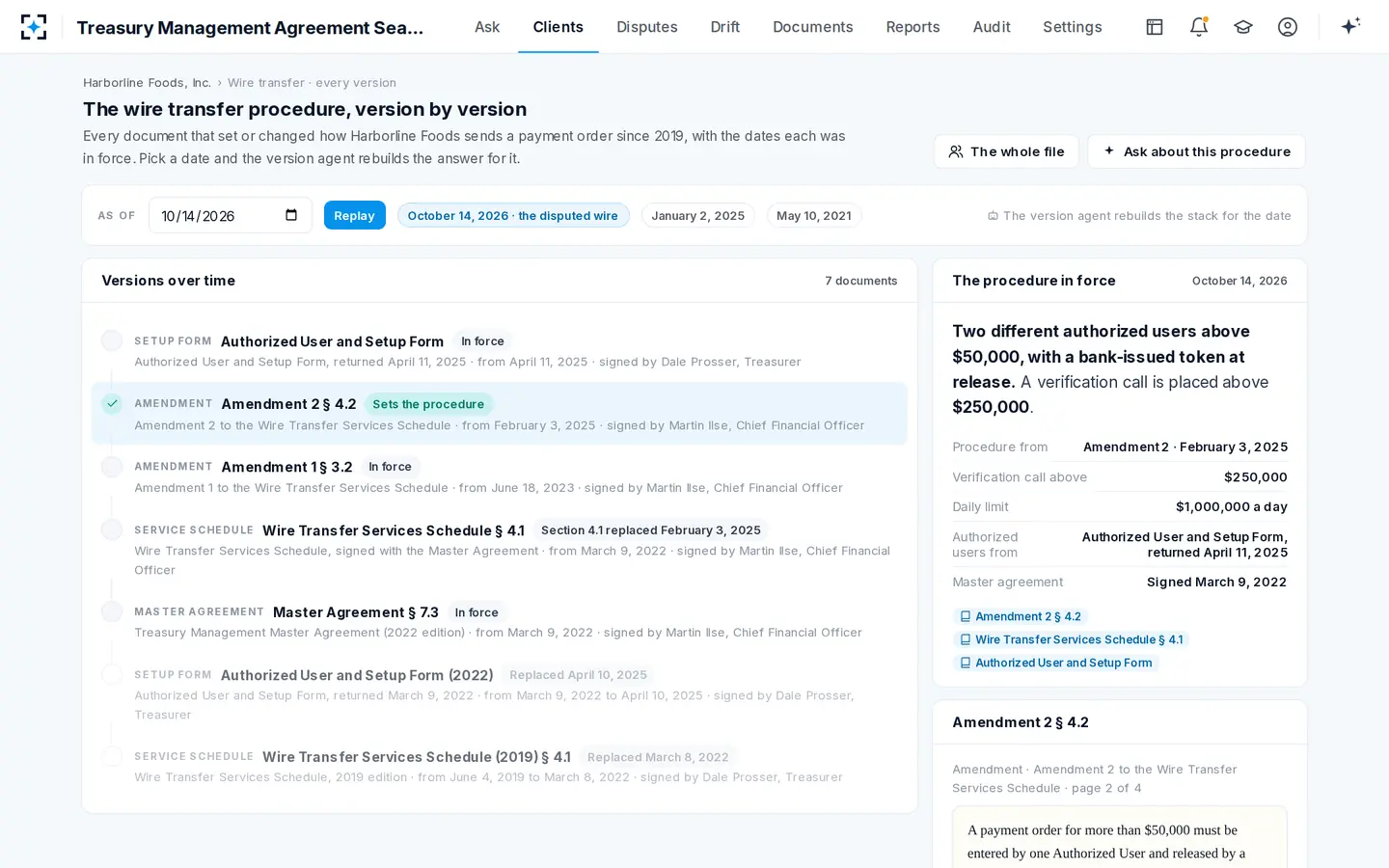
Inside the version agent
The version agent has one question: which text governed on this date, and what did a later text replace. It answers from the client's documents in document imaging, each one dated and attributed, and hands the result to the agents that compare it with the payment record and draft a position. It never decides whether the client was defrauded or whether the procedure was reasonable; it decides what the procedure was.
How the version agent answers which version was in force
Agent
Search agent gathers the fileEvery master agreement, schedule, amendment, fee exhibit and user form for one client, with pages and signers. In the sample dispute: 14 documents, 23 passages read.
Never: Opens another client's file
Agent
Version agent dates each documentEffective-from and effective-to for every section, from the document's own terms: "deleted and replaced", effective dates, signature dates.
Never: Treats an unsigned or draft amendment as in force
Agent
Version agent sets the dateUses the payment order's acceptance date from the payments hub, or any date a person picks for a replay.
Agent
Version agent marks what governedMarks the controlling section and lists what it did not use and why, so a reader sees the trap it avoided.
A person decides
Client services officer reads the answerChecks the quoted page and signer against the question, and drafts the position for Legal.
A person decides
Legal approves or returnsCan replay the file to any date before approving; the officer who drafted can never approve.
Replaying an earlier date
Replay is how Legal tests an answer, and how the bank answers a dispute about an old payment. Set the date to January 2, 2025 in the sample file and the stack rebuilds: the 2022 schedule's section 4.1 governs, any one authorized user may enter and release, a call is owed above $100,000, Amendment 2 is marked not yet in force, and the agent explains why the October 2026 answer differs.
Which version applied on any date you pick
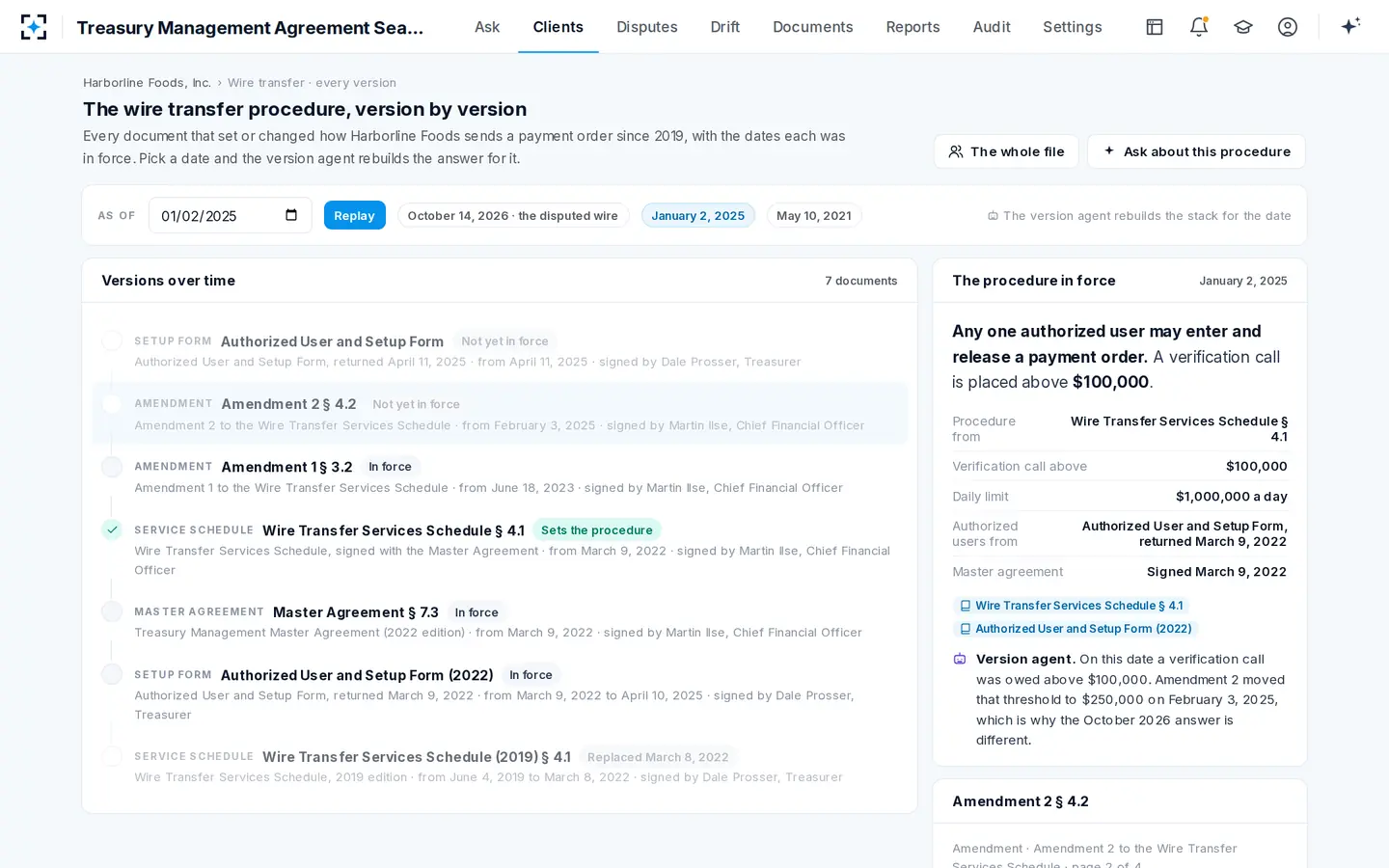
Replay is also the honest answer to a question that comes up whenever a bank changes a standard schedule: which clients are still on the old text? Because each client's stack carries its own dates, the answer is a list, not a guess, and the clients who never signed the new version are visible before they become a dispute.
What the version agent will not do
Its limits are written into it, and they are the reason its answers can be quoted. It never cites a superseded, unsigned or draft version as in force. It never answers from a scan the reader could not read; the sample bank had 77 such scans, and answers that would have quoted them say the page could not be read. And when two documents conflict on the same section with no clear order, it does not pick one: the question goes to Legal with a one-business-day clock.
Seven habits that make a master services agreement answerable on any date
- Every amendment names the section it replaces
"Section 4.1 is deleted and replaced" leaves no doubt; "amended as follows" invites two readings.
- Effective date and signature date are both recorded
They differ more often than not; the effective date decides.
- Unsigned documents are marked as unsigned, not filed beside signed ones
An amendment sent and never returned is not part of the agreement.
- Online terms are archived as published, with the date they went live
Patco turned on whether a changed term had been published before the fraud.
- The user form is dated and tied to the procedure it serves
A two-approver procedure means little if only one person is entitled to release.
- Incorporated user guides keep their old revisions
Documents "amended from time to time" are part of the contract on the day they were in force.
- Scans are checked for legibility when filed
A page nobody can read cannot be quoted to a client or a court.
Where the version agent sits in Treasury Management Agreement Search
The version agent is one of seven in the solution, and the others depend on it: the log agent's payment trail is compared with the text the version agent marks, and the position agent drafts only from that pairing. The design target is zero answers from a superseded version, with every quote carrying the page, the effective date and the signer in force that day.
What it needs from the bank is the documents themselves, read where they sit in document imaging, and the payment order records from the payments hub. What it cannot do is invent a missing signature or settle a genuine conflict between two documents. For the questions a buyer should ask of any tool that claims to handle amendments, see twelve questions for contract analysis software, or start from Treasury Management Agreement Search.
Questions people ask
What is a service schedule in a treasury agreement?
A service schedule is the part of a treasury management agreement that governs one service, such as wire transfers, ACH origination or positive pay. It usually holds that service's security procedure, limits and cut-off times, while the master agreement holds the terms common to all services. A schedule amended in one section stays in force in all its other sections.
Is a master agreement the same as a master services agreement?
In treasury management the terms are used interchangeably for the umbrella contract above the schedules. What matters is the document's own text: which schedules it incorporates, how it says amendments are made, and whether it reserves the bank's right to change terms by publication.
Does the newest amendment always govern?
No. An amendment governs only from its effective date, and only the sections it replaces. A payment accepted before that date is tested against the earlier text, and every section the amendment did not touch remains in force from the earlier document.
Can a bank change terms just by posting them online?
A master agreement can reserve the right, but the bank then has to prove what it posted and when. In Patco the client disputed that a modified clause was published before the fraud, which left the bank arguing about its own website instead of the security procedure.
How do you find the version in force on a date?
Date every section of every document by its own terms, set the date to the day the bank accepted the payment order, and read what governed then, including any user guide incorporated as amended. In the sample file that replay takes the version agent 1.4 seconds; by hand it means reading the whole stack.