Contract analysis software reads contracts and answers questions about them: which clauses say what, how documents differ, where terms are missing. Used on contracts in negotiation, its task is to find risky language in a draft. A bank's treasury agreements pose a different problem. They are already signed, they change by amendment over years, they hold account numbers that must not travel, and the question asked of them is usually about a specific payment on a specific day, under a legal test that puts the burden of proof on the bank. Software for that work has to answer from the version in force, quote the page and the signer, compare the contract with the transaction record, and refuse when it is unsure. Below are the twelve questions to ask any vendor, with what a strong answer sounds like. Botminds' Treasury Management Agreement Search is built to answer them for treasury management agreements, and the last sections say plainly where it fits and where it does not.
Product figures come from a fictional sample bank running the solution and are labelled as sample results, settings or design targets.
Twelve questions for contract analysis software, and what a strong answer sounds like
1
Does it answer from the version in force on a date you choose?
Why it mattersBank agreements change by amendment; the right answer depends on the day.
A strong answerShows the version it used, the versions it did not, and why.
2
Does every answer quote document, section, page, effective date and signer?
Why it mattersA citation a reviewer cannot open is not checked.
A strong answerOne click opens the signed page, passage highlighted.
3
Can it compare the contract with what actually happened?
Why it mattersDisputes ask whether the agreed procedure was followed.
A strong answerReads the transaction record and states in one line whether they match.
4
Does it read documents where they sit, or copy them?
Why it mattersCopies create a second retention and leakage problem.
A strong answerReads in place; no original leaves the imaging system.
5
How are account, routing and token numbers handled?
Why it mattersAnswers and exports travel further than the source.
A strong answerMasked to the last four everywhere, with no switch to turn it off.
6
What does it do when it is not sure?
Why it mattersA confident wrong answer is the costliest failure.
A strong answerA stated confidence floor; below it, a named person and a clock.
7
What about unsigned, conflicting or unreadable documents?
Why it mattersEvery real file has them.
A strong answerLists them, never treats them as in force, and asks for the missing page.
8
Who may see which client?
Why it mattersOne search box can expose the whole book.
A strong answerAccess from the bank's directory groups; portfolios stay walled.
9
Who approves an answer before it leaves the bank?
Why it mattersAn unreviewed reading of a contract is a concession in waiting.
A strong answerThe drafter never approves; the tool never sends.
10
How was it tested, and how is it re-tested?
Why it mattersGenerative and agentic AI sit outside the 2026 model risk guidance.
A strong answerA held-out set of approved answers, re-run before every change.
11
What does the trail record, and who owns it?
Why it mattersThe trail is the evidence an examiner asks for.
A strong answerWho asked, what was cited, who approved, and which steps an agent took; the bank owns and exports it.
12
What happens to the data when the contract ends?
Why it mattersQuestions and answers are records too.
A strong answerRetention on the bank's schedule, legal holds respected, full export at exit.
What contract analysis software does, and what banks need from it
Contract analysis software, also sold as contract analytics or AI contract review, extracts clauses, compares them with a standard and flags deviations. That is useful when a legal team negotiates hundreds of supplier contracts a year. It is the wrong shape for a bank's client agreements, where the hard questions are about the past: what did this client agree to, as of this date, and did the bank do it.
The difference shows up in the burden of proof. Under UCC Article 4A, a bank that wants a disputed payment order to bind its business client must prove it accepted the order in good faith and followed the security procedure the client agreed to (UCC §4A-202(b)). Software that summarises the current standard terms helps nobody prove that. Software that retrieves the clause in force on the payment date, with its signature, and lays the payment record beside it, does.
Can contract analysis software handle amendments?
Ask the vendor to show it, on a file with at least two amendments touching the same section. A strong tool builds each client's file as a dated stack, knows that an amendment replaces only the sections it names from its effective date, marks unsigned amendments as not in force, and can replay the file to any earlier date. A weak one indexes every document as equally current and returns whichever passage scores highest.
Replaying one client's file to an earlier date
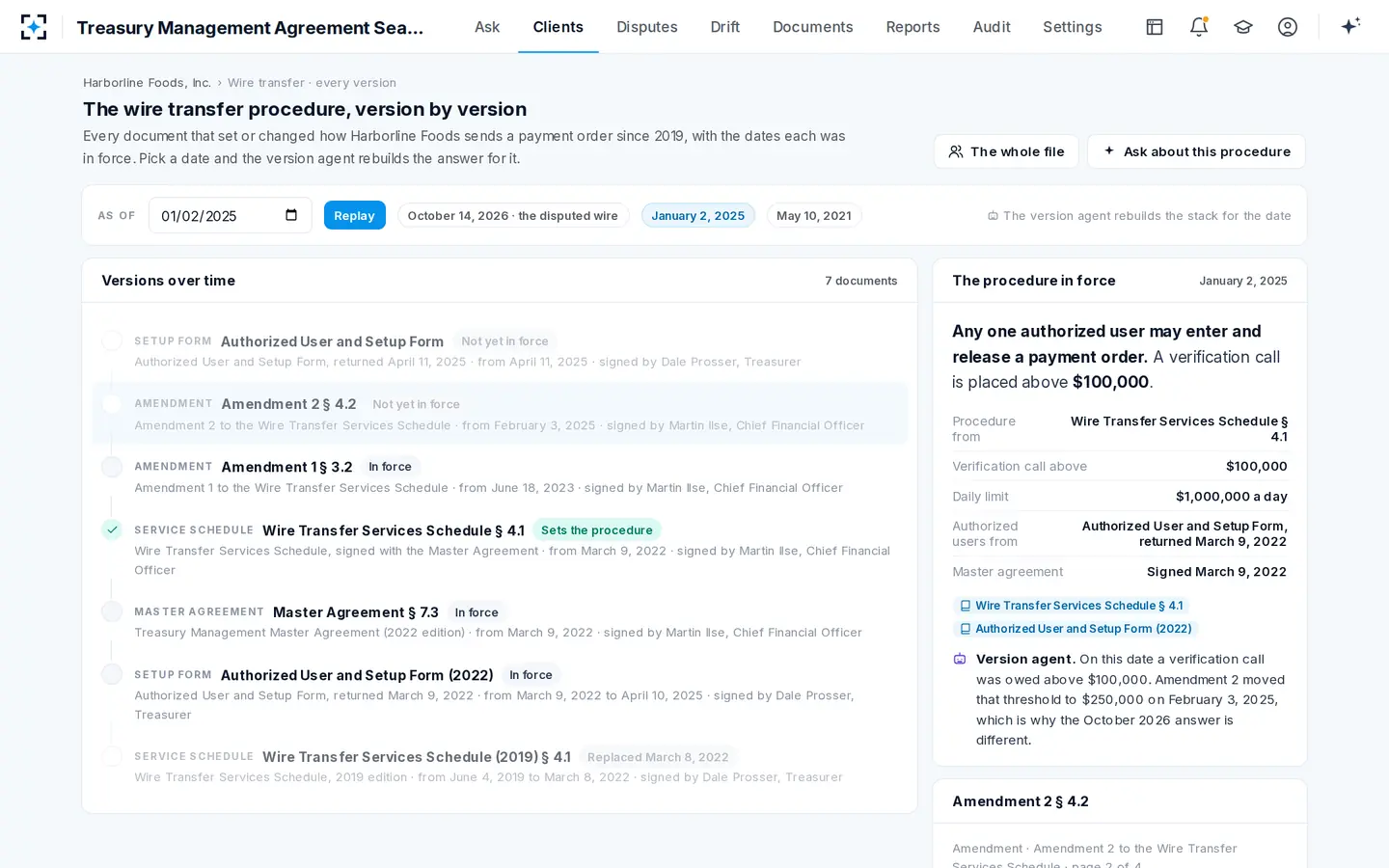
Then ask what it does with documents incorporated "as amended from time to time," such as user guides and online terms. If the vendor has no answer, the tool will treat the current guide as if it had always applied. How the version in force is established walks through the method on one client's seven years of documents.
Does it quote the page and the signer?
It should, every time, or the answer cannot be used in a dispute. Ask for a citation that names the document, the section, the page, the effective date and the person who signed it, and that opens the scanned page with the passage highlighted. Then ask what happens when the tool cannot find a supporting passage. The only acceptable answer is that it does not write one.
A weak and a strong answer to the same buying question
A weak answer: "Our AI understands the whole contract."
A strong answer: "It answers from the text in force on the date asked and lists the versions it did not use."
A weak answer: "Answers include references to the source document."
A strong answer: "Each quote names document, section, page, effective date and signer, and opens the signed page."
A weak answer: "Accuracy is above 95%."
A strong answer: "Below a confidence floor the bank sets, the question goes to a named reviewer with a clock."
A weak answer: "We ingest your documents into our secure platform."
A strong answer: "We read them in place; no original leaves your imaging system; numbers are masked everywhere."
A weak answer: "Trained on millions of contracts."
A strong answer: "Re-run against your approved answers before every change; results in your trail."
What happens when it does not know?
A tool that never says "I don't know" will eventually say something wrong with confidence. Ask for three behaviours. A confidence floor the bank sets, below which the answer goes to a person instead of being written; the sample bank sets 0.85 and gives Legal one business day. A list of documents the tool could not use, such as unsigned amendments and unreadable scans, with the answer saying so when one of them would have mattered. And a refusal to resolve a genuine conflict between two documents on its own.
The model risk guidance will not do this work for the buyer. The April 2026 interagency guidance leaves generative and agentic AI models outside its scope and says the agencies plan a request for information on AI (OCC Bulletin 2026-13). The second line's questions for AI contract search covers how to test the behaviours above.
Account numbers, client walls and exports
Treasury agreements and their setup forms carry account numbers, routing numbers and security token serials. Ask where those go: into answers, memos, exports, logs, the vendor's index. The strong answer is that they are masked to the last four in every output, including examiner exports, and that no setting turns masking off. Ask also whether the tool ever copies an original scan out of the imaging system; the sample bank's setting is off.
Client walls matter as much. A relationship officer should open only the clients in their portfolio, and one client's file should never be read to answer another client's question. The strong answer takes access from the bank's directory groups, so the bank keeps one list of who may see what.
How do you test contract analysis software before you buy?
On your own agreements, with answers your lawyers have already approved. A pilot on a vendor's demo data shows how the tool behaves on clean files; a pilot on one client's real master agreement, schedules and amendments, against its real payment records, shows how it behaves on yours. Keep the approved answers: they become the test set every later change is re-run against.
A pilot that tells you whether contract analysis software will hold up
- Pick a client whose file has at least two amendments and one unsigned document
The easy files prove nothing.
- Write twenty questions staff actually ask, with dates
What did they agree to before the last amendment? Which limit applied on the day of this payment?
- Have counsel approve the answers before the tool sees the questions
Otherwise the test grades itself.
- Score three rates separately
Supported by the right passage; from the version in force; declined when it should be.
- Open every citation
Check page, effective date and signer against the scan.
- Try to break the walls
Ask about one client from an account that should not see it; check exports for unmasked numbers.
- Change a setting and re-run
The vendor should show the re-run, not describe it.
What the sample bank sees after a quarter, and what it targets
92%
of 14,260 staff questions answered with a citation and no escalation, July 1 to October 21, 2026
sample result
98%
of positions sent inside the agreed response window: 193 of 196 this fiscal year
sample result
148
of 21,400 clients whose payments do not move the way their agreements say
sample result
0
answers from a superseded version
design target
What the vendor contract should cover
Software that reads a bank's client agreements is a third-party relationship, and the bank keeps the responsibility. The interagency guidance is direct on the point: handing an activity to a third party leaves the bank exactly as responsible for safety and legal compliance as if it did the work itself (Interagency Guidance on Third-Party Relationships, 2023; the sentence and the rest of the guidance are set out in the interagency third-party guidance in plain words). On September 15, 2026 the OCC, the Federal Reserve, the FDIC and the NCUA proposed replacement guidance, with comments due November 16, 2026; until it is final, the 2023 text is the standard (Proposed Third-Party Risk Management Guidance). That makes the contract part of the evaluation, not an afterthought.
The contract should cover confidentiality of customer information and the vendor's subcontractors, the bank's right to audit and require remediation, ownership of the data the tool generates (the questions, citations, drafts and approvals), how quickly the vendor discloses a security incident, and an exit that returns the trail in a usable form. Retention should follow the bank's schedule, including the five-year floor for records the Bank Secrecy Act requires (31 CFR 1010.430(d)), and legal holds should override it. Reading agreements where they sit covers the integration side.
Where Treasury Management Agreement Search fits among contract tools
It fits a bank that needs to answer what its business clients signed for treasury services, as of any date, and whether the payment record matches: client services officers drafting positions on disputed payments, Legal approving them, claims analysts sending them, relationship officers keeping files current. Seven agents find, date, compare, mask and draft; people approve and send. Overnight the same comparison runs across the book, so drift between the agreed procedure and the actual one surfaces before a dispute does.
The same question asked of every client, every night
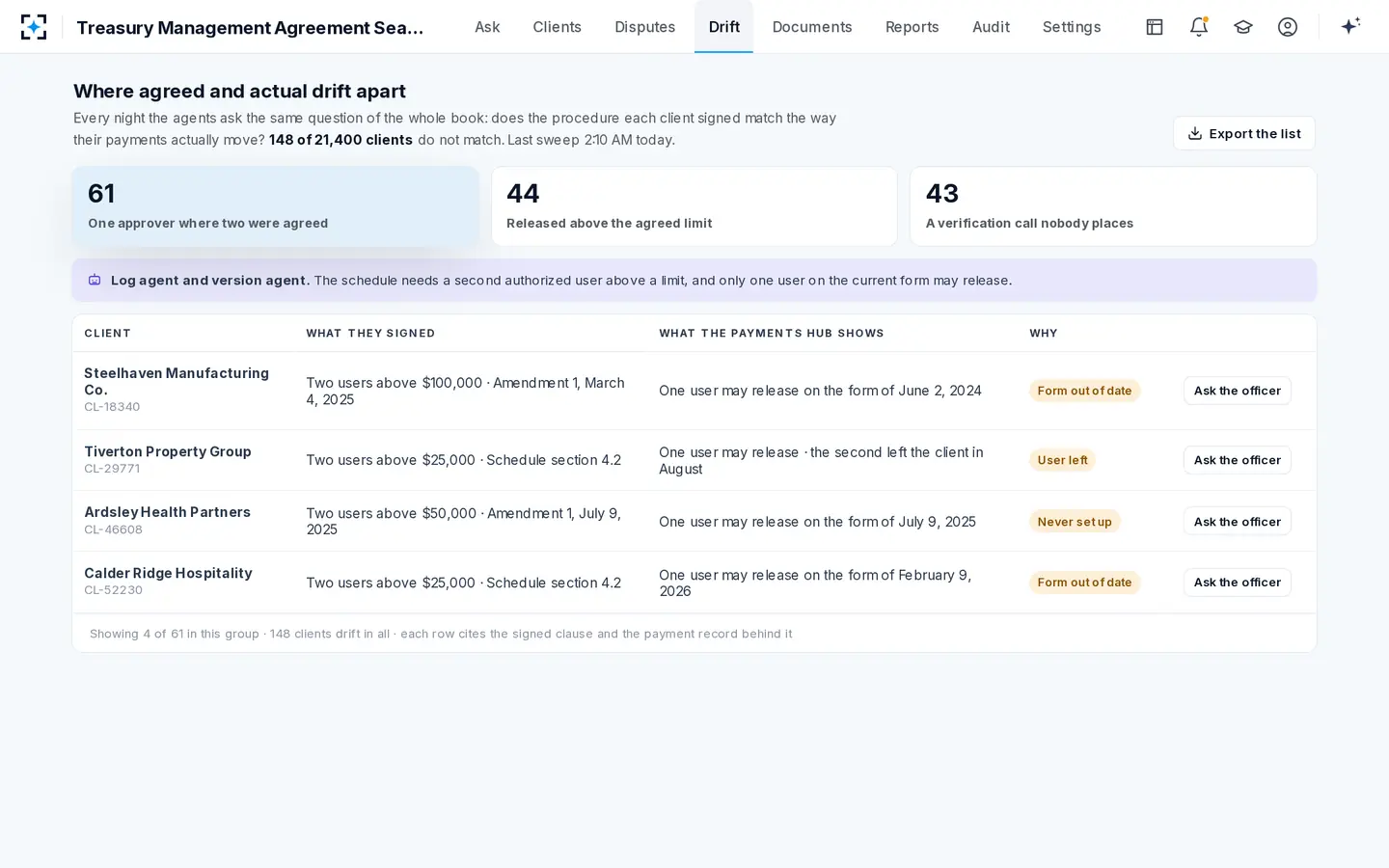
It does not draft or negotiate contracts, review supplier agreements, or replace document imaging, the payments hub or case management. It does not decide whether a procedure is commercially reasonable or whether a client was defrauded; those remain Legal's calls. And it cannot quote a document that was never signed or never scanned. If your need is clause review of contracts in negotiation, a different category of software fits better. If it is the questions above, start at Treasury Management Agreement Search.
Questions people ask
What is the difference between contract analysis software and contract management software?
Contract management software runs a contract's lifecycle: requests, drafting, approvals, signature, renewal. Contract analysis software reads the text to extract and compare terms. For a bank's signed treasury agreements, the useful capability is narrower than either: answering what was in force on a date and whether the transaction record matches it.
Is AI contract analysis accurate enough for a bank?
Only if accuracy is measured the right way: answers supported by the right passage, from the version in force, with declines where the tool should stop. A single accuracy percentage from a vendor's own data says little about a bank's files; a pilot on the bank's own agreements with lawyer-approved answers says much more.
What should the vendor's security answer include?
Where documents are read and whether originals are copied, how account and token numbers are masked in every output, how client access is enforced, who can export, and how quickly a security incident is disclosed. The interagency third-party guidance lists confidentiality, audit rights and incident disclosure among the contract provisions to consider.
How long does a pilot take?
The work is in preparing the questions and approved answers, not in running the software. One client's file with at least two amendments and one unsigned document, twenty dated questions with counsel-approved answers, three rates scored separately and one re-run after a settings change is enough to see whether version handling, citations and refusals hold; connecting the whole book comes after.
Does contract analysis software need model validation?
Partly. The April 2026 interagency guidance leaves generative and agentic AI outside its scope and excludes fixed rule-based software from its definition of a model, but a statistical component, such as one that ranks passages, can still meet that definition. The second line's view of AI contract search sorts a typical system part by part; for the generative part, a bank can apply the same discipline anyway: a written purpose, testing on held-out approved answers, monitoring and independent challenge.