A contract search tool finds the passages in a set of signed contracts that answer a question, and shows where each one came from. In a bank, the contracts that generate the hardest questions are treasury management agreements: a master agreement, a schedule per service and years of amendments and user forms, scanned into document imaging under a relationship number, while the record of what the client actually did with its wires and ACH files sits in a different system again. The right tool for that work does not ask the bank to move anything. It reads the scans where they sit, reads the payment record where it sits, and joins the two only when someone asks. Botminds' Treasury Management Agreement Search is built that way: it connects to six systems the treasury group already runs, copies no original out of document imaging, and writes only the drafted answer back to the dispute.
The architecture below is the solution's; the volumes are from a fictional sample bank with 21,400 business clients and 38,412 signed documents. The rules on retention and vendor oversight are quoted from the regulators' own text.
Six systems behind one answer, and what the contract search tool may do in each
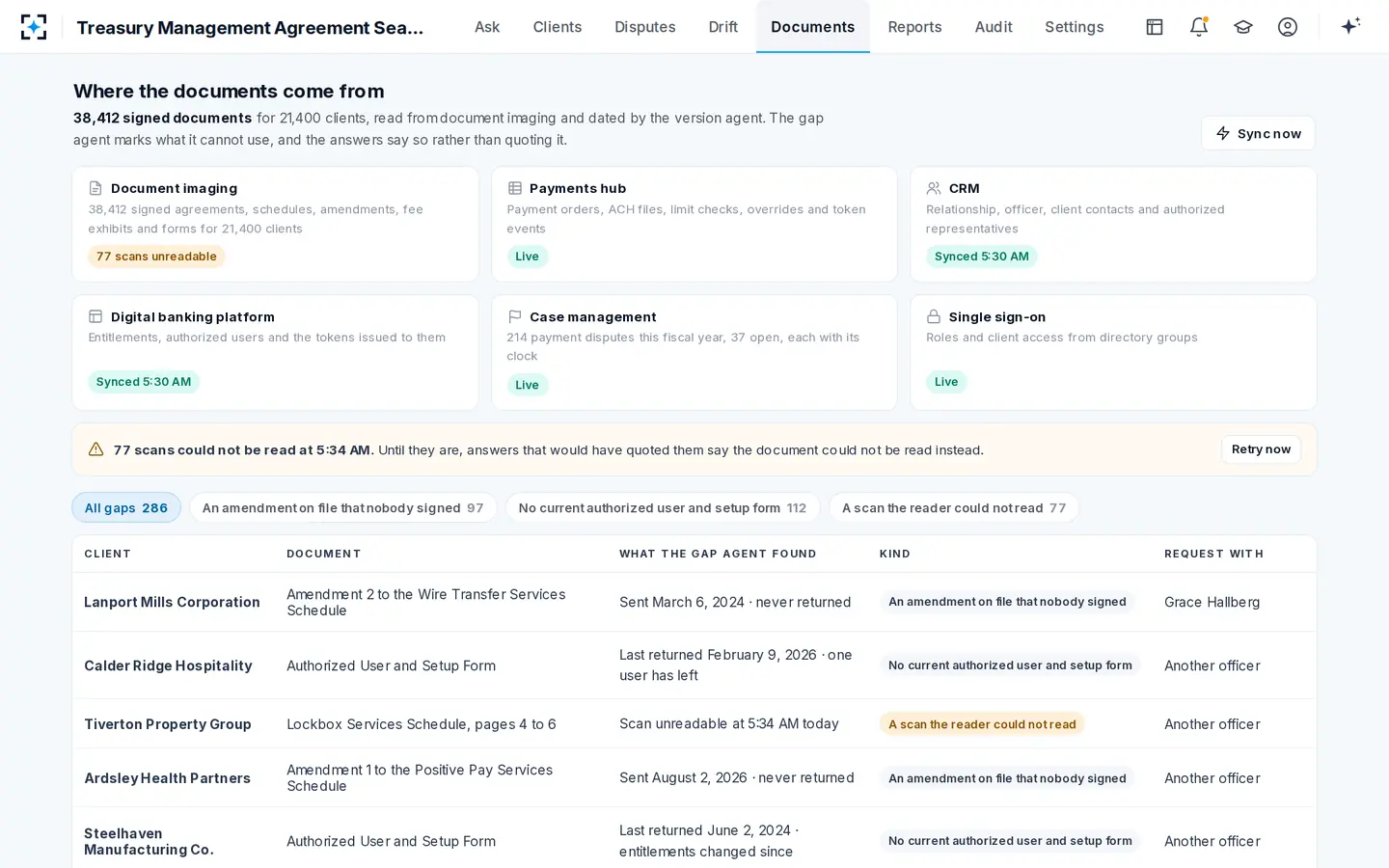
Document imaging
Master agreements, schedules, amendments, fee exhibits and setup forms, every version, as scans
Reads onlyRead in place. Passages quoted with page; the original scan is never copied out.
Payments hub
Payment orders, ACH files, limit checks, overrides and security token events
Reads onlyRead only. Never changes, repeats or recalls a payment order.
Digital banking platform
Entitlements, authorized users and the tokens issued to them
Reads onlyRead only, synced on a schedule, to compare who may release with who the client named.
CRM
The relationship, the officer, client contacts and authorized representatives
Reads onlyRead only, to route requests for missing documents to the right officer.
Case management
Payment disputes, their response windows and outcomes
Reads, and writes the answer backReads the dispute and its clock; the position and approvals are written back to the case.
Single sign-on
Roles and client access from directory groups
Reads onlyDecides who may open which client. No separate user list to keep in step.
What does a contract search tool do in a bank?
It answers a question about a contract with the passage that answers it, and with enough about the passage, its document, section, page, effective date and signer, that a reviewer can check it in one step. That is narrower than the contract lifecycle software sold for drafting and negotiation, and narrower than enterprise search. It is also harder, because the question is usually about a date: what did this client agree to on the day of the payment?
For treasury agreements, a useful tool also has to answer the second half of most questions, which is not in any contract: what actually happened. A client that disputes a wire wants to know whether the bank followed the procedure the client signed. The procedure is in document imaging; the entry, release and token events are in the payments hub. A contract search tool that cannot see both answers half a question.
Does a contract search tool replace document imaging?
It should not, and the law gives a bank no reason to want it to. Federal law lets a required record be kept electronically if the electronic record "accurately reflects the information set forth in the contract or other record" and "remains accessible to all persons who are entitled to access" for the required period, "in a form that is capable of being accurately reproduced for later reference" (15 U.S.C. §7001(d)). The bank's imaging system already does that job, under retention schedules the bank has approved. A second copy in a vendor's index creates a second retention problem and a second place for a client's account numbers to leak.
The solution therefore reads the scans in place and quotes the passage. Copying an original scan out of document imaging is a setting, and the sample bank has it off. When a reviewer opens a citation, the page is served from the imaging system, highlighted, with account, routing and token numbers masked to the last four.
Can a contract search tool read scanned agreements?
Yes, if it reads the page the way a person would and is honest about the pages it cannot read. Treasury files are full of decade-old scans, faxed signature pages and amendments marked up by hand. A tool that turns every page into text and searches the text will find most passages and silently miss some, and a missed amendment is the most expensive miss there is.
The useful behaviour is to know which pages failed. In the sample bank, 77 scans could not be read at the morning sync. Until they are, any answer that would have quoted one of them says the document could not be read, and the gap agent opens a request to the relationship officer. The same screen counts 97 amendments that nobody signed and 112 clients with no current authorized-user form: not reading failures, but gaps the search makes visible.
Where the documents come from, and what the agents will not quote
How to search treasury agreements without moving them
Search one client's file at a time, at the moment of the question, and keep an index of where things are rather than a copy of what they say. The sequence in the solution is short, and the people's steps are the ones a bank would want to keep.
From a question to a position, across four systems, without copying a scan
A person decides
Client services officer asksIn plain words, about one client and one payment, from inside the dispute or from the search screen.
Agent
Search agent reads document imagingFinds every agreement, schedule, amendment and form for that client only, with pages and signers.
Never: Reads another client's file
Agent
Version agent dates themMarks the text in force on the payment date, striking what later versions replaced.
Agent
Log agent reads the payments hubPulls the payment order's trail: entry, release, token, limit checks, verification call.
Never: Changes, repeats or recalls a payment order
Agent
Position agent draftsOne line on whether the two sides match, and a memo quoting both, written back to the dispute.
Never: Sends anything to a client
A person decides
Legal approves; the claims analyst sendsThe drafting officer can never approve; only the claims analyst delivers the answer to the client.
Access: who may open which client
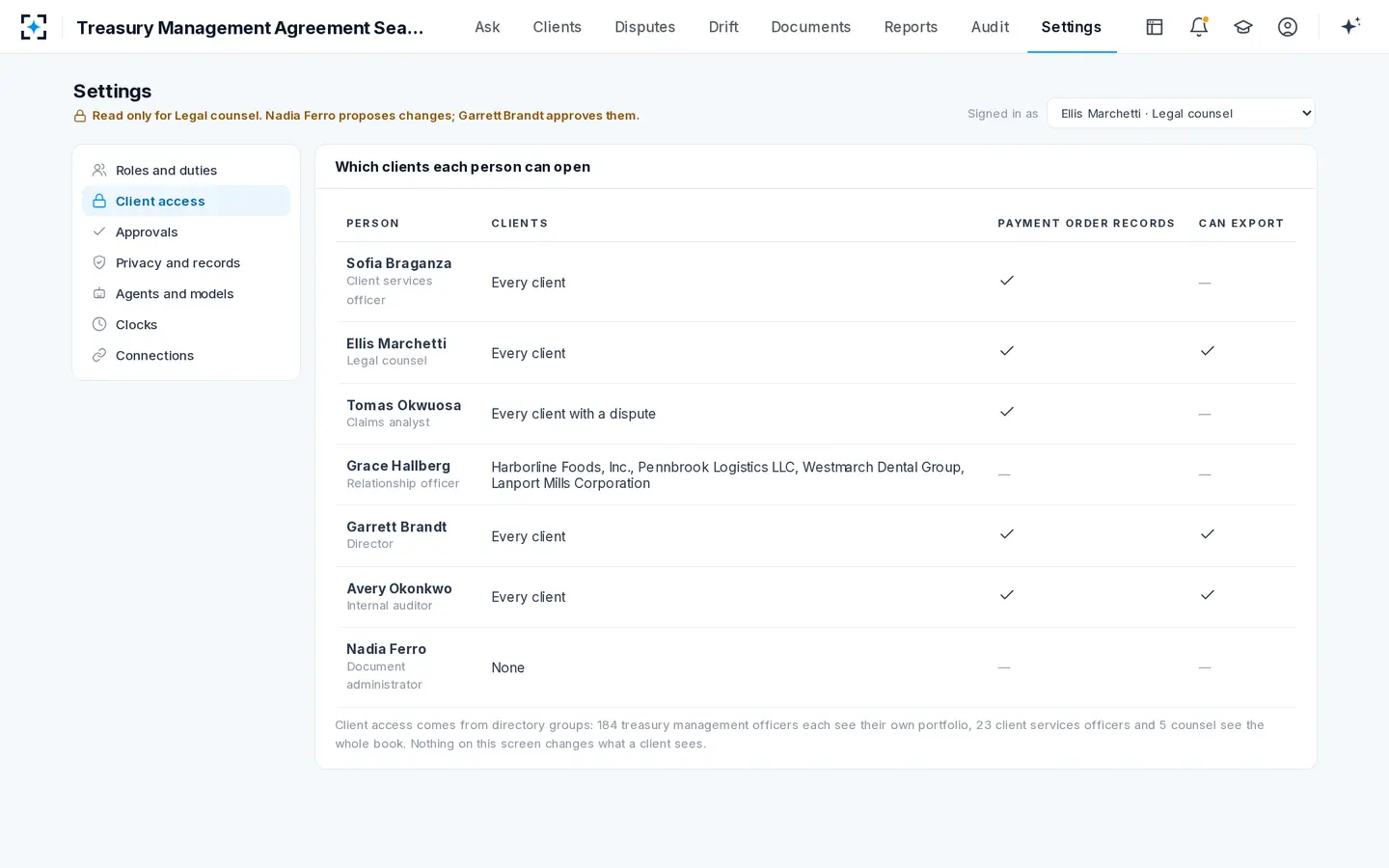
A search tool that can read every agreement in the bank is also a tool that can show every agreement to anyone who logs in, so access is part of the integration, not an afterthought. The solution takes client access from directory groups through single sign-on, so the bank maintains one list. In the sample bank, 184 treasury management officers each see their own portfolio, 23 client services officers and five counsel see the whole book, and the document administrator who proposes settings sees no clients at all.
The interagency authentication guidance makes a parallel point about business clients' own users, expecting extra controls on a client's own administrators, the users who can change digital banking settings such as giving a new employee the right to move money (FFIEC, Authentication and Access, 2021; why that user is the one to watch is the subject of the business banking administrator guide). The bank's own staff deserve the same discipline when they read what those users signed.
Who may open which clients, and who may export
Retention stays where it is
A contract search tool should not invent a retention schedule; it should follow the bank's. Records the Bank Secrecy Act requires must be kept for five years (31 CFR 1010.430(d); the rule and its starting points are in BSA record retention), and a bank may well keep treasury agreements longer than that, because a dispute can surface years after a payment. In the sample bank these are settings: funds-transfer records kept five years, treasury agreements and schedules kept six years after the relationship ends, questions and answers kept three or five years, and a legal hold overrides all of them.
Because the tool reads the scans in place, the agreements' own retention is untouched. What the tool adds is a new kind of record: the questions people asked, the passages cited, the drafts and the approvals. Those belong on the bank's schedule too, and an examiner pack built from them carries the governing version, the payment record, the position and the approvals, with account numbers masked.
What stays where after go-live
| Record | Where it lives | Who keeps it, and for how long |
|---|---|---|
| Signed agreements, every version | Document imaging, unchanged | The bank, on its existing schedule; 6 years after the relationship ends in the sample bank |
| Payment orders and token events | Payments hub, unchanged | The bank; 5 years for funds-transfer records in the sample bank |
| Dispute, window and outcome | Case management, with the position written back | The bank, on the case system's schedule |
| Questions, citations, drafts, approvals | The solution's trail | 3 or 5 years in the sample settings; a legal hold overrides |
| Copies of original scans | None | The setting that would allow one is off |
What the vendor contract should say
A tool that reads a bank's client agreements is a third-party relationship, and the interagency guidance on third parties spells out what an effective contract covers. "Effective contracts typically prohibit the use and disclosure of banking organization and customer information by a third party and its subcontractors, except as necessary to provide the contracted activities or comply with legal requirements," and a contract "often establishes the banking organization's right to audit and provides for remediation when issues are identified" (Interagency Guidance on Third-Party Relationships, 2023). That guidance is still the standard until a replacement is final: on September 15, 2026 the OCC, the Federal Reserve, the FDIC and the NCUA proposed replacement guidance, with comments due November 16, 2026 (Proposed Third-Party Risk Management Guidance). What the proposal would change is covered in the interagency third-party guidance in plain words.
The same guidance says a contract should settle whether data the third party generates belongs to the bank, because leaving it open invites disputes later (the sentence is quoted in audit management software for branch reviews). For a contract search tool that generated data is the trail: every question, citation and approval. The bank should own it, be able to export it and keep it when the relationship ends. Twelve questions for contract analysis software turns these into a buying checklist.
A go-live that starts with one client's file
Start with the client whose file the treasury group already knows best, and prove the answer before connecting the book. A first session on one client's master agreement, schedules and amendments, against that client's own payment order records, shows whether the tool finds the version in force, quotes the right page and matches the payments hub, and it surfaces the gaps that will matter at scale.
Go-live checks for a contract search tool on treasury agreements
- One client's file answers correctly on dates you choose
Ask about a date before and after the last amendment; the answers should differ, and say why.
- No original scan leaves document imaging
Confirm the setting, then look for copies in exports and logs.
- Masking holds in every output
Answers, memos, exports and the examiner pack show account, routing and token numbers to the last four only.
- Access mirrors directory groups
A relationship officer opens only their portfolio; the document administrator opens none.
- Unreadable and unsigned documents are listed, not skipped
The first week's gap list is a finding in its own right.
- The payments hub connection is read only
Test that no call can change, repeat or recall a payment order.
- The trail is the bank's and can be exported
Who asked, what was cited, who approved, with agents marked as agents.
- Approved answers are kept as a test set
They are what any later change is re-run against before it goes live.
Which banks Treasury Management Agreement Search fits
It fits a bank whose treasury agreements already live in document imaging and whose payment orders already live in a payments hub, and whose problem is joining the two under time pressure. It does not replace either system, does not manage contract drafting or negotiation, and does not hold the bank's agreements in a separate repository. If the agreements are not scanned at all, the first project is imaging, not search. The product is at Treasury Management Agreement Search; how its answers are kept to the version in force is in the master services agreement guide.
Questions people ask
What is a contract search engine?
A system that finds passages in a set of contracts in answer to a question and shows the source of each one. For bank agreements the source has to include the page, the effective date and the signer, or the answer cannot be used in a dispute.
Does contract search software need its own copy of the contracts?
It needs to read them, not keep them. Reading scans in place leaves retention, legal holds and access with the imaging system the bank already governs, and avoids a second copy holding unmasked account numbers.
How long does it take to connect a contract search tool?
The work is in the connections and the access model, not in moving documents. A first session on one client's file shows whether the answers hold before the whole book is connected; the systems involved in the sample bank are document imaging, the payments hub, digital banking, CRM, case management and single sign-on.
Can it search ACH, positive pay and lockbox agreements too?
Yes, if they are in the client's file. The sample client's file covers five services, wires, ACH origination, positive pay, remote deposit capture and lockbox, each with its own schedule, limit and signer.
Who owns the questions and answers the tool records?
The bank should, and the contract should say so. The interagency third-party guidance recommends settling, in the contract, whether data the vendor creates belongs to the bank.