A wire transfer agreement is the part of a bank's treasury management agreement that governs how a business client sends wires: the security procedure the bank will use to verify payment orders, who may enter and release them, the limits and cut-off times, how quickly the client must report a problem, and who pays when something goes wrong. When a client disputes a wire, that document decides the outcome, and several clocks start at once: the recall, the response window the bank's own agreement promises, and the interest Article 4A makes a bank pay on a refund it cannot avoid. A slow answer costs on every one of them. Botminds' Treasury Management Agreement Search reads the client's wire agreement as it stood on the day of the payment, puts it beside the payments hub's record of the order and drafts a position for Legal, so the bank knows where it stands in minutes rather than days.
The worked example is a fictional sample dispute: a food distributor, Harborline Foods, questioning a $186,400 wire sent on Wednesday, October 14, 2026, at a sample bank running the solution. Law and court figures are linked where they appear; product figures are sample results, settings or the vendor's own estimates, and are labelled.
Sixteen days, three clocks: one disputed wire from order to the agreement's deadline
- Wire out2 d
- Recall sent3 d
- $41,900 returned; $144,500 still out11 d
- Before notice2 d
- Notice to question asked5 d
- Position drafted and approved; window still open9 d
- Before notice2 d
- 10 business days from written notice14 d
What is a wire transfer agreement?
For a business account, it is the service schedule, or the stand-alone agreement, under which the bank accepts the client's payment orders by wire. Banks call it a wire transfer services schedule, a funds transfer agreement or simply the wire agreement; it sits under the treasury management master agreement and is read with it. Who signs each part of a treasury management agreement covers the stack as a whole.
Its legal backbone is UCC Article 4A, which governs commercial funds transfers and lets most of its rules be changed by agreement. That is why the document matters so much. The default rules decide almost nothing on their own; the agreed security procedure, the agreed limits and the agreed notice terms decide almost everything, provided they stay inside the few limits Article 4A will not let the parties cross.
What a wire transfer agreement for banks contains
The clauses that matter in a dispute are the same from bank to bank, even when the wording differs. Each one maps to a rule in Article 4A, and each one is something a person handling a dispute has to find and read under time pressure.
Wire transfer agreement language, clause by clause, and the rule each one rests on
| Clause | What it says in a typical schedule | The Article 4A rule behind it |
|---|---|---|
| Security procedure | How the bank verifies a payment order: users, approvals, tokens, a verification call above a threshold | §4A-201 defines it; §4A-202(b) makes a verified order the client's if the procedure is reasonable and followed |
| Users and entitlements | Who may enter and who may release, named on a separate form | §4A-202(a): an order is authorized if the sender authorized it or is bound under agency law |
| Limits | A daily limit, a per-order limit, and what the bank does with an order above it | Read with §4A-202(b): the bank must also comply with the client's written restrictions on acceptance |
| Cut-off times | When an order counts as received today | §4A-106(a) lets the bank fix cut-off times and roll late orders to the next funds-transfer business day |
| Notice duty | How fast the client must report an unauthorized or erroneous order | §4A-204: a reasonable time, not over 90 days, for interest; §4A-505: one year to object at all |
| Interest | The rate the bank pays on a refund | §4A-506(a) lets the agreement set it; otherwise the federal funds rate |
| Liability and indemnity | Limits on the bank's liability; the client's duty to indemnify | §4A-203(a)(1) needs an express written agreement; §4A-202(f) forbids varying the core rules |
Two of those clauses do the economic work. The security procedure decides whether a disputed order is the client's loss or the bank's. The notice and interest clauses decide how much the bank pays, and from when, if it is the bank's.
What clocks start when a client disputes a wire?
Four, and they run at different speeds. The fastest is the recall, because the money is still moving. The FBI's Internet Crime Complaint Center says the transaction details victims report assist its Recovery Asset Team's freezing process "when complaints are filed as quickly as possible," and reports that the process froze $679,013,183 across 3,900 incidents in 2025, a 58% success rate (IC3 2025 Annual Report). Recalls belong to the claims team, but the position the bank takes affects how hard it pushes one.
The second is the response window the bank's own agreement promises; in the sample master agreement, ten business days from the client's written notice. The third and fourth come from Article 4A. If the bank cannot enforce the order, it "shall refund any payment" and "shall pay interest on the refundable amount calculated from the date the bank received payment to the date of the refund" (UCC §4A-204(a)). The client loses that interest if it fails to tell the bank within a reasonable time, 90 days at most, and loses the right to object at all after one year. The 90-day and one-year clocks are set out in full elsewhere.
What a slow answer costs when the bank is wrong
Interest, at least, from the day the bank took the money. Article 4A lets the agreement set the rate; where it does not, the amount is the federal funds rate, averaged over the days and "divided by 360," times the amount and the number of days (UCC §4A-506(b)). At an assumed rate of 4.00%, $186,400 accrues about $20.71 a day. The interest is rarely the large number. The large number is what the bank concedes when it answers from the wrong text.
Experi-Metal v. Comerica shows the full bill. A criminal with an employee's credentials sent 93 fraudulent payment orders totalling $1,901,269 in about six and a half hours on January 22, 2009; the bank recovered all but $561,399. The court found the bank's security procedure commercially reasonable and found that the bank followed it, but held that the bank had not proved it acted in good faith, so the loss fell on the bank (Experi-Metal, E.D. Mich. 2011). The judgment of July 7, 2011 was for $561,399 "plus reasonable costs to be taxed and statutory interest from January 22, 2009 (the date the bank received the payment order)" (judgment). Two and a half years of interest and litigation sat on top of the loss.
What a disputed wire costs the bank, term by term
Recovered by recall
amount frozen or returned
Depends on how fast the recall goes out and where the money went. In the sample dispute, $41,900 of $186,400 came back five days after the order.
Wire fraud claims analyst
Loss the bank carries
amount not recovered, if the bank cannot prove an agreed, reasonable procedure was followed
In the sample dispute, $144,500 is still out. A concession drawn from the wrong version puts it on the bank.
Legal
Interest on the refund
refund × fed funds rate ÷ 360 × days, unless the agreement sets a rate
Runs from the date the bank received payment (§4A-204, §4A-506).
Treasury finance
Hours to answer
people × hours to find, date, compare, draft and review
The vendor's estimate for one sample dispute: 8.75 hours by hand, about 1.1 with the agents.
Client services
What it costs when the bank is right
Less money and more time. In the sample dispute the bank was right: the amendment in force required two different users above $50,000 and a token at release, the payments hub shows both, and no verification call was owed below $250,000. Both users were the client's own, so the order was authorized under the agreement and the loss is the client's unless it shows otherwise. That answer is worth having on day one, because the alternative is a week of the client believing the bank was at fault.
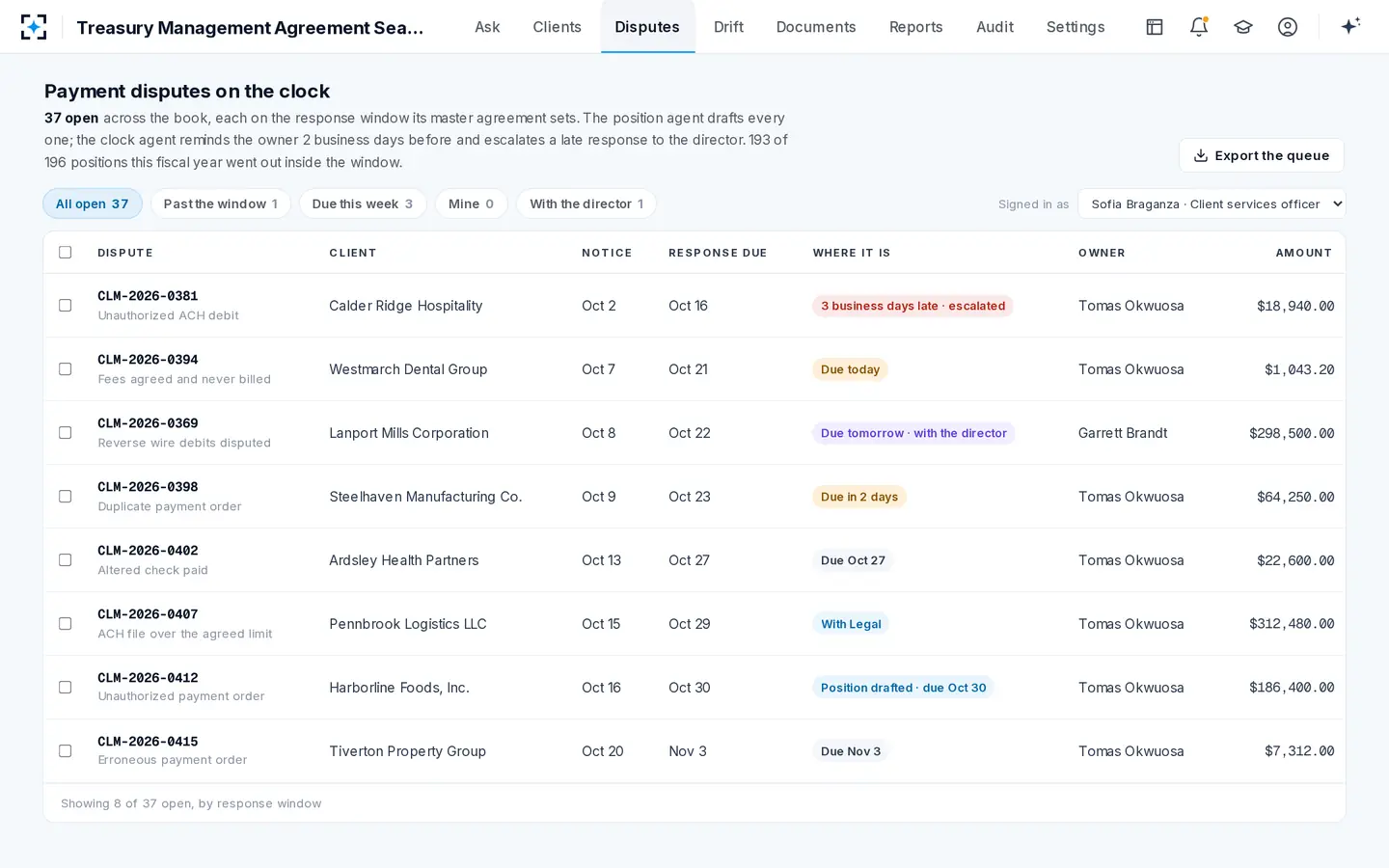
A right answer reached slowly still costs the relationship, the hours of three or four senior people, and the attention of a director when the window closes. In the sample bank, 193 of 196 positions this fiscal year went out inside the agreed window, and of 37 disputes open on October 21 one was three business days late and had been escalated.
Where the hours behind one disputed wire go, by hand and with the agents
Indemnification agreement for wire transfer: what the clause can and cannot do
An indemnity can move costs Article 4A does not allocate, but not the loss Article 4A does. In Choice Escrow v. BancorpSouth, the business services agreement made the client "indemnify and hold BancorpSouth harmless from any and all claims, damages, losses, liabilities, and costs and expenses, including reasonable attorney's fees." The district court held the provision unenforceable because it "could effectively require Choice to pay back" amounts the bank might owe under Article 4A (Choice Escrow, 8th Cir. 2014).
The Eighth Circuit reversed only as to fees: "Article 4A contains no provision allocating attorney's fees," so the fee part of the indemnity was not inconsistent with it, and the bank could pursue its fees. It did not need to decide whether the losses part could stand. A bank drafting or relying on an indemnity in a wire agreement should read the two halves separately, and should expect the half that shifts the loss itself to meet §4A-202(f), which keeps the rules on authorized and verified orders out of the parties' reach except as those sections allow (UCC §4A-202).
The numbers behind wire disputes, from the courts and the FBI
$3.05B
reported lost to business email compromise in 2025, across 24,768 complaints
$561,399
Experi-Metal judgment against the bank, plus statutory interest from the day of the orders
$440,000
Choice Escrow's loss, left with the client that had refused dual control in writing
How long does a bank have to answer a wire dispute?
As long as its own agreement says, because Article 4A sets no response deadline for the bank. The deadlines in Article 4A run against the client: the 90-day limit for interest and the one-year limit to object. A bank's promise to answer in ten business days, as in the sample master agreement, is a service commitment that the bank wrote and the client will hold it to.
That commitment is also the easiest one to miss, because nothing in the payments hub or the document imaging system counts it. In the solution, the clock agent counts each dispute's window in business days from the client's written notice, reminds the owner two business days before it closes and escalates a late answer to the director. It never extends a deadline.
Every payment dispute on the window its agreement sets
Reading the agreement fast enough to matter
The cost of a disputed wire is set in the first few days, and most of it is decided by one reading: which security procedure was in force when the bank executed the order, and does the payment record show it was followed. Everything downstream, the recall's priority, the position, the interest, the client's next move, follows from that reading.
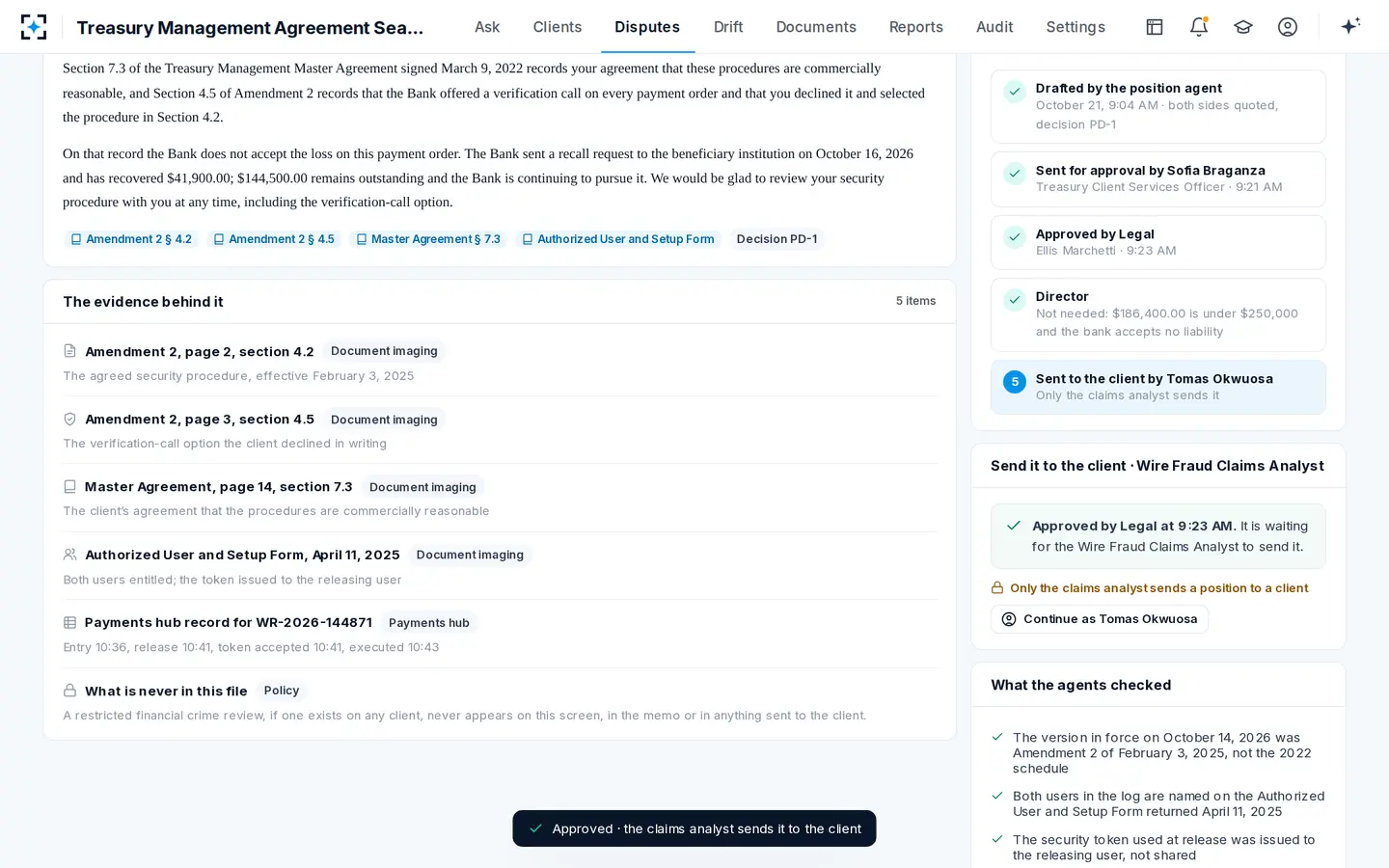
In the sample dispute, the reading took seconds and the full position, drafted by the agents, checked by the client services officer and approved by Legal, took minutes on the morning of October 21. The memo quoted both sides, offered to review the verification-call option with the client, and waited for the claims analyst to send it. The same solution is at Treasury Management Agreement Search, and the commercially reasonable security procedure test explains why the reading carries so much weight.
The position, approved by Legal, waiting for the claims analyst
Questions people ask
Is a wire transfer agreement the same as a funds transfer agreement?
In commercial banking the two names usually describe the same document: the terms under which a bank accepts a business client's payment orders. Article 4A uses "funds transfer" for the whole series of payment orders from originator to beneficiary, and a wire is the most common kind.
Does a bank pay interest on a refunded wire?
Yes, when it refunds an order it is not entitled to enforce: UCC §4A-204(a) requires interest from the date the bank received payment to the date of the refund. The client loses that interest if it fails to report within a reasonable time, never more than 90 days. The rate is the agreement's, or the federal funds rate under §4A-506.
What should a wire transfer agreement sample include?
At minimum: the security procedure, the users and how they are named, limits and what happens above them, cut-off times, the client's notice duty, the interest rate on refunds, liability limits and the indemnity, governing law, and how amendments are made. Each maps to a rule in Article 4A, and the procedure clause is the one that decides most disputes.
Can a bank refuse to refund a disputed wire?
Yes, if the order was authorized by the client, or verified under a commercially reasonable procedure the client agreed to and the bank followed in good faith (UCC §4A-202). If the client then proves the breach did not come from its side, §4A-203 lets it shift the loss back to the bank.
Who answers a wire dispute inside the bank?
It varies by bank. In the sample bank, the client services officer drafts the position, Legal approves it, the director approves anything over $250,000 or where the bank accepts liability, and only the wire fraud claims analyst sends it. The officer who drafts can never approve.