A treasury management agreement is the contract under which a bank provides cash management services to a business client: wire transfers, ACH origination, positive pay, remote deposit capture, lockbox. It is rarely one document. It is a master agreement, a service schedule for each service, then amendments, fee exhibits and the forms that name the client's authorized users, each signed by someone different on a different date. Those signatures are not paperwork: under UCC Article 4A, the client's signed acceptance of a security procedure, or its written refusal of a better one, decides who carries the loss on a fraudulent payment order. Botminds' Treasury Management Agreement Search reads every one of those documents for a client, works out which version governed on the day of a payment, and quotes the clause with its page and its signer beside what the payments hub recorded.
The examples come from a fictional sample bank with 21,400 business clients and 38,412 signed treasury documents between them, as they run through the solution. The law comes from the uniform text of Article 4A and the courts' own opinions, linked where they appear.
Four people answer for the same signed file, and each needs a different page of it
Today
Opens the scanned folder, reads the newest copy, then asks the payments team who released the order and waits.
With agents
Gets the clause in force that day, its page and its signer, beside the payment order's trail, and drafts the position.
Still theirs: The draft, and the duty to say what the agreement does not decide.
Today
Re-reads the master agreement and every amendment from scratch before approving a letter to a client.
With agents
Reads a memo that already cites clause, page, signer and log line, and approves or returns it with a reason.
Still theirs: The approval. Nothing reaches a client without it.
Today
Starts the recall, then waits days to learn what the client actually signed.
With agents
Sees the response window, the drafted position and the recall on one screen.
Still theirs: Sending the answer, and the recall.
Today
Finds out the setup form is three years old when something goes wrong.
With agents
Sees every service, limit and signer for the portfolio, and is asked for missing documents before a dispute needs them.
Still theirs: The relationship, and the request for a new signature.
What is a treasury management agreement?
A treasury management agreement, also called a treasury services agreement or a cash management services agreement, is the set of terms a bank and a business client sign before the client can move money through the bank's cash management services. In practice it has a master agreement that holds the general terms and a schedule for each service the client buys. Banks use the three names loosely; what matters is which documents the client actually signed and when.
No federal regulation prescribes what a treasury management agreement must say. For wire transfers and other commercial funds transfers the default rules come from UCC Article 4A, as each state enacted it, and Article 4A lets the parties change most of them: "the rights and obligations of a party to a funds transfer may be varied by agreement of the affected party," except where the Article says otherwise (UCC §4A-501(a)). The agreement is therefore where most of a wire dispute is decided, and the few rules it cannot change are the ones a bank most needs to know. Consumer transfers covered by the Electronic Fund Transfer Act fall outside Article 4A (UCC §4A-108), which is one reason treasury agreements are written for business accounts.
The documents that make up one client's treasury management agreement
| Document | What it decides | Who usually signs for the client |
|---|---|---|
| Master agreement | General terms: liability limits, notice duties, governing law, how the bank may amend | An officer with authority, often the CFO or owner |
| Service schedule, one per service | The security procedure, limits and cut-off times for wires, ACH, positive pay, deposit capture or lockbox | The same officer, at onboarding or when a service is added |
| Amendment | Replaces a section: a new approval threshold, a new limit, a new procedure | An officer with authority; the date it takes effect matters more than the date it was signed |
| Fee exhibit | Prices and how they are charged | Often signed with the schedule; sometimes acknowledged later |
| Authorized user and setup form | Which named people may enter or release a payment, and with which credentials | The client's administrator or treasurer, and it changes whenever staff change |
| Written waiver or refusal | That the client declined a procedure the bank offered, and agreed to be bound by the one it chose | An officer with authority; under Article 4A it must be in writing |
What is in a treasury management services agreement?
The terms that decide disputes sit in a handful of clauses, whatever the bank calls them. The security procedure says how the bank will verify that a payment order is the client's. The limits and cut-off times say what the bank will accept and when; Article 4A lets a bank fix cut-off times and treat a later order as received the next funds-transfer business day. The notice clause sets how quickly the client must report a problem. The liability clause, the indemnity and the governing-law clause decide what a court will be reading; parties may choose the law that governs, "whether or not the payment order or the funds transfer bears a reasonable relation to that jurisdiction" (UCC §4A-507(b)).
Two terms deserve a second look because Article 4A treats them differently from the rest. A bank may limit how far it enforces a verified payment order only "by express written agreement" (UCC §4A-203(a)(1)). And the rules on authorized and verified payment orders cannot be changed by agreement at all, beyond what those sections themselves allow (UCC §4A-202(f)). A clause that tries to shift loss outside those routes is a clause a court can ignore.
Which schedule a procedure sits in matters as much as what it says. In Patco Construction v. People's United Bank, the client had signed an ACH agreement that made it responsible for transfers the bank accepted "in compliance with the security procedure referred to in Schedule A," and then argued that Schedule A did not, by its express terms, apply to the online banking transfers that were stolen (Patco, 1st Cir. 2012). A clause in the wrong document is a gap a client's lawyer will find. What an ACH schedule itself has to contain, from limits to permitted entry classes, is laid out in the ACH origination agreement template.
Who signs a treasury management agreement?
For the client, an officer with authority to bind the company signs the master agreement and the schedules, and the people who will actually move money are named separately, on an authorized-user or setup form that is usually signed by the client's administrator. Those are different signatures with different jobs, and they change at different speeds: the master agreement may last a decade, while the user form goes stale the week a controller leaves.
The pattern is visible in the reported cases. In Experi-Metal v. Comerica, the company's president signed a "Treasury Management Services Agreement" on November 21, 2003 to gain funds transfer services, an agreement that was itself governed by a master agreement the bank had published in August 2002 (Experi-Metal, E.D. Mich. 2011). Years later, the court still had to decide whether one employee was authorized to send wires on the day of the fraud. There was "no single writing signed, submitted, or prepared by Experi-Metal expressly authorizing" him to do so; the court found he was authorized by piecing together the president's declarations, the implementation information she gave the bank listing him as a user, and a contingency form she signed naming him. A bank that has to reconstruct authority from five documents has a filing problem, not a legal one.
One client's signature chain: who signed each piece, and what it moved
A person decides
Client CFO signs the master agreementGeneral terms, and a clause recording that the client accepts the security procedures in each schedule as commercially reasonable for it.
A person decides
Client CFO signs the wire scheduleThe procedure the bank will use to verify payment orders: users, approvals, token, verification call threshold.
A person decides
Client treasurer returns the authorized-user formNames who may enter and who may release. The bank issues tokens to those people.
A person decides
Client CFO signs an amendmentReplaces the procedure from an effective date: two users above $50,000, a call only above $250,000.
Never: Takes effect before its effective date, or at all if unsigned
A person decides
Client declines a stronger option in writingRecords that the bank offered a call on every order and the client chose the procedure in the amendment instead.
Agent
Version agent dates the stackMarks which of the documents governed on the day of a disputed payment and strikes what a later version replaced.
Never: Cites a superseded, unsigned or draft version as in force
The signature that accepts the security procedure
The most consequential signature in the stack is the one that makes a security procedure an agreed one. Article 4A defines a security procedure as one established by agreement between the bank and its customer for verifying that a payment order is the customer's, and it rules out a bare comparison of signatures as a procedure on its own (UCC §4A-201). A procedure the client never agreed to is not one the bank can rely on.
Once agreed, the procedure does a great deal of work. A payment order verified under it binds the customer even if nobody at the customer authorized it, provided the procedure is commercially reasonable and the bank proves it accepted the order in good faith and by following that procedure (UCC §4A-202(b)). The burden sits with the bank. The bank proves compliance with the procedure the client signed, which means it has to know, quickly, which procedure that was on the date of the order. What makes a security procedure commercially reasonable works through the test itself.
The signature that refuses a better one
A client's written refusal is the signature most likely to decide a loss in the bank's favour. Article 4A builds a route for it directly into the reasonableness test: a procedure the customer chose after refusing a commercially reasonable one the bank offered is deemed reasonable, if the customer also agreed in writing to be bound by orders the bank accepts in compliance with the procedure it chose (UCC §4A-202(c)).
"Choice knew that dual control provided a reliable safeguard against Internet fraud, and it explicitly assumed the risks of a lesser procedure notwithstanding the relative ease with which it could have implemented dual control."
Choice Escrow and Land Title, LLC v. BancorpSouth Bank, 8th Cir., June 11, 2014
Choice Escrow and Land Title v. BancorpSouth shows the route in use. The bank offered dual control and made any customer that declined it sign a waiver. Choice declined, signed, was offered dual control again by email in November 2009 and declined again. When fraudsters sent $440,000 to Cyprus the following March, the Eighth Circuit held that the loss fell on Choice, and that the bank could also pursue its attorney's fees under the indemnity in the agreement (Choice Escrow, 8th Cir. 2014). The waiver itself, and how a bank records who may approve what, is the subject of entitlements in banking. Patco and the cases decided around it sets the waiver beside the cases the banks lost.
The waiver only helps a bank that can find it. A refusal recorded in a 2019 schedule is not a refusal of a procedure a 2025 amendment introduced, and an email reply is evidence of a conversation, not the written agreement to be bound that the deemed-reasonable route asks for. In the sample file, the refusal sits in section 4.5 of the amendment that also set the procedure, signed by the same officer on the same day, which is the cleanest version of the evidence a bank can hold.
The authorized-user form: the page that says who the client is
The user form decides whether a disputed order was authorized at all. Under Article 4A a payment order is the client's authorized order if the client authorized it or is bound by it under ordinary agency law (UCC §4A-202(a); how that rule sorts wire fraud between bank and client is in bank liability for wire fraud). When the person who entered and released a wire is named on the client's current form and used the token issued to them, the client's complaint that the wire was "unauthorized" is usually a complaint that its own staff were deceived. That is a different claim, decided under different facts.
It is also the document most often out of date. The sample bank's overnight comparison finds 112 clients with no current authorized-user form, and 61 whose schedule requires a second approver above a limit while the digital banking platform entitles only one person to release. Neither shows up until a dispute forces somebody to read both systems side by side. Keeping the two in step is servicing work, covered in entitlements in banking and, for changes requested by phone or email, callback verification of client changes.
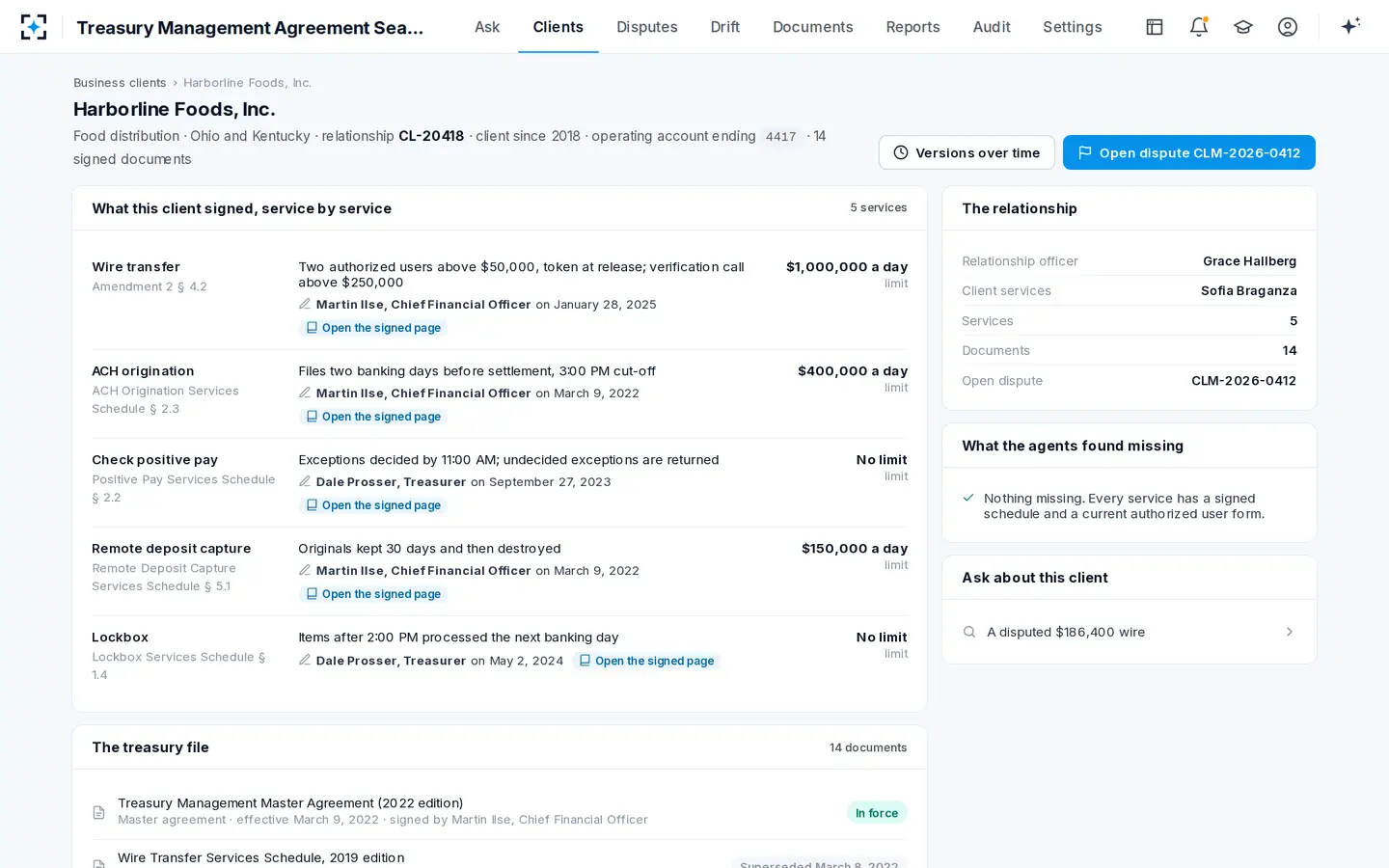
Everything one client signed, service by service, with the signer and the date
Can a treasury management agreement be signed electronically?
Yes. Federal law says a contract relating to a transaction in interstate commerce "may not be denied legal effect, validity, or enforceability solely because an electronic signature or electronic record was used in its formation" (15 U.S.C. §7001(a)). That covers schedules and amendments a client accepts through the bank's online platform as much as those signed in ink and scanned.
Electronic acceptance moves the evidence problem rather than removing it. The bank must still show which text the client accepted, when, and through which user, and it must be able to produce that text later as it stood then. Patco is the warning: the bank there had reserved the right to change its online banking terms simply by publishing them, claimed it had added a same-day objection duty for ACH debits, and the client disputed that the change was ever published before the fraud. Which version of a master services agreement was in force follows that problem through amendments and online terms.
Who carries the file inside the bank, and why that is a chain too
The client's signatures are only half the chain. Inside the bank, the people who answer a dispute sign off on the bank's reading of the client's signatures, and the separation between them is a control in its own right. In the sample bank the client services officer drafts the position, Legal approves it, the director approves anything over $250,000 or where the bank accepts liability, and only the wire fraud claims analyst sends it. The officer who drafts can never approve.
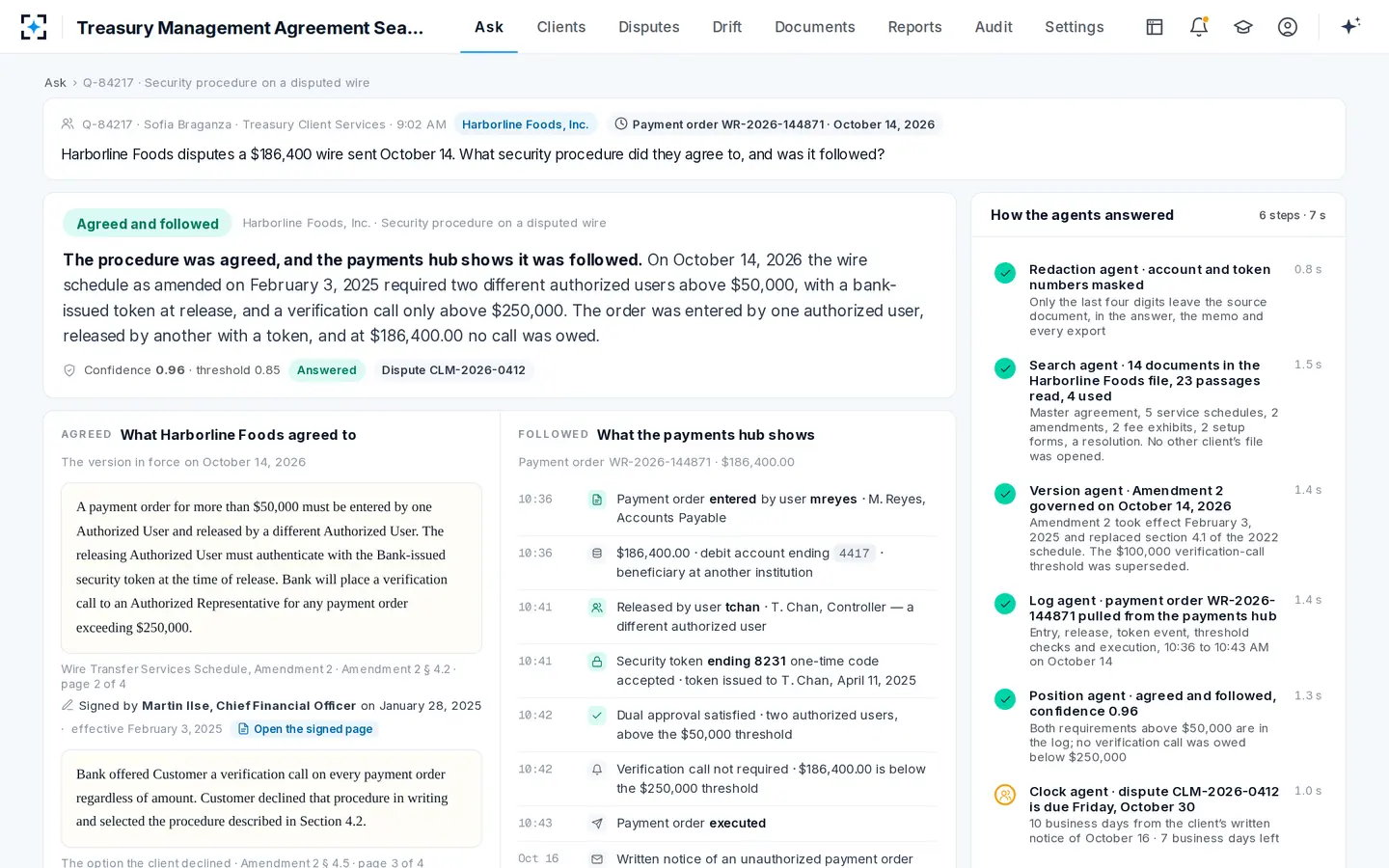
That separation protects the bank from the mistake a single reader makes most often: reading the newest copy in the folder rather than the one that governed. In the sample dispute, a $186,400 wire on October 14, 2026, the 2022 wire schedule required a verification call above $100,000. Amendment 2 had raised that threshold to $250,000 from February 3, 2025. An answer drawn from the 2022 schedule would have told the client the bank missed a call it never owed.
The agreement on one side, the payments hub on the other
Where Treasury Management Agreement Search fits in the signature chain
The solution answers one kind of question well: what did this client sign, as of a given date, and does the payment record match it. Seven agents find the documents, date them, pull the payment order's trail, mask account and token numbers to the last four, and draft a position for people to approve. The answer cites the clause, page, effective date and signer, or it is not written.
It does not draft or negotiate agreements, and it does not decide whether a client was defrauded or whether a court would find a procedure reasonable; those remain Legal's calls. It cannot quote a scan it could not read (the sample bank has 77 such scans), and it treats an amendment nobody signed as not in force, which is the right answer and sometimes an unwelcome one. Where the stack is incomplete, the gap agent asks the relationship officer for the missing signature before a dispute needs it. The full product is at Treasury Management Agreement Search.
Questions people ask
What is a cash management agreement?
It is another name for a treasury management agreement: the terms under which a bank provides cash management services such as wires, ACH origination and positive pay to a business. The name varies by bank; the structure, a master agreement plus a schedule per service, usually does not. What decides a dispute is the text the client signed and the date it took effect.
Does the client's CFO have to sign every schedule?
Not necessarily; the bank needs a signature from someone with authority to bind the company, and that is a question of the client's own authorizations. The people who move money are named separately on an authorized-user form. Under UCC §4A-202(a) an order is authorized if the person sending it authorized it or is bound by it under agency law, so a current form matters as much as the master signature.
Is a signature comparison enough to verify a payment order?
No. Article 4A says a comparison of the signature with the customer's authorized specimen is not, on its own, a security procedure (UCC §4A-201). A bank that relies on a signature check alone loses the protection that a commercially reasonable, agreed procedure gives it under §4A-202(b).
Can a bank limit its liability in a treasury management agreement?
Partly. Most Article 4A rules can be varied by agreement, but the rules on authorized and verified payment orders cannot, except as §4A-202 and §4A-203(a)(1) allow, and a limit on enforcing a verified order needs an express written agreement. In Choice Escrow the Eighth Circuit let the bank pursue attorney's fees under an indemnity because Article 4A does not allocate fees.
What happens if an amendment was never signed?
Treat it as not in force unless something else shows the client agreed to it. In the sample bank, 97 amendments on file were sent and never returned, and the solution answers from the last signed version and says so. Patco shows the cost of the alternative: a bank arguing that terms changed by posting them online, against a client that says it never saw the change.
Does a treasury management agreement cover consumer accounts?
It is written for business clients. Article 4A steps aside for any funds transfer that the Electronic Fund Transfer Act governs even in part (UCC §4A-108(a)), so consumer transfers follow a different set of rules and different disclosures.