Call back verification is required to validate changes to a business client's banking setup because the request itself can be forged: before a user, entitlement, limit or contact changes, the bank calls the client on a number it already held and confirms the client asked. Requiring a callback is the easy part. Proving afterwards that the right person was called on the right number, asked the right question and gave a clear answer is where desks fall short, and that proof is what an auditor, an examiner or a court will read. Botminds' Treasury Management Client Services treats the callback as one of five links in an evidence chain for every maintenance request, written as the work happens, so that each change carries its own proof.
The worked example is a forged request on a fictional credit union's sample data: add a user with wire release up to $250,000 and raise an ACH approval limit from $150,000 to $400,000, in the name of a millwork manufacturer's controller. The rules and court opinions are real and linked.
The evidence file for one change: five links, each with what it must hold
1
Who asked?
The file holdsThe requester named, matched to the administrators on file, with the date each was added
Checked: the controller, an administrator since March 4, 2021
2
Did it come from them?
The file holdsThe message as it arrived, its headers and sending domain, tested against the channels the agreement allows
Broken: a lookalike domain registered three days earlier; channel not allowed by §7.2
3
May they ask for this?
The file holdsThe resolution and the agreement clause that governs this change type
Needs a person: wire release needs a second administrator to countersign under §4.4
4
What did the callback say?
The file holdsThe number dialled, when it was put on file, who answered, and their answer in their own words
Broken: reached on the number on file at 09:02; she did not send it
5
Does it fit the limits?
The file holdsThe approved exposure limit, the date of its last review and the highest day actually used
Broken: $400,000 asked against a $350,000 approved daily exposure
Why call back verification is required to validate changes
A maintenance change rewrites who may move a client's money, and the channel it arrives on is the one a fraudster controls. An email that names the right controller, uses her signature block and sounds like her is cheap to produce. A call placed by the bank to a number it held before the email arrived is not, because the fraudster does not answer it.
The supervisory expectation is explicit. The FFIEC's 2021 guidance on authentication lists stronger authentication for account maintenance among its access and transaction controls, naming changes of address, email, password, contact details and enrolled devices, whether the customer makes them or asks the bank to (FFIEC, Authentication and Access to Financial Institution Services and Systems, 2021; the FFIEC authentication guidance explained quotes the control). The guidance covers business customers as well as consumers, and it remains the current interagency statement; it replaced the 2005 and 2011 internet-banking guidance.
The guidance does not prescribe a callback. It sets the outcome, enhanced authentication for maintenance, and leaves the method to the bank's risk assessment. For a treasury desk the callback is the method that fits: it works for requests that arrive on paper and in person as well as online, and it can be applied by change type, which is how the sample credit union writes its rules.
Is a callback a security procedure under UCC 4A?
For payment orders, yes: Article 4A names callback procedures expressly, alongside codes, identifying words or numbers and encryption, as devices a security procedure may use (UCC § 4A-201). A security procedure exists only if the bank and the customer agreed it, so the callback a bank relies on for wires should be written into the treasury agreement, with the numbers it will use; the commercially reasonable security procedure test shows how a court reads that agreement.
A maintenance change is not a payment order, so Article 4A does not govern it directly. It governs what the change touches. Adding a user with release rights, changing a callback number or removing a second approver changes the client's security procedure itself: who may originate verified orders, and how they are verified. A bank that would defend a wire by pointing to its agreed callback should apply at least the same care to the change that decides who can send the next wire. The liability side of that argument is set out in wire callback procedures, which follows one account number from email to Fedwire.
Which changes need a callback, and which do not
A callback should be required by change type, written in advance, rather than left to the specialist's sense of the request. A rule that says "callback when in doubt" produces callbacks on the requests that already look odd and none on the convincing forgeries, which are exactly the ones that need it.
Callback rules by change type: what the fictional credit union decided, in writing
| Change type | Callback rule | Which number | Who approves |
|---|---|---|---|
| A user add with payment release | Always verified by callback before it is made | The contact on file | The supervisor |
| A limit increase | Callback, and checked against the approved exposure | The contact on file | A second specialist; above the exposure, credit |
| A contact or callback change | Verified on the number already held, never the new one | The old number | A second specialist |
| An administrator change | Verified by callback and countersigned | The contact on file | A second specialist |
| A view-only user add | No callback required | Not applicable | A second specialist |
| Any request by telephone | Always held for a callback | The contact on file, never the caller's number | By change type |
Two rows deserve attention. The contact change is the request that quietly disarms every later callback, so it must be verified on the number the bank already holds. And the telephone row closes the obvious gap: a caller who asks for a change has proven only that they can dial.
Which number should a bank use for a callback?
The bank should call a number it held before the request arrived and that the request did not supply: in the sample setup, the contact on file for the named administrator, with the date it was put on file shown beside it. The number in the email's signature block, a number in the body, or one given by a caller is in the requester's control and verifies nothing.
On the sample request two numbers sat side by side: (812) 555-0147, on file for the controller since March 4, 2021, and (502) 555-0188, supplied in the request and marked never to call. The sample credit union also holds the client's main office number and marks it "not used for verification", because a switchboard proves the company exists, not that a particular person asked. Why only a channel held before the request can verify it takes that argument further, including what a cloned voice can and cannot do.
The callback procedure, step by step
A callback procedure has five parts: prepare, call, confirm identity from the file, read back exactly, and record. The step that fails most quietly is the read-back. A client who hears "we're calling about your recent request" will often say yes to a change they did not ask for, because they did ask for something recently.
One callback in Treasury Management Client Services: the agent prepares, a person calls and decides
Agent
Callback agent preparesPicks the contact on file for this change type, drafts the script from the request, and shows the number in the request as never to call.
Never: calls or messages a number or address taken from the request
A person decides
Specialist callsDials the number on file and confirms who answered using two details from the file, never from the request.
A person decides
Specialist reads backReads the request exactly as it arrived: a new user with wire release to $250,000, the approval limit to $400,000. Asks: did you send this, today, from an address of yours?
A person decides
Specialist records the answerChooses the outcome (confirmed, did not send it, could not reach, asked us to call back) and types what the client said in their own words.
Agent
Evidence agent attachesAdds the call, its time and duration, the number and its date on file to the chain and the trail.
Never: edits or removes anything once written
The sample script ends with an instruction many desks leave unwritten: if the client says they did not send it, make no change, tell them nothing more and refer it within the hour. The client is protected by the refusal, and anything the bank files afterwards stays inside the bank.
How to document a callback verification
A callback is documented when someone who was not on the call can tell, from the file alone, that the right person was reached on the right number and agreed to the exact change. "Callback completed" in a ticket field does not meet that bar, because it answers none of the questions anyone will later ask.
What a callback file must hold to stand up a year later
- The number dialled, and when it went on file
Proves the number was held before the request, not supplied by it.
- Who answered, and how their identity was confirmed
Two details from the bank's own file, never from the request.
- What was read back, word for word
The exact change and amounts, so a yes cannot be to something else.
- The outcome and the client's words
"I did not send that" is evidence; "negative" is not.
- The time, the duration and the person who called
The sample call: 09:02, 4 minutes 12 seconds, by a named specialist.
- What was decided, by whom, with a reason code
The call is evidence; the decision that follows is the control.
- The second name
The approver who read the same file before the change took effect, or the supervisor on a refusal.
Two numbers, one of them callable, and the outcome in the client's words
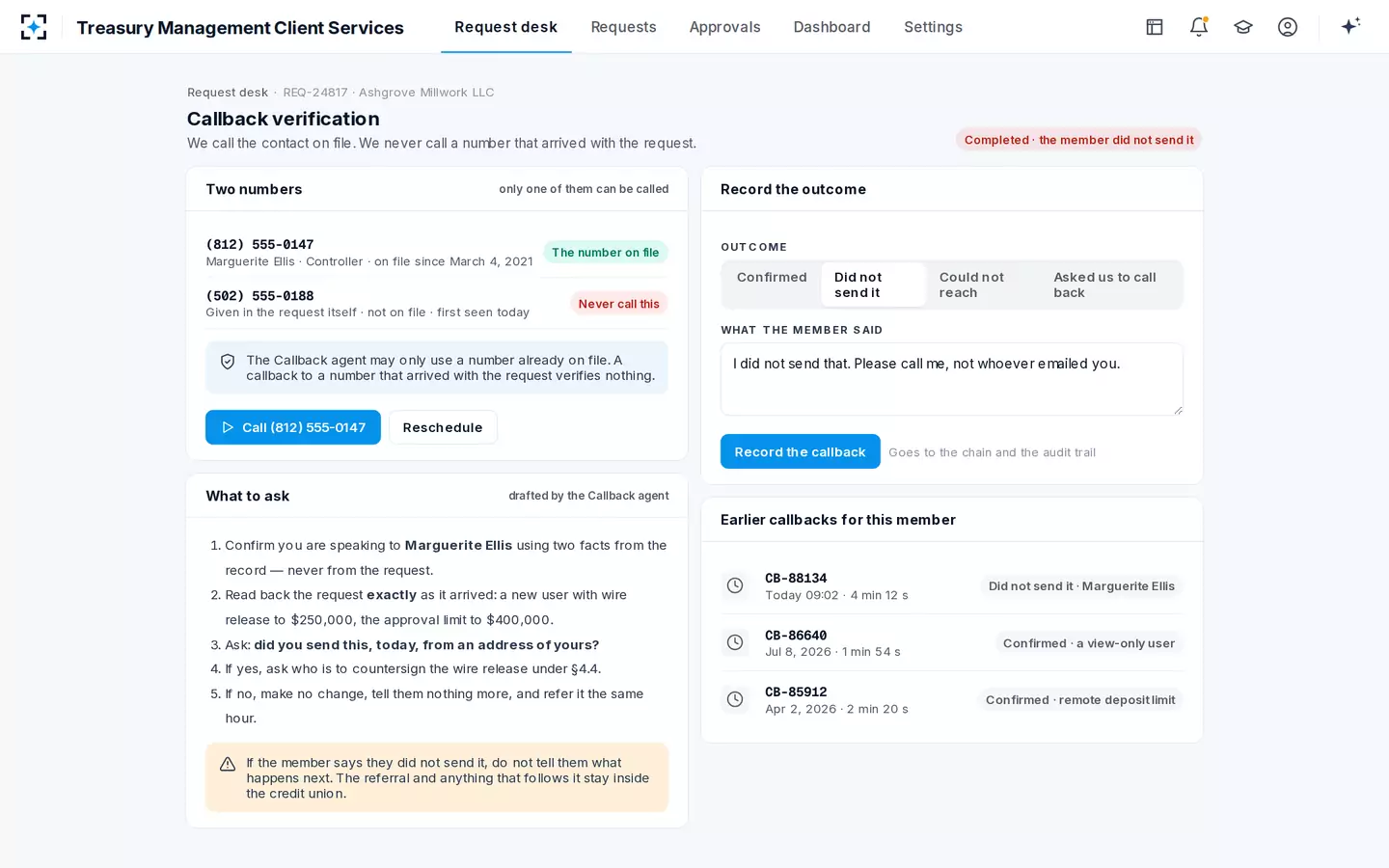
What if the client cannot be reached on the callback?
If the client cannot be reached, nothing changes. The request waits, the clock keeps running, and the desk tries again on the number on file, or on a second administrator's number if the bank's rules allow it. What the desk must never do is fall back to the number in the request because the client is in a hurry.
Writing the fallback down avoids the pressure call. The sample credit union lets a bank choose between calling the contact on file only, or the contact on file and then a second administrator; it gives the desk four business hours to respond and escalates at 80% of that clock. A client who cannot be reached is told, through an allowed channel, that the change is waiting for verification, which is also the moment a genuine client tends to call in from the number the bank already has.
A flag nobody acted on: the lesson from Patco
A verification that finds a problem and lets the change through anyway is worse than none, because it proves the bank knew. The First Circuit's Patco opinion turned on exactly that. Over seven days in May 2009, Ocean Bank authorized six fraudulent withdrawals totalling $588,851.26 from a construction company's account. Its system scored them between 563 and 790, against the company's usual 10 to 214, and nobody looked. The system flagged every payment as out of pattern for timing, amount and location, told no one, and let each one through. The court found those failures, taken together, made the bank's security procedures commercially unreasonable; the Patco decision quotes the opinion and sets the case beside the two that bracket it. After the bank blocked or recovered part of the money, the company's residual loss was $345,444.43.
"Now, transactions that generate high risk scores are personally reviewed by Ocean Bank personnel to determine their legitimacy."
Patco Construction Co. v. People's United Bank, U.S. Court of Appeals for the First Circuit, July 3, 2012
That is the bank's own later practice, recorded by the court, and it is the standard a desk should hold itself to before a dispute rather than after one.
For a maintenance desk the translation is direct. A chain that marks a link broken must stop the change, and the only way past a broken link is an override decided by a named person, with a reason code, approved by a supervisor. In the sample setup a broken link means the "make the change" action is not available at all; the choices are to ask the client through an allowed channel or to refuse and refer.
What an examiner or auditor will read in the file
An examiner reviewing a maintenance process will typically sample changes and ask, for each: who asked, how it arrived, what authority allowed it, how it was verified, who made it and who approved it. A desk that can answer from one screen per change is in a different position from one that answers with forwarded emails and a specialist's memory.
People and agents on one trail: every step with its reason and its evidence
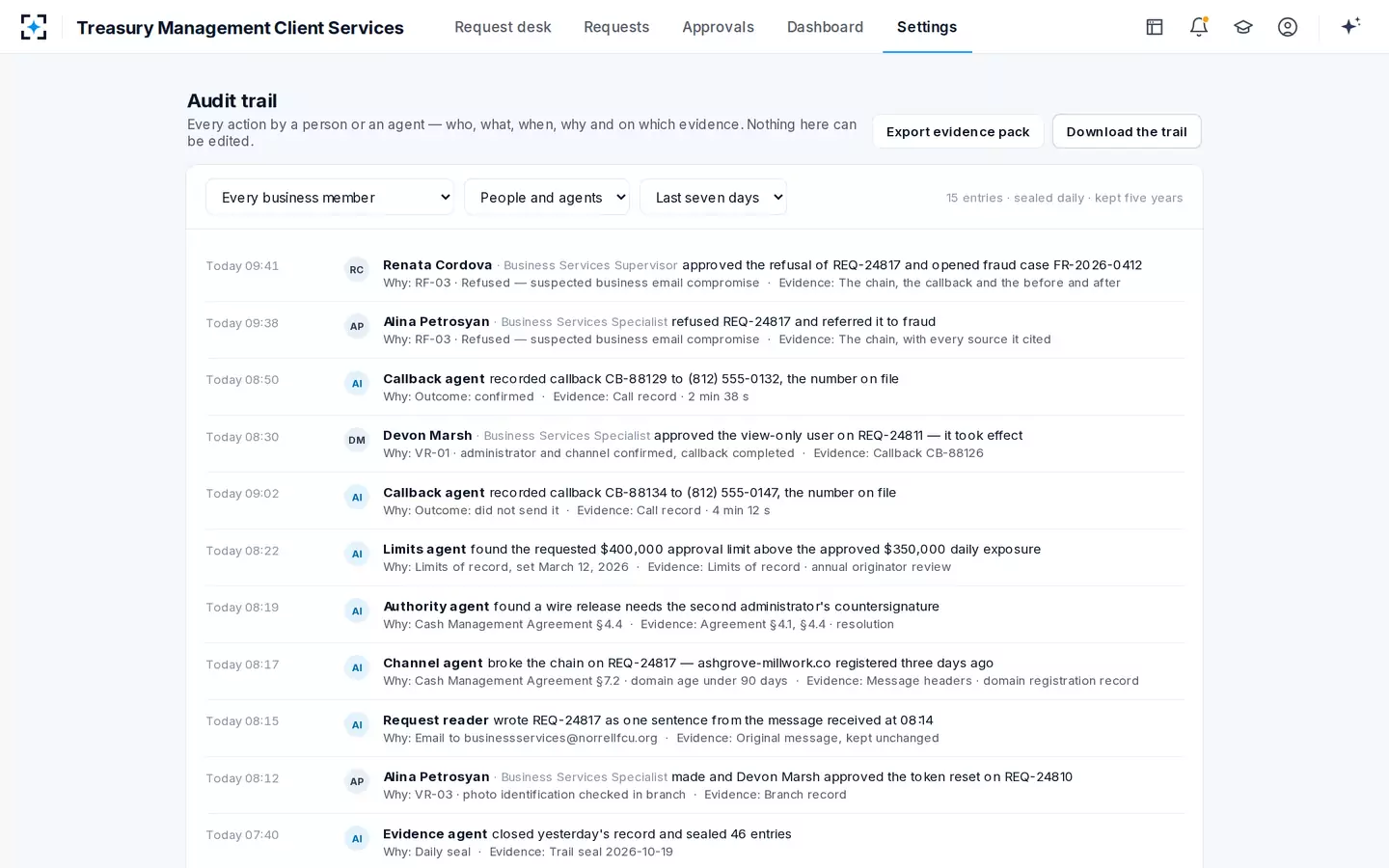
Retention is the last practical question. The sample credit union keeps the trail five years, sealed daily, with seven and ten years available as settings; the right figure is the bank's own retention policy for account records. What matters more than the number is that the callback evidence is kept with the change it verified, not in a separate call log someone has to match by date. A limit increase shows the same file working on a request that also needs a credit decision, and the four seats on the desk show who signs which part of it. To see the chain, the callback and the trail together, start from Treasury Management Client Services.
Questions people ask
What does callback verification mean?
Callback verification means confirming a request by calling the requester back on a number the bank already holds, rather than trusting the channel the request arrived on. It is named in UCC § 4A-201 as one of the devices a payment-order security procedure may use, and banks apply it to maintenance changes that decide who may send payments.
Does every maintenance change need a callback?
No; it should depend on what the change lets someone do. The sample rules require a callback for payment-release users, limit increases, administrator changes and contact changes, and none for a view-only user. The rules should be written per change type so the decision does not depend on how convincing a request looks.
Can a text message or email replace the callback?
An email reply goes to the channel under suspicion and verifies nothing. A one-time code sent by text to a number already on file is a separate channel, though NIST's 2025 authentication guidelines class telephone-network delivery as a restricted method. Many desks keep a voice call for high-risk changes because it also lets the specialist read the change back.
Who should make the callback?
A bank employee who did not receive the request through the suspect channel and who works from the bank's own contact list, ideally the specialist making the change, with the result reviewed by a second person. In the sample setup an agent prepares the number and the script, but a person places the call and records the answer.
How long should callback evidence be kept?
As long as the bank keeps the account change it supports, under its own retention policy. The sample credit union keeps its maintenance trail five years, sealed daily, with longer periods available as settings.