A treasury management support specialist is the person at a bank or credit union who makes changes for business clients already live on cash management: adding and removing users, changing entitlements and approval limits, adding services such as positive pay, and changing the contacts the bank calls to verify things. The job looks clerical and is not. Every one of those changes alters who may move a business's money, each arrives as an email, a secure message, a signed form or a branch visit that somebody has to believe, and fraud aims at exactly that belief. Botminds' Treasury Management Client Services exists for that desk: agents read each request, check it against the client's own agreement, limits and contacts on file, and lay the evidence out, while a specialist decides, makes the change and a second specialist approves it.
The examples below come from a fictional credit union as it runs the solution on sample data: about 2,100 business members, around 1,300 maintenance requests a month, and one Tuesday morning when 41 arrived. The people, businesses and numbers are invented; the rules and statistics are linked to the agencies that publish them.
One change, four seats: who does what before a user, limit or contact changes
Agent
The agents read and checkWrite the request as one sentence; test who asked, how it arrived, what the agreement allows, the callback and the approved limits; cite the clause or document behind each check.
Never: make the change or decide
A person decides
Seat 1 · the specialistCalls the client on the number already on file, decides with a reason code, and makes the change in digital banking administration.
Never: approves their own change
A person decides
Seat 2 · the second specialistReads what the maker read, the before and after values, and approves or sends it back.
A person decides
Seat 3 · the supervisorApproves refusals, overrides and any entitlement that releases payments; owns the verification rules.
A person decides
Seat 4 · the client's administratorAsks for the change through an allowed channel, confirms it on the callback, and countersigns where the agreement requires two administrators.
What does a treasury management support specialist do?
A treasury management support specialist services business clients after implementation: the queue of maintenance that never ends once a client is live. Typical requests on the sample desk that Tuesday were to add a user with wire release, to remove 14 users after a payroll system change, to add a second approver on wires, to change the wire callback contact, to add positive pay to an operating account, and to remove a controller who had left and move his ACH approval to the finance director.
Each of those is a small change in the digital banking administration system and a large change in risk. A new user with release rights can send money for weeks. A changed callback number turns every later verification into a call to whoever supplied it. A raised approval limit lets a single compromised login move more in a day than the client's own controls were built for. That is why the job description says "support" and the work is authorization.
The desk sits between onboarding, which sets a client up once, and the fraud and audit functions, which look at what happened afterwards. Requests arrive by secure message, by email from an administrator's address on file, on a signed service change form or in person at a branch. A telephone request is held until someone calls the client back on a number already held. That is the sample credit union's rule, and it is a sensible default anywhere.
The four seats one change passes through
A defensible change has four seats, and each one owns a different decision. The specialist owns whether the request is genuine and allowed. The second specialist owns whether the first one's work holds up. The supervisor owns the exceptions: refusals, overrides and anything that lets a user release payments. The client's administrator, outside the bank, owns the client's side of the authority.
The seats exist because each one sees something the others do not. The maker sees the request as it arrived. The checker sees the maker's reasoning, which is where a tired shortcut shows. The supervisor sees the pattern across requests: on the sample desk, two more requests from lookalike domains were held for callback in the same week. The administrator sees whether the client actually asked.
The same request in four seats: their morning before, and with the agents doing the reading
Today
Recognizes the name and the signature block, makes the change, and hopes the email was real. Reads the thread, hunts for the agreement in imaging, and dials whichever number is to hand.
With agents
Opens a request already written as one sentence, with five checks walked and each one cited, and spends the time on the call and the decision.
Still theirs: The call to the client and the decision, with a reason code
Today
Approves a ticket that says the change was made, without seeing what was checked or which number was called.
With agents
Reads the same five checks the maker saw, plus the before and after values, before adding a second name.
Still theirs: The right to send it back
Today
Hears about a refusal after the client has already been answered, and learns the callback rules from whoever trained the newest hire.
With agents
Approves every refusal, override and payment-release entitlement, and sets the verification rules once, in writing.
Still theirs: The rules, and every exception to them
Today
Emails a change request and waits; is called back on whatever number the specialist finds, sometimes the one in the email.
With agents
Is called only on the number the bank held before the request, and countersigns where the agreement says two names are needed.
Still theirs: The client's own authority, under its agreement
Seat one: the specialist who makes the change
The specialist's real job is five questions, asked in order, on every request. Who asked, and are they an administrator on file? Did it really come from them? Does the client's agreement let them ask for this particular change? What did the client say on a callback to the number held before the request arrived? Does the change fit the limits the client was approved for? A request that cannot answer all five is not made, however familiar the name.
Take the sample request that arrived at 08:14: add a user with wire release up to $250,000 and raise an ACH approval limit from $150,000 to $400,000, for a millwork manufacturer, in the name of its controller. The name was right. The controller was an administrator on file since March 4, 2021. Everything else was wrong: the sending domain was a hyphenated lookalike registered three days earlier, the agreement's channel clause did not allow it, and the controller, reached at 09:02 on the number on file, said she had not sent it.
Manufacturing is not an unusual target. FinCEN's analysis of business email compromise reports put manufacturing and construction first among targeted sectors, at 25% of reported cases, ahead of commercial services at 18% and real estate at 16% (FinCEN Advisory FIN-2019-A005; wire fraud red flags quotes the finding). Those are the clients a commercial desk serves every day, and the specialist is the person a forged instruction has to get past. The FBI's own advice to businesses is the same discipline the specialist needs: check links and sender addresses for a misspelled version of the real domain (FBI IC3, I-091124-PSA).
The queue a specialist starts the day with, each request already checked or broken
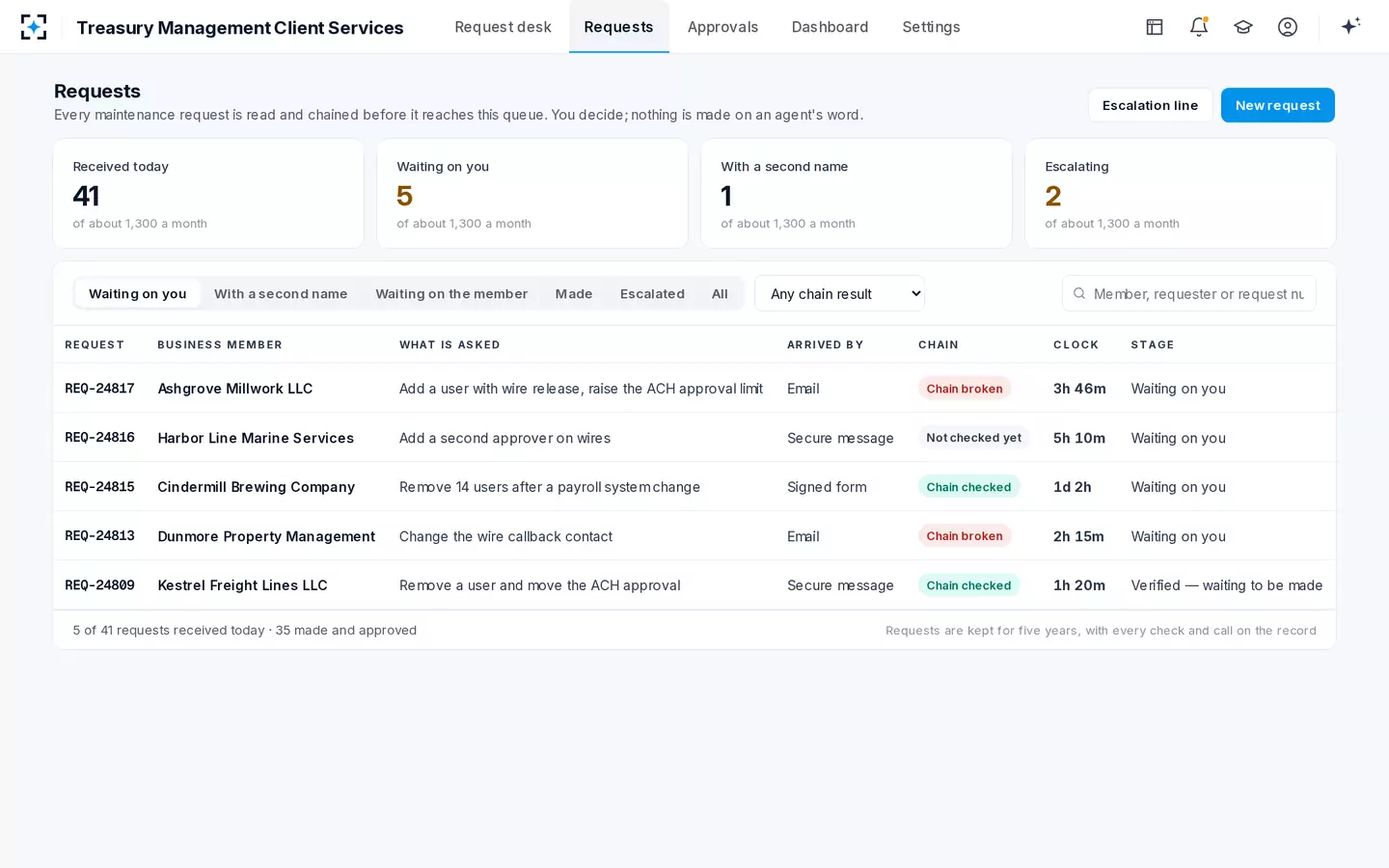
Seat two: the second specialist who approves it
The second specialist is there to catch the first one's shortcut, and can only do that if they see what the first one saw. A ticket that says "user added, callback done" proves nothing: done to which number, by whom, with what answer? On the sample desk the checker's screen shows the client, what was asked, how it arrived, the maker's reason code and all five checks with their evidence, before an Approve button that warns "Approving puts your name on this."
The rule that matters most is the dull one: nobody approves their own change. In the sample setup the change only takes effect when a second name approves it, and the person who made it cannot be that name. The same separation applies to the routine request as to the suspicious one. When the leaving controller at a freight client was removed and his ACH approval moved to the finance director, all five checks were green and the callback had been completed at 08:50. A second specialist still had to approve it. What an entitlement is, and why each change gets two names, takes that rule apart.
Seat three: who approves a treasury maintenance request that is refused or risky
The supervisor approves the decisions that are hardest to undo: refusals, overrides of a failed check, and any entitlement that lets a user release payments. On the sample desk, a refusal waits for the business services supervisor beside routine changes waiting for a second specialist, and approving it opens a fraud referral with the evidence already assembled: the message and its headers, the domain registration, the callback, the agreement clauses, the entitlements as they stood when the request arrived, and the chain with every decision.
The supervisor also owns the rules every seat follows: which change types always need a callback, who the bank calls back, how new a sending domain can be before a request is held, which channels are accepted, and how long the desk has to respond. Written down as settings rather than kept in a trainer's head, those rules are what a new hire follows on day one and what an examiner reads when asking how the desk decides. The supervisor's other duty is visible in the referral screen: a refusal is explained to the client without naming any report, and anything sent to the BSA officer stays inside the institution.
What waits for a second name: a routine change beside a refusal
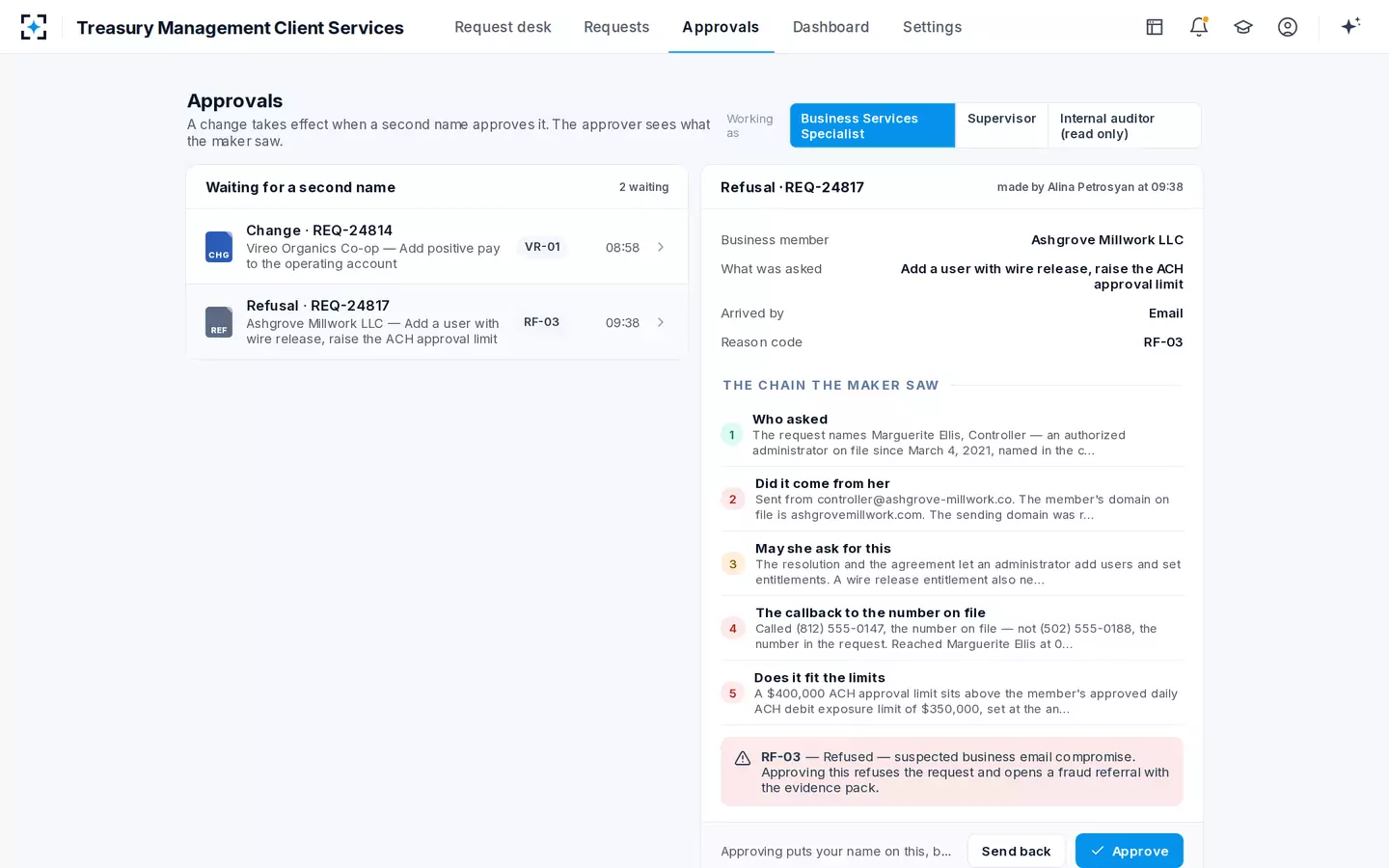
Seat four: the client's administrator, the seat outside the bank
The client's administrator is the person the client's own documents authorize to ask for changes, and the agreement decides how many of them a change needs. In the sample client's cash management agreement, a wire release entitlement is designated by one authorized administrator and countersigned by a second. The forged request asked for wire release with one name on it, so even a genuine controller could not have had it on her own.
Two things make this seat part of the desk's work rather than the client's problem. First, the bank holds the list: which administrators are on file, since when, and the numbers the bank may call. Second, the administrator is the account fraud most wants to impersonate, because one convincing request from an administrator can create users with payment rights. Why the business banking administrator is the account fraudsters want covers that seat from the client's side.
The treasury management support specialist job description, rewritten as decisions
Job postings for this role list tasks; the work is a series of decisions, each with the evidence that settles it. Writing the job description that way makes training concrete and makes the desk auditable, because every line names what someone else could check afterwards.
Six lines from a typical posting, and the decision each one hides
| The posting says | The decision it really is | The evidence that settles it |
|---|---|---|
| Process client maintenance requests | Is this request what it says it is, from whom it says? | The message as it arrived, kept unchanged, with its headers and sending domain |
| Add and remove users and entitlements | May this requester ask for this change? | The corporate resolution, the agreement clause, the administrators on file and the date each was added |
| Perform callback verification | Did the client actually ask for it? | A call to the number held before the request, the script used and the answer in the client's words |
| Update ACH and wire limits | Does the new limit fit what the client was approved for? | The approved exposure limit, the date of its last review and the highest day actually used |
| Maintain accurate documentation | Could an auditor follow this change without asking me? | A trail with who, what, when, why and the evidence behind each step |
| Provide responsive client support | What may we tell the client, and where do we send it? | A note to the address on file, never to the address on the request |
The fifth row is the one hiring managers underrate. A specialist who keeps good notes is not being tidy; they are producing the only thing that survives a dispute. What a defensible callback file contains spells out what that documentation has to show.
What skills does a treasury management support specialist need?
The skills that matter are reading, suspicion and the discipline to say no to a known client. Reading means agreements and resolutions: knowing where the channel clause lives, which changes need two administrators, and what a signed service change form must carry. Suspicion means noticing a hyphen added to a domain, a reply-to address that differs from the sender, or urgency that a client has never shown before. Discipline means calling the number on file even when the request helpfully supplies another one.
Limits literacy is the fourth skill and the least taught. A specialist needs to know the difference between a per-approver approval limit, a daily exposure limit set by credit at an annual originator review, and a network cap such as the Same Day ACH per-payment limit, because a request to raise one is often a request that runs into another. The sample forged request asked for a $400,000 approval limit against an approved daily ACH debit exposure of $350,000; no maintenance change can raise that.
"Those who work in finance and insurance may need several months of training to learn complicated financial regulations."
U.S. Bureau of Labor Statistics, Occupational Outlook Handbook, Customer Service Representatives
Training decides whether a desk's rules survive staff turnover. The FFIEC's 2021 authentication guidance makes the point for call centers, listing training in verification and authentication for password resets among its controls (FFIEC, Authentication and Access, 2021; contact center fraud prevention covers that desk). The same reasoning applies with more force to a desk that changes payment rights, and the most effective training material is the bank's own written verification rules, applied the same way to every request.
How the role compares with the nearest jobs the government counts
The Bureau of Labor Statistics has no occupation for treasury management support, so pay and headcount have to be read from the nearest standard occupations. Customer service representatives and new accounts clerks are the closest; neither describes the authorization work, which is why bank pay for this role tends to be set by the bank's own grading rather than by a market survey.
The nearest occupations the BLS counts: a job titled service, doing authorization
$44,770
median annual pay, customer service representatives, 2025
2.67M
customer service representative jobs in 2025, across all industries
$47,670
median annual wage, new accounts clerks, May 2025
37,900
new accounts clerk jobs in 2025
The comparison is useful for one argument. A role paid near a service-desk median is being asked to make the same kind of judgment a wire room makes, often on larger amounts, because a new user with release rights is worth more to a fraudster than one wire. The case for tooling on this desk is not headcount; it is that the evidence each decision needs should be in front of the person making it.
Where Treasury Management Client Services takes the reading off the desk
Seven agents do the reading and checking: a request reader writes the request as one sentence and keeps the original unchanged; an authority agent reads the resolution, the agreement and the entitlements on file and cites the clause; a channel agent tests how the request arrived against the channels the agreement allows; a callback agent schedules and scripts the call to the contact on file; a limits agent compares the request with the approved exposure; a change drafter prepares the exact change with before and after values; an evidence agent writes the trail as the work happens. None of them makes a change or decides.
The design targets are five checks on every request and four hours from a request arriving to a verified, approved change. What changes for each seat is where the time goes: less hunting through imaging and threads, more time on the call and the decision. To see the queue, the chain and the approvals working together, start from Treasury Management Client Services.
Questions people ask
What is treasury management support?
Treasury management support is the bank team that services business clients after their cash management services go live: user and entitlement changes, limit changes, added services and contact changes, plus the client questions that come with them. It is distinct from implementation, which sets a client up once, and from the sales officer who prices the relationship.
Is a treasury management support specialist the same as a treasury management officer?
No. A treasury management officer sells and prices services and owns the relationship; the support specialist services the client once live and makes the changes. Many banks also have implementation specialists between the two, who build the client's setup and hand it to support.
How much does a treasury management support specialist earn?
There is no BLS category for the role. The nearest occupations, customer service representatives and new accounts clerks, had median pay of $44,770 in 2025 and a median wage of $47,670 in May 2025 respectively. Bank postings vary widely with seniority and with whether the role includes limit and fraud decisions.
Can a support specialist approve their own change?
It should not be possible. A change to users, entitlements, limits or contacts should take effect only when a second person approves it, and that person should see the same checks the maker saw. In the sample setup the system enforces this rather than leaving it to policy.
What does a treasury management client service specialist do when a request looks wrong?
Make no change, call the client on the number already held, and record the answer. If the client did not send it, refuse with a reason code and refer it to fraud with the evidence; the client is told no change was made, without any mention of a report.