Treasury management software for banks is a label for at least four different products: systems that manage the bank's own balance sheet, platforms through which the bank delivers cash management services to business clients, the software a company's own treasurer uses, and the servicing layer that onboards clients and verifies every change to who may move their money. A bank looking for the last of those is usually solving a specific problem: the maintenance queue for users, entitlements, limits and contacts, where requests arrive by email and are believed on a recognized name. Botminds' Treasury Management Client Services is built for that queue. It does not replace digital banking or the payments hub; it reads each request against the client's own agreement and limits, cites what it found, and leaves the change to two people, one who makes it and one who approves it.
The screens below show the solution on a fictional credit union's sample data. The rules, guidance and dates are linked to the agencies and the rule-maker that publish them.
Four products called treasury management software, and which one a client services desk needs
| What it is | Who uses it | What it does | Fits the maintenance queue? |
|---|---|---|---|
| Bank balance-sheet treasury software | The bank's own treasurer and ALM team | Investment portfolio, funding, liquidity and interest-rate risk for the bank itself | No: it never sees a client request |
| Cash management platforms | Business clients, through the bank | Digital banking, ACH and wire origination, positive pay, remote deposit, account analysis | Holds the users and entitlements, but does not itself verify the request that changes them |
| Corporate treasury management systems | A company's own treasury team | Cash positioning, forecasting and payments across many banks | No: it sits on the client's side |
| Treasury servicing and verification | The bank's implementation and client services teams | Onboarding, maintenance requests, verification, approvals and the evidence behind each change | Yes: this is where Treasury Management Client Services sits |
What does treasury management software do for a bank?
For a bank, treasury management software either runs the services it sells to businesses or controls how those services are set up and changed. The first kind moves money: it takes the client's ACH files and wires, matches positive pay issues, deposits images and produces analysis statements. The second kind decides who may do those things and how much, and keeps the evidence of each decision.
The two kinds are often bought and owned separately, and the result can be a mismatch: a digital banking platform that can enforce dual control on every wire, administered by a team whose authority to add a user with wire release rests on an email and a specialist's memory of a voice. The control is only as strong as the change process behind it.
Where client services sits in the stack
Client services software sits beside the systems a maintenance request already touches and reads from each of them. It needs the agreements and resolutions from document imaging, the users and entitlements from digital banking administration, the account and client data from the core, the approved limits from the payments hub or credit, the incoming requests from the secure message center and mailboxes, and a route into case management for fraud referrals.
It should write in only one place, and only after people decide: the change in digital banking administration, made by a specialist and approved by a second. Everything else is reading and citing. A product that asks to become the system of record for users or limits is asking for a migration the bank does not need and an outage risk it does not want.
The systems a client services desk reads from, and what each contributes to one decision
- Secure message center and mailboxes
The request as it arrived, with headers: the evidence for how it came in.
- Document imaging
Corporate resolutions, cash management agreements and signature cards: who may ask, and through which channels.
- Digital banking administration
Users, entitlements and approval limits: the before values, and where the change is finally made.
- Payments hub or credit
Approved ACH exposure, wire ceilings and remote deposit limits, with the date of the last review.
- Core banking system
Accounts, balances and the client record that ties the request to a real relationship.
- Case management
Where a refusal goes as a fraud referral, with the evidence already assembled.
Treasury management software features that matter for maintenance
The features that matter are the ones that make a forged request fail and a genuine one pass with evidence. Feature lists often stress workflow: queues, statuses, notifications. Those help with throughput; they do nothing about whether the request was real. The questions below are the ones a specialist actually has to answer on every request, so the software should answer them first.
What a demo shows, and what to ask the vendor to show instead
Typical demo claim: Requests from every channel land in one queue
Ask to see: The original message kept unchanged, the sending domain and its age, and whether the agreement allows that channel
Typical demo claim: Requester validated
Ask to see: The clause and the administrator on file it relied on, including where a change needs two administrators
Typical demo claim: Callback task created
Ask to see: Proof the call went to a number held before the request, and the client's answer in their words
Typical demo claim: Limit updated
Ask to see: The approved exposure, its review date and the highest day used, and what happens when a request exceeds it
Typical demo claim: Four-eyes workflow
Ask to see: A system that refuses self-approval, and an approver screen showing what the maker saw
Typical demo claim: Full audit log
Ask to see: One request's evidence exported in one action, and a read-only auditor role that cannot approve
The FFIEC's 2021 authentication guidance describes what a log must be good for:
"Transaction and audit logs monitor and record system and account activity to identify unauthorized activities, detect intrusions, reconstruct events, and promote customer and user accountability."
FFIEC, Authentication and Access to Financial Institution Services and Systems, 2021
"Reconstruct events" is the test to apply in a demo: pick a change and ask the vendor to show, from the product alone, why it was allowed. What a defensible change file contains lists the fields that reconstruction needs.
What the regulators expect of software you buy
Buying software for a control function moves the work, not the responsibility. The interagency guidance on third-party relationships, issued by the Federal Reserve, the FDIC and the OCC in June 2023, says so directly: a bank that uses a third party remains responsible for the activity being run safely and soundly and within the law (88 FR 37920; the interagency guidance on third-party relationships quotes it and reads it clause by clause). That guidance may be replaced: on September 15, 2026 the OCC, the Federal Reserve, the FDIC and the NCUA proposed new third-party risk management guidance, with comments due November 16, 2026, and until a final version is issued the 2023 text is the standard (Proposed Third-Party Risk Management Guidance).
In practice that means three things for a client services product. The bank must be able to see why each change was allowed, so a vendor that cannot show its evidence is a risk the bank carries. The bank owns its rules: callback requirements, accepted channels, approvers and clocks should be settings the bank sets and changes, with each change on the trail. And the bank needs an exit: its agreements, rules and trail must be exportable in a form it can read without the vendor (OCC Bulletin 2023-17 conveys the same guidance for national banks).
The ACH rules raised the stakes in 2026. Nacha's fraud-monitoring rules require every ODFI to run risk-based processes designed to catch ACH entries initiated by fraud, in force since March 20, 2026 for all ODFIs and the largest originators; the second phase, dated June 19, 2026, took effect in practice on Monday, June 22, because June 19 was a federal holiday (Nacha, Fraud Monitoring Phase 1; ACH Operations Bulletin #1-2024). The 2026 Nacha fraud monitoring rules sets out who owes what. A new user with release rights or a raised limit, granted on a forged request, sits upstream of every fraudulent entry that user later sends, and nothing in the entry itself will look wrong; a bank describing its risk-based processes will want to show how maintenance changes are verified.
What systems does client services software connect to?
It should connect read-only to imaging, the core, the payments hub and the message channels, and read-write to digital banking administration for the final change. Ask how each connection fails. A product that cannot reach the administration system should leave the change drafted and waiting, not half-made, and the demo should prove it by cutting the connection.
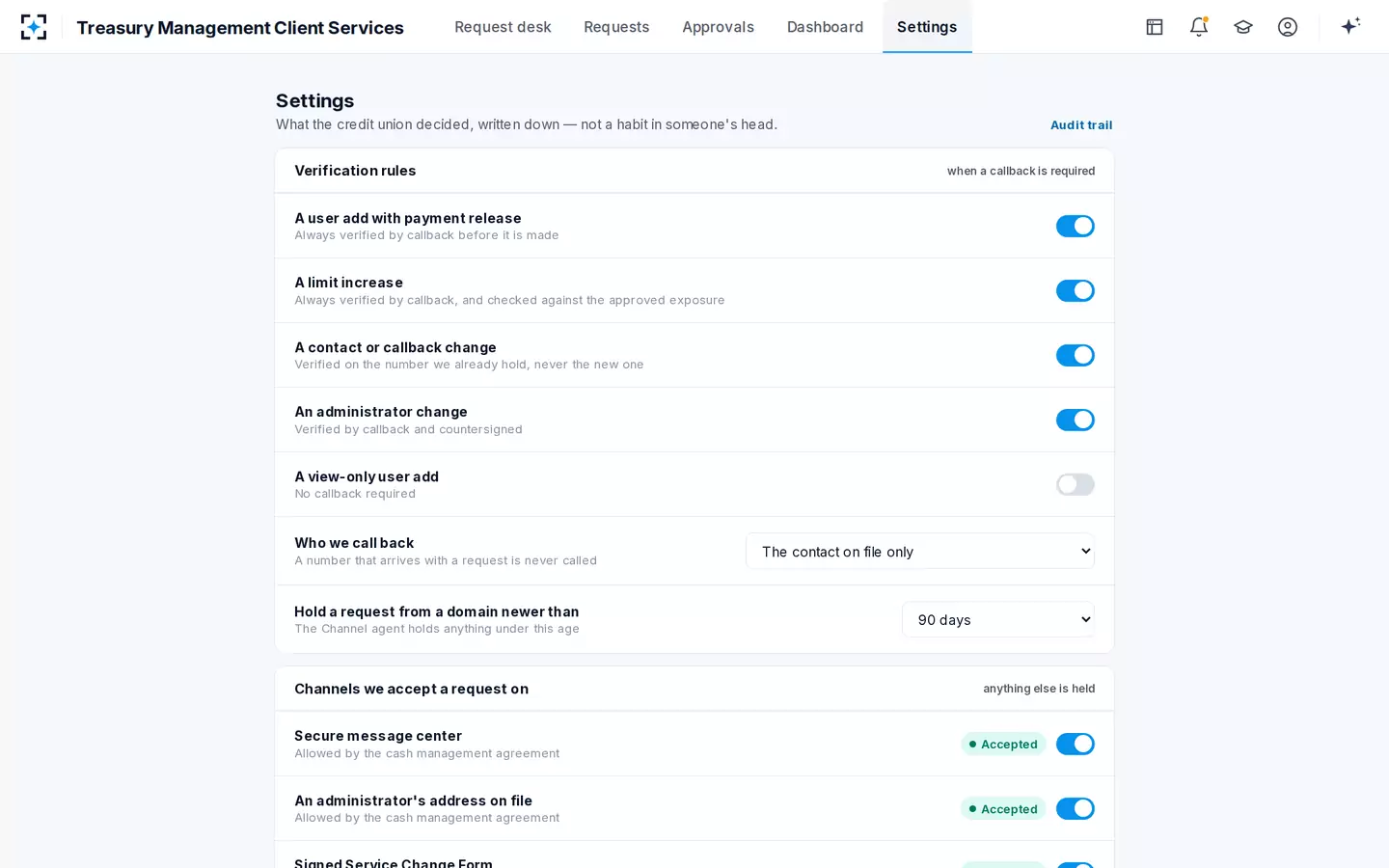
The rules, written down: which changes need a callback, who is called, and which channels count
How long does it take to go live? A plan in five phases
Going live is mostly about documents and rules, not code. The phases below are the order that works; how long each takes depends on whether the bank's agreements and authorized-user forms are already imaged, how quickly the administration system can be connected, and how long the bank wants to run in shadow before switching on.
An illustrative go-live: documents first, then rules, then a shadow run on real requests
- Documents in2 wks
- Rules1 wk
- Systems connected2 wks
- Shadow run2 wks
- Switch on1 wk
The shadow run is the phase not to cut. For two weeks the agents check every real request while the desk works as it does today, and the two are compared: which requests the chain broke that the desk made, and which it passed that the desk refused. The first list is the business case; the second is where the rules need tuning. Switching on then changes one thing for the specialist: the evidence arrives with the request instead of being gathered after it.
What should a bank ask a treasury software vendor?
Ask questions whose answers can be checked in a demo on the bank's own material. A vendor willing to run its product on a sample of the bank's past maintenance requests, including a few the bank knows were fraudulent, is offering evidence rather than a feature list.
Eight questions for any client services vendor, each answerable in a demo
- Will you run on a sample of our past requests, including known frauds?
The only test of whether the checks catch what your desk missed.
- Show me why one change was allowed, from the product alone.
Clause, channel, callback, limits and both names, without asking anyone.
- What happens when a check fails?
The change should be unavailable, not merely flagged.
- Who can change the verification rules, and where is that recorded?
Rules are controls; changing them should leave a trail.
- Which systems do you write to, and what happens if one is down?
One write, after two approvals; a failure leaves the change drafted.
- Can anyone approve their own change?
The answer should be a system refusal, not a policy.
- What does an auditor see, and what can they do?
Everything, and nothing beyond reading and exporting.
- If we leave, what do we take with us?
Rules, trail and evidence in a readable form.
Building the business case from your own queue
The business case for client services software rests on two numbers the bank already has and rarely counts: how many maintenance requests arrive each month, by change type, and how many of them change payment rights or limits. The sample credit union receives about 1,300 a month across 2,100 business members; a bank's own figure, split by type, tells it how many requests need a callback under its rules and therefore where the elapsed time goes.
The time side should be measured, not borrowed. Botminds estimates that, by hand, a single request takes a little over six hours from first read to a written-up change, of which about four are waiting on the callback, and a little under an hour with the agents preparing the evidence; the shadow run is where a bank replaces that estimate with its own. The loss side needs no estimate at all: the FBI's Internet Crime Complaint Center recorded $3,046,598,558 in reported business email compromise losses in 2025 (IC3, 2025 Annual Report), and a forged maintenance request is one of the quieter routes into that figure. For a desk that changes payment rights, the control argument comes first and the hours second.
Where Treasury Management Client Services does not fit
Being clear about the edges saves an evaluation. The solution does not originate payments, does not replace digital banking or its administration screens, and is not a corporate treasury system. It is not an identity and access tool for the bank's own employees; reviewing staff access to bank systems is a different product, as user access review software explains. It does not decide: agents read, check and cite, and a specialist and a second approver make every change.
It also does not see what it is not shown. Changes a client's own administrators make inside online banking, under self-administration, never reach the bank's maintenance queue unless the bank routes them there. A bank that wants those verified too has to decide which self-service changes should come to the desk, which is a policy question before it is a software one. For the questions a model risk or operational risk team will ask about the agents themselves, AI in banking operations sets out what an agent may and may not change. To see it on a sample of your own requests, start from Treasury Management Client Services.
Questions people ask
What is the difference between a treasury management system and cash management software?
In corporate finance, a treasury management system is the company's own tool for cash positioning and payments across its banks. In a bank, cash management software usually means the platform that delivers services to business clients: digital banking, ACH, wires, positive pay. Client services software is a third thing: it controls how those services are set up and changed.
Can client services software replace our ticketing system?
It can sit beside it. A bank can keep a general ticketing tool for questions and route maintenance requests that change users, entitlements, limits or contacts to the verification queue, where the evidence and the two approvals live. What matters is that those requests are not closed in a ticket without the five checks.
What does a bank need on the first day?
Its cash management agreements and corporate resolutions, the authorized-user and administrator lists, the contacts on file, the approved limits with review dates, and its own verification rules written down. The rules are often the gap: practices that were never written down as settings.
Do the agents need model validation?
The April 2026 interagency model risk guidance places generative and agentic AI outside its scope. Banks still apply their own risk management to such tools, and the safest design keeps the agents to reading, checking and citing, with every change made and approved by people.
Does client services software work for credit unions as well as banks?
Yes; the work and the guidance are the same. The FFIEC, whose 2021 authentication guidance sets the expectation for maintenance changes, includes the National Credit Union Administration, and the sample institution on these screens is a credit union with about 2,100 business members.