"Clinical trial design software" is a search term rather than a product category, and four quite different things answer to it: a protocol template, a structured authoring tool built on ICH M11, a trial simulation package, and an agentic design review that reads a finished draft against the sponsor's own history. They fix four different failures, they need four different things in place first, and only one of them will change whether your next protocol is amended for the reason your last one was. The hard part of a short list is not comparing features; it is working out which failure you actually have. Botminds' Protocol Design Optimization is the fourth of the four — it reads drafts, cites precedents and routes findings to owners — and this page is as clear about what that does not cover as about what it does.
The screens below show sample data on fictional studies. Where a figure describes the solution it says so; where it describes the category it is our reading, and the published sources are linked where they appear.
What is clinical trial design software? Four products, one phrase
Start by naming the failure, because each of the four was built for a different one. A template fixes inconsistency between documents. A structured authoring tool fixes content written twice and maintained by hand. A simulation package fixes quantitative choices made by precedent. A design review fixes repeated mistakes — the criterion, the window, the missing stopping rule that this sponsor has already paid for once.
A sponsor whose protocols are internally inconsistent and whose amendments come from design choices needs two of the four, not one. A sponsor whose protocols are immaculate and whose trials still enrol at half of plan needs the fourth and would be disappointed by the first three.
The four things sold as clinical trial design software
A protocol template
The failure it fixes
Drafts that are structured differently from one another, so a reviewer cannot find anything twice in the same place.
What it needs first
A document and a style decision. Nothing else.
What it produces
A consistent table of contents, common headings and instructions for content.
What it cannot do
It cannot read what you wrote into it. A template is satisfied by a complete section, not by a correct one.
A structured protocol authoring tool
The failure it fixes
Content that has to be written twice and then kept in agreement by hand — the synopsis, the body and the registry entry.
What it needs first
The ICH M11 template and technical specification, a content library, and an agreement about who owns each section.
What it produces
Protocol content as data: fields that can be reused in a registry entry, a data capture design or a later study.
What it cannot do
It does not know which design choices your own trials have already paid for. Structure is not judgement.
A trial simulation package
The failure it fixes
Quantitative design choices made by precedent — sample size, randomisation ratio, interim timing, adaptive rules.
What it needs first
A statistical model, assumptions with a defensible source, and a statistician who will own the output.
What it produces
Operating characteristics: power under assumptions, expected duration, the behaviour of an adaptive design.
What it cannot do
It takes your assumptions as given. It will not tell you that the eligibility criterion feeding them is too narrow.
An agentic design review
The failure it fixes
The same avoidable amendments returning, because nobody rereads the archive of past changes before the committee meets.
What it needs first
Past protocols and their summaries of changes, design standards, and a named owner for each area of the protocol.
What it produces
Findings on a specific draft, each citing the protocol line and the past amendment or standard behind it, with an owner.
What it cannot do
It does not write the protocol and it does not simulate the trial. It reads a draft someone else wrote.
Is a protocol template the same as design software?
No, and the distinction is worth holding because templates are the cheapest thing on any short list and are frequently proposed as a substitute for the rest. A template governs where content sits. It cannot evaluate the content, which means a protocol can satisfy a template completely and still contain the eligibility criterion that stopped enrolment in your last study.
What a template does well is real, though, and ICH M11 says what it is: a template helps a sponsor write a protocol that is complete, unambiguous, well organised and in line with the quality-by-design principles of the other ICH guidelines (ICH M11, adopted 19 November 2025). Complete, unambiguous and well organised are worth having. None of the three is the same as right.
The honest place for a template on a short list is as a prerequisite rather than a product. If your drafts do not share a structure, the other three approaches all work worse: a structured tool has nothing to map onto, a simulation has to be fed by hand, and a reviewer — human or otherwise — spends its time finding sections instead of reading them.
What a structured protocol tool (ICH M11) actually gives you
ICH M11 is two documents and a guideline: a template that fixes the structure, and a technical specification that turns protocol content into exchangeable data. The guideline's own reasoning for the second is the one that matters commercially: "a technical specification presenting the business requirements and common structured protocol content components will enable an open, nonproprietary interoperable standard for electronic exchange, aiding the review and execution of protocols."
In practice, structured content means a visit in the schedule of activities is not a cell in a table but a set of fields with names, which a registry entry, a data capture design and a monitoring plan can all read without anyone retyping. The guideline lists content re-use as a design principle in its own right: "the protocol is a rich source of information that can be re-used as a part of the clinical trial management and review process, for publishing on clinical trial registries to promote clinical trial transparency, or for standardised clinical trial data capture."
One row of a schedule of activities, as prose and as structured content
| As the document reads it | The fields it becomes | What that then enables |
|---|---|---|
| Ileocolonoscopy, centrally read, at Week 12 (± 7 days) | Procedure name · central reading flag · visit · nominal day · window before · window after | The same visit timing can be read by the registry entry, the data capture design and the monitoring plan without anyone retyping it. |
| Participants must have failed at least two biologic classes | Criterion type · ordinal number · concept · threshold · comparator | The criterion can be compared across your own protocols, and a change to it can be tracked between versions as data rather than as tracked changes. |
| The primary endpoint is clinical remission at Week 12 | Endpoint role · variable · timepoint · population · summary measure | The endpoint in the synopsis and the endpoint in the analysis section are the same object, so they cannot drift apart silently. |
If your problem is that the synopsis and the body text disagree, structure genuinely helps, because two views of one field cannot disagree. If your problem is that the field holds the wrong value, structure does not help at all. For the buying question on authoring specifically — what a tool of this kind costs to adopt and what it asks of a writing team — see the guide on protocol authoring tools, and for the template itself, the ICH M11 template.
Is trial simulation the same as protocol optimisation?
No. Simulation answers quantitative questions about a design you have already chosen: how much power does this sample size give under these assumptions, how often would this adaptive rule stop early, how long will recruitment take at this number of sites. It is indispensable for those questions and it is owned by the biostatistician.
What it cannot do is challenge the assumptions it is fed. A simulation that shows 90% power at 640 participants is silent on whether the eligibility criteria will deliver 640 participants, whether the Week 12 endoscopy can be booked inside the screening window, or whether the dropout rate you assumed came from a trial with a different estimand. Those are design-feasibility questions, and they are where avoidable amendments come from.
The two are complements, not alternatives, and they are usually bought by different people — simulation by biostatistics, design review by clinical development or clinical operations. A short list that puts them in the same column will end up comparing a statistical package with a review process on criteria that fit neither.
Agentic design review: reading the draft against your own history
The fourth approach starts from a different premise: that the most reliable predictor of what will be amended in your next protocol is what was amended in your last forty. A design review reads a finished draft section by section against the sponsor's own archive of summaries of changes, its design standards and the ICH guidelines, and produces findings rather than a document — each one naming the protocol line it is about and the past amendment or standard behind it.
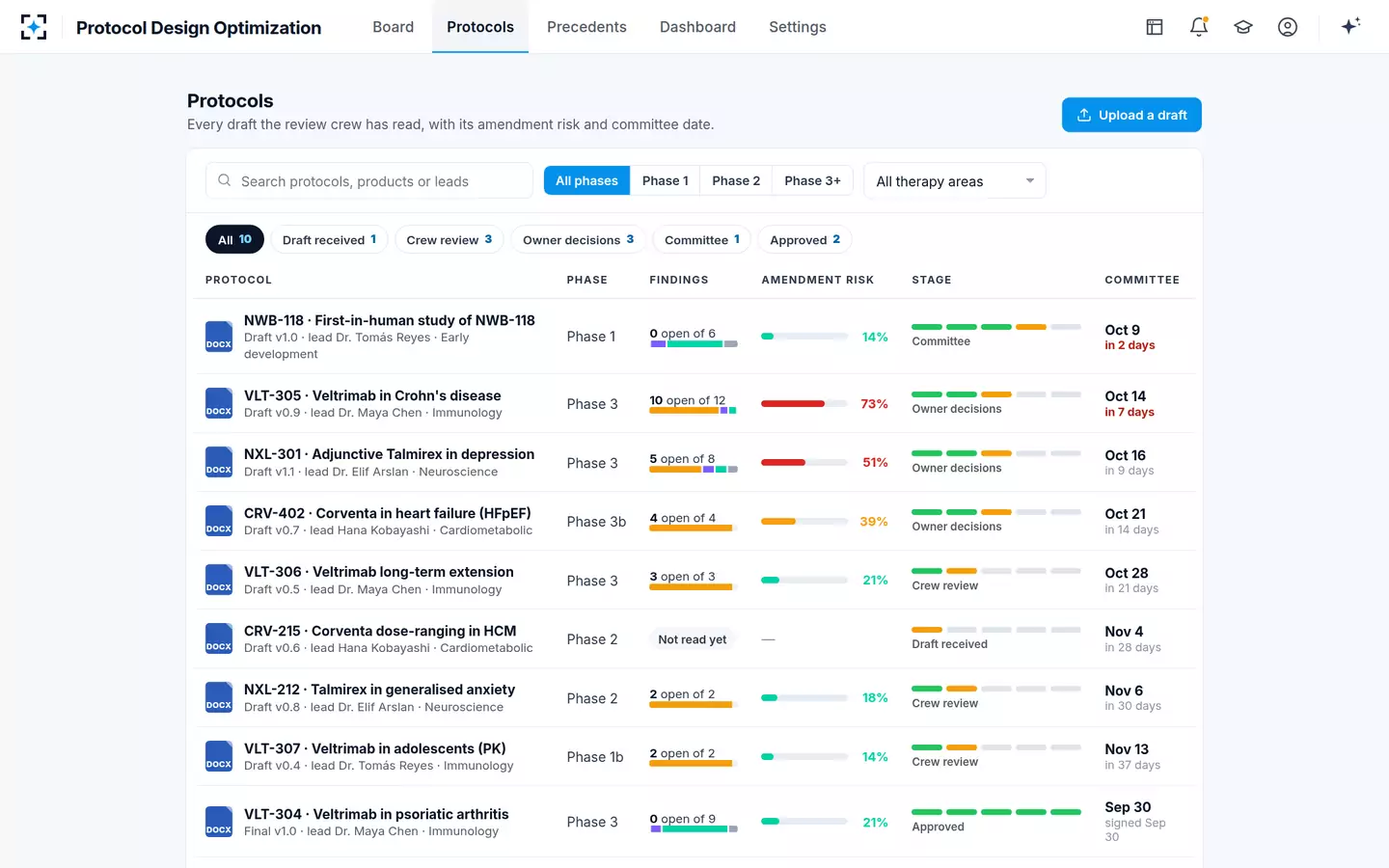
What makes it work or fail is not the reading but the routing. A finding with no owner is a comment; a finding with an owner, a likelihood and a decision is a review. In this solution each area has a named owner — eligibility and population, endpoints and estimands, safety monitoring, operational feasibility, consistency — and the owner accepts, rejects with a written reason, or raises the finding to the committee.
Every draft before the committee, with its findings and its amendment risk
Can you do protocol design review in Word and Excel?
Yes, and plenty of good sponsors do. The review itself is reading, and a well-run comment cycle with a real checklist catches a great deal. The question is what it costs and where it quietly fails, which is usually the same two places: the archive nobody has time to reread, and the three-way consistency check nobody can do reliably by eye.
The same review, by hand and with the archive read for you
A comment cycle in Word, reconciled by hand: Arrive by email and in tracked changes, in several versions, and are reconciled by the protocol lead.
The same cycle with the draft read against the archive: Still arrive from people — the difference is that the mechanical findings are already raised and attributed, so the comment cycle is about judgement.
A comment cycle in Word, reconciled by hand: Exists, and is almost never reread before a committee date. The knowledge lives in whoever ran the earlier study.
The same cycle with the draft read against the archive: Read on every draft. Each finding cites the summary of changes it resembles, with what that amendment cost and how long it took.
A comment cycle in Word, reconciled by hand: Checked by eye, late, by one person. On the sample 148-page draft the automated check found six mismatches.
The same cycle with the draft read against the archive: Compared for every procedure and visit, with all three passages shown side by side so a person decides which is right.
A comment cycle in Word, reconciled by hand: Often nothing visible. The reason lives in an email thread.
The same cycle with the draft read against the archive: A rejection needs a written reason and goes on the decision log the committee and an inspector see.
A comment cycle in Word, reconciled by hand: Days of the protocol lead's time per draft, most of it reconciliation rather than thinking.
The same cycle with the draft read against the archive: A setup cost in getting the archive and standards in, then review time spent on the findings that need judgement.
The honest summary: the tool does not replace the review, it removes the clerical half of it. If your protocol lead spends four days per draft reconciling and half a day thinking, the prize is the three and a half days, not the removal of the reviewers.
Does structured authoring reduce amendments on its own?
Not by itself, and the guideline that defines structured authoring says so in plain terms. ICH M11 states that neither the guideline, the template nor the technical specification teaches how to design a good trial or describes what a well-crafted protocol looks like. They set common instructions for where content goes. Placement is not design.
They do not supersede or negate other guidelines that establish requirements for protocol content.
ICH M11 Clinical Electronic Structured Harmonised Protocol, §1.3, adopted 19 November 2025
M11 does name the problem it solves: differences in format and core content between sponsors make protocols harder to search, review and assess. That is a real problem and structure is the right answer to it. But the causes of amendments that have been studied are mostly not formatting. A 2023 mixed-methods study of amendments to trials sponsored in the UK found, among other causes, that some amendments traced back to regulatory checks missed during an onerous, error-prone application process (Trials, January 2023) — a process failure, not a template failure. And Tufts research on design variables and trial performance found that protocols that went through more internal reviews before finalisation also had more amendments, longer durations and higher dropout (Ther Innov Regul Sci, March 2022), which should at least complicate any assumption that more review rounds are by themselves the cure.
Where structure does help amendments is second order and worth having: when the synopsis and the schedule are two views of one field, the class of amendment that exists only to reconcile a document with itself disappears. On the sample draft used throughout these guides, six such mismatches were open at once, and every one of them was fixable in the schedule table.
How the category arrived: four adoptions in six years
- E9(R1) to E8(R1)23 months
- E8(R1) to E6(R3)39 months
- E6(R3) to M1110 months
What has to be in place before any of this works
Every one of the four approaches has a prerequisite, and a common reason a pilot disappoints is that the prerequisite was assumed rather than checked. A design review in particular is only as good as the archive it reads: forty protocols with no summaries of changes attached, or summaries that say "various administrative updates", give a reviewer nothing to cite.
What you need before a design-review pilot is worth running
- Past protocols, final versions, in one place
The sample archive behind these guides holds 41. They do not have to be in one format, but they do have to be findable.
- Their summaries of changes, with reasons
The rationale is the part that matters. An amendment log that records what changed but not why can be classified but not learned from.
- Your design standards, written down
Even three or four — a maximum visit length, a rule about washouts, a rule about stopping criteria — turn a generic review into your review.
- A named owner for each area of the protocol
Eligibility, endpoints and estimands, safety monitoring, operational feasibility, consistency. Findings with no owner become comments, and comments are what you already have.
- One draft that is genuinely in flight
A pilot on an approved protocol proves the reading; only a live draft proves whether anything changes as a result.
- A decision about what blocks a committee date
If nothing can hold a draft back, a review is advice. Deciding in advance which findings must be decided first is the difference.
How to choose between build and buy
Most large sponsors can build something that reads a protocol. The question is whether they can keep it. The parts that look easy — splitting a document into sections, matching text against a corpus — are easy. The parts that decide whether it is used are the unglamorous ones: classifying an archive of amendments consistently, keeping the standards current as they change, routing findings to owners who move roles, and holding an audit trail a quality colleague will accept.
A decision grid: start from where your amendments actually come from
| If your summaries of changes mostly say | The failure is | Start with |
|---|---|---|
| A criterion was broadened, or a window extended, after slow enrolment | Design choices made without reference to your own history | A design review that reads the archive — the fourth approach |
| A section disagreed with another section, or with the schedule | Content maintained in more than one place by hand | Structured authoring, plus a consistency check on every draft |
| A safety monitoring rule was added after a finding in an earlier study | Safety design not tied to the product's own history | A design review with the investigator brochure and earlier results in scope |
| The sample size or the interim timing changed | Quantitative assumptions not tested before finalisation | Simulation, owned by biostatistics |
| A regulatory or administrative requirement was missed | A process gap rather than a design gap | Fixing the submission process first; no design tool addresses this |
| Protocols are inconsistent between studies, and reviewers get lost | No shared structure | The ICH M11 template, before anything else |
Two rules of thumb. Buy where the value is in something you do not have — an archive classified consistently, a reading of the guidelines kept current. Build where the value is in something only you have, such as a therapy-area rule nobody else would write. And in either case, the thing that decides adoption is whether a reviewer gets findings they would have wanted to know, which can only be tested on a real draft.
Validation, records and the questions quality will ask
Whatever you choose, it is a computerised system used in a clinical trial, and ICH E6(R3) sets the expectation for how it is governed: "documented procedures should be in place to ensure the appropriate use of computerised systems in clinical trials for essential activities related to data collection, handling and management" (ICH E6(R3) §4.3.1). The validation effort should be proportionate to what the system actually does — a tool that proposes wording to a named person is a different risk from one that writes into a controlled document.
The questions a quality colleague will ask are predictable, so collect the answers before the demonstration rather than after: what does the system do and what is left to people; who can change a rule or an owner, and is the change on the record; what does the audit trail hold, and can it be exported; what happens when a new version of a draft arrives — are earlier decisions carried over, and on what basis; and who signs, with what stated meaning.
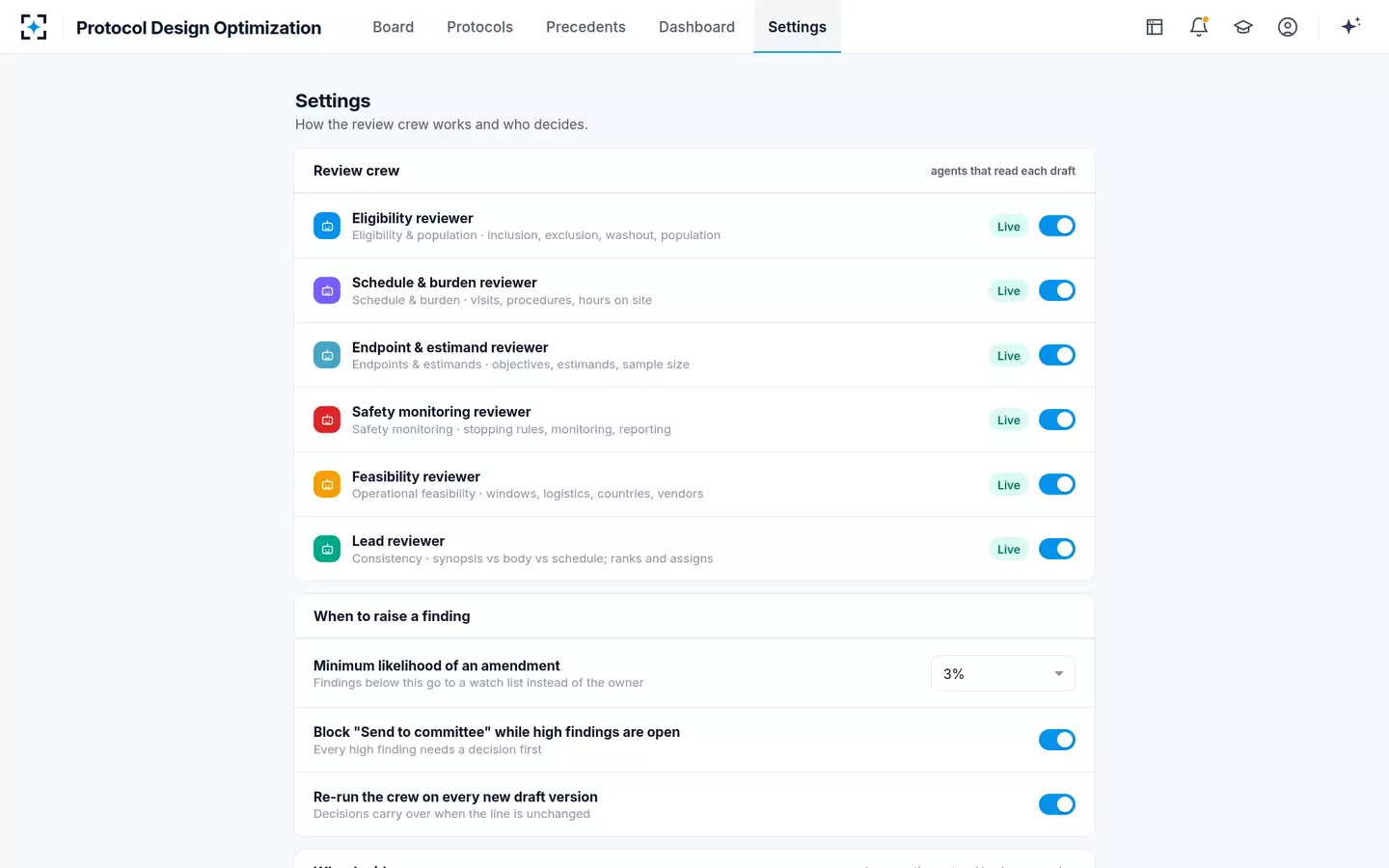
The rules, the thresholds and the owners, as settings rather than a build
One last caution about implementation time, because every supplier in this category is asked for a number. Any figure quoted before a sponsor's archive has been looked at is a guess, and the variable that moves it most is not the software: it is how much of the archive has usable reasons attached. Ask for the gating list rather than the duration.
ICH E8(R1) states the standard all four approaches are ultimately judged against: "the foundation of a successful study is a protocol that is both scientifically sound and operationally feasible" (ICH E8(R1) §3.3.5). A template and a structured tool help with the document; a simulation helps with the first half; a design review is aimed squarely at the second. To see what the fourth approach produces on a draft, start from Protocol Design Optimization, or read the review checklist it runs.
Questions people ask
What is clinical trial design software?
The phrase covers four distinct things: a protocol template, a structured authoring tool built on ICH M11, a trial simulation package, and a design review that reads a finished draft against a sponsor's own history and the ICH guidelines. They fix inconsistent documents, duplicated content, untested quantitative assumptions and repeated design mistakes respectively. A short list goes wrong when it compares products from different rows against one set of criteria.
Does a structured protocol tool reduce protocol amendments?
It removes one class of them — the amendment that exists only to reconcile a document with itself — and ICH M11 is explicit that neither its guideline nor its template provides instruction on developing a well-designed trial or characterises a well-crafted protocol. If your amendments come from criteria, windows and monitoring rules rather than from formatting, structure alone will not change the number.
Is trial simulation software the same as protocol optimisation?
No. Simulation evaluates the quantitative properties of a design you have already chosen — power, duration, the behaviour of an adaptive rule — and takes your assumptions as given. Design review challenges the design choices that produce those assumptions, such as whether the eligibility criteria will deliver the participants the sample size needs. They are complements, usually bought by different functions.
Can you run a protocol design review without buying anything?
Yes. A written checklist, a named owner per section and a disciplined read of your last ten summaries of changes will catch a lot. What hand review reliably loses is the archive nobody has time to reread and the three-way check between the synopsis, the body and the schedule, which is where a 148-page draft can carry half a dozen mismatches at once.
What do you need in place before a pilot?
Past protocols in one place, their summaries of changes with reasons, a few written design standards, a named owner for each area, one draft that is genuinely in flight, and a decision about which findings hold a committee date. The second item is the one to check first: an amendment log that records what changed but not why can be classified but not learned from.
What should a design review tool never promise?
That it will eliminate amendments, that its risk figure is a measurement rather than an estimate from your own archive, that it has regulatory approval or qualification of any kind, or that it can give you an implementation date before anyone has looked at your archive. A number quoted before that is a guess, and the variable that moves it is your documents rather than the software.