A clinical trial protocol review checklist is worth building because the alternative — six functions commenting in parallel and one person reconciling them — reliably misses the same things. The good news is that you do not start from a blank page: ICH E8(R1) publishes a list of considerations for identifying what is critical to quality in a study, and it maps almost line for line onto checks a reviewer can run on a draft. The rest of your checklist should come from your own archive of summaries of changes, one line per amendment you have already paid for. Botminds' Protocol Design Optimization runs a checklist of exactly that shape — guideline considerations plus the sponsor's own design standards and past amendments — but the checklist belongs to the sponsor, and a list nobody owns catches nothing whoever runs it.
Screens on this page show sample data on fictional studies. The published figures come from regulators and peer-reviewed research, linked where they appear.
Why the list is worth building
57%
of protocols in a Tufts study had at least one substantial amendment
45%
of those amendments were judged avoidable — the share a review can reach
16.2%
of procedures per phase III protocol were classified non-core in 2026 benchmarking
What a clinical trial protocol review checklist should include
Three things, in this order. First, the considerations from ICH E8(R1) — they are agreed, they are short, and an agency reviewer has read them. Second, one line for every avoidable amendment in your own archive, written as a check rather than as a story: not "VLT-204 had to broaden inclusion 3" but "does any eligibility criterion narrow the population beyond the target label without a stated scientific reason?". Third, your own design standards, which usually already exist as SOPs and are rarely read at the right moment.
And two things each item needs, which is where most checklists fail. Every item needs an owner — the seat that decides it, not the person who notices it. And the checklist as a whole needs a rule about what blocks a committee date, because a check that cannot fail is not a check.
A protocol review checklist, grouped by section
- Section 3, Objectives and estimands — is the primary estimand stated, with a strategy for each named intercurrent event?
Prevents: the agency asking for the strategies after first participant in. "To be detailed in the analysis plan" is the finding, not the answer.
- Section 3 — does the objective, the endpoint and the analysis describe one question?
Prevents: an amendment to align a section with itself. Read the three together, out loud, once.
- Section 5, Population — does every criterion that narrows the population beyond the target label state a scientific reason?
Prevents: the broadening amendment that follows slow enrolment. Ask for the estimated effect on the eligible pool as well as the reason.
- Section 5 — does any criterion contradict a randomisation stratum or another criterion?
Prevents: a stratum in which every participant falls into one level, which is found at the first interim and fixed by amendment.
- Section 5 — is every exclusion that a site will read as absolute written with its intended exceptions?
Prevents: screen failures for conditions you never meant to exclude. "History of any malignancy" excludes a treated basal cell carcinoma unless it says otherwise.
- Section 8, Assessments and schedule — what are the hours on site per visit, and which visits exceed your own standard?
Prevents: burden-driven dropout, and the amendment that removes assessments once sites complain. Total it before first participant in, not after.
- Section 8 — does every procedure support a required endpoint or a safety rule?
Prevents: paying participants' time for data nobody analyses. An exploratory objective is a legitimate answer if it is written down as one.
- Section 8 — do the synopsis, the body section and the schedule agree on every procedure and visit?
Prevents: deviations at every site that follows the table. This check is mechanical and should never be done by eye.
- Section 8 — is every window wide enough for the third party it depends on?
Prevents: the screening-window extension. Build the window from your own site history for endoscopy suites, imaging centres and central readers.
- Section 9, Safety monitoring — does every known or suspected risk have monitoring and a stopping or interruption rule?
Prevents: adding stopping rules mid-study and re-consenting. Read the investigator brochure and the earlier studies, not just the current label.
- Section 10, Statistics — is the analysis plan pre-specified, and does it match the estimand rather than a familiar method?
Prevents: an estimand changed after the fact, which ICH E9(R1) warns reduces the credibility of the trial.
- Across the document — is every number that appears twice the same number?
Prevents: the contraception period, the follow-up duration and the visit window that disagree between sections. Cheap to check, embarrassing to amend.
Which protocol sections need the most review attention
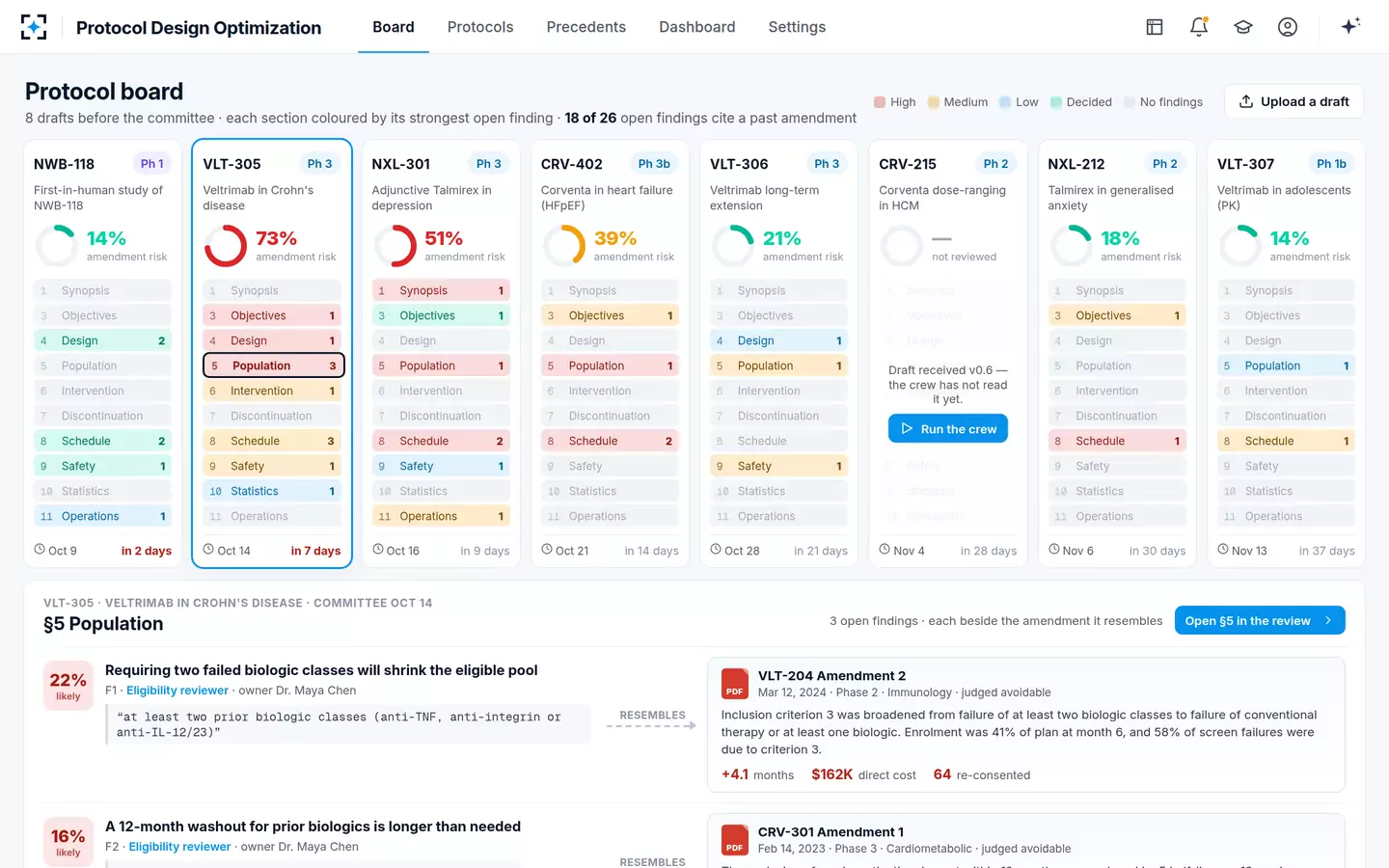
Not evenly. On the sample draft used throughout these guides — a Phase 3 immunology study at 148 pages — the open findings cluster in two places: the population section and the assessments and schedule section carry three each, and the remaining findings are spread one apiece across objectives and estimands, trial design, intervention, safety monitoring and statistics.
Where the findings sat on one 148-page draft
One draft is an anecdote, not a distribution. The useful move is to run the same count over your own last twenty amendments and see which sections produced them, because that ordering is more stable than any published average and it is the ordering your reviewers should spend their time in.
Two sections are likely to come near the top of an archive for structural reasons. Population, because eligibility is where a scientific instinct to keep the trial clean collides with an operational need to enrol. And assessments and schedule, because it is the only section written three times — in the synopsis, in the body and in the table — and the three are reconciled by hand.
The critical-to-quality factors to check in a draft
ICH E8(R1) defines these precisely: "these critical to quality factors are attributes of a study whose integrity is fundamental to the protection of study participants, the reliability and interpretability of the study results, and the decisions made based on the study results" (ICH E8(R1) §3.2). Section 7 of the same guideline then lists the considerations that help identify them, and it reads very much like a review checklist that somebody declined to call one.
ICH E8(R1)'s own considerations, and the check each one becomes on a draft
| The guideline consideration | What that is on a real draft | How it can fail |
|---|---|---|
| "The eligibility criteria should be reflective of the study objectives and be well documented in the clinical study protocol." | Read every inclusion and exclusion criterion against the objective and the target label. | A criterion narrower than the label, with no reason in the protocol — a classic source of an avoidable amendment. |
| "The number of participants included, the duration of the study, and the frequency of study visits are sufficient to support the study objective." | Count visits and total hours on site; check the sample size against the stated estimand. | Sufficient in one direction only: enough visits for the objective, more than enough for the participant. |
| "The protocol specifies the collection of data needed to meet the study objectives, understand the benefit/risk of the drug, and monitor participant safety." | Trace every row of the schedule to an objective or a safety rule. | Rows that trace to nothing, which the 2026 benchmarking classifies as non-core. |
| "The choice of response variables and the methods to assess them are well-defined and support evaluation of the effects of the drug." | Check the endpoint wording in the synopsis against the body and the analysis section. | Three wordings of one endpoint, which become three different endpoints by database lock. |
| "The statistical analysis plan is pre-specified and defines the analysis methods appropriate for the endpoints and the populations of interest." | Check that the analysis matches the estimand rather than a method the team is used to. | A plan written to a familiar method, with the estimand adjusted afterwards to fit it. |
| "The feasibility of the study should be assessed to ensure the study is operationally viable." | Compare screening windows, shipping and vendor turnaround with your own site history. | A 28-day screening window for a procedure your sites take 19 days to book and six days to read centrally. |
| "Adequate measures are used to protect participants' rights, safety, and welfare." | Check that every known risk from earlier studies has monitoring and a stopping or interruption rule. | A liver finding in an earlier study with no hepatic stopping rule in this one. |
| "Information provided to the study participants should be clear and understandable." | Read the burden the schedule implies as a participant would see it, in hours and journeys. | A consent form that is accurate and a schedule that nobody described in hours until month six. |
Eligibility and population: the four tests
Four questions catch most of what this section produces. Does the criterion narrow the population beyond what the target label needs, and if so is the scientific reason written down? What is the estimated effect on the eligible pool — a number, even a rough one, changes the conversation. Does the criterion contradict another criterion, or a randomisation stratum? And will a site read it as more absolute than you meant it?
The last one is underrated. "History of any malignancy" is a perfectly ordinary exclusion that, read literally by a coordinator, excludes a participant whose basal cell carcinoma was removed a decade ago. The exclusion that was meant and the exclusion that was written differ by one clause, and the difference shows up as screen failures long before anyone re-reads the protocol.
The same arithmetic in the other direction is worked through in the companion guide on screen failure rate and eligibility criteria, which is where the effect of a criterion on the eligible pool becomes a number you can defend.
Schedule and burden: the arithmetic checks
This group is the easiest to run and the most often skipped, because it is arithmetic rather than judgement. Total the hours on site per visit. Mark every visit above your own standard. Count procedures with no endpoint and no safety rule behind them. Check every window against the third party it depends on. Then look at the shape: a schedule that puts its longest days inside the induction period is spending goodwill before the treatment has earned any.
Benchmarking published in 2026 attributes up to 30% of the burden on participants and sites to procedures that are non-core or non-essential, which gives the count a size. The full method — how to total hours before the first participant, and which rows come out first — is in the companion guide on reducing patient burden.
Objectives, endpoints and the estimand: what must be stated before finalisation
One check, with a clear pass condition: the protocol states the primary estimand, and for each intercurrent event it names, it states which strategy applies. A draft that defers the strategies to the analysis plan fails this check, however complete the rest of section 3 looks, because the strategy decides the population, the follow-up and what the case report form must capture after a participant stops treatment.
ICH E8(R1) adds the companion check on the analysis side: "the statistical analysis plan is pre-specified and defines the analysis methods appropriate for the endpoints and the populations of interest." Pre-specified and appropriate are two separate tests — a plan can be written in advance and still be written to a method the team prefers rather than to the question the estimand asks. What this costs when it is found late is set out in the guide on estimands and intercurrent events.
How to check the synopsis against the body and the schedule of activities
Mechanically, and never by eye. Build a list of every procedure and every endpoint, and for each one record the week it appears in the synopsis, the week in the body section, and the week in the schedule table. Then look only at the rows where the three differ. On a 148-page draft this is a few hundred comparisons, which is why a person doing it at the end of a comment cycle finds some of them and not all.
When they differ, assume the table wins in practice — coordinators build visit calendars from it — and decide which of the three is right rather than defaulting to the one that was written first. The FDA's draft guidance on protocol deviations points at the same place from the other end, asking that "if there are recurrent protocol deviations that are similar in nature, the sponsor or clinical investigator should conduct a root-cause analysis to determine what actions may be appropriate to address the noted noncompliance and prevent recurrence of the same or similar deviations" (FDA, December 2024). The same deviation at many sites is usually a document disagreeing with itself.
Who should sign off each section of a protocol, and what blocks the committee
A checklist without owners produces comments; a checklist with owners produces decisions. The grid below is one workable allocation — the seats matter more than the titles, and the point is that it is written down before the review rather than negotiated during it.
Who decides each group, and what happens when an item fails
| Checklist group | The seat that decides | When an item fails |
|---|---|---|
| Objectives, endpoints and the estimand | Biostatistician | Accept, reject with a written reason, or raise to the committee. A statistical suggestion never goes to anyone else. |
| Eligibility and population | Clinical scientist, protocol lead | Accept with the wording change, or record the scientific reason that justifies the narrower criterion. |
| Schedule, burden and feasibility | Clinical operations lead | Remove the row, widen the window, or state why the burden is necessary. Statistical assessments move only with the statistician. |
| Safety monitoring | Medical monitor | Add the monitoring and the stopping rule, or record why the earlier finding does not apply here. Never downgraded below medium. |
| Internal consistency | Lead reviewer, then the protocol lead | Decide which of the three passages is right and fix the other two. Almost always fixable in the schedule table. |
| The draft as a whole | Protocol lead, then the committee chair | The lead signs the disposition log with its stated meaning; the chair takes the decision on the protocol. |
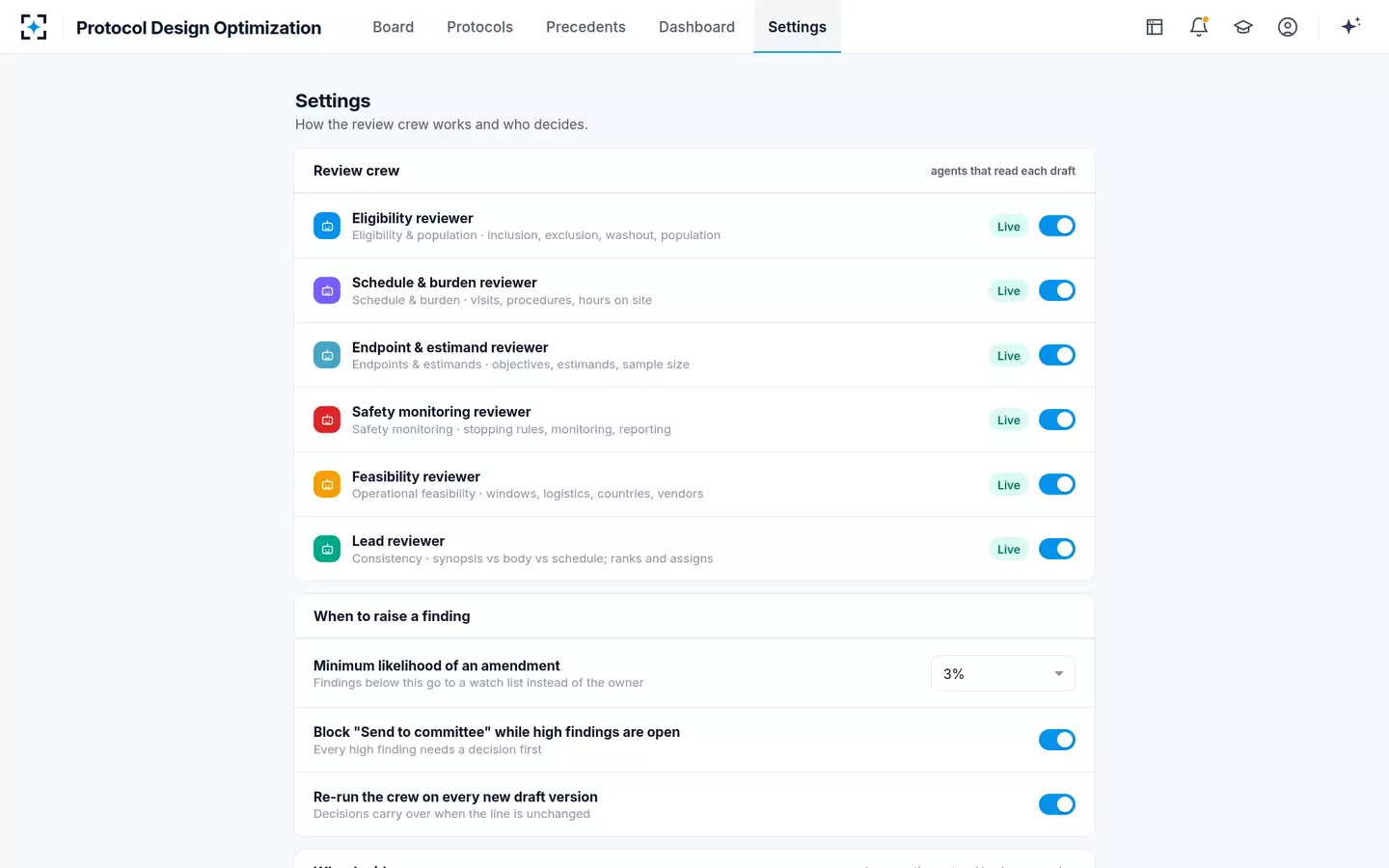
Then the rule that gives the checklist teeth: which findings must be decided before the draft can go to committee. In this solution it is a setting — high findings hold the draft back, and the protocol lead cannot sign while one is open — and whether you implement it in software or in a procedure matters much less than whether it exists. A checklist in which every item can be left open is a form, not a control.
The thresholds, the owners and the rule that holds a draft back, as settings
How to stop a checklist becoming a tick-box exercise
The guideline that gives you the best checklist also warns about checklists, and the warning should sit inside your list rather than be quietly left out of it.
Creating a culture that values and rewards critical thinking and open, proactive dialogue about what is critical to quality for a particular study or development programme, going beyond sole reliance on tools and checklists, is encouraged.
ICH E8(R1) General Considerations for Clinical Studies, §3.3.1, adopted 6 October 2021
The same section adds that inflexible, one-size-fits-all approaches should be discouraged: standard operating procedures are necessary and beneficial, but study-specific strategies are needed too. Read together, that is an argument for a checklist that is short, owned and current, rather than for no checklist at all.
Three habits keep a list honest. Make every item a question with a possible answer of "no", not a statement to agree with — "does every criterion that narrows the population state its reason?" rather than "eligibility criteria reviewed". Keep one line per avoidable amendment you have actually had, and delete items that have not caught anything in two years, so the list stays short enough to be read. And leave room at the end for the finding nobody's list predicted: the last question on any good checklist is "what about this study is unusual, and what does that put at risk?".
It is also worth being explicit that a checklist is a floor and not a ceiling. ICH E6(R3) describes the target the whole exercise serves: a protocol that is clear, concise and workable in practice, kept free of unnecessary complexity, and designed to reduce or remove the important risks to participants and to the reliability of the data (Appendix B). No list of twelve items guarantees that. It just stops the same twelve failures.
Recording the decision so an inspector can follow it
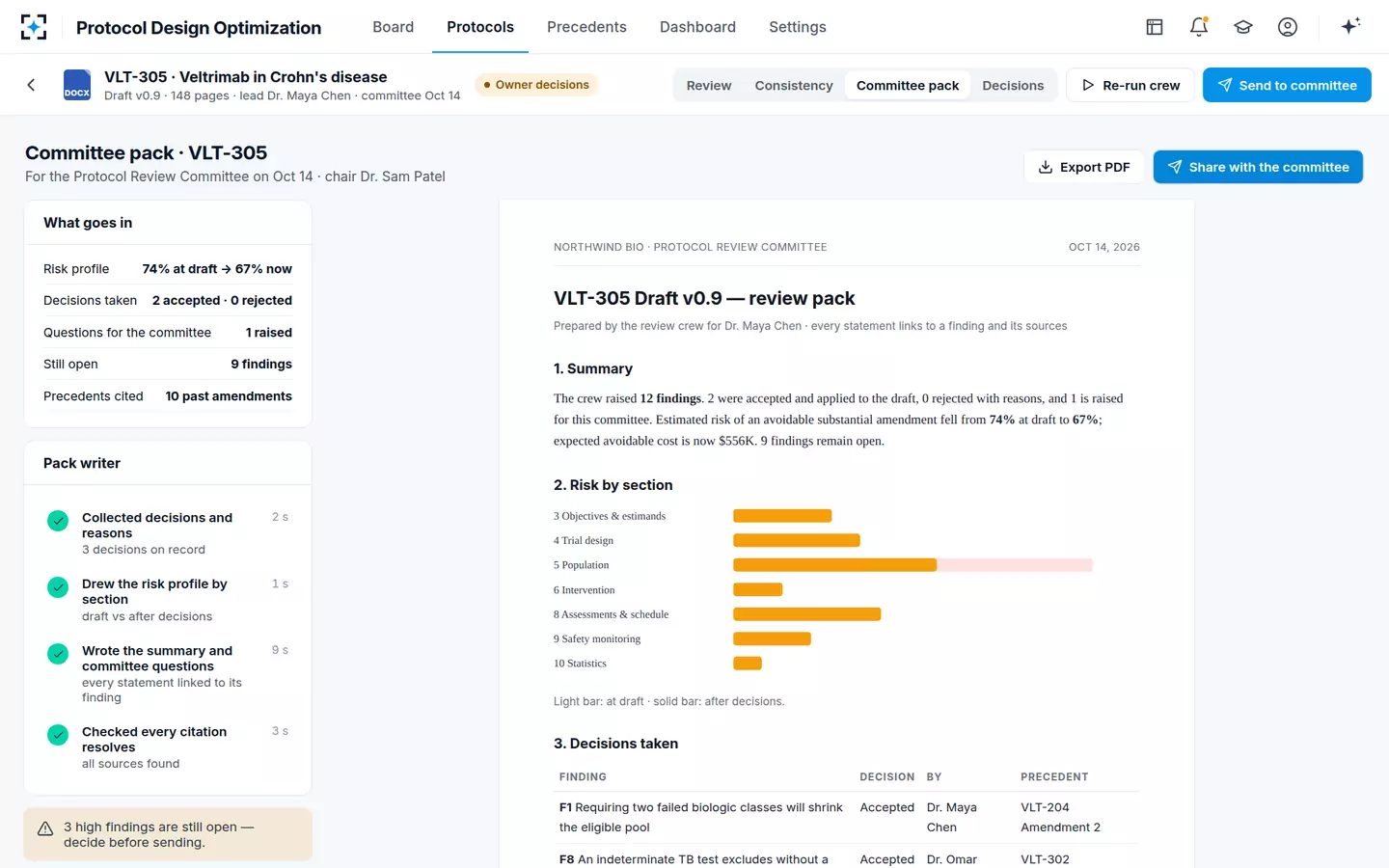
What an inspector asks for is rarely the checklist. It is the trail: which version of the draft the check was run against, what was found, who decided it, when, and why. A rejection with a written reason is far more useful evidence than an acceptance, because it shows a judgement was made rather than a box filled.
Definitions matter here too, because the same vocabulary carries into conduct. ICH E6(R3) defines the category that review is ultimately trying to prevent: important protocol deviations, the subset that could significantly affect how complete, accurate or reliable the trial data are, or a participant's rights, safety or wellbeing (§3.9.3). A design review that prevents one of those has done something measurable; a review that produces a signed form has not.
A pack the committee can read, written from the decisions
What to ask a supplier whose tool claims to run your checklist
Five questions, and they are mostly about ownership rather than coverage. Can we add, edit and remove items ourselves, without a support request? Can we set the owner for each group, and change it when someone moves role? What happens to a finding below the threshold — is there a watch list a person can open, or does it disappear? What does each finding carry: the protocol line it is about, and a source we can open and read? And what does the audit trail hold, and can we export it?
Two answers should give you pause. "The checklist is built in" means it is the supplier's list, not yours, and your archive's lessons have nowhere to go. And a confidence score with no source behind it is not a finding — a reviewer cannot act on a number they cannot check.
Eight drafts, each section coloured by its strongest open finding
The thing worth remembering when you compare lists is that the checklist is the cheap part. Writing twelve good questions takes an afternoon. Keeping them owned, current and capable of holding a committee date is the work, and it is the part a supplier should be asked about. To see the shape of it on a real draft, start from Protocol Design Optimization, or read the four approaches compared before you write a short list.
Questions people ask
What should a clinical trial protocol review checklist include?
The considerations in ICH E8(R1) §7, one line for each avoidable amendment in your own archive, and your own design standards. Each item should be a question that can be answered "no", each should name the seat that decides it, and the list as a whole needs a rule about which findings must be decided before a draft can go to committee. Twelve good items beat sixty generic ones.
Which sections of a protocol need the most review?
Often the population section and the assessments and schedule section. Population, because eligibility is where scientific caution collides with the need to enrol; assessments and schedule, because it is the only content written three times — synopsis, body and table — and reconciled by hand. Count your own last twenty amendments by section before accepting anyone's ordering, including this one.
What are critical-to-quality factors, and how do you check them?
ICH E8(R1) defines them as attributes of a study whose integrity is fundamental to protecting participants, to the reliability and interpretability of the results, and to the decisions made from them. Section 7 of the guideline lists considerations for identifying them, and each one converts into a check on a draft: eligibility criteria against the objectives, visits and duration sufficient for the objective, data collection tied to the objectives and to safety, endpoints well defined, the analysis plan pre-specified and appropriate.
Can a checklist replace a reviewer?
No, and ICH E8(R1) says as much, encouraging a culture of critical thinking and open dialogue "going beyond sole reliance on tools and checklists". A list catches the failures you have already had. It does not catch the one that is specific to this study, which is why the last question on a good list asks what is unusual about this protocol and what that puts at risk.
What should block a protocol from going to the committee?
Whatever you decide, written down in advance. One workable rule is that any finding judged likely to force a substantial amendment must have a decision — accepted, rejected with a reason, or raised for the committee — before the draft is sent. The principle matters more than the threshold: if every item can be left open, the checklist is a form rather than a control.
How do you record a protocol review so an inspector can follow it?
Keep the version of the draft each check ran against, the finding, the owner, the decision, the time and the reason — especially for rejections, which show judgement was exercised. ICH E6(R3) defines important protocol deviations as those that may significantly affect the completeness, accuracy or reliability of trial data or a participant's rights, safety or well-being; a review trail that shows one being prevented at the design stage is the evidence worth keeping.