The cost of protocol amendments is usually quoted as one number — about $535,000 for a Phase 3 substantial amendment, about $141,000 for Phase 2 — and that number is the direct cost of implementing the change, the part a finance system can see. It is the smallest part of the bill. What makes an amendment expensive is everything the published median does not count: the months between deciding to change the protocol and the last country approving it, the ethics and agency re-approvals, the sites retrained, the participants asked to consent again, and the enrolment an amended study never recovers. Botminds' Protocol Design Optimization puts that price in front of the person writing the draft, by matching each design choice to the past amendment it resembles and showing what that one actually took — months, direct cost, approvals, re-consents — while the choice can still be made differently.
Two kinds of figure appear on this page and they are never mixed. Published benchmark figures come from peer-reviewed studies and are linked where they appear. Figures from inside the solution — study VLT-204 and its second amendment, the sample archive — are sample data on fictional studies, shown with the study name so they cannot be read as a measured industry average.
What the published cost of an amendment is, and how thin the base underneath it is
$141K
median direct cost to implement one substantial amendment on a Phase 2 protocol
$535K
median direct cost on a Phase 3 protocol
136
amendments the impact assessments were based on, from a study of 836 protocols
direct-cost estimates derived from 52 protocols
What a protocol amendment costs: the published numbers, by phase
The benchmark figure comes from one study, and it is worth knowing how it was made before leaning on it. Data from 836 Phase 1 to 2b/4 protocols gave the prevalence of amendments; impact was assessed on 136 randomly selected amendments; and the money came from a smaller set again — medians of US$141,000 to implement one substantial amendment on a Phase 2 protocol and $535,000 on a Phase 3 protocol. Fifty-two protocols produced those medians. That is enough to anchor a conversation and not enough to budget a programme, which is the first argument for a sponsor building its own archive of what its own amendments cost.
The count matters as much as the unit price, because amendments are not a once-per-study event. The same study put Phase 2 and Phase 3 protocols at a mean of 2.2 and 2.3 global amendments each. A later study, on data gathered in 2022 from 950 protocols across sixteen companies, found higher counts still and a wide split by therapy area.
Mean number of amendments per protocol, by phase and by therapy area
Multiply even conservatively and the number stops being a line item. A Phase 3 protocol carrying two substantial amendments at the published median is spending over a million dollars of direct cost on changes to a document — before anyone counts a day of delay. And the counts in the later sample are higher, not lower, than in the earlier one.
What is inside the direct cost of an amendment, and what is left out
Direct cost is the work a sponsor can invoice to the change: writing and quality-checking the amended protocol and the consent documents, assembling and filing the submissions, the regulatory and ethics fees, retraining the sites, updating the electronic case report forms and the randomisation system, reprinting materials, re-labelling or re-supplying where a dosing change requires it, and the project management around all of it. It is real money and it is countable, which is why it is the number that gets published.
Four costs sit outside it, and each is larger on a late-stage study. The first is time: the months between the decision to amend and the last approval, during which enrolment at affected sites is often slowed or paused. The second is the re-approval load — every ethics committee and competent authority that approved the original has to see the change, and the cost is set by the slowest, not the average. The third is re-consent: the participants already enrolled who must be told, and in many cases asked to sign again. The fourth is enrolment that never comes back, which the benchmark study measured directly rather than estimated.
The Trials study that examined 242 approved amendments from 53 clinical research studies makes the same point about the published figure from the non-commercial side: an amendment "can take a significant amount of time and resources to develop, review and implement at participating sites", and the authors note that the actual costs are likely to be much higher once indirect costs such as staff time are included.
Six costs to record against every substantial amendment, so the next estimate is your own
- Writing, quality control and submission assembly
The amended protocol, the consent documents in each language, the cover letter and the justification the regulator asks for.
- Agency and ethics re-approval
Fees and staff time per country and per committee — and the date of the last approval, because that sets the calendar.
- Site retraining and re-activation
Monitor and coordinator hours at every affected site, counted from the approval that site was waiting for.
- Re-consenting participants already enrolled
How many participants, how many extra visits, and how many withdrew rather than sign again.
- Systems, materials and vendor updates
Case report forms, the randomisation and drug-supply system, laboratory manuals and printed materials.
- Enrolment paused or slowed while the change lands
Screening days lost at sites that stopped until they were retrained — the cost that never appears on an invoice.
The clock: from the decision to amend to the last approval
Elapsed time is the cost that compounds, because every other cost runs while it does. The sample archive inside the solution records it per amendment, and the one the eligibility reviewer cites most often ran 4.1 months from the decision to amend to the last approval — on a study with 52 ethics committees to satisfy. Nothing in that span was unusual: an impact assessment, a redraft, consent documents in each language, a filing, a staggered set of approvals, then site retraining in the order the approvals arrived.
The comparison that matters is not amendment against no amendment. It is the same change, made at two different moments.
The same design change, written into the draft and written as an amendment
- The scheduled review window, first circulation to committee23 working days
- Decision to amend through the last of 52 ethics approvals4.1 months
The upper lane is the argument for design review in one picture. The change itself is the same; made in the draft, it rides inside time that was already booked, before anything depended on it. That is also why the review window is the first thing to protect when a committee date moves — on the sample Phase 3 draft, the estimated time spent checking the draft against past amendments and design standards is four working days out of twenty-three, and it is the step that disappears first.
Re-consent: who has to be asked again, and what the rule actually requires
The regulation is narrower than the practice, and knowing the difference is worth money. The consent regulation requires that the consent document include, where appropriate, "A statement that significant new findings developed during the course of the research which may relate to the subject's willingness to continue participation will be provided to the subject." That is a duty to inform, and it attaches to significant new findings rather than to amendments as a class. Whether a participant must also sign a revised consent form is a judgement the reviewing ethics committee makes on the particular change.
In practice the answer turns on three questions. Does the change alter anything the participant was told — the risks, the procedures, the duration, the alternatives? Does it change what the participant will actually do? And does it apply to people already enrolled, or only to those not yet screened? A new exclusion criterion affecting only future screening usually needs no re-consent; a new liver-monitoring schedule for everyone on treatment usually does. On the sample amendment, 64 participants were re-consented: a subset, chosen by what the change touched.
The cost of re-consent is rarely the document. It is the visit. A participant who must sign before the next dose either comes in early or waits, and the coordinator time, the scheduling and the occasional withdrawal land on the site that already had the least slack.
The ethics and agency re-approvals nobody budgets
A global amendment is not one approval; it is one submission and many decisions. Under the EU Regulation the application for a substantial modification is assessed by the reporting Member State for Part I and by each Member State concerned for Part II, with a decision each — and the Q&A is explicit that different Member States can reach different conclusions on a Part I modification. The submission itself carries a content requirement that is easy to underestimate: it "shall describe the type of change with a justification (e.g. inclusion of a new exclusion criteria in the protocol due to a potential liver toxicity described in section x of the IB)".
Read that example again, because it is the regulator's own illustration of an avoidable amendment. A potential liver toxicity described in the investigator's brochure, turned into an exclusion criterion by amendment — which means the information existed before the protocol was written. The safety monitoring reviewer in the solution looks for exactly that case: a known or suspected risk in the brochure or an earlier study with no corresponding monitoring or stopping rule in the draft.
The budgeting mistake is to cost approvals as a sum rather than as a maximum. Fifty-two committees do not cost fifty-two weeks of calendar; they cost however long the slowest one takes, during which the study is running two versions of the protocol in different countries and the data management team is reconciling both.
How much enrolment an amended protocol does not get back
This is the finding that turns an amendment from an expense into a performance problem. The 2016 benchmark study found that protocols carrying at least one substantial amendment screened and enrolled fewer patients, measured against their original baseline plan, than protocols that were never amended. The later oncology study found the same shape in retention.
Oncology protocols with amendments had significantly lower participant completion rates compared to oncology protocols without amendments, while no significant differences were found among non-oncology.
Botto, Smith and Getz, Ther Innov Regul Sci, July 2024 (58(4):645–654)
Both studies are careful about what that does and does not establish. The 2016 paper also reports that amended protocols tended to be bigger in scope and to run longer, in recruitment and overall — so some of the gap is selection: bigger, longer, harder studies both attract amendments and miss plans. The association is not proof that the amendment caused the shortfall. Whatever the direction of causation, the planning consequence is the same. A development plan that assumes an amended protocol will enrol to its original curve is assuming something the published data does not support.
What does a month of delay cost?
The most recent peer-reviewed estimate puts a number on both halves of it. Working from 409 clinical trial budgets and 645 drugs launched since 2000, a 2024 study in Therapeutic Innovation & Regulatory Science put the direct cost of running a Phase 2 or Phase 3 trial at roughly $40,000 a day, and the sales a launched prescription drug or biologic forgoes at roughly $500,000 a day. The same authors note that the figures usually quoted for both were outdated and anecdotal, which is why they went back to the data.
Read the two numbers for what they are. The $40,000 is an average daily running cost across Phase 2 and 3 budgets — the sites, monitoring, vendors and management that keep going while an amendment waits for its last approval. The $500,000 is average daily sales for a launched product, and it only applies if the delay moves the launch; the study also found daily sales vary widely by therapy area and have been falling year on year. Neither is a constant for your programme. The honest instruction is to compute your own figure once, using these as the cross-check, and then use that single number in every design-review argument: a team that knows what a month costs its own programme can price a four-month amendment against a few extra days of design review and get the same answer every time.
Which amendments are worth paying for
Plenty of them. An amendment that adds monitoring after a genuine new safety signal is the system working; so is one that implements a regulator's request, or that responds to an external event nobody could have designed around. The Trials study's categories are a useful reality check here: "The 'Addition of sites' was the most common amendment change, and the most common reason for amendments was 'To achieve the trial's recruitment target'." Adding sites to hit recruitment is not a design failure in itself — though it is sometimes the downstream repair of one.
The distinction worth making in an archive is not good against bad but avoidable against unavoidable: was the information that would have prevented this change available to the sponsor when the protocol was written? A liver finding in the brochure was. A competitor's readout eighteen months later was not. Classifying past amendments that way is what makes the archive predictive rather than historical, as what a summary of changes archive tells you sets out.
One summary of changes, with what it cost attached
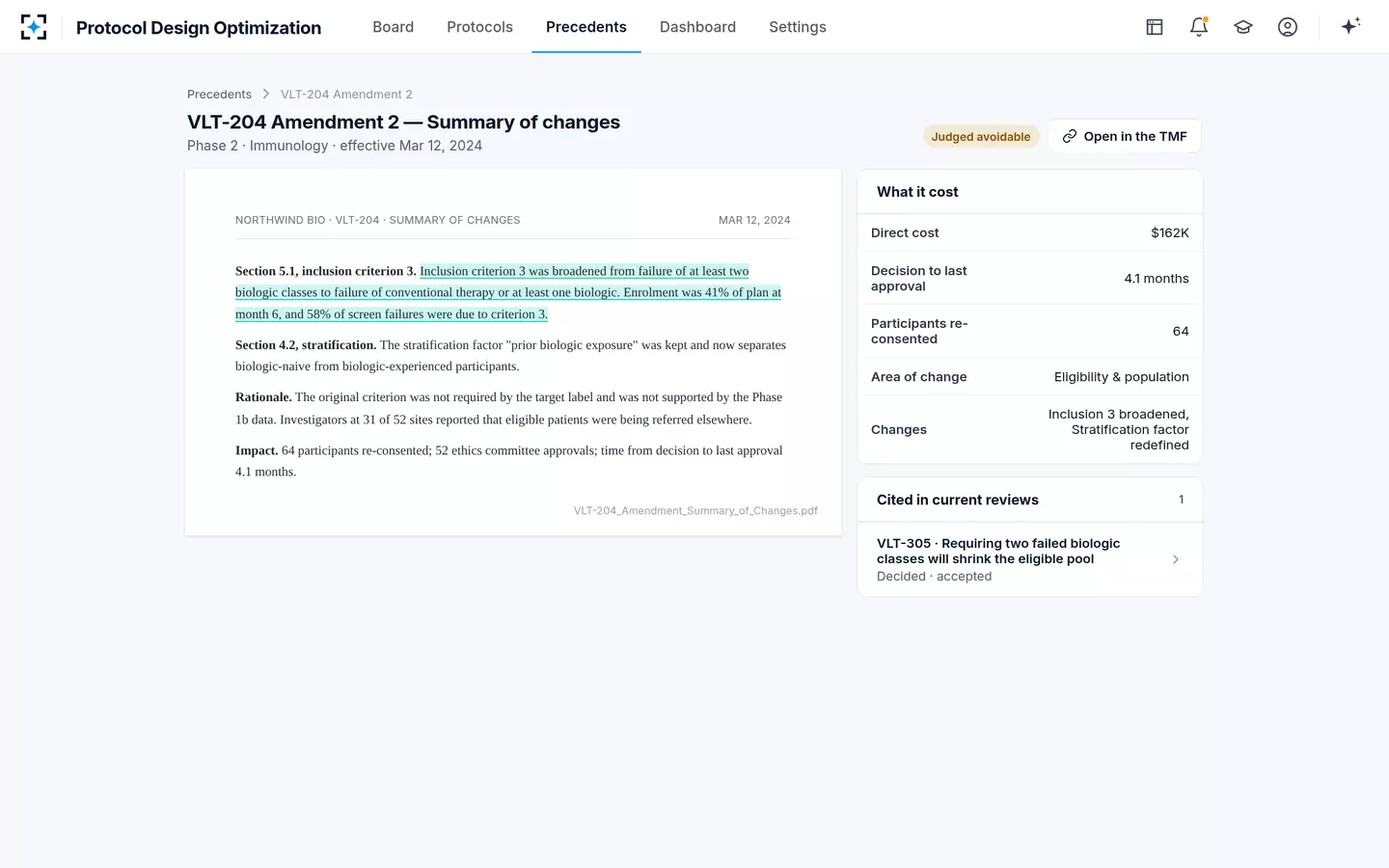
Putting a number on the amendment you prevented
Prevention is hard to claim and easy to overclaim, which is why the arithmetic has to be stated rather than asserted. The approach the solution takes is to price a draft rather than a saving: for each finding, the chance that this design choice forces a substantial amendment, estimated from how often the same choice appears as the changed item in the sponsor's own past amendments; multiplied by what those amendments cost; summed across the draft. On the sample Phase 3 draft, accepting one rewritten eligibility criterion moves the estimated risk of at least one avoidable substantial amendment from 73% to 67% and the expected cost from $656K to $556K — both estimates on sample data, both shown with the decision that produced them.
Three honesty rules make that number usable. It is an expected value, not a saving: no particular amendment was avoided, a probability moved. It is only as good as the archive behind it, which is why a sponsor's first year of classified amendments is worth more than any benchmark. And it belongs to the decision, not to the solution — the risk changed because a named person accepted a different wording, and the log says who.
The archive Protocol Design Optimization prices a draft against
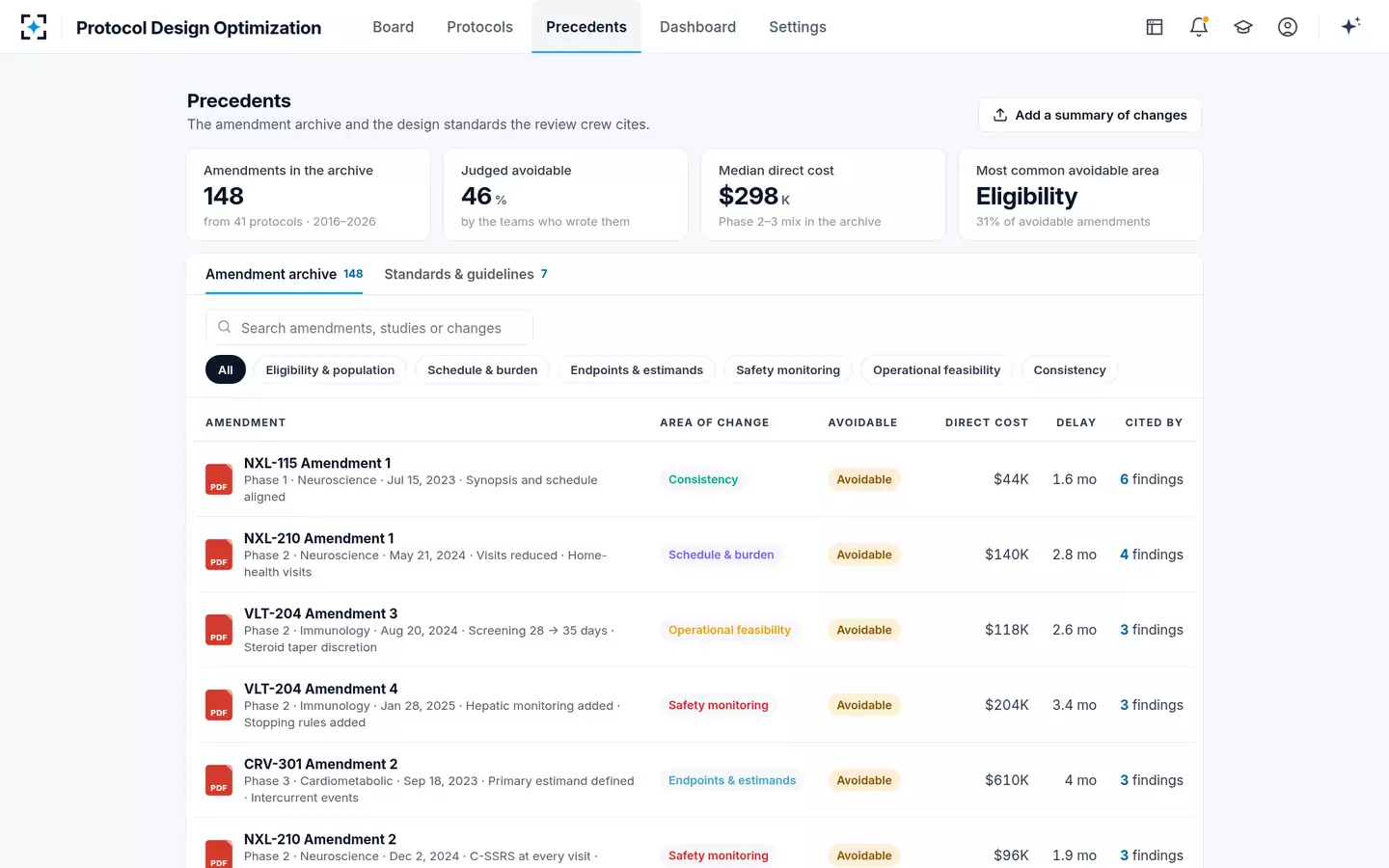
The counts behind these figures sit in why the same protocol amendments return, and the review cycle that is supposed to catch them in who reads a draft protocol. To put your own amendment costs behind your next draft, start from Protocol Design Optimization.
Questions people ask
What is the median direct cost of a Phase 3 protocol amendment?
$535,000, in the published benchmark — against US$141,000 for a substantial amendment on a Phase 2 protocol — from a study of 836 protocols in which the cost estimates were derived from 52 of them. Direct cost covers the document, submission, fees, site retraining, system updates and project management. It excludes the delay, the re-approval load, re-consent and lost enrolment, so a sponsor's all-in figure is higher.
Does a Phase 3 amendment cost more than a Phase 2 amendment?
Substantially more, in the published medians — $535,000 against $141,000, close to four times. The driver is not the writing but the footprint: more countries, more ethics committees, more sites to retrain, more participants already enrolled, and more systems holding the protocol's logic. The same design error is cheap in Phase 1 and expensive in Phase 3 for reasons that have nothing to do with the error.
How long does a protocol amendment take from decision to approval?
No regulator sets a standard time, and the elapsed time is set by the slowest approval rather than the average one, so it scales with the number of countries rather than with the size of the change. On the sample amendment inside the solution the figure is 4.1 months across 52 ethics committees. A sponsor that records this per amendment can forecast it from its own history far better than from any benchmark.
How many participants have to be re-consented after an amendment?
Only those the change actually touches, and whether a new signature is needed is a judgement for the reviewing ethics committee. The regulation's own hook is the requirement that the consent document state that significant new findings which may relate to a subject's willingness to continue will be provided to them. A change that applies only to future screening usually needs no re-consent; one that alters risks, procedures or duration for people on treatment usually does.
Do amended protocols enrol fewer participants than planned?
On average, yes. The 2016 benchmark study found that protocols with a substantial amendment screened and enrolled fewer patients against their original plan than protocols without one. It also found that amended protocols were usually bigger and slower to recruit, so part of that gap is the kind of study that attracts amendments rather than the amendment itself. A later oncology study found significantly lower participant completion rates among amended oncology protocols.
How do you put a number on an amendment you prevented?
As an expected value, not a saving. Estimate the chance that a given design choice forces a substantial amendment — from how often that choice appears as the changed item in your own past amendments — and multiply it by what those amendments cost you. Accepting a change moves the probability, and the number is only as good as the archive behind it. Claiming a specific amendment was avoided is a claim nobody can check.