Reducing patient burden in clinical trials is usually treated as a matter of goodwill — consult the patient advisory board, add a travel stipend, promise fewer visits in the next study. It is better treated as arithmetic, because the burden is already written down. The schedule of activities names every procedure at every visit, so before the first participant is screened you can total the hours someone will spend on site, count the invasive procedures, and ask of each row which endpoint it feeds. Published benchmarking finds that as much as 30% of participant and site burden comes from procedures that support no core endpoint, or that are non-essential even where they support one. Botminds' Protocol Design Optimization reads that table on every draft protocol, totals the hours per visit, compares them with the therapy-area median and the sponsor's own design standard, and flags the visits and procedures that have nothing behind them.
The screens and study figures on this page are sample data from the solution, on fictional studies, companies and people: VLT-305, a 640-participant Phase 3 study of Veltrimab in moderately to severely active Crohn's disease, draft v0.9 at 148 pages. The research figures come from regulators and peer-reviewed benchmarking, linked where they appear. For what a schedule of activities is and how one is written in the first place, the companion guide on the schedule of activities covers the document; this page is about what you can measure from it.
What participant burden is, measured from the protocol itself
Participant burden is everything a trial asks of a person beyond the treatment itself: hours on site, journeys made, blood taken, scopes and scans tolerated, diaries filled in on days when nothing happens, and the household rearrangement each visit forces on a carer. Most of it is countable from the protocol, and the countable part is the part a design review can change.
Three quantities do most of the work. The first is hours on site per visit, which decides whether someone can keep a job and attend. The second is invasive or unpleasant procedures per participant across the study — endoscopies, biopsies, lumbar punctures, long infusions — which decides who is willing to enrol at all. The third is the share of rows in the schedule that support no required endpoint and no safety rule, which is the part that is pure loss: a cost to the participant with nothing on the other side of it.
ICH E8(R1) states the obligation plainly: every study procedure and assessment has to be scientifically necessary and must not put undue burden on participants (ICH E8(R1) §2.1). "Necessary from a scientific viewpoint", in the guideline's words, is a test that can be applied to a table, one row at a time, by a person holding the objectives beside it.
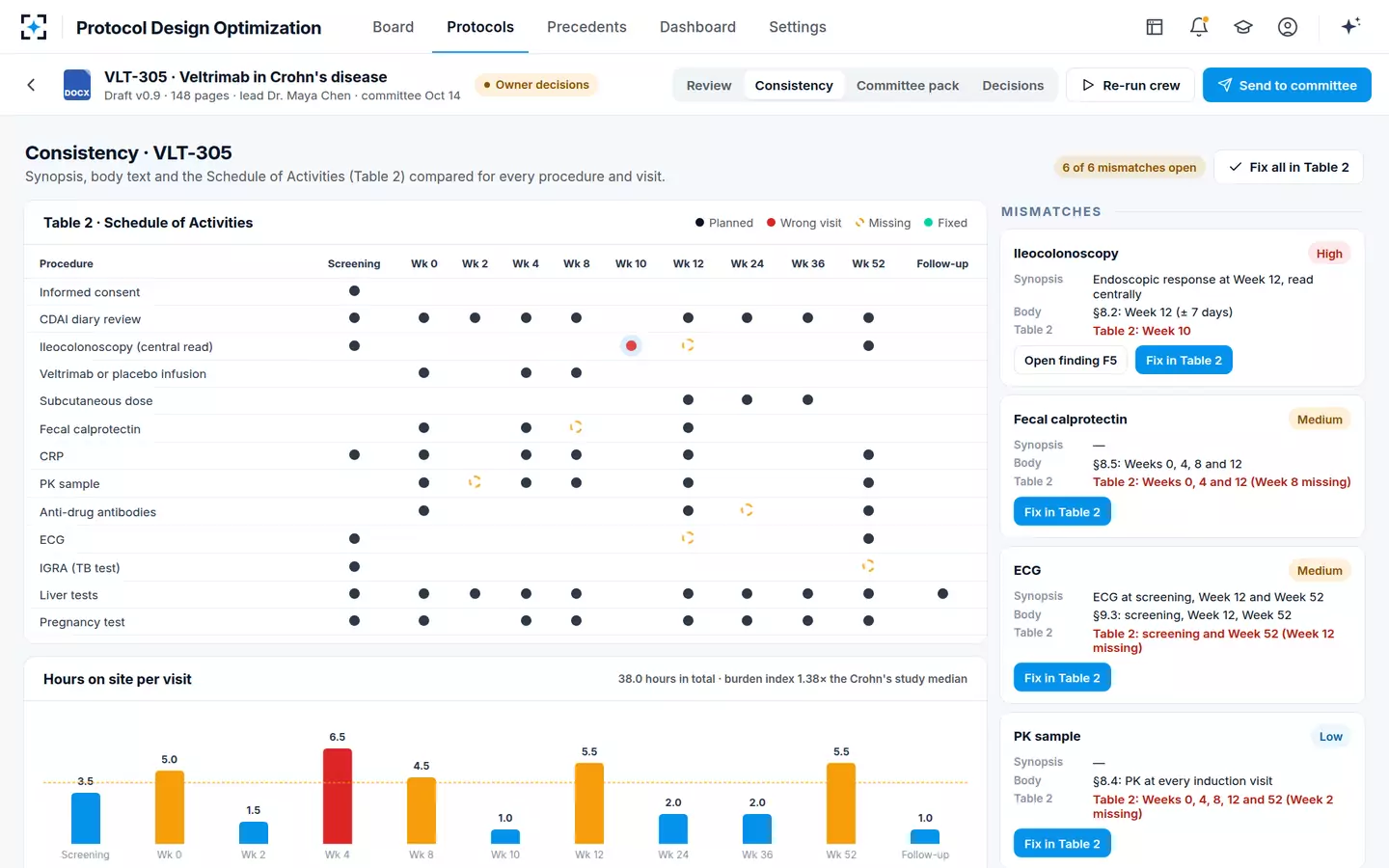
On the sample study, that arithmetic gives 38.0 hours on site across eleven visits, and a burden index of 1.38× the median of the sponsor's own earlier Crohn's studies. Neither number is an industry figure; the index compares one sample study with a sample median, and its value is that it is comparable within one sponsor's portfolio, where the therapy area, the population and the standard of care are held roughly still.
Hours on site per visit: how to work it out before the first participant
The method is dull and it works. Take each column of the schedule — one visit — and assign every marked procedure a realistic duration from your own site history, not from the vendor's. Add the parts the table never shows: check-in and consent re-confirmation, the wait for pharmacy, the wait between a pre-dose and a post-dose draw, the discharge paperwork. Sum the column. Then do it for every column and look at the shape of the series rather than at any one number.
Two rules of thumb survive contact with sites. Anything that must be done in a fixed order, such as a pre-dose sample followed by an infusion followed by observation, costs its sum and not its maximum. And any procedure with a preparation, such as a bowel preparation or a fast, costs the participant a day on either side of the visit that the hours on site never capture.
One Week 4 visit, drawn to scale: six and a half hours
- Arrival, vitals, diary60 min
- Draws, pre-dose, pharmacy90 min
- Infusion60 min
- Observation2 h
- Samples, discharge60 min
Drawn to scale, the visit explains itself. Two of the six and a half hours are observation after an infusion, which is a safety requirement and stays. An hour and a half goes on the draws, the pre-dose sample and the wait for pharmacy, and the wait is a site process that a confirmed pharmacy slot can shorten. The blood draws themselves are quick; it is the sequencing around them that costs the afternoon. A review that reports "Week 4: 6.5 hours" without this breakdown invites the wrong fix, which is to delete an assessment.
Hours on site, visit by visit, against a four-hour standard
The series matters more than any bar. Five visits of the eleven break the sponsor's own four-hour standard, and four of those five fall inside the twelve-week induction period, when a participant is least sure the treatment is working and most likely to leave. A schedule that front-loads its long days is a schedule that spends its goodwill before it has earned any.
How much of the schedule supports no required endpoint?
This is the question that turns a feeling into a budget. The 2026 benchmarking study of protocol data collection by Tufts researchers in Therapeutic Innovation & Regulatory Science classifies every procedure in a protocol as core, standard or required, or non-core, and reports that "as much as 30% of participant and site burden is associated with non-core procedures or are non-essential procedures supporting core, standard/required endpoints" (Ther Innov Regul Sci, March 2026).
The same study counts the procedures themselves: "non-core procedures comprise 17.8% of total phase II and 16.2% of total phase III procedures per protocol, a downward trend from the proportion of non-core procedures observed in 2020." Read the two figures together and the point is that procedure counts understate the problem. Non-core work is about a sixth of the procedures; add the non-essential procedures that sit under core endpoints — a second scan where one would do, a sample taken more often than the analysis needs — and the share of burden can reach 30%. The study also reports that nearly half of phase II and about a third of phase III non-core procedures gather data for exploratory and future-use purposes, which is exactly the row a design review can question.
A sixth of the procedures are non-core; up to 30% of the burden is non-core or non-essential
Phase II procedures per protocol
- Core, standard or required · 82.2%
- Non-core 17.8% · 17.8%
Phase III procedures per protocol
- Core, standard or required · 83.8%
- Non-core 16.2% · 16.2%
Participant and site burden
- Everything else · 70%
- Non-core or non-essential — as much as 30% · 30%
Behind the procedures sits the data they produce, and the data keeps growing: the same study reports that "total data volume continues to grow with 5.9 million datapoints now collected on average per phase III protocol, up 11% annually since 2020." A protocol team that adds a panel because the data might be useful later is making a decision whose cost lands on a participant in a chair and a coordinator at a keyboard, and whose benefit is speculative.
The test to run on each row is short, and it is a test that can fail. Name the objective or safety rule the row serves. If the answer is an exploratory objective, say so in the row, because that is a different conversation. If the answer is "we have always collected it", the row is a candidate. If the answer is "the biostatistician asked for it", the biostatistician is the person who takes it out, not the reviewer.
The three places a visit is written, and what happens when they disagree
A protocol says when a procedure happens three times: once in the synopsis, once in the body section that owns the assessment, and once in the schedule of activities. ICH M11 deliberately places the synopsis, the schema and the schedule near the front of its template, because they are what a site needs to run the study, and it sets out to remove repetition wherever it is not needed (ICH M11 §3, adopted 19 November 2025). Repetition that cannot be eliminated has to be reconciled, and that reconciliation is almost always done by eye, late, by one tired person.
The same four procedures, as three sections of one draft describe them
Ileocolonoscopy, centrally read
SynopsisEndoscopic response at Week 12, read centrally
Body sectionSection 8.2: Week 12 (± 7 days)
ScheduleTable 2: Week 10
What a site doesBooks the endoscopy suite for Week 10. The co-primary endpoint is then read two weeks early, at every site that follows the table.
Fecal calprotectin
SynopsisNot named
Body sectionSection 8.5: Weeks 0, 4, 8 and 12
ScheduleTable 2: Weeks 0, 4 and 12
What a site doesCollects no Week 8 sample. The gap is found at database lock, when the induction curve has a hole in it.
ECG
SynopsisECG at screening, Week 12 and Week 52
Body sectionSection 9.3: screening, Week 12, Week 52
ScheduleTable 2: screening and Week 52
What a site doesRuns no Week 12 ECG — the visit at which the induction dose has been in the participant longest.
Pharmacokinetic sample
SynopsisNot named
Body sectionSection 8.4: at every induction visit
ScheduleTable 2: Weeks 0, 4, 8, 12 and 52
What a site doesDraws no Week 2 sample, so the early part of the exposure curve is missing for every participant.
The first row is the expensive one. A co-primary endpoint is read at Week 12 in the synopsis and in section 8.2, and at Week 10 in the table. Nothing about it is ambiguous to a reader who holds the three pages side by side; everything about it is ambiguous to a coordinator who holds one.
Why sites follow the table, not the synopsis
Because the table is what a visit calendar is built from. A coordinator scheduling a participant does not re-read the synopsis; they read the column for the next visit and book what is in it. The synopsis is for the person deciding whether to run the study, and the body sections are for the person writing the analysis. The schedule is the operating document, and it wins every disagreement in practice.
On the sample study, the same mismatch had already cost a sibling protocol: an earlier study recorded eighteen protocol deviations against a timing conflict before it was amended. The FDA's draft guidance on protocol deviations puts the causation the right way round — "thoughtful protocol design can help to minimize important protocol deviations" (FDA, December 2024) — which is to say that a deviation report full of the same visit window, at many sites, is usually a document problem wearing a conduct problem's clothes.
Table 2 checked against the synopsis and the body, row by row
Which procedures come out first, and who has to agree
Cut in this order, because it takes the burden out in the order that costs the study least.
First, rows with no endpoint and no safety rule behind them. These are free. Second, measurements duplicated by another row — a central laboratory panel that repeats a local one, a questionnaire that overlaps an instrument already collected. Third, visits that exist only for one assessment: if the Week 2 column holds a single draw, ask whether the draw can move to Week 4 or go to a local laboratory, because the participant is paying a whole journey for one row. Fourth, and last, frequency: a quarterly assessment taken monthly.
ICH E8(R1) supports the first two directly: "consideration should be given to eliminating nonessential activities and data collection from the study to increase quality by simplifying conduct, improving study efficiency, and targeting resources to critical areas" (ICH E8(R1) §3.3.2). The guideline frames this as a quality measure rather than a kindness, which is the right frame: shorter visits are completed, and completed visits produce data.
Who agrees matters as much as what comes out. A statistical assessment leaves only on the statistician's say-so, because an assessment that looks redundant to a clinician may be the one supporting the key secondary analysis. A safety assessment leaves only on the medical monitor's say-so. Everything else belongs to the clinical scientist and the operations lead together, because the second of them knows what the site will actually do with the time saved. In the solution those owners are a setting, not a convention, and a suggestion from a reviewer agent always goes to the named owner for the area rather than being applied.
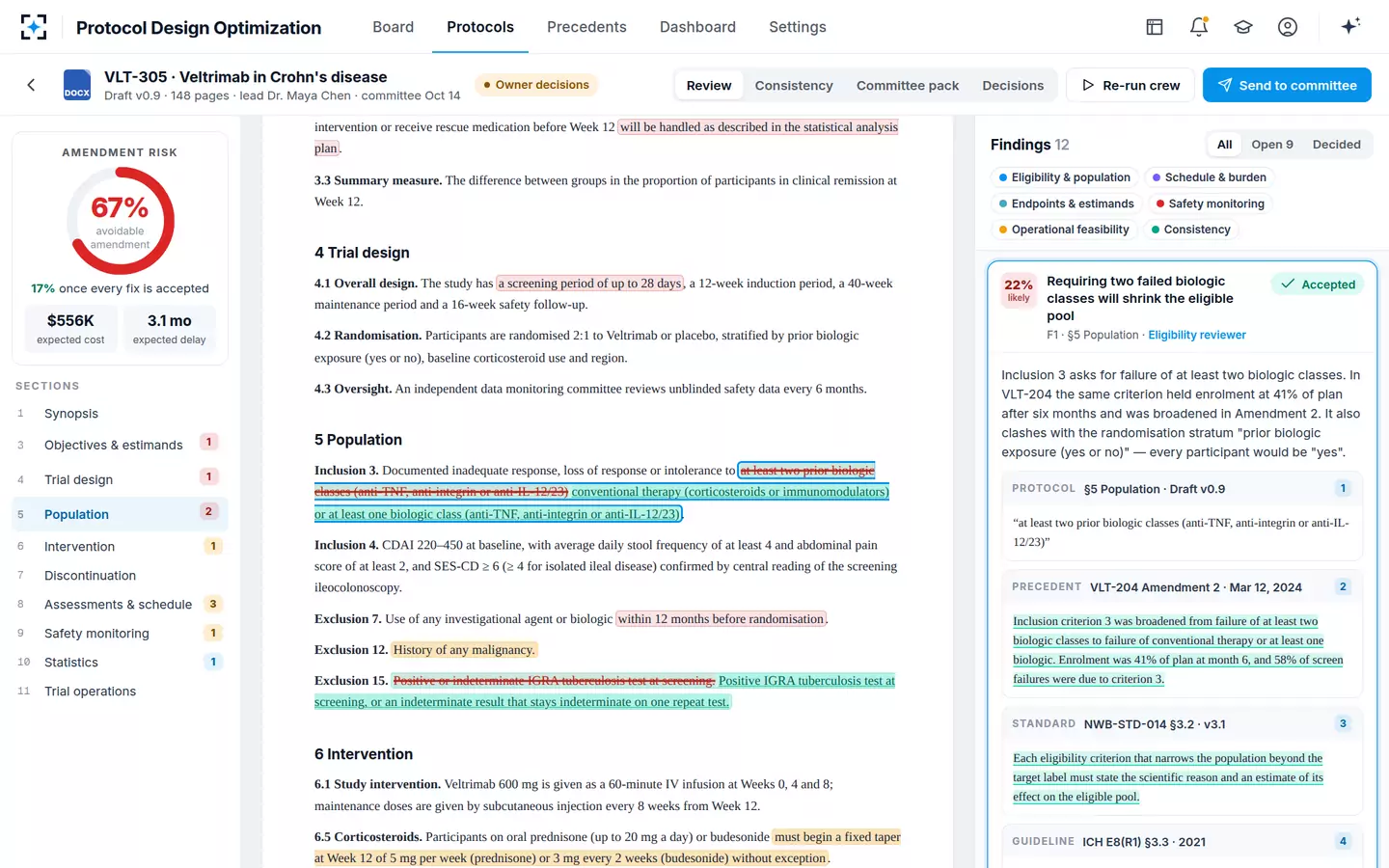
A finding, the protocol line it is about, and the evidence behind it
Do decentralised elements reduce patient burden, or move it?
Both, and which one depends on details the protocol has to settle. The FDA's 2024 guidance is clear about the upside: "by enabling remote participation, DCTs may enhance convenience for trial participants, reduce the burden on caregivers, and facilitate research on rare diseases and diseases affecting populations with limited mobility or limited access to traditional clinical trial sites" (FDA, September 2024). For a participant who would otherwise drive two hours for a blood draw, a local phlebotomy appointment is an unambiguous gain.
The movement is easy to miss. A home nursing visit converts the participant's travel into a visiting nurse's travel and a chain of custody for the sample, which is a cost to the study rather than to the participant, and a fair trade — but it is a trade, and the protocol has to say who arranges it and what happens when the nurse cannot come. A local laboratory removes the journey and introduces an equivalence question for any assay that was going to be read centrally. And a daily electronic diary, often counted as decentralisation, moves burden from eleven visit days to 365 ordinary ones; it can be the single heaviest thing a protocol asks, and it is almost never counted in hours.
So count it. The honest measure of a decentralised design is hours asked of the participant across the whole study, not visits to a site, and a protocol that cuts site visits while adding a twice-daily symptom diary may have increased the total.
Burden, dropout and the data you lose either way
Burden shows up in the data twice: as missed assessments inside the visits people do attend, and as the participants who stop attending. ICH E8(R1) names the connection where it names who should be consulted about a design: investigators and prospective participants, because they can say whether the scheduled visits and procedures are heavy enough to make people drop out early.
The quantitative work points the same way. A Tufts study of 187 protocols from 20 companies found that more countries and more sites went with more amendments, longer screening and study durations, and higher participant dropout (Ther Innov Regul Sci, March 2022), and that procedures per visit was among the design characteristics that predicted cycle time, enrolment, retention and amendment outcomes in its regression models. Complexity and dropout travel together, and a protocol team is usually looking at the complexity months before anyone can see the dropout.
The arithmetic of a withdrawal is worth stating once. A participant who leaves at Week 24 of a 52-week study has given every hour of their burden and returns a partial dataset, which may or may not support the analysis depending on how the protocol handles the event; the cost of an over-built schedule is therefore paid twice, by the person and by the study. The companion guide on screen failure rates and eligibility criteria works the same arithmetic on the other end of the funnel.
What the guidelines require you not to do to participants
Throughout drug development, care should be taken to ensure all study procedures and assessments are necessary from a scientific viewpoint and do not place undue burden on study participants.
ICH E8(R1) General Considerations for Clinical Studies, §2.1, adopted 6 October 2021
ICH E6(R3) turns that into a duty with a name on it. Its Principle 7.4 asks that trial processes be workable, free of procedures and data collection nobody needs, and tied to the key objectives — and it tells the sponsor, by name, not to put unnecessary burden on participants or investigators. Burden is not a site's problem to absorb or a participant's price of admission; it is a design decision made at the sponsor's desk, months before anyone is consented.
ICH E8(R1) adds the measurable form of the same idea in its considerations for identifying what is critical to quality: the participant numbers, the study's length and how often participants visit should be enough to support the objective. Enough, which cuts both ways — too few visits and the objective is unsupported; more than sufficient and the surplus is burden with no defence. The same guideline warns against letting the factors that matter be crowded out by minor ones — a long tail of secondary objectives, or data collected for neither participant protection nor the primary objectives.
Seven questions to ask of every row in a schedule of activities
- Which objective or safety rule does this row serve?
Name it. An exploratory objective is a legitimate answer, but it should be written down as one so the row can be weighed against its cost.
- Does another row already measure this?
Central and local laboratory panels, overlapping questionnaires and duplicated vitals are the common pairs. One of the two usually goes.
- How long does this take the participant, at this visit, in this order?
Not the procedure time — the time it costs in sequence, including the waiting it creates for whatever follows.
- Does this visit exist only for this row?
A whole journey for one assessment is the most expensive thing a schedule can contain. Ask whether it can move or go local.
- Does the synopsis, the body section and this table agree about the week?
Check all three for every procedure. Sites build calendars from the table, so a disagreement becomes a deviation at every site that reads it.
- Is the window wide enough for the real world?
A procedure that needs an appointment at a third party — an endoscopy suite, an imaging centre, a central reader — needs a window built from your own site history, not from the standard template.
- Who has to agree before this row is removed?
Statistical assessments belong to the statistician, safety assessments to the medical monitor. Write the owner next to the row before the discussion starts, not during it.
Run the seven on one schedule and the result is usually a handful of rows and one visit, which is a modest-sounding change until you multiply it by 640 participants and eleven visits. To see the hours per visit, the consistency check and the findings beside their precedents on a draft of your own, start from Protocol Design Optimization, or read the protocol review checklist these checks belong to.
Questions people ask
How do you measure patient burden in a clinical trial?
From the schedule of activities, before anyone is enrolled. Assign a realistic duration to every marked procedure, add the check-in, pharmacy and discharge time the table never shows, and total each visit column; then count invasive procedures per participant and diary days across the study. Compare the totals with your own earlier studies in the same therapy area rather than with a published average, because the comparison that means anything holds the disease and the standard of care still.
How many hours does a clinical trial visit take?
It varies from under an hour for a safety call to most of a day for an infusion visit with observation. The useful figure is the one your own schedule implies: on the fictional sample study on this page, eleven visits total 38.0 hours, the median visit is 3.5 hours and the longest is 6.5. A sponsor can set its own standard — the sample sponsor uses four hours — and treat any visit above it as a finding that needs a reason.
Which procedures should come out of a schedule of activities first?
Rows that support no required endpoint and no safety rule, then measurements already captured by another row, then visits that exist for a single assessment, then frequencies that exceed what the objective needs. Benchmarking published in 2026 puts non-core procedures at 16.2% of phase III procedures per protocol, and as much as 30% of participant and site burden on non-core or non-essential procedures, so the first two categories are usually worth finding.
Does cutting procedures weaken the study?
Only if you cut the wrong ones, which is why the removals are owned rather than suggested. A statistical assessment leaves on the statistician's decision and a safety assessment on the medical monitor's. ICH E8(R1) treats the removal of nonessential activities as a way of increasing quality, not reducing it, on the reasoning that a simpler study is completed more faithfully.
Do decentralised trials really reduce patient burden?
They can, and FDA's 2024 guidance says so, noting that remote participation may enhance convenience, reduce the burden on caregivers and widen access for people with limited mobility. But some decentralised designs move burden rather than remove it: a home visit shifts travel to a nurse and adds a sample chain, and a daily electronic diary spreads effort across every day of the study. Measure hours asked of the participant across the whole trial, not visits to a site.
Who should decide which assessments come out of the protocol?
The owner of the area the assessment belongs to, named before the discussion starts. In practice that means the biostatistician for anything feeding an analysis, the medical monitor for anything feeding safety monitoring, and the clinical scientist with the operations lead for the rest. ICH E6(R3) places the duty not to impose unnecessary burden on the sponsor, so the decision cannot be delegated to the sites that have to carry it.