The schedule of activities in a clinical trial is the table that lists every visit across the top and every procedure down the side, with an allowable window on each visit. Building one is not a layout job: because every other section quotes it, the table decides which eligibility tests exist, when each endpoint is measured and how often safety is checked, so it has to be built before the prose and tested against the endpoints afterwards. It is hard for a dull reason — it is usually adapted from a past study whose visits were in different weeks. Clinical Protocol Authoring is Botminds' software for drafting trial protocols, and it opens on this table, with the fourteen sections drafting beside it and a running check that every endpoint has a visit to be measured at.
Two names for one table, before anything else. ICH M11 calls it the schedule of activities; most sponsors, and the sample draft used here, call it the schedule of assessments; ICH E6(R3) asks for "a description of the schedule of events"; SPIRIT 2025 calls it the participant timeline. They are the same artefact, and this guide uses the template's name for it. The worked example throughout is the invented study VLT-302 — a Phase 3 trial of Veltrimab in moderate-to-severe plaque psoriasis — and its people, sponsor and data are sample data, not a customer's.
What is a schedule of activities in a clinical trial?
It is the operational contract between the protocol and the site. A coordinator who has to know what happens on a given morning does not read section 8; they read one column of this table. That is why ICH M11 places it at section 1.3, in the first few pages: "the Template is designed with the most vital information for execution (e.g., Synopsis, Schema, Schedule of Activities) near the front," because the needs of investigators and site staff were given primary consideration.
It is also the only place in the protocol where the whole trial is visible at once. Section 5 says who may enrol; section 6 says what they are given; section 8 says how each assessment is performed; section 10 says what will be analysed. Only the schedule says when, and in what combination, and therefore what a single participant's Tuesday looks like.
One schedule of activities: eleven visits, fifteen procedures, a burden score on every column
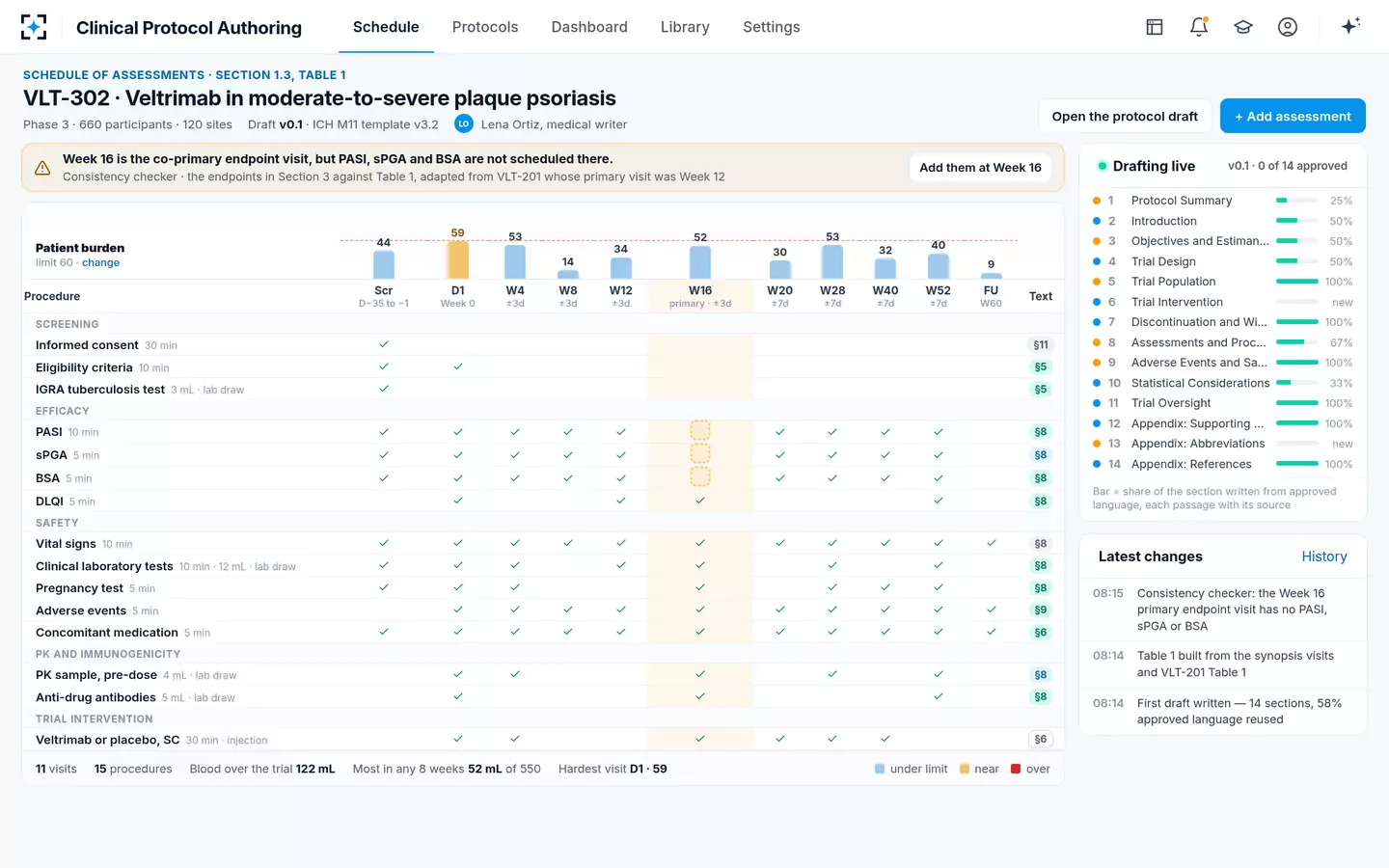
Visits across, procedures down: how the table is laid out
The convention is near-universal and worth following even where a sponsor template is silent. Columns are visits in time order, each carrying its study day or week, its window and its period. Rows are procedures, grouped by why they are done — screening, efficacy, safety, pharmacokinetics and immunogenicity, intervention — because a reader scanning for one kind of obligation scans by group. A tick marks the intersection; a footnote carries the exception.
Two columns are usually worth adding beyond the ticks. The first is what each procedure costs a participant: minutes on site, millilitres of blood, needle sticks. The second is which section of the protocol the row is written into, so that a change to the table has an obvious destination in the prose. Neither is required by anyone. Both make the table reviewable rather than merely correct.
The fifteen procedure rows of one Phase 3 schedule, and what each one asks
| Procedure | Group | What it costs a participant | Written into |
|---|---|---|---|
| Informed consent | Screening | 30 min, screening visit only | Section 11, oversight and consent |
| Eligibility criteria | Screening | 10 min, screening and Day 1 | Section 5, trial population |
| IGRA tuberculosis test | Screening | 3 mL, screening only, taken with the screening draw | Section 5, trial population |
| PASI | Efficacy | 10 min, every visit from screening | Section 8, assessments |
| sPGA | Efficacy | 5 min, every visit from screening | Section 8, assessments |
| BSA | Efficacy | 5 min, every visit from screening | Section 8, assessments |
| DLQI | Efficacy | 5 min, from Day 1 | Section 8, assessments |
| Vital signs | Safety | 10 min, every visit | Section 8, assessments |
| Clinical laboratory tests | Safety | 10 min and 12 mL, taken with the other draws of that visit | Section 8, assessments |
| Pregnancy test | Safety | 5 min, every visit for participants of childbearing potential | Section 8, assessments |
| Adverse events | Safety | 5 min, every visit and every contact | Section 9, adverse events |
| Concomitant medication | Safety | 5 min, every visit | Section 6, intervention and concomitant therapy |
| PK sample, pre-dose | PK and immunogenicity | 4 mL, dosing visits, before the injection | Section 8, assessments |
| Anti-drug antibodies | PK and immunogenicity | 5 mL, at the sampling visits | Section 8, assessments |
| Veltrimab or placebo, subcutaneous | Trial intervention | 30 min including observation, at each dosing visit | Section 6, intervention |
What belongs in it — and what ICH M11 says must be in it
The template's instruction for section 1.3 is five clauses long and every one of them is a rule a real schedule breaks somewhere. Read it slowly; it is the shortest useful checklist in the whole document.
The ICH M11 instruction for the schedule of activities, clause by clause
“the procedures that will be accomplished at each trial visit”
Every procedure, at every visit. A procedure a site performs but the table omits is a procedure nobody has costed, consented for or scored.
“and all contact with participants (e.g., telephone contacts)”
Telephone calls, diary reminders, remote questionnaires. Contact without a visit is still contact, and still belongs as a column.
“any tests that are used for eligibility, participant randomisation or stratification, or decisions on trial intervention discontinuation”
The tests that make a decision. These are the rows a reader checks against sections 5, 6 and 7, so they must be identifiable in the table rather than buried in a group.
“Allowable windows should be stated for all visits and procedures”
All of them. A window stated only in the text leaves the table saying something stricter than the protocol means.
“A tabular format is recommended”
Not a paragraph, not a diagram alone. And where sampling is extensive — serial pharmacokinetics, for example — a separate table may be added rather than crushed into this one.
The third clause is the one most often missed, because the tests it names look like ordinary rows. An IGRA tuberculosis test is a screening laboratory result in most templates; in this trial it decides eligibility, which means section 5 has to say what result excludes a participant and the table has to show that the test happens before randomisation. The same applies to a stratification measure and to any test that triggers discontinuation.
What are visit windows, and why they belong in the table
A visit window is the span of days around a nominal visit day in which the visit may still take place and still count. It exists because participants have jobs, sites have holidays, and a trial that treats every scheduled day as absolute converts ordinary life into a stream of deviations.
Windows are usually tighter where a measurement matters and looser where it does not. In the sample trial, visits through Week 16 — the co-primary endpoint visit — carry a window of plus or minus three days; from Week 20 to Week 52 the window opens to plus or minus seven. Screening is expressed differently again, as a span rather than a tolerance: day minus 35 to day minus 1.
Two mistakes recur. The first is a window stated only in the prose, which leaves a site reading a table that looks absolute. The template is explicit that "allowable windows should be stated for all visits and procedures" — all of them, in the table. The second is a window that disagrees with the one in section 8, which is the subject of the next section and the most common finding on a first draft.
The footnotes are where the protocol usually breaks
Footnotes carry everything a grid of ticks cannot: that a procedure is done only for participants of childbearing potential, that a sample is taken before dosing, that a window differs after a given visit. They are written last, read least, and copied wholesale from the past protocol more often than any other part of the table.
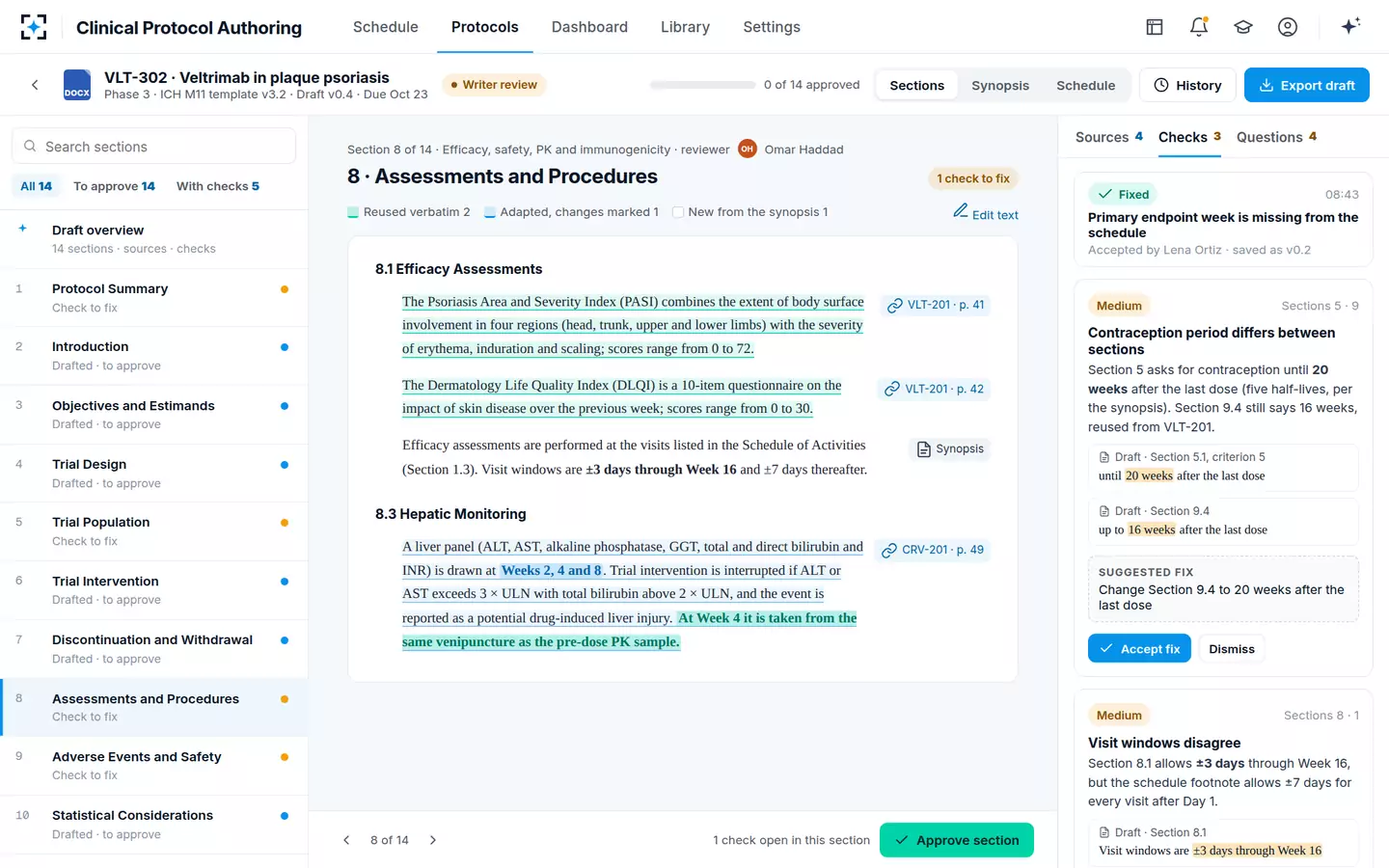
The sample draft carries a textbook instance. Section 8.1 says visit windows are plus or minus three days through Week 16 and plus or minus seven thereafter — which matches the synopsis. The schedule's footnote, inherited from the earlier study, allows plus or minus seven days for every visit after Day 1. Both statements are defensible in isolation. Together they mean a Week 12 visit held five days late is compliant by the footnote and a deviation by section 8.1, and nobody finds out until a monitor asks.
A window that disagrees with its own footnote, with both passages shown
A practical habit: write the footnotes before the ticks. If a footnote cannot be written without naming a section, that is a sign the exception belongs in the prose and the table needs another row instead.
Every endpoint needs a visit: the check nobody runs by hand
The single most valuable test of a schedule takes one pass and is almost never done. For each endpoint in section 3, find the timepoint; find that visit's column; confirm the measurement is ticked there. It is tedious, which is why it slips, and it catches the most expensive class of error there is.
The sample draft failed it on its first morning. Its schedule was adapted from VLT-201, a Phase 2 study whose primary endpoint sat at Week 12. VLT-302's co-primary endpoints are PASI 90 and sPGA 0/1 at Week 16. The adapted table carried PASI, sPGA and BSA at every visit it had carried them at before — and not at Week 16. The protocol defined endpoints it had no means of measuring, and the draft was two minutes old.
A Phase 2 schedule adapted to a Phase 3 trial: the timepoint that moved
- To primaryWk 12
- To co-primaryWk 16
- MaintenanceWk 52
- Follow-upWk 60
Four other cross-checks belong in the same pass, and all four are mechanical. Does every eligibility test appear before randomisation? Does every dosing visit carry the intervention row? Does the number of visits in the table match the number the synopsis states? Does any visit carry a procedure that no endpoint and no safety rule requires — the question that decides what may be cut when a visit runs long?
Screening, run-in, treatment, follow-up: one row per period
Above the visit columns, most schedules carry a period band: screening, any run-in or washout, treatment, follow-up. SPIRIT 2025 asks for exactly this at item 18 — the time schedule "including any run-ins and washouts" — and it earns its space for three reasons. It tells a reader where consent sits relative to the first procedure. It shows where the analysis sets of section 10 begin and end. And it makes the shape of the trial legible without reading a word.
The sample trial has four periods: screening up to five weeks, treatment from Day 1 through the last dose at Week 40, continued assessment to the Week 52 database lock, and a safety follow-up visit at Week 60. Each boundary is a sentence somewhere else in the protocol, and each is a place where a schedule inherited from a shorter study quietly keeps the wrong number of weeks.
SPIRIT 2025 item 18 and the ICH M11 schedule of activities: one table, two vocabularies
SPIRIT 2025, item 18: "Time schedule of enrolment, interventions (including any run-ins and washouts), assessments, and visits for participants. A schematic diagram is highly recommended."
ICH M11, section 1.3: "The schedule of activities must capture the procedures that will be accomplished at each trial visit, and all contact with participants (e.g., telephone contacts)." A tabular format is recommended.
SPIRIT 2025, item 18: Participant timeline — one of 34 minimum items for a randomised trial protocol.
ICH M11, section 1.3: Schedule of activities — section 1.3, inside the protocol summary, near the front of the document.
SPIRIT 2025, item 18: Names run-ins and washouts explicitly, and recommends a schematic diagram as well as the grid.
ICH M11, section 1.3: Requires allowable windows for all visits and procedures, and names the tests used for eligibility, randomisation, stratification and discontinuation decisions.
SPIRIT 2025, item 18: Draw the periods, including anything before first dose, and keep the diagram in step with the table.
ICH M11, section 1.3: Put a window on every column, and make the decision-making tests identifiable rather than buried in a group.
The table a site reads, and the burden it carries
A schedule can be entirely correct and still be a bad schedule, because correctness says nothing about what a column asks of one person on one day. ICH E8(R1) puts the point where it belongs — in design, not in monitoring: clinical investigators and potential participants "have valuable insights into the feasibility of enrolling participants who meet proposed eligibility criteria, whether scheduled study visits and procedures may be overly burdensome and lead to early dropouts".
Published benchmarks show how much a modern protocol asks. In a study of protocol design across phases, Phase III protocols carried the highest mean number of distinct procedures, 34.5, and the highest mean total procedures, 266.0, alongside the highest mean page count of 115.9; Phase II protocols carried the most endpoints, at a mean of 20.7.
What a Phase III protocol typically asks for
34.5
mean distinct procedures per Phase III protocol
266.0
mean total procedures per Phase III protocol
115.9
mean total pages per Phase III protocol
20.7
mean endpoints per Phase II protocol, the highest of any phase
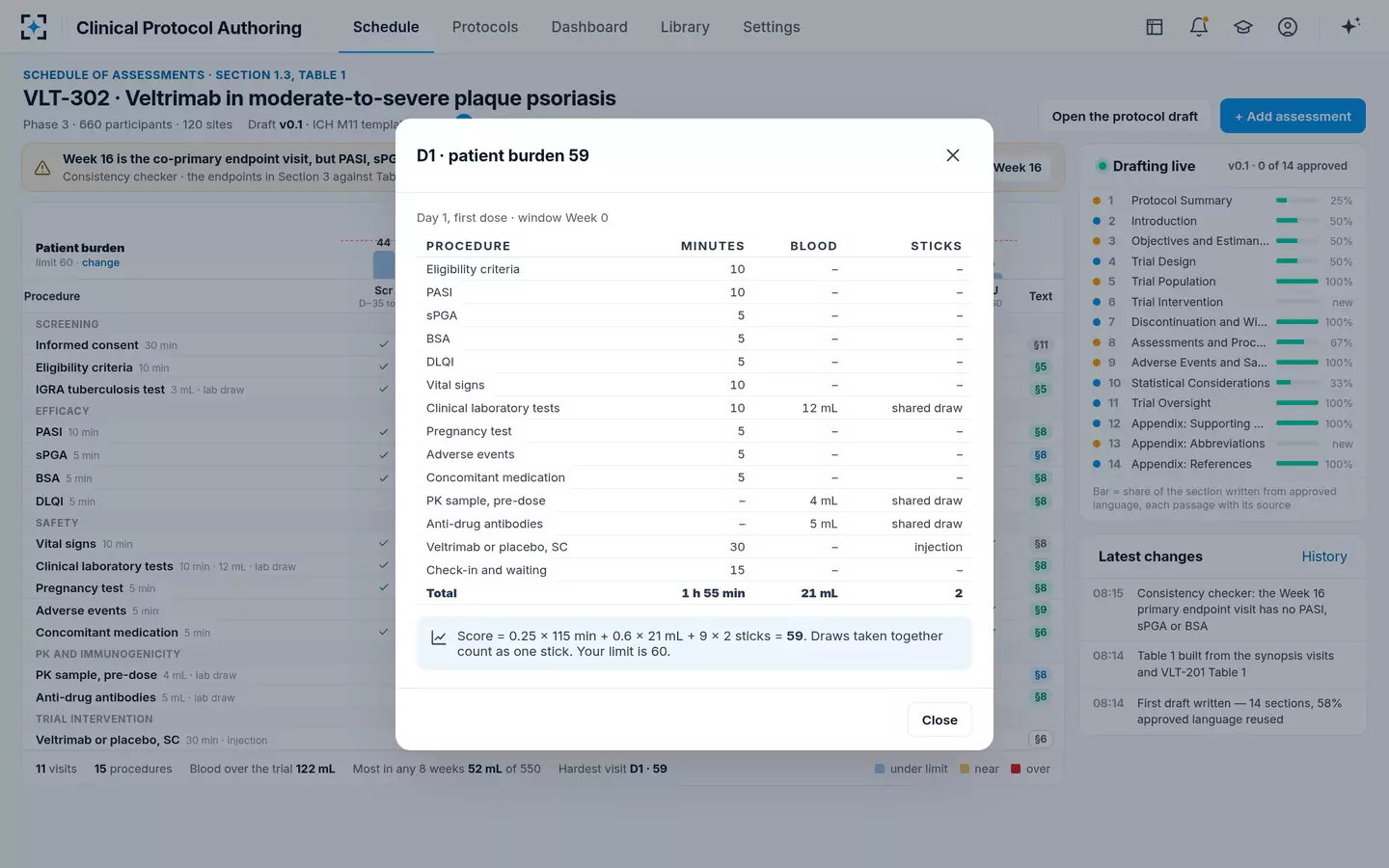
Against those means, a per-visit arithmetic is a cheap discipline. The sample trial scores each visit on minutes on site, millilitres of blood and needle sticks, with draws taken together counted once, and holds the result against a limit the sponsor sets. Day 1 is the hardest visit in the first draft: one hour fifty-five minutes, 21 mL and two sticks, which scores 59 against a limit of 60. The method, and the published limits that bound the blood half of it, are taken apart in blood draw limits for research.
One visit's arithmetic, procedure by procedure
Who reviews the schedule before it goes out
Four readers, in this order, and each one is looking for something the others are not. The writer checks that every row has a home in the prose and every window matches it. Clinical operations checks that a site can actually run the column — rooms, staff, fasting, the order of procedures within the morning. The medical monitor checks that safety assessments are frequent enough and sit where a signal would appear. The statistician checks that every endpoint has a visit, and that the visits support the analysis timepoints in section 10.
Eight checks to run on a schedule before it goes to review
- Every endpoint in section 3 has a measurement ticked at its timepoint
The cheapest check there is, and the one an adapted schedule fails most often.
- Every eligibility, stratification and discontinuation test is in the table, and before the decision it feeds
Named explicitly by the ICH M11 instruction for section 1.3.
- Every visit column carries a window, and the same window appears in the prose
Compare the footnote with section 8.1 line by line; this is the classic inherited mismatch.
- Every contact that is not a visit has a column
Telephone calls, diaries and remote questionnaires included, as the template requires.
- The number of visits and the week of each match the synopsis
If the synopsis is silent on a timepoint, that is an open question, not a default.
- Every dosing visit carries the intervention row, and every pre-dose sample is marked pre-dose
A PK sample on the wrong side of the injection is an unusable result, not a deviation.
- Each visit has been added up: minutes, millilitres and sticks
Do it before a site does it for you, after the first participants are enrolled.
- Every procedure traces to an endpoint, a safety requirement or a regulatory one
Anything that traces to none of the three is the first thing to cut when a visit runs long.
Trial processes should be operationally feasible and avoid unnecessary complexity, procedures and data collection. Trial processes should support the key trial objectives. The sponsor should not place unnecessary burden on participants and investigators.
ICH E6(R3), Good Clinical Practice, adopted 6 January 2025
In Clinical Protocol Authoring the table is the first screen, the checks run as the draft is written, and the fourteen sections draft beside it — so a change to a column is a change to the prose in the same breath. Where the schedule sits in the rest of the drafting order is set out in how to write a clinical trial protocol, and what the template changed about section numbering in the ICH M11 template. To see the whole table on one trial, start from Clinical Protocol Authoring.
Questions people ask
What does SoA stand for in a clinical trial?
Schedule of activities — the table of visits and procedures at section 1.3 of the ICH M11 protocol template. The same abbreviation is sometimes read as schedule of assessments, which is what many sponsor templates call it. Both refer to the same table; M11 uses activities, and the template's instruction appears under that heading.
Is the schedule of activities the same as the schedule of assessments?
In practice, yes. Sponsors have used schedule of assessments, schedule of events, study flow chart and participant timeline for the same grid. ICH M11 standardised on schedule of activities, ICH E6(R3) asks for "a description of the schedule of events", and SPIRIT 2025 calls it the participant timeline at item 18. If your template and your sponsor's house style differ, pick one and use it consistently, because a protocol that uses two names for one table will eventually be read as having two tables.
Where does the schedule of activities go in the protocol?
At section 1.3, inside the protocol summary, directly after the synopsis and the trial schema. That placement is deliberate: the template puts the information most needed to run the trial near the front, for investigators and site staff. Legacy sponsor templates often put it at the back as an appendix, which is one of the practical moves a template migration has to make.
How do you write footnotes in a schedule of assessments?
Number them against the cell or the column they qualify, keep each to one idea, and make each one testable: who it applies to, what changes, and from which visit. Avoid footnotes that restate a rule the prose owns — they drift. And check every footnote that states a window or a duration against the section that states the same thing, because footnotes are copied from past protocols more often than any other part of the table.
How many visits does a phase 3 trial have?
There is no standard number; it follows the endpoints and the treatment duration. The sample Phase 3 trial here has eleven, from screening to a safety follow-up at Week 60. Published benchmarks give a better sense of scale than a visit count: Phase III protocols carry a mean of 34.5 distinct procedures and 266.0 total procedures. A useful question is not how many visits there are but how many procedures each one carries that no endpoint or safety rule requires.
How do you check that every endpoint has a visit?
Take each endpoint from section 3 with its timepoint, find that visit's column, and confirm the measurement is ticked there — then do the reverse, and look for measurements that are ticked at visits no endpoint needs. Do it as a list rather than by eye, because the failure mode is an adapted schedule where almost everything is right. In the sample draft, the co-primary endpoints at Week 16 had no PASI, sPGA or BSA scheduled at that visit at all, inherited from a study whose primary endpoint sat at Week 12.