Blood draw limits for research are not a single legal ceiling, and that is the first thing to get straight. The numbers everyone quotes come from three separate documents with three separate jobs: 550 mL in eight weeks and the lesser of 50 mL or 3 mL per kilogram are thresholds in the United States list of research that an ethics committee may review by an expedited procedure, while 3% of total blood volume over four weeks and 1% at any one time is European guidance for trials in minors. None of the three is a statutory cap on a clinical trial. What the protocol actually owes is a stated volume, a justification, and a per-visit total that a site and an ethics committee can both live with. Clinical Protocol Authoring is Botminds' software for drafting trial protocols, and it adds up every visit — minutes, millilitres and needle sticks — as the schedule is built, holding the running eight-week blood total against whatever limit the sponsor has set.
The worked trial here is the solution's invented Phase 3 sample, VLT-302 in moderate-to-severe plaque psoriasis. Its study, drug, people and figures are sample data. The thresholds quoted around them come from the regulators and are linked where they appear.
What one Phase 3 schedule asks for in blood
21mL
on Day 1, the heaviest visit, across three tubes and two needle sticks
59/60
Day 1 patient burden against the sponsor's own limit
68mL
the most drawn in any eight weeks, once a liver panel was added
146mL
drawn across the whole trial, from screening to the Week 60 visit
How much blood can be taken in a clinical trial?
As much as the protocol states and justifies, and as much as the ethics committee reviewing it will accept. There is no number in the law that answers the question directly, which is why the question keeps being asked and keeps being answered with figures lifted from somewhere else.
What exists instead is a set of published thresholds, each attached to a specific mechanism. Knowing which is which matters, because quoting a threshold outside its mechanism is how a protocol ends up claiming an authority it does not have.
The published thresholds people quote, who each one covers, and what it actually governs
| Threshold | Who it covers | What it governs |
|---|---|---|
| 550 mL in an 8-week period, no more than twice a week | Healthy, nonpregnant adults who weigh at least 110 pounds | Whether a US ethics committee may review the research by an expedited procedure. It is an eligibility threshold for a review route, not a cap on a trial. |
| The lesser of 50 mL or 3 mL per kg in an 8-week period, no more than twice a week | All other adults, and children | The same expedited-review route, with the committee also weighing "the age, weight, and health of the subjects, the collection procedure, the amount of blood to be collected, the frequency with which it will be collected". |
| 3% of total blood volume over four weeks | Minors in trials of medicinal products in the European Union | A recommendation of the European Commission's expert group on clinical trials, expressed as a general rule and translated into a table of allowable volumes by body weight. |
| 1% of total blood volume at any single time | Minors in trials of medicinal products in the European Union | The same recommendation, applied per draw rather than per month. The two run together: a four-week ceiling and a single-occasion ceiling. |
Where the 550 mL in eight weeks figure comes from
It comes from a Federal Register notice published on 9 November 1998, which set out the categories of research that an institutional review board may review through an expedited procedure. Category two covers blood collection "by finger stick, heel stick, ear stick, or venipuncture", and its first subcategory reads: "From healthy, nonpregnant adults who weigh at least 110 pounds. For these subjects, the amounts drawn may not exceed 550 ml in an 8 week period and collection may not occur more frequently than 2 times per week."
Three qualifiers in that sentence are routinely dropped when the number is quoted. The participants must be healthy, nonpregnant and at least 110 pounds — a trial in patients, which is most trials, is not in this subcategory at all. The frequency cap of twice a week travels with the volume. And the whole thing is a condition on a review route, authorised under 45 CFR 46.110 and the parallel FDA regulation, not a permission to draw 550 mL.
The notice also says plainly what the list is not: "the activities listed should not be deemed to be of minimal risk simply because they are included on this list. Inclusion on this list merely means that the activity is eligible for review through the expedited review procedure when the specific circumstances of the proposed research involve no more than minimal risk to human subjects."
The lesser of 50 mL or 3 mL/kg: everyone who is not a healthy adult
The second subcategory covers "other adults and children" and is the one that applies to nearly every therapeutic trial. The amount "may not exceed the lesser of 50 ml or 3 ml per kg in an 8 week period and collection may not occur more frequently than 2 times per week," with the committee directed to consider the age, weight and health of the participants, the collection procedure, the amount and the frequency.
Read the arithmetic of "the lesser of" and the shape of the rule becomes clear. For anyone over about 16.7 kg, three millilitres per kilogram exceeds fifty millilitres, so the flat 50 mL is the binding figure — for a 70 kg adult patient, 50 mL in eight weeks, not 210 mL. Below that weight the per-kilogram figure binds instead: 36 mL for a 12 kg child, 15 mL for a 5 kg infant. The effect is a single rule that is flat for most people and proportionate for the smallest.
The drop from 550 mL to 50 mL between the two subcategories is a factor of eleven, and it is the single most consequential thing on this page. A protocol in patients that borrows the healthy-volunteer figure has not been conservative by a margin; it has used the wrong rule. The 1998 notice makes the same point about pregnancy explicitly: the subcategory's final sentence "makes it clear that the amount of blood that can be drawn is subject to limitations greater than those on healthy nonpregnant adults."
Children: 3% of total blood volume in four weeks, 1% at a time
Europe approaches paediatric volumes from physiology rather than from a review route. The European Commission's expert group on clinical trials, in its recommendations for trials with minors, states that "per individual, the research related blood loss (including any waste) as a general rule should not exceed 3% of the total blood volume over a period of four weeks, and should not exceed 1% at any single time", and converts the rule into a table of allowable volumes by body weight.
Two details in that sentence carry weight. "Including any waste" means the discard volume at the start of a line draw counts; a protocol that states only the assayed volume understates what is taken. And "as a general rule" is not decoration — the same guidance warns that where routine care already requires significant sampling, "the indicated research related blood volumes may even be excessive", so in individual cases the acceptable research-related loss is lower than the table.
Maximum research-related blood volumes for minors, as the European guidance tabulates them
| Body weight | Circulating total blood volume | Over four weeks — 3% | At a single time — 1% |
|---|---|---|---|
| 0.5–1.5 kg | 50–150 mL | 1.5–4.5 mL | 0.5–1.5 mL |
| 2.5–5 kg | 250–500 mL | 7.5–15 mL | 2.5–5 mL |
| 5–12 kg | 480–960 mL | 14.4–28.8 mL | 4.8–9.6 mL |
| 12–20 kg | 960–1600 mL | 28.8–48 mL | 9.6–16 mL |
| 20–30 kg | 1600–2400 mL | 48–72 mL | 16–24 mL |
| 30–70 kg | 2400–5600 mL | 48–168 mL | 24–56 mL |
The paediatric arithmetic also explains why micro-methods are not a nicety. The same guidance asks that alternatives to blood such as urine or saliva be preferred where possible, that micro-volumes and micro-assays be used or developed, and that not using micro-assays be justified in the protocol. In a 5 kg infant the single-occasion ceiling is a few millilitres; the assay choice decides whether the sampling schedule is possible at all.
What the limits are not: minimal risk is not a licence
Every number above is a threshold inside a procedure, and none of them answers the question an ethics committee is actually asking. The US regulation keeps the committee's judgement above the list: a board may use the expedited procedure for research on the list only "unless the reviewer determines that the study involves more than minimal risk". The list describes what is eligible for a faster route, and the reviewer still decides.
So a protocol that draws under 550 mL has established nothing except that one review route may be available to a trial in healthy volunteers. What has to be established is the case: that each volume is needed for an endpoint or a safety requirement, that no smaller volume or alternative sample would do, and that the total across the trial and across any eight or four weeks is reasonable for the people being asked. ICH E6(R3) frames the same obligation as a design duty rather than a review one — trial processes "should support the key trial objectives", and the sponsor "should not place unnecessary burden on participants and investigators".
Counting what a visit actually asks: minutes, millilitres, sticks
Volume is one of three things a visit costs, and on its own it misleads. A visit that takes 12 mL in one draw is easier than a visit that takes 9 mL in three, and both are easier than a two-hour morning. A workable count puts the three in one number so that visits can be compared and a ceiling can be set.
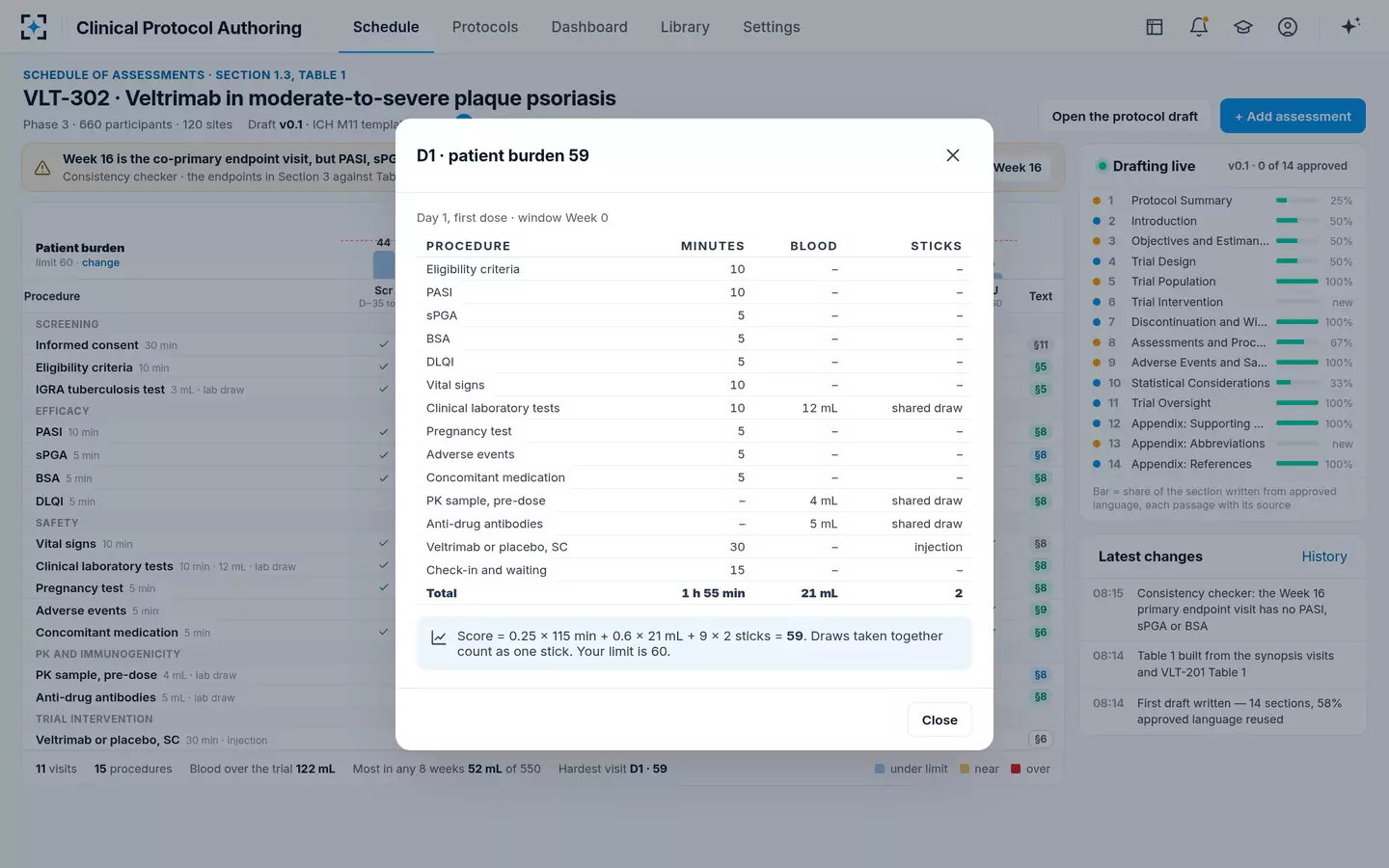
In the sample trial the weights are a quarter of a point per minute on site, six-tenths per millilitre of blood and nine points per needle stick or injection, with draws taken together counted once. The weights are a sponsor setting, not a standard; what matters is that they are explicit and that the arithmetic is shown to the person deciding.
Day 1 of the sample trial: 59 points against a limit of 60
Time on site
0.25 × 115 min
One hour fifty-five minutes, including fifteen minutes of check-in and waiting
28.75 points
Blood drawn
0.6 × 21 mL
12 mL of clinical laboratory tests, a 4 mL pre-dose PK sample and 5 mL for anti-drug antibodies
12.6 points
Needle sticks
9 × 2 sticks
One venipuncture for all three tubes, plus the subcutaneous injection
18 points
One visit's burden, procedure by procedure, with the sum shown
Can research draws be combined with clinical care draws?
Yes, and the European guidance asks for it directly.
Where possible within the limits of both the trial and the clinical setting, procedures should be combined, for example taking study blood samples at the same time as those required for usual clinical care.
European Commission expert group on clinical trials, Ethical considerations for clinical trials conducted with minors, Revision 1, 18 September 2017
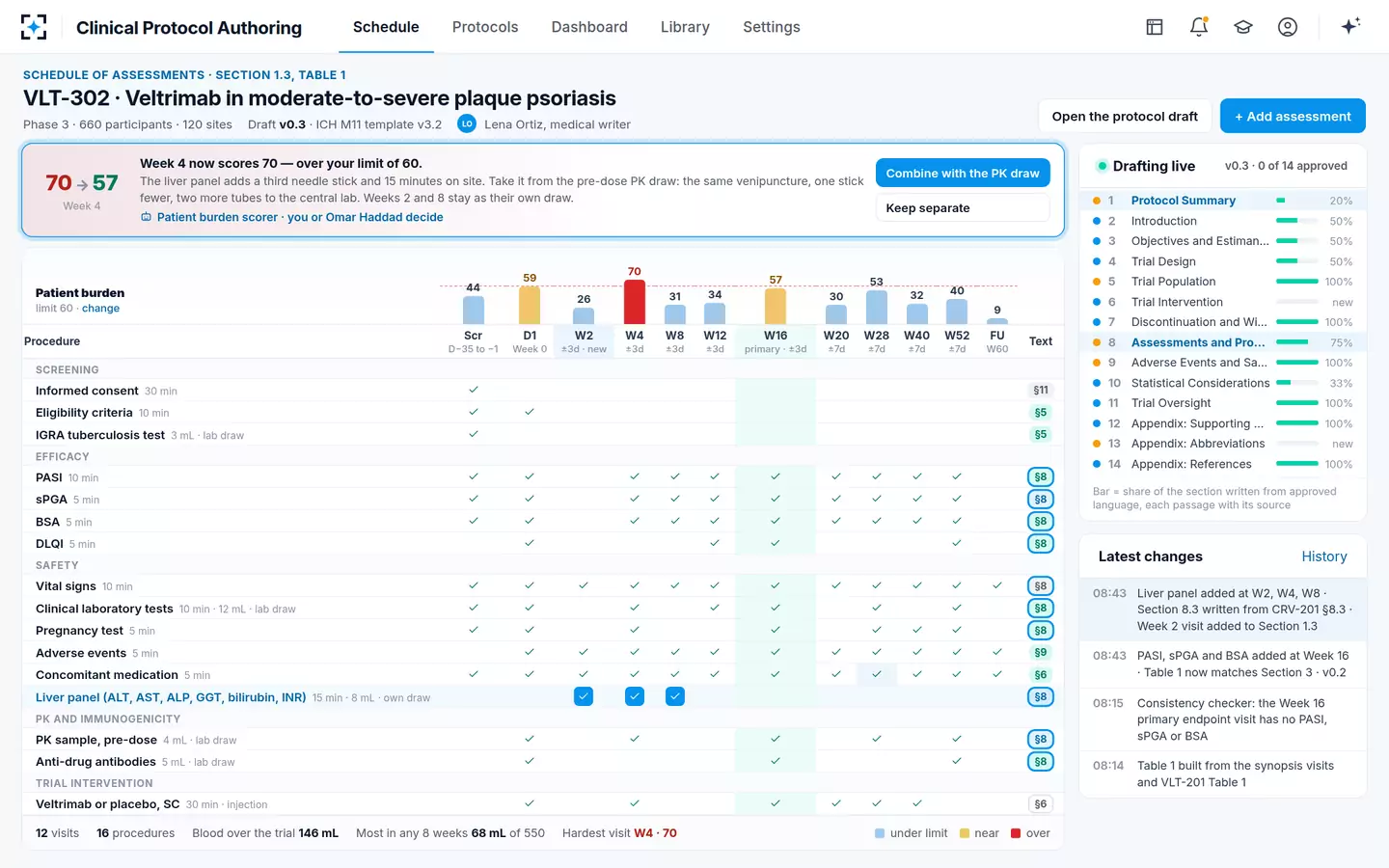
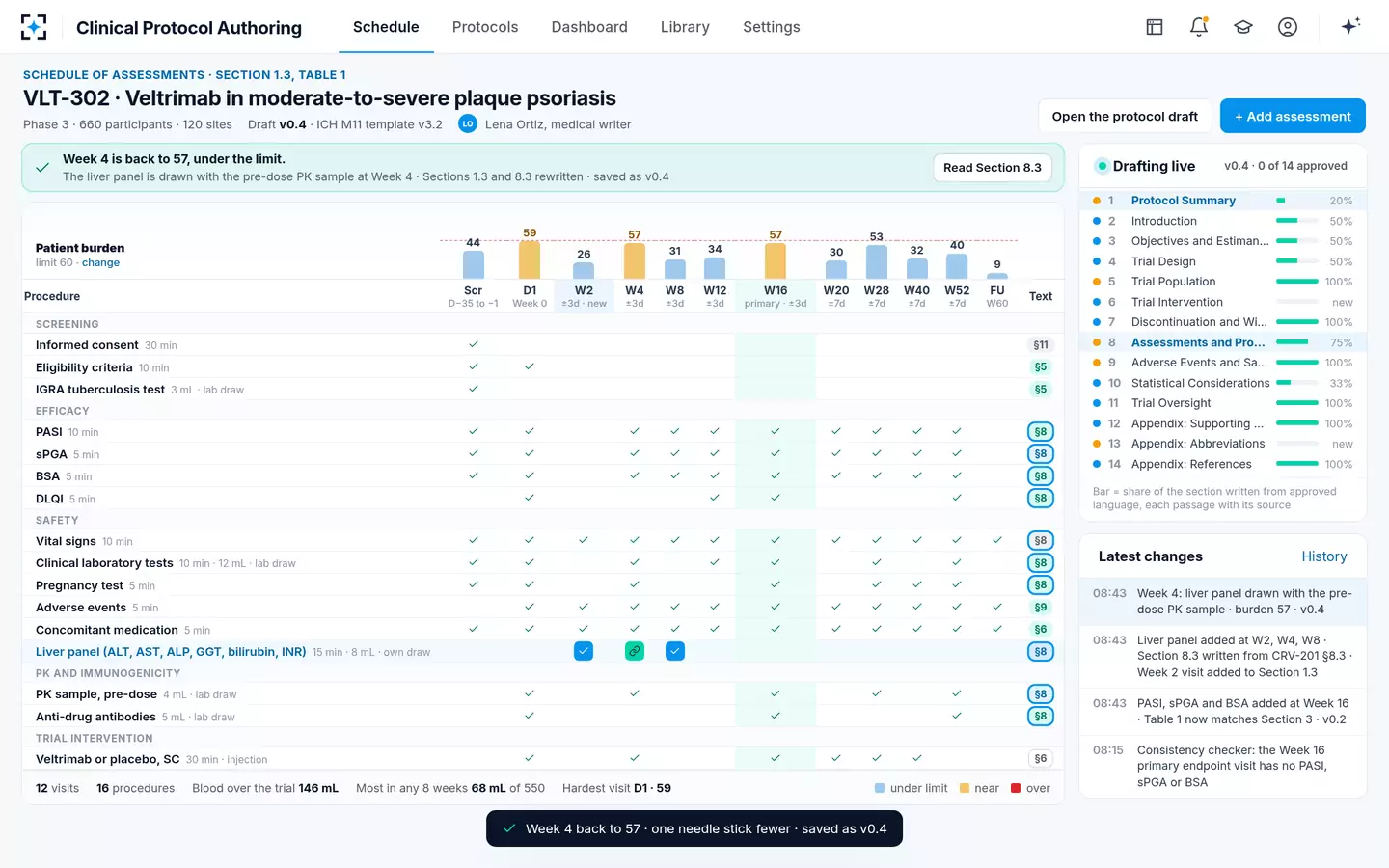
Combining is the cheapest burden reduction there is, because it moves the term with the heaviest weight — the needle stick — without touching the science. The sample trial shows the shape of it. A medical monitor's safety request added a liver panel at Weeks 2, 4 and 8. At Week 4 that landed as a third needle stick and fifteen more minutes, and the visit went from 53 to 70, over the sponsor's limit. The proposal was not to drop the panel but to take it from the same venipuncture as the pre-dose PK sample: one stick fewer, two more tubes to the central laboratory, the same millilitres. Week 4 came back to 57.
The same liver panel, taken two ways
As its own draw: Three: one venipuncture for the laboratory and pre-dose PK tubes, the injection, and a separate draw for the liver panel.
From the pre-dose PK venipuncture: Two: the shared venipuncture, now filling the liver panel tubes too, and the injection.
As its own draw: 8 mL for the panel, on top of the visit's other 16 mL.
From the pre-dose PK venipuncture: The same 8 mL. Combining changes the stick count, not the volume.
As its own draw: Fifteen minutes more, for a separate draw with its own set-up and labelling.
From the pre-dose PK venipuncture: Little or none: the tubes are drawn in the same sitting.
As its own draw: 70, above the sponsor's limit of 60.
From the pre-dose PK venipuncture: 57, back under it, with the panel still at Weeks 2, 4 and 8 as requested.
As its own draw: Nothing unusual — which is why nobody notices the third stick.
From the pre-dose PK venipuncture: One sentence in section 8.3, and the matching footnote in the schedule.
A visit over the limit, and the smallest change that brings it back
Writing and justifying volumes in the protocol
The European guidance states the obligation in one line: "blood sampling volumes, assays, and investigations related to the trial should be described and justified in the protocol." Described and justified are two different things, and most protocols do the first.
A description is the volume per sample, per visit and per participant across the trial, with the waste counted. A justification says what each volume buys — which endpoint, which safety requirement, which regulatory expectation — and why a smaller volume will not do. Where the assay could be run on a micro-volume and is not, the guidance asks for that to be justified too.
Four places in an ICH M11 protocol carry the content. Section 1.3, the schedule of activities, shows which visits draw blood and in what combination. Section 8 describes each assessment and how it is performed. Section 12.1, the appendix of clinical laboratory tests, lists the panels. And section 2.2, the assessment of risks and benefits, is where the burden of the sampling schedule belongs if it belongs anywhere as an argument rather than a table. The table that ties the first two together is built in the schedule of activities.
The eight-week total nobody adds up until a site complains
Per-visit volumes are easy to see and easy to defend. The number that goes wrong is the rolling total, because it is a property of the schedule rather than of any one visit, and because it changes every time a visit is added.
The sample trial makes the point quietly. Its first draft drew 122 mL across the trial, with 52 mL as the most in any eight weeks. The liver panel at Weeks 2, 4 and 8 took that to 146 mL across the trial and 68 mL in the worst eight weeks — a thirty per cent rise in the rolling figure from a request that looked like three extra tubes. Neither number is close to the sponsor's 550 mL setting, which is the point: the number worth watching is the direction, and it is invisible unless something is adding it up as the schedule changes.
Back under the limit, with the protocol text rewritten to match
Eight questions to ask of a sampling schedule before it goes to an ethics committee
- Which rule are you quoting, and does it cover your participants?
The 550 mL figure covers healthy, nonpregnant adults of at least 110 pounds. For patients, the US expedited-review threshold is the lesser of 50 mL or 3 mL per kg.
- Is the waste counted?
The European guidance counts research-related blood loss "including any waste". A line discard is blood taken.
- What is the largest total in any eight weeks, and in any four?
A rolling figure, not a trial total. It moves every time a visit or a panel is added.
- How many separate needle sticks does the heaviest visit involve?
Count sticks and millilitres separately. Three tubes from one venipuncture is one stick.
- Which draws could be combined, and which cannot?
Procedures should be combined where the trial and the clinical setting allow, including with samples required for usual care.
- Could a micro-volume or micro-assay be used instead?
In paediatric trials the guidance asks for micro-methods, and for a justification where they are not used.
- Does every sample trace to an endpoint, a safety requirement or a regulatory one?
Anything that traces to none of the three is the first thing to remove when a visit is over the line.
- Is each volume justified in the protocol, not merely stated?
Volumes, assays and investigations "should be described and justified in the protocol" — two obligations, not one.
Where this arithmetic belongs in the drafting sequence, and the other checks that run beside it, is set out in how to write a clinical trial protocol. To see every visit scored as the schedule is built, start from Clinical Protocol Authoring.
Questions people ask
What is the maximum blood volume for research in adults?
There is no statutory maximum. The figure most often quoted, 550 mL in an eight-week period with collection no more than twice a week, applies to healthy, nonpregnant adults who weigh at least 110 pounds, and only as a threshold for whether a US ethics committee may use an expedited review procedure. For other adults — which includes most patients in a therapeutic trial — the corresponding threshold is the lesser of 50 mL or 3 mL per kg in eight weeks. Neither is permission to draw that much; the protocol still has to justify what it takes.
How much blood can be drawn from a child in research?
In the European Union, the expert group's recommendation is that research-related blood loss, including waste, should not exceed 3% of total blood volume over four weeks and 1% at any single time, which it tabulates by body weight — 28.8 mL over four weeks for a 12 kg child, for example, and 9.6 mL at any one draw. In the United States, the expedited-review threshold for children is the same lesser of 50 mL or 3 mL per kg in eight weeks that applies to non-healthy adults. Where routine clinical care already requires significant sampling, the European guidance says the tabulated maximums may be excessive and the acceptable research volume lower.
How do you calculate 3% of total blood volume?
Estimate total blood volume from body weight, then take three per cent of it. The European guidance gives approximately 80 to 90 mL per kg of body weight, and approximately 100 mL per kg in neonates — so a 20 kg child has roughly 1,600 to 1,800 mL of circulating blood, and the four-week ceiling is roughly 48 to 54 mL, with the single-occasion ceiling a third of that at one per cent. The guidance's own table is the safer reference, because it states the ranges the expert group intended.
Does the FDA set a blood volume limit for trials?
Not as a volume. The familiar US numbers come from the list of research categories eligible for expedited institutional review board review, which FDA and the HHS Office for Protection from Research Risks published as identical lists in 1998. They determine which review route is available, not how much a trial may draw. What binds a trial is the protocol's own stated volumes and the judgement of the reviewing committee, which may decide a study involves more than minimal risk whatever the list says.
How do you count needle sticks in a visit?
One per venipuncture, not one per tube or per assay. If the clinical laboratory panel, the pharmacokinetic sample and the anti-drug antibody sample are drawn in a single sitting from one puncture, that is one stick and three tubes. Counting this way is what makes the combining decision visible: adding an eight-millilitre panel to a visit changes the volume a little and the stick count a lot, and the stick is what the participant remembers.
Where do blood volumes go in the protocol?
Across four places in an ICH M11 protocol. The schedule of activities at section 1.3 shows which visits draw blood and which draws are combined. Section 8 describes each assessment, including the sampling. The appendix of clinical laboratory tests at section 12.1 lists the panels. And the justification — why this volume, why not less — belongs with the risk and benefit assessment at section 2.2 or alongside the assessment it supports, because the European guidance asks for volumes to be described and justified, not merely tabulated.